• Trade
  • Markets
  • Copy
  • Contests
  • News
  • 24/7
  • Calendar
  • Q&A
  • Chats
Trending
Screeners
SYMBOL
LAST
BID
ASK
HIGH
LOW
NET CHG.
%CHG.
SPREAD
SPX
S&P 500 Index
6816.90
6816.90
6816.90
6861.30
6801.50
-10.51
-0.15%
--
DJI
Dow Jones Industrial Average
48360.31
48360.31
48360.31
48679.14
48285.67
-97.73
-0.20%
--
IXIC
NASDAQ Composite Index
23104.64
23104.64
23104.64
23345.56
23012.00
-90.51
-0.39%
--
USDX
US Dollar Index
97.950
98.030
97.950
98.070
97.740
0.000
0.00%
--
EURUSD
Euro / US Dollar
1.17462
1.17469
1.17462
1.17686
1.17262
+0.00068
+ 0.06%
--
GBPUSD
Pound Sterling / US Dollar
1.33708
1.33718
1.33708
1.34014
1.33546
+0.00001
0.00%
--
XAUUSD
Gold / US Dollar
4302.24
4302.58
4302.24
4350.16
4285.08
+2.85
+ 0.07%
--
WTI
Light Sweet Crude Oil
56.324
56.354
56.324
57.601
56.233
-0.909
-1.59%
--

Community Accounts

Signal Accounts
--
Profit Accounts
--
Loss Accounts
--
View More

Become a signal provider

Sell trading signals to earn additional income

View More

Guide to Copy Trading

Get started with ease and confidence

View More

Signal Accounts for Members

All Signal Accounts

Best Return
  • Best Return
  • Best P/L
  • Best MDD
Past 1W
  • Past 1W
  • Past 1M
  • Past 1Y

All Contests

  • All
  • Trump Updates
  • Recommend
  • Stocks
  • Cryptocurrencies
  • Central Banks
  • Featured News
Top News Only
Share

Goldman Sachs Says They Believe That The Copper Price Is Vulnerable To An Ai-Linked Price Correction

Share

Goldman Sachs Upgrades 2026 Copper Price Forecast To $11400 From $10,650

Share

Attempts By Ukrainian Troops To Advance From The South-West To Outskirts Of Kupiansk Are Being Thwarted

Share

Russian Troops Control All Of Kupiansk - IFX Cites Russian Military

Share

On Monday (December 15), The South Korean Won Ultimately Rose 0.60% Against The US Dollar, Closing At 1468.91 Won. The Won Was On An Upward Trend Throughout The Day, Rising Significantly At 17:00 Beijing Time And Reaching A Daily High Of 1463.04 Won At 17:36

Share

Health Ministry: Israeli Forces Kill Palestinian Teen In West Bank

Share

New York Federal Reserve President Williams: Over Time, The Size Of Reserves Could Grow From $2.9 Trillion

Share

New York Fed President Williams: AI Valuations Are High, But There Is A Real Driving Factor

Share

New York Federal Reserve President Williams: The Job Market Is In Very Good Shape

Share

New York Fed President Williams: 'Very Supportive' Of USA Central Bank's Decision To Cut Interest Rates Last Week

Share

New York Fed President Williams: 'Too Early To Say' What Central Bank Should Do At January Meeting

Share

New York Fed President Williams: Strong Markets Part Of Reason Why Economy Will Grow Robustly In 2026

Share

New York Fed President Williams: What Constitutes Ample Reserves Will Change Over Time

Share

New York Fed President Williams: Market Valuations 'Elevated,' But There Are Reasons For Pricing

Share

New York Fed President Williams: Ample Reserves System Working Very Well

Share

New York Fed President Williams: Some Signs That Parts Of Underlying Economy Not As Strong As GDP Data Suggests

Share

New York Fed President Williams: Expects Coming Job Data Will Show Gradual Cooling

Share

Ukraine President Zelenskiy: Monitoring Of Ceasefire Should Be Part Of Security Guarantees

Share

Ukraine President Zelenskiy: Ukraine Needs Clear Understanding On Security Guarantees Before Taking Any Decisions Regarding Frontlines

Share

U.S. Commerce Secretary Rutnick Praised Korea Zinc Co. Ltd., Stating That The United States Will Have Priority Access To The Company's Products In 2026

TIME
ACT
FCST
PREV
Japan Tankan Small Manufacturing Outlook Index (Q4)

A:--

F: --

P: --

Japan Tankan Large Non-Manufacturing Outlook Index (Q4)

A:--

F: --

P: --

Japan Tankan Large Manufacturing Outlook Index (Q4)

A:--

F: --

P: --

Japan Tankan Small Manufacturing Diffusion Index (Q4)

A:--

F: --

P: --

Japan Tankan Large-Enterprise Capital Expenditure YoY (Q4)

A:--

F: --

P: --

U.K. Rightmove House Price Index YoY (Dec)

A:--

F: --

P: --

China, Mainland Industrial Output YoY (YTD) (Nov)

A:--

F: --

P: --

China, Mainland Urban Area Unemployment Rate (Nov)

A:--

F: --

P: --

Saudi Arabia CPI YoY (Nov)

A:--

F: --

P: --

Euro Zone Industrial Output YoY (Oct)

A:--

F: --

P: --

Euro Zone Industrial Output MoM (Oct)

A:--

F: --

P: --

Canada Existing Home Sales MoM (Nov)

A:--

F: --

P: --

Canada National Economic Confidence Index

A:--

F: --

P: --

Canada New Housing Starts (Nov)

A:--

F: --

P: --
U.S. NY Fed Manufacturing Employment Index (Dec)

A:--

F: --

P: --

U.S. NY Fed Manufacturing Index (Dec)

A:--

F: --

P: --

Canada Core CPI YoY (Nov)

A:--

F: --

P: --

Canada Manufacturing Unfilled Orders MoM (Oct)

A:--

F: --

P: --

U.S. NY Fed Manufacturing Prices Received Index (Dec)

A:--

F: --

P: --

U.S. NY Fed Manufacturing New Orders Index (Dec)

A:--

F: --

P: --

Canada Manufacturing New Orders MoM (Oct)

A:--

F: --

P: --

Canada Core CPI MoM (Nov)

A:--

F: --

P: --

Canada Trimmed CPI YoY (SA) (Nov)

A:--

F: --

P: --

Canada Manufacturing Inventory MoM (Oct)

A:--

F: --

P: --

Canada CPI YoY (Nov)

A:--

F: --

P: --

Canada CPI MoM (Nov)

A:--

F: --

P: --

Canada CPI YoY (SA) (Nov)

A:--

F: --

P: --

Canada Core CPI MoM (SA) (Nov)

A:--

F: --

P: --

Canada CPI MoM (SA) (Nov)

A:--

F: --

P: --

Federal Reserve Board Governor Milan delivered a speech
U.S. NAHB Housing Market Index (Dec)

A:--

F: --

P: --

Australia Composite PMI Prelim (Dec)

--

F: --

P: --

Australia Services PMI Prelim (Dec)

--

F: --

P: --

Australia Manufacturing PMI Prelim (Dec)

--

F: --

P: --

Japan Manufacturing PMI Prelim (SA) (Dec)

--

F: --

P: --

U.K. 3-Month ILO Employment Change (Oct)

--

F: --

P: --

U.K. Unemployment Claimant Count (Nov)

--

F: --

P: --

U.K. Unemployment Rate (Nov)

--

F: --

P: --

U.K. 3-Month ILO Unemployment Rate (Oct)

--

F: --

P: --

U.K. Average Weekly Earnings (3-Month Average, Including Bonuses) YoY (Oct)

--

F: --

P: --

U.K. Average Weekly Earnings (3-Month Average, Excluding Bonuses) YoY (Oct)

--

F: --

P: --

France Services PMI Prelim (Dec)

--

F: --

P: --

France Composite PMI Prelim (SA) (Dec)

--

F: --

P: --

France Manufacturing PMI Prelim (Dec)

--

F: --

P: --

Germany Services PMI Prelim (SA) (Dec)

--

F: --

P: --

Germany Manufacturing PMI Prelim (SA) (Dec)

--

F: --

P: --

Germany Composite PMI Prelim (SA) (Dec)

--

F: --

P: --

Euro Zone Composite PMI Prelim (SA) (Dec)

--

F: --

P: --

Euro Zone Services PMI Prelim (SA) (Dec)

--

F: --

P: --

Euro Zone Manufacturing PMI Prelim (SA) (Dec)

--

F: --

P: --

U.K. Services PMI Prelim (Dec)

--

F: --

P: --

U.K. Manufacturing PMI Prelim (Dec)

--

F: --

P: --

U.K. Composite PMI Prelim (Dec)

--

F: --

P: --

Euro Zone ZEW Economic Sentiment Index (Dec)

--

F: --

P: --

Germany ZEW Current Conditions Index (Dec)

--

F: --

P: --

Germany ZEW Economic Sentiment Index (Dec)

--

F: --

P: --

Euro Zone Trade Balance (Not SA) (Oct)

--

F: --

P: --

Euro Zone ZEW Current Conditions Index (Dec)

--

F: --

P: --

Euro Zone Trade Balance (SA) (Oct)

--

F: --

P: --

Euro Zone Total Reserve Assets (Nov)

--

F: --

P: --

U.K. Inflation Rate Expectations

--

F: --

P: --

Q&A with Experts
    • All
    • Chatrooms
    • Groups
    • Friends
    Connecting
    .
    .
    .
    Type here...
    Add Symbol or Code

      No matching data

      All
      Trump Updates
      Recommend
      Stocks
      Cryptocurrencies
      Central Banks
      Featured News
      • All
      • Russia-Ukraine Conflict
      • Middle East Flashpoint
      • All
      • Russia-Ukraine Conflict
      • Middle East Flashpoint
      Search
      Products

      Charts Free Forever

      Chats Q&A with Experts
      Screeners Economic Calendar Data Tools
      Membership Features
      Data Warehouse Market Trends Institutional Data Policy Rates Macro

      Market Trends

      Market Sentiment Order Book Forex Correlations

      Top Indicators

      Charts Free Forever
      Markets

      News

      News Analysis 24/7 Columns Education
      From Institutions From Analysts
      Topics Columnists

      Latest Views

      Latest Views

      Trending Topics

      Top Columnists

      Latest Update

      Signals

      Copy Rankings Latest Signals Become a signal provider AI Rating
      Contests
      Brokers

      Overview Brokers Assessment Rankings Regulators News Claims
      Broker listing Forex Brokers Comparison Tool Live Spread Comparison Scam
      Q&A Complaint Scam Alert Videos Tips to Detect Scam
      More

      Business
      Events
      Careers About Us Advertising Help Center

      White Label

      Data API

      Web Plug-ins

      Affiliate Program

      Awards Institution Evaluation IB Seminar Salon Event Exhibition
      Vietnam Thailand Singapore Dubai
      Fans Party Investment Sharing Session
      FastBull Summit BrokersView Expo
      Recent Searches
        Top Searches
          Markets
          News
          Analysis
          User
          24/7
          Economic Calendar
          Education
          Data
          • Names
          • Latest
          • Prev

          View All

          No data

          Scan to Download

          Faster Charts, Chat Faster!

          Download App
          English
          • English
          • Español
          • العربية
          • Bahasa Indonesia
          • Bahasa Melayu
          • Tiếng Việt
          • ภาษาไทย
          • Français
          • Italiano
          • Türkçe
          • Русский язык
          • 简中
          • 繁中
          Open Account
          Search
          Products
          Charts Free Forever
          Markets
          News
          Signals

          Copy Rankings Latest Signals Become a signal provider AI Rating
          Contests
          Brokers

          Overview Brokers Assessment Rankings Regulators News Claims
          Broker listing Forex Brokers Comparison Tool Live Spread Comparison Scam
          Q&A Complaint Scam Alert Videos Tips to Detect Scam
          More

          Business
          Events
          Careers About Us Advertising Help Center

          White Label

          Data API

          Web Plug-ins

          Affiliate Program

          Awards Institution Evaluation IB Seminar Salon Event Exhibition
          Vietnam Thailand Singapore Dubai
          Fans Party Investment Sharing Session
          FastBull Summit BrokersView Expo

          Oil falls as OPEC+ proceeds with September output increase

          Adam

          Commodity

          Summary:

          Oil prices dropped as OPEC+ confirmed a September output increase of 547,000 bpd, reversing previous cuts. Market pressure grew amid potential extra supply, U.S. tariffs, and sanctions on Russian oil.

          Oil prices fell to their lowest in a week on Monday after OPEC+ agreed to another large output increase in September, though traders remained wary of further sanctions on Russia.
          Brent crude futures fell $1.17, or 1.7%, to $68.50 a barrel by 1127 GMT. U.S. West Texas Intermediate crude declined $1.26, or 1.9%, to $66.07. Both contracts lost about $2 on Friday.
          The Organization of the Petroleum Exporting Countries and its allies, together known as OPEC+, agreed on Sunday to raise oil production by 547,000 barrels per day (bpd) for September.
          The latest in a series of accelerated output increases aimed at capturing market share was in line with market expectations and marks a full and early reversal of the group's largest tranche of output cuts, amounting to about 2.5 million bpd, or about 2.4% of global demand.
          Oil prices are under pressure because of the OPEC+ decision, said PVM analyst Tamas Varga, adding that potential discussions to unwind a further 1.65 million bpd of cuts added to the downside price pressure.
          Analysts at Goldman Sachs expect that the actual increase in supply from the eight OPEC+ countries that have raised output since March will be 1.7 million bpd because other members have cut output after overproducing.
          Investors also continued to digest the impact of the latest U.S. tariffs on exports from dozens of trading partners and remain wary of further U.S. sanctions on Russia.
          U.S. President Trump has threatened to impose 100% secondary tariffs on Russian crude buyers as he seeks to pressure Moscow into halting its war in Ukraine.
          "In the medium term, oil prices will be shaped by a mix of tariffs and geopolitics. Any price jump triggered by energy sanctions is expected to be ephemeral," PVM's Varga said.
          At least two vessels loaded with Russian oil bound for refiners in India have diverted to other destinations after new U.S. sanctions, trade sources said on Friday and LSEG trade flows showed.
          About 1.7 million bpd of crude supply will be at risk if Indian refiners stop buying Russian oil, ING analysts wrote.
          However, two Indian government sources told Reuters on Saturday that the country will keep purchasing oil from Russia despite Trump's threats.

          Source: Reuters

          Risk Warnings and Disclaimers
          You understand and acknowledge that there is a high degree of risk involved in trading. Following any strategies or investment methods may lead to potential losses. The content on the site is provided by our contributors and analysts for information purposes only. You are solely responsible for determining whether any trading assets, securities, strategy, or any other product is suitable for investing based on your own investment objectives and financial situation.
          Add to Favorites
          Share

          IMF Says Saudi Arabia Has Cut Spending Enough Even If Oil Slides

          Michelle

          Commodity

          Economic

          Saudi Arabia has cut spending enough this year and probably won’t need to make further fiscal adjustments even if crude oil prices weaken, according to the International Monetary Fund.

          The kingdom said in late 2024 it would trim 2025 expenditure to 1.285 trillion riyals ($342 billion) after previously overshooting on its targets in a bid to drive progress on its plans to diversify the economy.

          While the government has made cuts, expenditures are likely to be higher than budgeted and some one-off spending will continue, according to Amine Mati, the IMF’s Saudi mission chief.

          The Washington-based lender sees Saudi Arabia’s fiscal deficit rising to 4% this year, a level Mati describes as “quite appropriate” given the country’s adequate level of foreign reserves. The Saudi government’s own projection is for a shortfall of 2.3% this year.

          “We don’t think any more action on spending cuts or fiscal adjustment are needed for this year,” even if oil prices fall to $60 a barrel, Mati said in an interview with Bloomberg. Global benchmark Brent is currently trading below $70 as the Organization of the Petroleum Exporting Countries hikes output, and many forecasters including Goldman Sachs Group Inc. see a further slide toward $60 later in the year.

          In a scenario where oil prices decline significantly and permanently, the IMF would recommend a “more aggressive fiscal consolidation strategy,” according to a report released on Monday.

          The Middle East’s biggest economy is spending heavily on Crown Prince Mohammed bin Salman’s Vision 2030 strategy, which includes major infrastructure projects and an overarching goal of weaning the economy off its reliance on crude oil revenues. It has said it’s running deeper budget deficits by design as it seeks to progress that strategy and is borrowing heavily in the meantime to finance the shortfall.

          Already this year, Saudi Arabia has sold almost $15 billion of sovereign debt in dollars and euros. The IMF’s baseline scenario sees the kingdom continuing to take on debt, increasing the debt-to-GDP ratio to almost 41% by 2030, from below 30% now. That’d still be low by global standards.

          The focus for Saudi Arabia going forward should be on reducing current expenditures that are deemed low priority and have a limited long-term fiscal multiplier, such as some spending on goods and services, the IMF said in its Article IV report.

          “The view that we have on recalibration is to make sure that spending is efficient and is aligned with priority project and overheating, and not a recalibration that is done because oil prices are lower than initially thought,” Mati said.

          More clarity is also needed for investors, especially those sitting abroad, after signs that some repriorization in Saudi Arabia has happened, he added. “It’s very important to clearly communicate and explain to market and investors what are the new spending plans, and what projects are kept. This is a recommendation that we keep making.”

          The IMF expects the Saudi economy to grow 3.6% this year, supported by the phase-out of OPEC+ production cuts. Non-oil growth is seen converging toward 3.5% in the medium term as non-oil private investment steadily grows, including through contributions from the Public Investment Fund.

          Mati said the PIF is expected to continue spending at least $40 billion a year on some of the domestic investment and projects that are already part of Vision 2030. “This is going to help keep growth positive and robust compared to what’s happening elsewhere.”

          Source: Bloomberg Europe

          To stay updated on all economic events of today, please check out our Economic calendar
          Risk Warnings and Disclaimers
          You understand and acknowledge that there is a high degree of risk involved in trading. Following any strategies or investment methods may lead to potential losses. The content on the site is provided by our contributors and analysts for information purposes only. You are solely responsible for determining whether any trading assets, securities, strategy, or any other product is suitable for investing based on your own investment objectives and financial situation.
          Add to Favorites
          Share

          Euro-to-Dollar Week Ahead Forecast: "Brutal" Jobs Report Turns Tables on USD

          Warren Takunda

          Economic

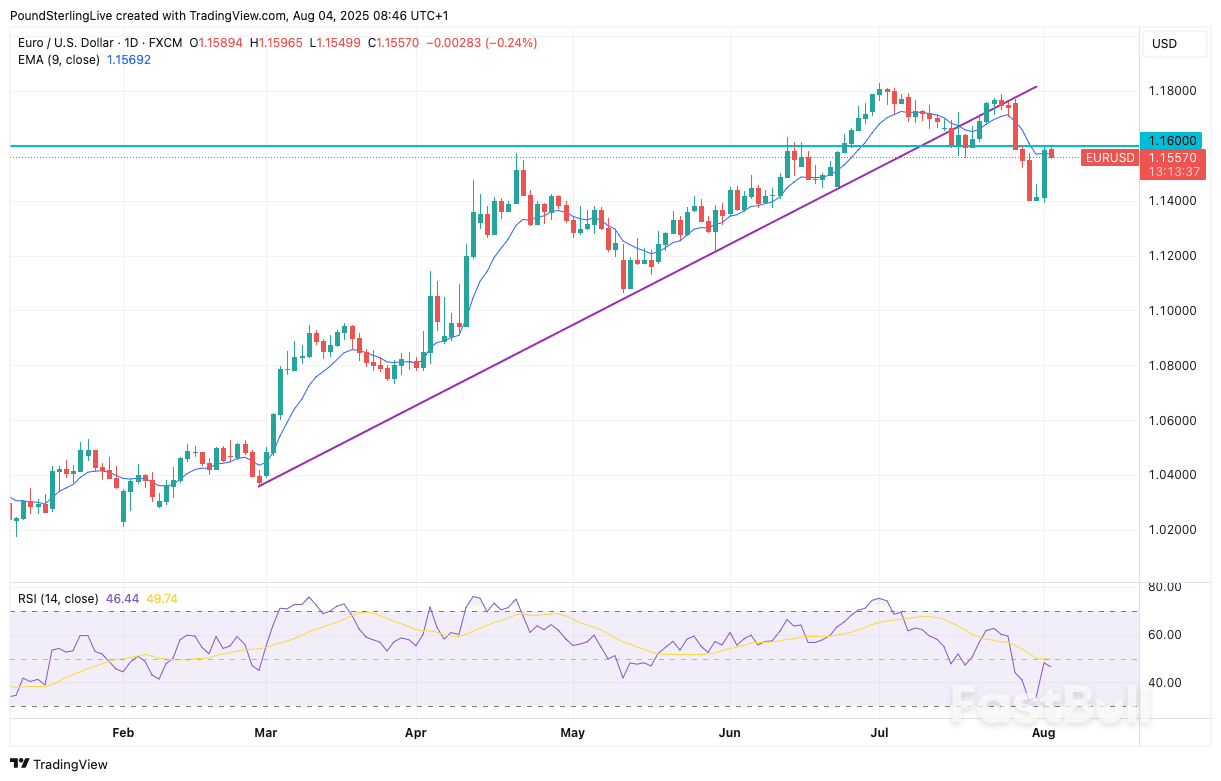
          The Euro to Dollar exchange rate (EUR/USD) could cross 1.16 again this week as momentum sways away from the Dollar back to the Euro.
          Friday's 1.52% gain in EUR/USD was impressively strong, and might just be enough to shift the underlying technical structure from the downside to the upside.
          To be sure, there is more work to be done; for instance, a close above the nine-day exponential moving average (EMA), to confirm the near-term trend has turned bullish again.
          Euro-to-Dollar Week Ahead Forecast: "Brutal" Jobs Report Turns Tables on USD_1

          Above: EUR/USD at daily intervals.

          And, the chart shows that the 1.16 graphical resistance line is back in play Monday, which could thwart upside in the coming hours and early stages of the week.
          Yet, despite some near-term hurdles, we think they are relatively minor, and suspect the fundamental backdrop and the strength of the move on Friday will prove enough to allow further near-term gains, with a drift above 1.16 likely in the coming days.
          The trigger behind the lift in EUR/USD was the stock market fall that followed Friday's U.S. labour report that showed just 73K non-farm jobs were added in July, disappointing versus the 104k median expected by analysts.
          "Quite a brutal non-farm payrolls report all in," says Sam Hill, Head of Markets Insights at Lloyds Bank. "Revisions were sharply lower. They slashed jobs growth in June to 14k from the 147k initially reported and left the cumulative two-month revision 258k jobs lower. Revisions over the first half of the year now sum to -461k."
          These data send the sober message that the U.S. economy could yet feel the impact of a destabilising six months of frantic policy adjustment in the U.S. under its new president. The most important development is, of course, the imposition of import tariffs to levels last seen in the 1930s.
          "We remain constructive toward EUR-USD over the medium term. The factors behind the USD weakness that has emerged so far this year remain alive. And kicking," says Roberto Mialich, FX strategist at UniCredit.
          Tariffs will have the effect of raising inflation and forcing readjustments amongst domestic businesses. But, from a market perspective, the more significant development is that this still-high inflation limits the Federal Reserve's ability to cut interest rates.
          Sure, the Fed will probably cut rates in September following this jobs report, but it will still be constrained by inflation going forward.
          Since 2008 investors have known they can count on the Fed to jump in and support them on the first signs of danger. But we are in a world now where inflation is uncomfortably high, limiting the Fed's ability to help.
          It is little wonder then that markets fell, and the Dollar was dragged down too. These data mean the end of U.S. market exceptionalism remains a theme to consider, and it is the Euro that stands to benefit the most from any rebalancing in global portfolios as international investors seek greater diversification.
          "The euro remains the default option for global investors diversifying out of the USD," says Bolz. "The fiscal measures in Germany and increased European defence spending should give the EUR another boost. We therefore retain our Attractive rating on the euro," says Constantin Bolz, CFA, Strategist, UBS Switzerland AG.

          Source: Poundsterlinglive

          To stay updated on all economic events of today, please check out our Economic calendar
          Risk Warnings and Disclaimers
          You understand and acknowledge that there is a high degree of risk involved in trading. Following any strategies or investment methods may lead to potential losses. The content on the site is provided by our contributors and analysts for information purposes only. You are solely responsible for determining whether any trading assets, securities, strategy, or any other product is suitable for investing based on your own investment objectives and financial situation.
          Add to Favorites
          Share

          Dow Jones Technical: Minor pull-back found support with bullish elements sighted in Caterpillar

          Adam

          Stocks

          Since the medium-term swing low on 7 April 2025, triggered by the US Liberation Day tariff announcement, the Dow Jones Industrial Average has underperformed compared to the S&P 500 and Nasdaq 100.
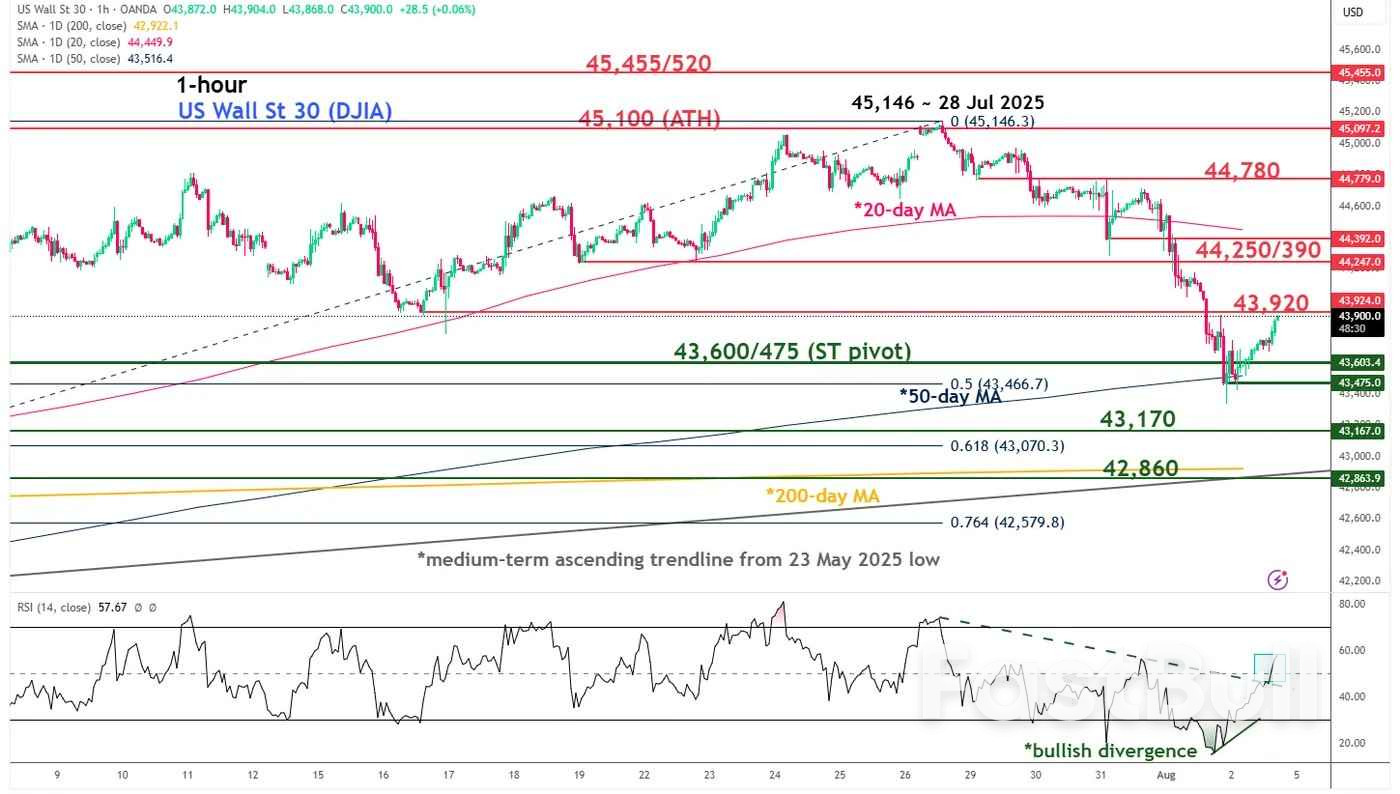
          So far, the US Wall Street 30 CFD Index (a proxy of the Dow Jones Industrial Average futures) has not yet broken above its current all-time high of 45,100 printed in December 2024 after a retest of it last Monday, 28 July, versus fresh all-time highs seen on the S&P 500 and Nasdaq 100.
          Caterpillar’s ex-post earnings price actions may drive Dow Jones
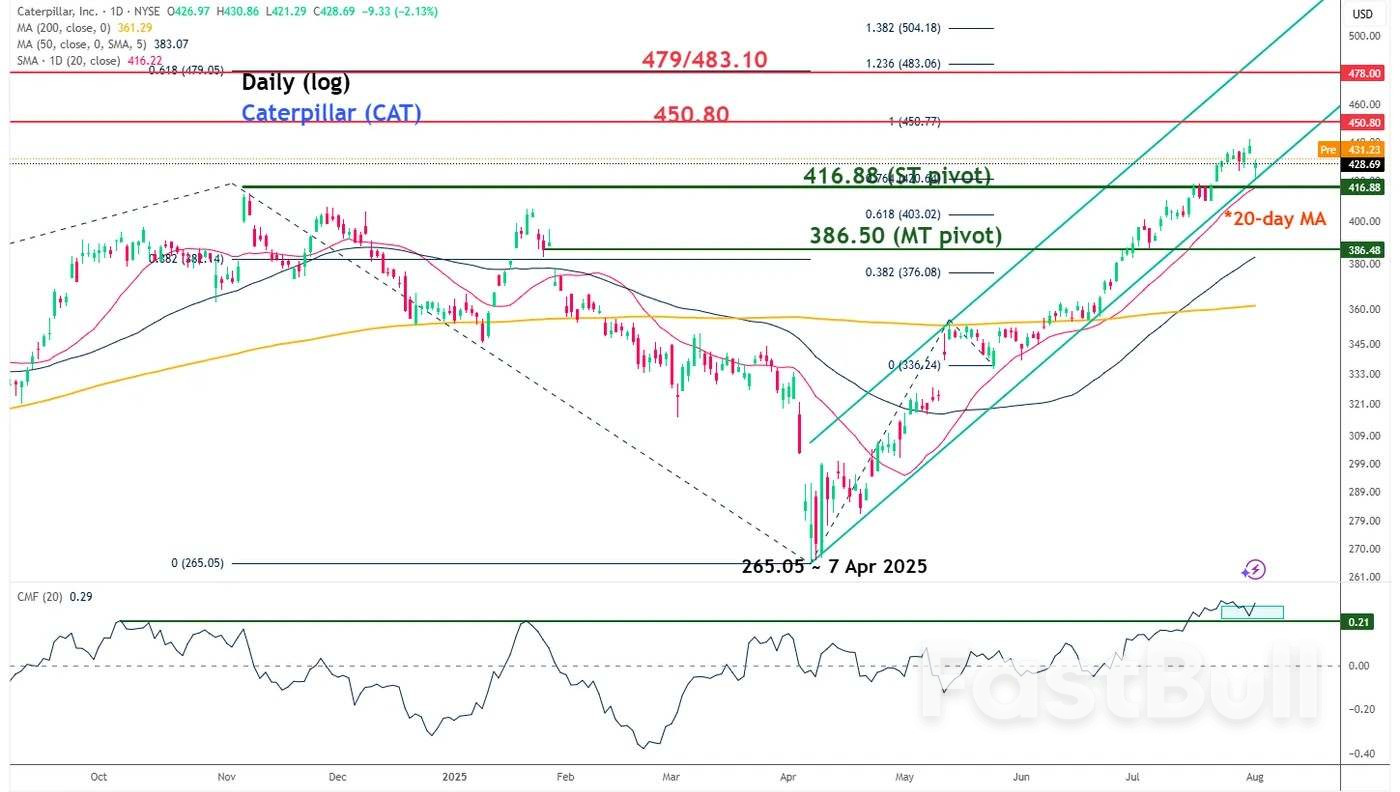
          Let’s examine the Dow Jones Industrial Average from a technical analysis perspective within a short-term time horizon (1 to 3 days), coupled with an inter-market analysis of Caterpillar (CAT), the third biggest weightage component stock of the DJIA (6%) as its Q2 earnings release will be out on Tuesday, 5 August before the US market opens.
          Dow Jones Technical: Minor pull-back found support with bullish elements sighted in Caterpillar_1

          Fig. 1: US Wall Street 30 CFD Index minor trend as of 4 Aug 2025

          Dow Jones Technical: Minor pull-back found support with bullish elements sighted in Caterpillar_2

          Fig. 2: Caterpillar medium-term trend as of 4 Aug 2025

          Preferred trend bias (1-3 days)

          The five-day minor corrective decline of the US Wall Street 30 CFD Index since the 28 July high of 45,146 is likely to have reached an exhaustion zone after last Friday, 1 August’s intraday sell-off triggered by the weaker-than-expected US non-farm payroll print for July.
          Bullish bias above 43,600/43,475 key short-term pivotal support and a clearance above 43,920 may reinforce a potential minor recovery towards the next intermediate resistances at 44,250/44,390 and 44,780 (see Fig. 1).

          Key elements

          The -4% minor corrective decline of the US Wall Street 30 CFD Index has stalled right at the 50-day moving average and the 50% Fibonacci retracement of prior bullish impulsive up move from 17 June 2025 low to 28 July 2025 high. Its confluence zone is defined as 43,600/43,475.
          The hourly RSI momentum indicator has flashed out a bullish divergence condition at its oversold region on last Friday, 1 August, before a bullish breakout above a parallel descending trendline resistance seen in today’s Asia session. These observations suggest last Friday’s downside momentum has eased.
          Caterpillar has also managed to hold right at its 20-day moving average support of 416.88, which confluences with the medium-term ascending channel support from the 7 April 2025 low. In addition, the daily Chaikin Money Flow Index (price momentum with volume) has managed to exhibit bullish momentum conditions above 0.21( a parallel support) (see Fig. 2).

          Alternative trend bias (1 to 3 days)

          Failure to hold at 43,475 invalidates the bullish scenario for an extension of the minor corrective decline towards the next supports at 43,170 and 42,860 (the key 200-day moving average and the medium-term ascending trendline from 23 May 2025 low).

          Source: marketpulse

          Risk Warnings and Disclaimers
          You understand and acknowledge that there is a high degree of risk involved in trading. Following any strategies or investment methods may lead to potential losses. The content on the site is provided by our contributors and analysts for information purposes only. You are solely responsible for determining whether any trading assets, securities, strategy, or any other product is suitable for investing based on your own investment objectives and financial situation.
          Add to Favorites
          Share

          Trump Set to Name Replacements At The Fed And BLS in Coming Days

          Glendon

          Economic

          Political

          President Donald Trump plans over the next several days to name replacements for two key vacancies, one to fill a spot on the Federal Reserve and other to replace the head of the Bureau of Labor Statistics.

          Both spots opened up Friday — the Fed position through the surprise resignation of Governor Adriana Kugler, and the other from Trump's stunning decision to fire Erika McEntarfer, the commissioner at the Bureau of Labor Statistics.

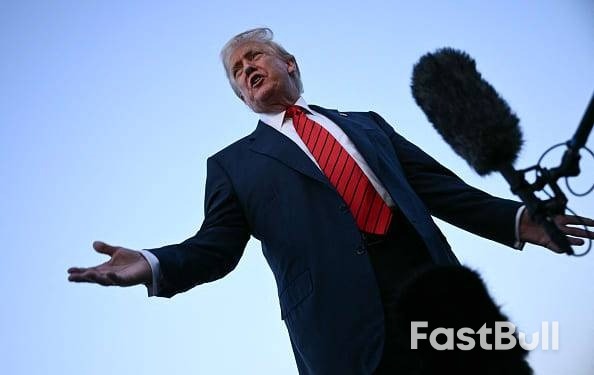
          Trump told reporters Sunday that he is thinking of several possible candidates for the Fed spot, and that he is set to replace McEntarfer soon.

          "I have a couple of people in mind," Trump said regarding the Kugler vacancy. "I'll be announcing that probably over the next couple of days."

          Kugler's Fed term expired next January, but she decided to exit ahead of time. In a letter submitted Friday to Trump, Kugler gave no reason for the move, which takes effect Aug. 8.

          As a Fed governor, Kugler was a permanent voter on the Federal Open Market Committee, which sets the central bank's key funds level used as a peg for interest rates across the U.S. economy. In addition, governors help craft banking regulations.

          During her short stint, which lasted less than two years, Kugler consistently aligned herself with the policies of Chair Jerome Powell, who has been on the receiving end of frequent Trump criticism.

          Trump has stated that future Fed nominees will be litmus tested for whether they will vote to lower the funds rate.

          The Kugler resignation "jump-starts the Trumpification of the Fed by handing President Trump a vacancy into which he can place a potential or even a clearly designated successor to Powell as Fed chair," Krishna Guha, head of global policy and central bank strategy at Evercore ISI, said in a note.

          Potential successors include former Fed Governor Kevin Warsh, Treasury Secretary Scott Bessent and National Economic Council Director Kevin Hassett.

          Controversy over jobs count

          Trump sacked McEntarfer following Friday's disappointing nonfarm payrolls report. The BLS not only reported that the economy added just 73,000 jobs in July, but it also revised the prior two months' totals lower by 258,000.

          In a Truth Social post Sunday, Trump alleged that McEntarfer was responsible for "the biggest miscalculations in over 50 years."

          Revisions are common for monthly jobs numbers as the BLS receives more information through the survey of establishments it uses to calculate the nonfarm payrolls figure. However, as survey responses have declined over time, revisions have risen, with the BLS last year adjusting down its count for the 12-month period preceding March 2024 by 818,000.

          McEntarfer's firing has drawn widespread criticism due to worries that the move could politicize the BLS statistics, which are used to set policy and as a barometer for multiple aspects of the economy.

          "Potential politicization of the Fed has been much discussed over the past several months, but the risk of politicizing the data collection process should not be overlooked," wrote Michael Feroli, chief U.S. economist at JPMorgan Chase. "To borrow from the soft-landing analogy, having a flawed instrument panel can be just as dangerous as having an obediently partisan pilot."

          Trump has not public discussed potential replacements for McEntarfer. Deputy Commissioner William Wiatrowski is serving in an acting role now.

          Source: CNBC

          To stay updated on all economic events of today, please check out our Economic calendar
          Risk Warnings and Disclaimers
          You understand and acknowledge that there is a high degree of risk involved in trading. Following any strategies or investment methods may lead to potential losses. The content on the site is provided by our contributors and analysts for information purposes only. You are solely responsible for determining whether any trading assets, securities, strategy, or any other product is suitable for investing based on your own investment objectives and financial situation.
          Add to Favorites
          Share

          Investors Turn Attention from Trade Wars to Economic Reality as Jobs Data Disappoints

          Adam

          Economic

          Stocks Slide as Weak Jobs Report Sparks Economic Worries

          Markets pulled back sharply on Friday after a disappointing U.S. jobs report shifted investor focus away from trade tensions and toward a more pressing concern: whether the economy is actually strong enough to justify record-high stock prices.
          For weeks, investors had treated tariff headlines as the main risk to markets. But with stocks climbing steadily despite escalating trade rhetoric, it’s now clear that tariffs were never the real driver. Friday’s reaction showed that investors may finally be waking up to a more fundamental risk—slowing economic growth.

          Why Are Interest Rates Back in Focus?

          The Labor Department reported just 73,000 jobs added in July, falling well short of forecasts for over 100,000. Even more concerning, previously reported gains in May and June were revised down by a combined 258,000. The weaker-than-expected numbers forced a reassessment of the job market’s true strength and raised doubts about the broader economy.
          Stock indexes tumbled, with the Dow down 542 points (1.23%), the S&P 500 off 1.6%, and the Nasdaq losing 2.24%, marking the worst day in weeks for all three.
          Bond markets moved swiftly in response, as investors bet the Federal Reserve would need to step in. The 10-year Treasury yield fell to 4.23%, its lowest in three months, while the 2-year yield dropped even more sharply.
          Rate cut expectations surged—traders now see more than an 80% chance of a Fed cut in September, up from less than 40% the day before. Some analysts are even predicting a half-point cut rather than the standard quarter-point move. While lower rates could ease borrowing costs, they also signal growing anxiety about the economy’s direction.

          Which Stocks Were Hit the Hardest?

          Sector performance reinforced the shift in tone. Consumer and tech stocks—typically more sensitive to economic conditions—led the declines, falling 3.6% and 2.1% respectively.
          On the flip side, utilities and other defensive sectors rose as investors looked for safer ground. The U.S. dollar also weakened by more than 1% against major currencies, reflecting the market’s view that interest rates are headed lower and making U.S. assets less attractive to global investors.

          What Should Investors Watch Now?

          More than just a reaction to weak data, Friday’s selloff revealed what had been hiding in plain sight: the market wasn’t rising in spite of tariffs—it was ignoring signs of a slowing economy.
          With that blind spot exposed, investors may now place less weight on political noise and focus more closely on fundamentals.
          Key indicators to watch in the coming weeks include inflation reports, consumer spending data, and any guidance from the Federal Reserve. As the focus shifts to economic health, portfolio positioning may need to follow.

          Source: fxempire

          To stay updated on all economic events of today, please check out our Economic calendar
          Risk Warnings and Disclaimers
          You understand and acknowledge that there is a high degree of risk involved in trading. Following any strategies or investment methods may lead to potential losses. The content on the site is provided by our contributors and analysts for information purposes only. You are solely responsible for determining whether any trading assets, securities, strategy, or any other product is suitable for investing based on your own investment objectives and financial situation.
          Add to Favorites
          Share

          White House Keeps Tariff Pressure on EU Car Industry

          Warren Takunda

          Economic

          China–U.S. Trade War

          US President Donald Trump doesn’t appear willing to ease the pressure on German carmakers. The US executive order on reciprocal tariffs published just before 1 August stopped short of applying the 15% tariffs agreed by Trump and Commission president Ursula von der Leyen to US imports of EU vehicles.
          Since 2 April, EU cars have been hit with 25% US tariffs under the section 232 of the US Trade Expansion Act, which allows the US president to restrict imports of goods threatening US national security.
          The deal concluded last Sunday with President Ursula von der Leyen was meant to apply the 15% tariffs to EU cars, and to exempt certain strategic products such as aircraft from tariffs, but neither proviso appears in the executive order.
          The executive order imposes a blanket 15% tariff on EU goods to apply from 8 August. Goods already in transit before that date will enjoy the previous tariff rate of 10% until 5 October, the US order says. Any attempt to circumvent these tariffs will be penalized with a 40% duty on the goods concerned, the order adds.
          Despite the apparent omissions from the order, EU Trade Commissioner Maroš Šefčovič welcomed “the first results of the EU–US deal".
          “This reinforces stability for businesses as well as trust in the transatlantic economy,” he said on X, adding: “EU exporters now benefit from a more competitive position.”
          Šefčovič also said, however, that “the work continues”, referring to ongoing negotiations on a joint statement intended to formalise the political trade agreement reached on July 27.

          Diverging narratives

          The Commission and the US administration are struggling to agree on a joint text, and up to now have pushed diverging narratives on the deal.
          Uncertainty remains over the fate of steel and aluminium, currently hit by 50% US tariffs, which, according to the Commission, are expected to soon be subject to lower tariff-rate quotas. Negotiations are also ongoing over a series of exemptions, as pressure mounts from the EU wine and spirits industry.
          In a factsheet published on Monday, the US also claimed that the EU committed not to apply telecommunications network usage fees in an upcoming Digital Network Act, which is currently being disputed between EU telecom companies and US tech giants in Brussels.
          On Thursday the Commission noted that a white paper on digital networks published in February 2024 assessed that imposing a network fee was “not a viable solution”. “Such an exemption would not apply to US company only,” a Commission spokesperson said.

          Source :Euronews

          To stay updated on all economic events of today, please check out our Economic calendar
          Risk Warnings and Disclaimers
          You understand and acknowledge that there is a high degree of risk involved in trading. Following any strategies or investment methods may lead to potential losses. The content on the site is provided by our contributors and analysts for information purposes only. You are solely responsible for determining whether any trading assets, securities, strategy, or any other product is suitable for investing based on your own investment objectives and financial situation.
          Add to Favorites
          Share
          FastBull
          Copyright © 2025 FastBull Ltd

          728 RM B 7/F GEE LOK IND BLDG NO 34 HUNG TO RD KWUN TONG KLN HONG KONG

          TelegramInstagramTwitterfacebooklinkedin
          App Store Google Play Google Play
          Products
          Charts

          Chats

          Q&A with Experts
          Screeners
          Economic Calendar
          Data
          Tools
          Membership
          Features
          Function
          Markets
          Copy Trading
          Latest Signals
          Contests
          News
          Analysis
          24/7
          Columns
          Education
          Company
          Careers
          About Us
          Contact Us
          Advertising
          Help Center
          Feedback
          User Agreement
          Privacy Policy
          Business

          White Label

          Data API

          Web Plug-ins

          Poster Maker

          Affiliate Program

          Risk Disclosure

          The risk of loss in trading financial instruments such as stocks, FX, commodities, futures, bonds, ETFs and crypto can be substantial. You may sustain a total loss of the funds that you deposit with your broker. Therefore, you should carefully consider whether such trading is suitable for you in light of your circumstances and financial resources.

          No decision to invest should be made without thoroughly conducting due diligence by yourself or consulting with your financial advisors. Our web content might not suit you since we don't know your financial conditions and investment needs. Our financial information might have latency or contain inaccuracy, so you should be fully responsible for any of your trading and investment decisions. The company will not be responsible for your capital loss.

          Without getting permission from the website, you are not allowed to copy the website's graphics, texts, or trademarks. Intellectual property rights in the content or data incorporated into this website belong to its providers and exchange merchants.

          Not Logged In

          Log in to access more features

          FastBull Membership

          Not yet

          Purchase

          Become a signal provider
          Help Center
          Customer Service
          Dark Mode
          Price Up/Down Colors

          Log In

          Sign Up

          Position
          Layout
          Fullscreen
          Default to Chart
          The chart page opens by default when you visit fastbull.com