• Trade
  • Markets
  • Copy
  • Contests
  • News
  • 24/7
  • Calendar
  • Q&A
  • Chats
Trending
Screeners
SYMBOL
LAST
BID
ASK
HIGH
LOW
NET CHG.
%CHG.
SPREAD
SPX
S&P 500 Index
6827.42
6827.42
6827.42
6899.86
6801.80
-73.58
-1.07%
--
DJI
Dow Jones Industrial Average
48458.04
48458.04
48458.04
48886.86
48334.10
-245.98
-0.51%
--
IXIC
NASDAQ Composite Index
23195.16
23195.16
23195.16
23554.89
23094.51
-398.69
-1.69%
--
USDX
US Dollar Index
97.910
97.990
97.910
98.070
97.890
-0.040
-0.04%
--
EURUSD
Euro / US Dollar
1.17401
1.17408
1.17401
1.17447
1.17262
+0.00007
+ 0.01%
--
GBPUSD
Pound Sterling / US Dollar
1.33810
1.33819
1.33810
1.33856
1.33546
+0.00103
+ 0.08%
--
XAUUSD
Gold / US Dollar
4345.83
4346.17
4345.83
4350.16
4294.68
+46.44
+ 1.08%
--
WTI
Light Sweet Crude Oil
57.399
57.429
57.399
57.601
57.194
+0.166
+ 0.29%
--

Community Accounts

Signal Accounts
--
Profit Accounts
--
Loss Accounts
--
View More

Become a signal provider

Sell trading signals to earn additional income

View More

Guide to Copy Trading

Get started with ease and confidence

View More

Signal Accounts for Members

All Signal Accounts

Best Return
  • Best Return
  • Best P/L
  • Best MDD
Past 1W
  • Past 1W
  • Past 1M
  • Past 1Y

All Contests

  • All
  • Trump Updates
  • Recommend
  • Stocks
  • Cryptocurrencies
  • Central Banks
  • Featured News
Top News Only
Share

Ishares Silver Trust, Global X Silver Miners ETF Up 3.3% Each

Share

Hecla Mining Up 4.6%, Coeur Mining Up 3.3%

Share

London Metal Exchange: Announces Publication Of Update Describing How The London Metal Exchange Plans To Implement The Fca Policy Statement 25/1 On Commodity Reform

Share

Philippine Presidential Palace, Citing Foreign Ministry, Says It Will File Demarche To Chinese Embassy Today

Share

USA - Listed Shares Of Gold Miners Rise Premarket After Gold Rises About 1%

Share

The Council Of The European Union: In Light Of The Situation In Venezuela, The Council Decided Today To Extend The Existing Restrictions For Another Year, Until 10 January 2027

Share

Ivory Coast 2025/26 Cocoa Arrivals Reached 894000 T By December 14 Versus 895000 T Year Ago - Exporters' Estimate

Share

Ishares MSCI Chile ETF Up 3.9% Premarket After Jose Antonio Kast Wins Chile's Presidential Election On Sunday

Share

Spain's Debt-To-GDP Ratio Falls To 103.2% In Third Quarter 2025

Share

China's Central Bank: Authorises DBS Bank As Yuan Clearing Bank In Singapore

Share

Bank Of Korea - South Korea Central Bank, Nps Agree To Extend Currency Swap Agreement For Another Year

Share

Poland's CPI At 0.1% Month-On-Month In November Versus 0.1% Released Earlier

Share

London Metal Exchange (LME): Copper Inventories Decreased By 25 Tons, Aluminum Inventories Decreased By 50 Tons, Nickel Inventories Increased By 360 Tons, Zinc Inventories Increased By 2,550 Tons, Lead Inventories Increased By 17,725 Tons, And Tin Inventories Increased By 125 Tons

Share

Polish Inflation At 2.5% Year-On-Year In November

Share

Poland's January-October Import Up 5.4% To 309.3 Billion Euros

Share

Poland's January-October Trade Balance At -5.1 Billion Euros

Share

Poland's January-October Export Up 2.8% To 304.3 Billion Euros

Share

Ceasefire Negotiations Between Ukraine And US Representatives In Berlin To Continue Monday Morning - German Source Familiar With The Schedule

Share

Spain's IBEX Hits Fresh Record High, Up Over 1%

Share

Spot Silver Rises Nearly 3% To $63.82/Oz

TIME
ACT
FCST
PREV
France HICP Final MoM (Nov)

A:--

F: --

P: --

China, Mainland Outstanding Loans Growth YoY (Nov)

A:--

F: --

P: --

China, Mainland M2 Money Supply YoY (Nov)

A:--

F: --

P: --

China, Mainland M0 Money Supply YoY (Nov)

A:--

F: --

P: --

China, Mainland M1 Money Supply YoY (Nov)

A:--

F: --

P: --

India CPI YoY (Nov)

A:--

F: --

P: --

India Deposit Gowth YoY

A:--

F: --

P: --

Brazil Services Growth YoY (Oct)

A:--

F: --

P: --

Mexico Industrial Output YoY (Oct)

A:--

F: --

P: --

Russia Trade Balance (Oct)

A:--

F: --

P: --

Philadelphia Fed President Henry Paulson delivers a speech
Canada Building Permits MoM (SA) (Oct)

A:--

F: --

P: --

Canada Wholesale Sales YoY (Oct)

A:--

F: --

P: --

Canada Wholesale Inventory MoM (Oct)

A:--

F: --

P: --

Canada Wholesale Inventory YoY (Oct)

A:--

F: --

P: --

Canada Wholesale Sales MoM (SA) (Oct)

A:--

F: --

P: --

Germany Current Account (Not SA) (Oct)

A:--

F: --

P: --

U.S. Weekly Total Rig Count

A:--

F: --

P: --

U.S. Weekly Total Oil Rig Count

A:--

F: --

P: --

Japan Tankan Small Manufacturing Outlook Index (Q4)

A:--

F: --

P: --

Japan Tankan Large Non-Manufacturing Diffusion Index (Q4)

A:--

F: --

P: --

Japan Tankan Large Non-Manufacturing Outlook Index (Q4)

A:--

F: --

P: --

Japan Tankan Large Manufacturing Outlook Index (Q4)

A:--

F: --

P: --

Japan Tankan Small Manufacturing Diffusion Index (Q4)

A:--

F: --

P: --

Japan Tankan Large Manufacturing Diffusion Index (Q4)

A:--

F: --

P: --

Japan Tankan Large-Enterprise Capital Expenditure YoY (Q4)

A:--

F: --

P: --

U.K. Rightmove House Price Index YoY (Dec)

A:--

F: --

P: --

China, Mainland Industrial Output YoY (YTD) (Nov)

A:--

F: --

P: --

China, Mainland Urban Area Unemployment Rate (Nov)

A:--

F: --

P: --

Saudi Arabia CPI YoY (Nov)

A:--

F: --

P: --

Euro Zone Industrial Output YoY (Oct)

--

F: --

P: --

Euro Zone Industrial Output MoM (Oct)

--

F: --

P: --

Canada Existing Home Sales MoM (Nov)

--

F: --

P: --

Euro Zone Total Reserve Assets (Nov)

--

F: --

P: --

U.K. Inflation Rate Expectations

--

F: --

P: --

Canada National Economic Confidence Index

--

F: --

P: --

Canada New Housing Starts (Nov)

--

F: --

P: --

U.S. NY Fed Manufacturing Employment Index (Dec)

--

F: --

P: --

U.S. NY Fed Manufacturing Index (Dec)

--

F: --

P: --

Canada Core CPI YoY (Nov)

--

F: --

P: --

Canada Manufacturing Unfilled Orders MoM (Oct)

--

F: --

P: --

U.S. NY Fed Manufacturing Prices Received Index (Dec)

--

F: --

P: --

U.S. NY Fed Manufacturing New Orders Index (Dec)

--

F: --

P: --

Canada Manufacturing New Orders MoM (Oct)

--

F: --

P: --

Canada Core CPI MoM (Nov)

--

F: --

P: --

Canada Trimmed CPI YoY (SA) (Nov)

--

F: --

P: --

Canada Manufacturing Inventory MoM (Oct)

--

F: --

P: --

Canada CPI YoY (Nov)

--

F: --

P: --

Canada CPI MoM (Nov)

--

F: --

P: --

Canada CPI YoY (SA) (Nov)

--

F: --

P: --

Canada Core CPI MoM (SA) (Nov)

--

F: --

P: --

Canada CPI MoM (SA) (Nov)

--

F: --

P: --

Federal Reserve Board Governor Milan delivered a speech
U.S. NAHB Housing Market Index (Dec)

--

F: --

P: --

Australia Composite PMI Prelim (Dec)

--

F: --

P: --

Australia Services PMI Prelim (Dec)

--

F: --

P: --

Australia Manufacturing PMI Prelim (Dec)

--

F: --

P: --

Japan Manufacturing PMI Prelim (SA) (Dec)

--

F: --

P: --

U.K. Unemployment Claimant Count (Nov)

--

F: --

P: --

U.K. Unemployment Rate (Nov)

--

F: --

P: --

U.K. 3-Month ILO Unemployment Rate (Oct)

--

F: --

P: --

Q&A with Experts
    • All
    • Chatrooms
    • Groups
    • Friends
    Connecting
    .
    .
    .
    Type here...
    Add Symbol or Code

      No matching data

      All
      Trump Updates
      Recommend
      Stocks
      Cryptocurrencies
      Central Banks
      Featured News
      • All
      • Russia-Ukraine Conflict
      • Middle East Flashpoint
      • All
      • Russia-Ukraine Conflict
      • Middle East Flashpoint

      Search
      Products

      Charts Free Forever

      Chats Q&A with Experts
      Screeners Economic Calendar Data Tools
      Membership Features
      Data Warehouse Market Trends Institutional Data Policy Rates Macro

      Market Trends

      Market Sentiment Order Book Forex Correlations

      Top Indicators

      Charts Free Forever
      Markets

      News

      News Analysis 24/7 Columns Education
      From Institutions From Analysts
      Topics Columnists

      Latest Views

      Latest Views

      Trending Topics

      Top Columnists

      Latest Update

      Signals

      Copy Rankings Latest Signals Become a signal provider AI Rating
      Contests
      Brokers

      Overview Brokers Assessment Rankings Regulators News Claims
      Broker listing Forex Brokers Comparison Tool Live Spread Comparison Scam
      Q&A Complaint Scam Alert Videos Tips to Detect Scam
      More

      Business
      Events
      Careers About Us Advertising Help Center

      White Label

      Data API

      Web Plug-ins

      Affiliate Program

      Awards Institution Evaluation IB Seminar Salon Event Exhibition
      Vietnam Thailand Singapore Dubai
      Fans Party Investment Sharing Session
      FastBull Summit BrokersView Expo
      Recent Searches
        Top Searches
          Markets
          News
          Analysis
          User
          24/7
          Economic Calendar
          Education
          Data
          • Names
          • Latest
          • Prev

          View All

          No data

          Scan to Download

          Faster Charts, Chat Faster!

          Download App
          English
          • English
          • Español
          • العربية
          • Bahasa Indonesia
          • Bahasa Melayu
          • Tiếng Việt
          • ภาษาไทย
          • Français
          • Italiano
          • Türkçe
          • Русский язык
          • 简中
          • 繁中
          Open Account
          Search
          Products
          Charts Free Forever
          Markets
          News
          Signals

          Copy Rankings Latest Signals Become a signal provider AI Rating
          Contests
          Brokers

          Overview Brokers Assessment Rankings Regulators News Claims
          Broker listing Forex Brokers Comparison Tool Live Spread Comparison Scam
          Q&A Complaint Scam Alert Videos Tips to Detect Scam
          More

          Business
          Events
          Careers About Us Advertising Help Center

          White Label

          Data API

          Web Plug-ins

          Affiliate Program

          Awards Institution Evaluation IB Seminar Salon Event Exhibition
          Vietnam Thailand Singapore Dubai
          Fans Party Investment Sharing Session
          FastBull Summit BrokersView Expo

          Greenback Slumps Below 0.81 vs CHF as Traders Bet on Fed Easing and Flee Risk

          Warren Takunda

          Economic

          Summary:

          The USD/CHF pair crashed to levels not seen since January 2015 on Monday, weighed down by heightened fears of a U.S. recession, dovish Federal Reserve rate expectations, and renewed global trade uncertainty.

          SELL USDCHF
          Close Time
          CLOSED

          0.80900

          Entry Price

          0.78000

          TP

          0.82300

          SL

          0.79624 +0.00042 +0.05%

          140.0

          Pips

          Loss

          0.78000

          TP

          0.82301

          Exit Price

          0.80900

          Entry Price

          0.82300

          SL

          The U.S. Dollar opened the week under heavy pressure, as the USD/CHF pair tumbled to its lowest level in over a decade, sliding below the mid-0.8000s in the first half of Monday’s European session. The decline marks a significant technical and psychological breakdown for the pair, sending a clear signal that bearish momentum has taken firm control. What began as a quiet consolidation over the past week quickly erupted into a sharp sell-off, as the pair crashed through critical support levels, solidifying the view that the path of least resistance is now firmly to the downside.
          At the heart of the move lies a confluence of fundamental drivers. Global markets remain rattled by trade-related uncertainty, with investors growing increasingly wary of the long-term implications of U.S. President Donald Trump’s erratic trade policy maneuvers. The president’s unpredictable announcements, including tit-for-tat tariff threats and escalating rhetoric, have reignited fears of a full-blown global trade war. These concerns are having a pronounced impact on investor sentiment, as equity markets across major regions display a cautious, risk-averse tone.
          As risk appetite continues to wane, the Swiss Franc is once again emerging as a preferred destination for capital seeking shelter from volatility. The Franc’s reputation as a stable, reliable safe-haven asset has only grown stronger in this environment, attracting inflows from both institutional and retail investors alike. The CHF’s rally has been further bolstered by its relative insulation from the chaos affecting other G10 currencies, positioning it as a prime beneficiary of market defensiveness.
          Compounding the pressure on USD/CHF is the mounting concern over the trajectory of the U.S. economy. Analysts and investors alike are increasingly pricing in the likelihood of a recession as soft economic data continues to roll in. The combination of a cooling labor market, tepid consumer demand, and slowing industrial output has cast a long shadow over America’s near-term outlook. In this fragile context, markets are bracing for a return to policy easing from the Federal Reserve.
          Market expectations for Federal Reserve policy have shifted dramatically in recent weeks. Despite Fed Chair Jerome Powell’s hawkish remarks last week—where he suggested that the central bank remains in a position to hold rates steady pending greater clarity—investors are betting otherwise. Futures markets are now fully pricing in the possibility of at least 100 basis points of rate cuts through 2025, a sharp contrast to the Fed’s stated patience. The U.S. Dollar Index (DXY), which tracks the greenback against a basket of major currencies, has slumped to its lowest reading since April 2022 as a result, reflecting broad-based bearish sentiment toward the dollar.
          This macroeconomic backdrop has created fertile ground for a technical breakdown in USD/CHF, and the charts are now confirming what the fundamentals have been suggesting for weeks. The pair had been coiling within a bearish triangle pattern, repeatedly posting lower highs while clinging to a key support level near 0.8098. Monday’s move finally breached that base decisively, as a surge in bearish volume overwhelmed buyers and drove the pair into fresh multi-year lows.
          Technical AnalysisGreenback Slumps Below 0.81 vs CHF as Traders Bet on Fed Easing and Flee Risk_1
          Technically, the picture is unequivocally bearish. USD/CHF has remained below the 200-period exponential moving average, underscoring the strength of the downtrend. The most recent attempt to break through the falling resistance line of the triangle was swiftly rejected near the 34 EMA band, which served as a cap on bullish momentum. That rejection triggered a sharp influx of sell orders, driving prices lower in a high-volume move. At the same time, the Relative Strength Index (RSI) has remained firmly below 50 during the entirety of the consolidation, offering a steady confirmation of underlying bearish pressure.
          As the pair plunged through the former support at 0.8098 now converted into resistance—it printed a new low of 0.8068, confirming a fresh lower low in the ongoing downtrend. The technical implication is clear: what was once a floor has now become a ceiling, and traders are increasingly looking for confirmation of a "break and retest" setup to capitalize on further declines. A potential retest of the 0.8098 to 0.8114 zone in the coming sessions could provide short sellers with another entry point, provided the bearish momentum remains intact.
          TRADE RECOMMENDATION
          SELL USDCHF
          ENTRY PRICE: 0.8090
          STOP LOSS: 0.8230
          TAKE PROFIT: 0.7800
          Risk Warnings and Disclaimers
          You understand and acknowledge that there is a high degree of risk involved in trading. Following any strategies or investment methods may lead to potential losses. The content on the site is provided by our contributors and analysts for information purposes only. You are solely responsible for determining whether any trading assets, securities, strategy, or any other product is suitable for investing based on your own investment objectives and financial situation.
          Add to Favorites
          Share

          Bearish Momentum Could Regain Control as RSI Diverges

          Manuel

          Central Bank

          Economic

          Summary:

          The transition from support to resistance suggests the potential for a trend reversal, particularly if price action confirms a rejection from this zone.

          SELL AUDCAD
          Close Time
          CLOSED

          0.88500

          Entry Price

          0.85750

          TP

          0.89700

          SL

          0.91487 -0.00109 -0.12%

          13.4

          Pips

          Profit

          0.85750

          TP

          0.88366

          Exit Price

          0.88500

          Entry Price

          0.89700

          SL

          The Bank of Canada (BoC) has adopted a more cautious and restrained tone, shifting from its earlier “moderate” outlook to a measured “wait-and-see” approach. This shift comes amid growing uncertainty surrounding evolving U.S. trade policies under former President Donald Trump, which continue to weigh heavily on the global and Canadian economic outlooks.
          During its latest Monetary Policy Report, the BoC outlined two distinct future scenarios, both of which reflect the profound level of uncertainty currently influencing policy decisions:
          Optimistic scenario: If trade tensions are resolved diplomatically and tariffs are removed through negotiations, Canada would likely face a temporary slowdown in growth. Under this outlook, inflation could dip to 1.5% before gradually returning to the central bank’s 2% target.
          Pessimistic scenario: In the event of a prolonged trade war, Canada could slip into a more severe economic recession, with inflation peaking above 3% by mid-2026 before eventually stabilizing.
          In light of these contrasting possibilities, the BoC chose to hold its key interest rate steady at 2.75%, breaking a streak of seven consecutive rate cuts that began in June 2024. The decision underscores the bank’s intention to pause and evaluate unfolding developments before committing to a new policy path.
          BoC Governor Tiff Macklem emphasized this stance during the press conference, stating, “We will proceed with caution and provide fewer forward-looking signals than usual until there is greater clarity.” He further noted that recent data point to a marked slowdown in business investment and household spending, largely attributed to the lingering effects of U.S.-imposed retaliatory tariffs.
          Meanwhile, on the other side of the globe, the Reserve Bank of Australia (RBA) continues to tread carefully as well. The minutes from the RBA's March 31–April 1 meeting reveal a similarly uncertain outlook regarding the timing of the next interest rate move. While the May meeting was highlighted as a potential opportunity for policy review, the Board was quick to clarify that no decisions have been preemptively made.
          The RBA emphasized that both upside and downside risks remain relevant for Australia’s economy and inflation path. This balanced view is supported by recent mixed data. The unemployment rate rose slightly to 4.1% in March, just below the 4.2% market expectation. However, the employment change figure of 32.2K came in below the 40K consensus, hinting at a possible loss of momentum in job creation.
          Furthermore, the Westpac Leading Index—a key indicator of short- to medium-term economic trends—slowed to 0.6% in March from 0.9% in February. This decline highlights the fragile state of the Australian economy and supports the RBA’s deliberate, data-dependent policy stance.Bearish Momentum Could Regain Control as RSI Diverges_1

          Technical Analysis

          The AUDCAD pair has rebounded significantly from its recent local low of 0.8438, reaching a short-term peak of 0.8880 on April 15. This level represents a notable resistance zone, previously acting as support and now being tested from the other side. The transition from support to resistance suggests the potential for a trend reversal, particularly if price action confirms a rejection from this zone.
          Adding to the confluence, the 100- and 200-period moving averages sit just above the current level at 0.8929 and 0.8965, respectively. This leaves a 30–40 pip buffer zone for price to make a limited upside attempt before encountering heavier resistance.
          One key technical signal pointing to a potential bearish shift is the bearish RSI divergence. While price has failed to post a new high relative to the previous swing, the RSI has climbed to a fresh local peak, suggesting weakening bullish momentum. This type of divergence often precedes a trend reversal or at least a corrective move, especially when combined with strong resistance levels.
          If the RSI divergence plays out and price begins to roll over, a resumption of bearish momentum could emerge, with downside targets aligned with previous support zones or near-term moving averages.
          Trading Recommendations
          Trading direction: Sell
          Entry price: 0.8850
          Target price: 0.8575
          Stop loss: 0.8970
          Validity: Apr 28, 2025 15:00:00
          Risk Warnings and Disclaimers
          You understand and acknowledge that there is a high degree of risk involved in trading. Following any strategies or investment methods may lead to potential losses. The content on the site is provided by our contributors and analysts for information purposes only. You are solely responsible for determining whether any trading assets, securities, strategy, or any other product is suitable for investing based on your own investment objectives and financial situation.
          Add to Favorites
          Share

          A Fresh Bullish Wave May Be Brewing from the Pullback

          Manuel

          Forex

          Central Bank

          Summary:

          Despite this pullback, the pair has been unable to establish new lows, indicating that selling momentum may be waning.

          BUY EURAUD
          Close Time
          CLOSED

          1.78666

          Entry Price

          1.84200

          TP

          1.73500

          SL

          1.76547 +0.00110 +0.06%

          7.2

          Pips

          Profit

          1.73500

          SL

          1.78738

          Exit Price

          1.78666

          Entry Price

          1.84200

          TP

          The minutes from the Reserve Bank of Australia's (RBA) March 31–April 1 meeting reflected ongoing uncertainty about the timing of the next interest rate adjustment. While the Board viewed the upcoming May meeting as a logical juncture to reassess monetary policy, officials were careful to emphasize that no decisions had been made in advance. The statement noted that both upside and downside risks remain in play for the Australian economy and the inflation trajectory, suggesting that policy decisions will remain finely balanced in the months ahead.
          Labor market figures also offered a mixed view. Australia’s unemployment rate inched up to 4.1% in March, slightly better than market expectations of 4.2%, yet still indicative of some slack in the job market. Meanwhile, the change in employment came in at 32.2K, falling short of the 40K consensus forecast, signaling a possible cooling in hiring momentum.
          Adding to the cautious tone, the Westpac Leading Index, which provides insight into the likely direction of economic growth over the next three to nine months, slowed to 0.6% in March, down from 0.9% in February. This deceleration highlights the fragile nature of Australia’s current economic outlook and reinforces the RBA’s measured approach.
          At the same time, the European Central Bank (ECB) has now carried out six straight rate cuts—marking its seventh since beginning its easing cycle last June. With eurozone inflation gradually trending toward the ECB’s 2% target, market participants have increasingly anticipated further policy accommodation. Concerns about external shocks and a weakening global economy have only strengthened the case for continued monetary stimulus.
          In its latest statement, the ECB acknowledged that disinflation remains well on track, but stopped short of committing to a predetermined interest rate path. Instead, the central bank reaffirmed its cautious, data-driven stance, committing to a meeting-by-meeting evaluation amid what it described as “exceptional uncertainty.” This uncertainty, according to ECB officials, is closely tied to former U.S. President Donald Trump’s shifting trade policies.
          ECB President Christine Lagarde added during her press conference that rising global trade tensions are likely to drag on eurozone growth by hampering exports—one of the bloc’s most important economic drivers. Her remarks signaled an elevated level of concern regarding the region’s vulnerability to global headwinds.
          Additional insight came from Governing Council member François Villeroy de Galhau, who noted that inflationary risks linked to trade disputes appear limited and may even lean to the downside. Meanwhile, fellow ECB policymaker Madis Müller explained that the latest 25-basis-point rate cut was primarily driven by falling energy costs and increasing tariff pressure. Müller emphasized that interest rates no longer pose a drag on eurozone activity and observed that key economic indicators are gradually moving in a more favorable direction. However, he cautioned that a more fragmented global economy could still add upward pressure on prices over time.A Fresh Bullish Wave May Be Brewing from the Pullback_1

          Technical Analysis

          EURAUD peaked at a local high of 1.8557 on April 9 before entering a corrective phase that found a floor around 1.7384. Despite this pullback, the pair has been unable to establish new lows, indicating that selling momentum may be waning. This opens the door for a potential bullish rebound, especially as the price is now testing the 100-period moving average, which sits near 1.7748 on the 4-hour chart. The pair has previously found upward momentum from this dynamic support level, and if the zone continues to hold over the coming sessions, we could see another leg higher toward 1.8427.
          The Relative Strength Index (RSI) recently dipped to a local low of 39. While this is not technically in oversold territory, it’s worth noting that during strong uptrends—like the one EURAUD experienced recently—RSI often reverses from higher levels. This suggests that bullish momentum could resume at any moment.
          Should the pair break below the 100-period moving average, however, attention will shift to the 200-period moving average, which aligns closely with key support around 1.7384. This would mark the next important area for a potential bullish defense or a deeper retracement if breached.
          Trading Recommendations
          Trading direction: Buy
          Entry price: 1.7867
          Target price: 1.8420
          Stop loss: 1.7350
          Validity: Apr 28, 2025 15:00:00
          Risk Warnings and Disclaimers
          You understand and acknowledge that there is a high degree of risk involved in trading. Following any strategies or investment methods may lead to potential losses. The content on the site is provided by our contributors and analysts for information purposes only. You are solely responsible for determining whether any trading assets, securities, strategy, or any other product is suitable for investing based on your own investment objectives and financial situation.
          Add to Favorites
          Share

          A Pullback Toward the Trendline Could Trigger a Bearish Setup

          Manuel

          Forex

          Central Bank

          Summary:

          The key support level to monitor lies near 1.5852. If this area remains intact, the pair could bounce higher, resuming its bullish trajectory.

          SELL EURCAD
          Close Time
          CLOSED

          1.58520

          Entry Price

          1.55860

          TP

          1.59700

          SL

          1.61532 -0.00118 -0.07%

          52.5

          Pips

          Profit

          1.55860

          TP

          1.57995

          Exit Price

          1.58520

          Entry Price

          1.59700

          SL

          The European Central Bank (ECB) has now implemented six consecutive interest rate cuts—its seventh since launching an easing cycle in June. Market expectations had strongly leaned toward further monetary accommodation, as eurozone inflation appears to be steadily approaching the ECB’s 2% target by the end of the year. Meanwhile, concerns over external shocks to an already fragile economy have further reinforced the case for continued stimulus.
          In its policy statement, the ECB acknowledged that the disinflationary trend remains well underway, but refrained from outlining any preset interest rate path. Instead, it reiterated a cautious, data-driven, and meeting-by-meeting approach, citing “exceptional uncertainty”—a term the ECB has linked directly to former U.S. President Donald Trump’s evolving tariff policies.
          During the post-decision press conference, ECB President Christine Lagarde highlighted how the sharp escalation in global trade tensions is likely to hinder euro area growth, particularly by weighing on exports. Her remarks underscored the central bank’s growing concern over international headwinds.
          Further commentary came from ECB Governing Council member François Villeroy de Galhau, who said the inflation risk arising from trade tensions seems limited for now and may even tilt to the downside. Meanwhile, policymaker Madis Müller attributed the latest 25-basis-point rate cut to falling energy prices and rising tariff pressures. He also emphasized that monetary policy is no longer restraining economic activity in the eurozone, with key indicators now moving in a more favorable direction—though a more fragmented global economy could ultimately push prices higher.
          At the same time, the Bank of Canada (BoC) has shifted its stance from a “moderate” outlook to a more cautious “wait-and-see” position, as policymakers assess the impact of evolving U.S. trade policies under former President Donald Trump.
          “We will proceed with caution and provide fewer forward-looking signals than usual until there is greater clarity,” stated BoC Governor Tiff Macklem.
          He noted that recent data increasingly point toward a notable slowdown in business investment and household spending, largely driven by continued uncertainty around U.S.-imposed retaliatory tariffs.A Pullback Toward the Trendline Could Trigger a Bearish Setup_1

          Technical Analysis

          On the 4-hour timeframe, EURCAD remains in a sustained uptrend, with price consistently finding support upon retracing to the 200-period moving average. This moving average currently aligns with an ascending trendline, further increasing the technical significance of that region. A correction toward this confluence zone could present either a new opportunity for bulls to reload or a potential break lower should support fail to hold.
          The key support level to monitor lies near 1.5852. If this area remains intact, the pair could bounce higher, resuming its bullish trajectory. On the other hand, a firm breakdown below this level could signal a shift in market sentiment, leading to further downside movement.
          Both the 100-period and 200-period moving averages—currently positioned around 1.5615 and 1.5585, respectively—align closely with horizontal support at 1.5586, which could serve as the next key downside target. A move into this zone might attract buyers once again, especially if oversold conditions begin to emerge.
          Alternatively, a decisive breakout above recent highs would confirm a new local higher high, potentially accelerating bullish momentum and opening the door to further upside extension.
          Trading Recommendations
          Trading direction: Sell
          Entry price: 1.5852
          Target price: 1.5586
          Stop loss: 1.5970
          Validity: Apr 28, 2025 15:00:00
          Risk Warnings and Disclaimers
          You understand and acknowledge that there is a high degree of risk involved in trading. Following any strategies or investment methods may lead to potential losses. The content on the site is provided by our contributors and analysts for information purposes only. You are solely responsible for determining whether any trading assets, securities, strategy, or any other product is suitable for investing based on your own investment objectives and financial situation.
          Add to Favorites
          Share

          Downtrend Persists Amid Market Uncertainty

          Eva Chen

          Cryptocurrency

          Summary:

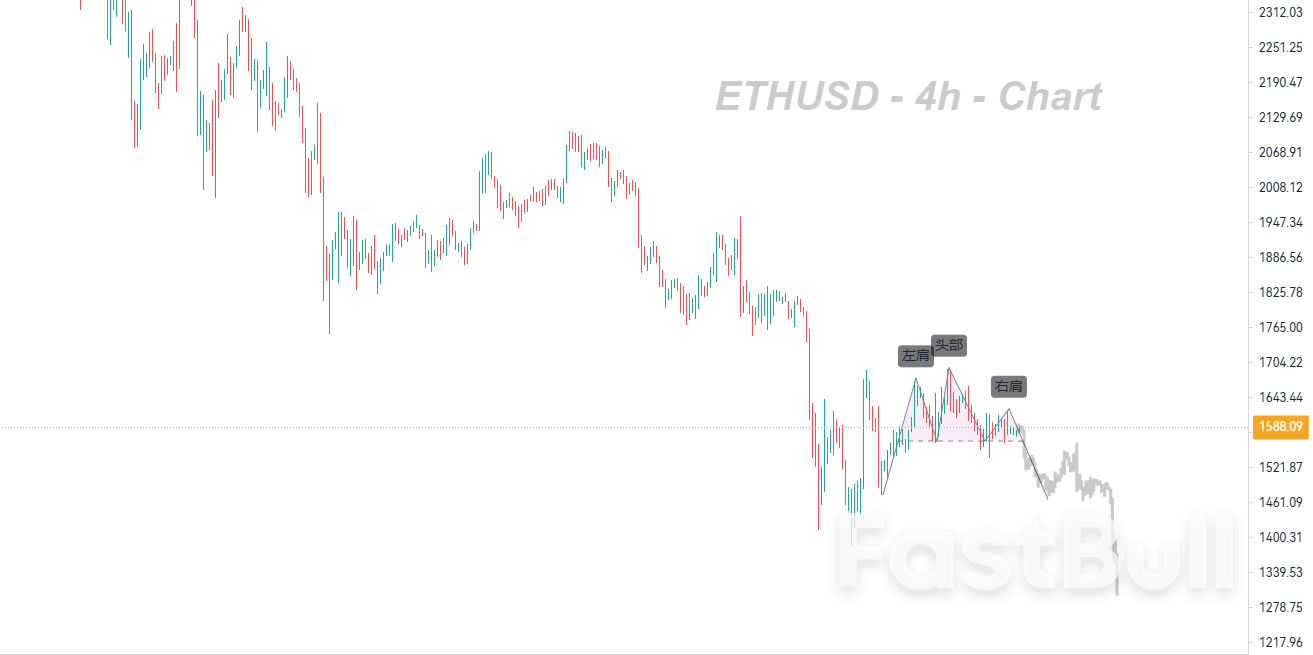
          The cryptocurrency market capitalization declined by over 18% in the first quarter of this year, with $633.5 billion in value erased. Ethereum found support near $1,375. However, the downtrend remains intact as its price continues to trade significantly below the key bearish trendline.

          SELL ETH-USDT
          Close Time
          CLOSED

          1589.19

          Entry Price

          1342.00

          TP

          1740.00

          SL

          3145.76 +61.20 +1.98%

          1508.1

          Pips

          Loss

          1342.00

          TP

          1740.61

          Exit Price

          1589.19

          Entry Price

          1740.00

          SL

          Fundamentals

          Over the past seven days, the cryptocurrency market capitalization experienced a drop to $2.5 trillion, a subsequent rebound to $2.71 trillion, and a further pullback to the $2.65 trillion area. The recovery momentum weakened near the previous consolidation zone. The market has thus far failed to break through the downward resistance line formed by the peak on the day of the U.S. presidential inauguration. The cryptocurrency market capitalization declined by over 18% in the first quarter of this year, with $633.5 billion in value erased.
          Ethereum's market share fell to 7.9%, the lowest level since the end of 2019. Other altcoins experienced a decline of 3.5%, with their market share dropping to 15.7%. Among major cryptocurrencies, only Ripple (XRP) and Binance Coin (BNB) maintained their market share.
          The Fear & Greed Index is gradually moving out of the "extreme fear" zone and consolidating in the "fear" zone. While this is a positive signal, it does not indicate that the pullback has ended. Technically, the market remains in a bearish death cross downward state. For now, the market still lacks sufficient catalysts to drive a full-scale rebound.
          Downtrend Persists Amid Market Uncertainty_1

          Technical Analysis

          Unlike Bitcoin, Ethereum's price experienced a significant breakdown below the $2,000 level in early April, trading below the key support levels of $1,800 and $1,550. Subsequently, the price tested its two-year low near $1,387.
          On the daily chart, Ethereum's price remains well below the 100-day and 200-day moving averages, teetering on the edge of a secondary bear market. Despite a recent rebound, the further downside trend has not been relieved, as it remains in a bearish death cross downward and head-and-shoulders top pattern on the smaller 4-hour timeframe.
          On the upside, the next major resistance level is near $1,690, followed by the psychological level of $1,700. On the same chart, a key bearish trendline has formed, with resistance at $1,740. This trendline is close to the 50% Fibonacci retracement of the downtrend from the $2,100 to $1,379 lows.
          A daily closing price above the $1,740 resistance level could potentially open the door for a new round of steady gains. In this case, the price might rise towards the $2,000 level.
          On the downside, Ethereum may find support near $1,465, with the next major support level at $1,387. A break below this support could push the price towards $1,320. If the decline continues, the price could fall towards $1,280.

          Trading Recommendations

          Trading Direction: Sell
          Entry Price: 1600/1630
          Target Price: 1342
          Stop Loss: 1740
          Valid Until: May 3, 2025, 23:55:00
          Support: 1465/1387/1320
          Resistance: 1617/1662/1669
          Risk Warnings and Disclaimers
          You understand and acknowledge that there is a high degree of risk involved in trading. Following any strategies or investment methods may lead to potential losses. The content on the site is provided by our contributors and analysts for information purposes only. You are solely responsible for determining whether any trading assets, securities, strategy, or any other product is suitable for investing based on your own investment objectives and financial situation.
          Add to Favorites
          Share

          Downtrend Confirmed, Yet Market Awaits Upside Mean Reversion

          Eva Chen

          Economic

          Commodity

          Summary:

          The depreciation of the U.S. dollar and an optimistic outlook for trade negotiations have propelled oil prices upward. Upward revisions to crude oversupply expectations and downward adjustments to oil price forecasts.

          BUY WTI
          Close Time
          CLOSED

          59.985

          Entry Price

          68.260

          TP

          56.400

          SL

          57.399 +0.166 +0.29%

          358.5

          Pips

          Loss

          56.400

          SL

          56.400

          Exit Price

          59.985

          Entry Price

          68.260

          TP

          Fundamentals

          Encouraged by the weak U.S. dollar and the positive prospects for U.S. tariff negotiations, WTI crude oil prices have risen for the second consecutive day. During Thursday's Asian session, WTI traded around $62.50 per barrel. However, macroeconomic headwinds may cap the price recovery, despite optimism regarding potential tariff reductions. Meanwhile, the increase in U.S. crude oil inventories signals ample supply. Without broader market support, crude oil prices are likely to remain near current lows.
          Additionally, as demand expectations are pressured, OPEC+'s decision to accelerate production increases in May, beyond market expectations, is notable. We believe this production increase may be influenced by external factors such as political and geopolitical considerations, which will exacerbate the oversupply pressure in the crude oil market.
          High-frequency data indicate that since March, the number of active U.S. oil rigs has begun to decline, suggesting that the cost challenges for North American shale oil may have arrived. Considering the fundamental changes since the beginning of the year, we have revised our full-year oil supply-demand surplus expectation upward to 670,000 b/d and lowered the annual Brent oil price midpoint to $70 per barrel. The projected midpoints for the second to fourth quarters are $67.50, $72.50, and $65.00 per barrel, respectively.
          Furthermore, if global economic growth is further pressured by trade frictions, it could bring an additional $5 downside risk to oil prices.
          Downtrend Confirmed, Yet Market Awaits Upside Mean Reversion_1

          Technical Analysis

          In the broader time frame, after WTI crude oil broke below $57.21 per barrel, prices have continued to exhibit bearish momentum. Currently, oil prices are hovering around $62.50. The current price action indicates that following a significant downtrend in early April, the market is currently in a phase of mean reversion to the upside.
          The chart shows resistance around $63.00. Over the past week, this resistance level has repeatedly capped upside attempts. The recent price action appears to have formed a potentially bearish inverse head-and-shoulders pattern, adding uncertainty to a further breakout above the $63.00 neckline.
          In terms of momentum, the stochastic oscillator readings are hovering slightly above the midpoint of its range, with momentum strengthening but not yet turning positive. This suggests that the market is neither overbought nor oversold. However, the recent decline indicates that energy is likely to develop to the upside.
          Investors should closely monitor a potential breakout above $63.00, as a breach of this resistance level could trigger a faster pace of upward mean reversion.

          Trading Recommendations

          Trading Direction: Buy
          Entry Price: 60.00/61.00
          Target Price: 68.60
          Stop Loss: 56.40
          Valid Until: May 2, 2025, 23:55:00
          Support: 61.43/60.50/58.33
          Resistance: 63.00/64.29/66.50
          Risk Warnings and Disclaimers
          You understand and acknowledge that there is a high degree of risk involved in trading. Following any strategies or investment methods may lead to potential losses. The content on the site is provided by our contributors and analysts for information purposes only. You are solely responsible for determining whether any trading assets, securities, strategy, or any other product is suitable for investing based on your own investment objectives and financial situation.
          Add to Favorites
          Share

          AUD/USD Turns Bearish as Australia’s Job Market Softens and USD Strengthens

          Warren Takunda

          Economic

          Summary:

          The Australian Dollar weakened against the US Dollar as March labor data missed expectations and the unemployment rate ticked up.

          SELL AUDUSD
          Close Time
          CLOSED

          0.63500

          Entry Price

          0.62200

          TP

          0.64140

          SL

          0.66491 -0.00029 -0.04%

          64.0

          Pips

          Loss

          0.62200

          TP

          0.64141

          Exit Price

          0.63500

          Entry Price

          0.64140

          SL

          The Australian Dollar (AUD) came under pressure on Thursday, halting a six-day rally against the US Dollar (USD) as soft domestic labor market figures and a stronger greenback shifted the momentum back in favor of the bears. At the heart of the move was the latest Australian employment report, which failed to meet expectations and sowed renewed doubt over the health of the labor market. The data, combined with hawkish US economic signals, catalyzed a reversal in AUD/USD dynamics, pushing the pair off recent highs and toward short-term technical support.
          The AUD/USD pair dipped below the critical 0.6390 resistance level after the Australian Bureau of Statistics reported a net employment gain of 32.2K in March—well below the consensus estimate of 40K. The unemployment rate rose to 4.1%, a modest uptick from the prior reading but still under the forecasted 4.2%. While the data was not disastrous, it marked a clear cooling in what had been a surprisingly resilient job market.
          Markets responded swiftly. The Aussie, which had shown notable strength amid recent risk-on sentiment and China’s economic rebound, lost traction against a broadly stronger US Dollar. The disappointing employment figures, when paired with dovish tones from the Reserve Bank of Australia’s (RBA) April meeting minutes, amplified rate cut expectations for the months ahead. Traders are now pricing in a 25-basis point cut as early as May, with nearly 120 basis points of easing projected over the next year.
          While the Aussie faltered, the US Dollar surged, buoyed by robust March retail sales, which rose 1.4% month-on-month—topping both the prior month’s 0.2% gain and the consensus forecast of 1.3%. The data underscored the resilience of the US consumer, even in the face of elevated borrowing costs and lingering inflationary pressures. This strength was reflected in the US Dollar Index (DXY), which climbed toward 99.60, its highest level in weeks.
          In addition, inflation metrics offered a mixed but generally supportive narrative for the greenback. The March Consumer Price Index (CPI) rose 2.4% year-over-year, cooling from February’s 2.8% and undershooting the expected 2.6%. Core CPI, which excludes volatile food and energy components, printed at 2.8%, also softer than expected. While this may give doves some ammunition, the Fed remains cautious. Atlanta Fed President Raphael Bostic reiterated that the central bank still faces a “long road” in returning inflation to its 2% target, downplaying hopes for imminent rate cuts.
          The tone was echoed by a recent consumer sentiment survey from the New York Fed, which revealed growing household concerns over inflation, job security, and credit access. Yet, despite this unease, consumer spending remains robust—a dynamic that continues to confound market expectations for rapid policy easing.
          Providing a modicum of support to the AUD was the latest batch of Chinese macroeconomic data. China’s Q1 GDP expanded by 5.4% year-over-year, beating expectations of 5.1%, while industrial production and retail sales surged 7.7% and 5.9% respectively, both well above consensus. As Australia’s largest trading partner and a key buyer of its iron ore and other commodities, a resurgent China typically bodes well for the Aussie.
          However, the impact was dulled by renewed geopolitical friction. The Chinese Foreign Ministry issued a strong statement in response to the US’s continued tariff threats, warning that Beijing would “simply ignore” further provocations. This escalation casts a shadow over future trade flows and limits the upside for risk-sensitive currencies like the AUD.
          Back home, the RBA’s April meeting minutes did little to lift sentiment. Policymakers struck a cautious tone, suggesting uncertainty over the appropriate timing of the next policy move. The board acknowledged that May could be a suitable time for adjustment, but fell short of committing to action. The dovish undertone reinforces the market’s expectation of an imminent rate cut, especially in light of the softening labor market and slowing domestic momentum—evident in Westpac’s Leading Index, which dropped from 0.9% to 0.6% in March.
          This policy ambiguity, juxtaposed with a clearer Fed trajectory—either a prolonged pause or modest tightening—has skewed rate differentials against the Aussie. Until clarity emerges from the RBA, the AUD is likely to remain under pressure.
          Technical AnalysisAUD/USD Turns Bearish as Australia’s Job Market Softens and USD Strengthens_1
          From a technical perspective, the AUD/USD pair has turned bearish in the short term. After failing to break above the key horizontal resistance at 0.6390, the pair is now forming a local pullback, indicating a possible continuation of the downtrend. A negative divergence is forming on the Relative Strength Index (RSI), which, despite being in oversold territory, is flashing warning signs for further downside.
          Currently, the price is trading above the 50-day Exponential Moving Average (EMA), but bearish pressure may intensify if the pair fails to hold current levels. A short position could be considered with a take-profit target at 0.6220 and a stop-loss at 0.6414, reflecting the likelihood of a deeper correction if market sentiment continues to favor the greenback.
          TRADE RECOMMENDATION
          SELL AUDUSD
          ENTRY PRICE: 0.6350
          STOP LOSS: 0.6414
          TAKE PROFIT: 0.6220
          Risk Warnings and Disclaimers
          You understand and acknowledge that there is a high degree of risk involved in trading. Following any strategies or investment methods may lead to potential losses. The content on the site is provided by our contributors and analysts for information purposes only. You are solely responsible for determining whether any trading assets, securities, strategy, or any other product is suitable for investing based on your own investment objectives and financial situation.
          Add to Favorites
          Share
          FastBull
          Copyright © 2025 FastBull Ltd

          728 RM B 7/F GEE LOK IND BLDG NO 34 HUNG TO RD KWUN TONG KLN HONG KONG

          TelegramInstagramTwitterfacebooklinkedin
          App Store Google Play Google Play
          Products
          Charts

          Chats

          Q&A with Experts
          Screeners
          Economic Calendar
          Data
          Tools
          Membership
          Features
          Function
          Markets
          Copy Trading
          Latest Signals
          Contests
          News
          Analysis
          24/7
          Columns
          Education
          Company
          Careers
          About Us
          Contact Us
          Advertising
          Help Center
          Feedback
          User Agreement
          Privacy Policy
          Business

          White Label

          Data API

          Web Plug-ins

          Poster Maker

          Affiliate Program

          Risk Disclosure

          The risk of loss in trading financial instruments such as stocks, FX, commodities, futures, bonds, ETFs and crypto can be substantial. You may sustain a total loss of the funds that you deposit with your broker. Therefore, you should carefully consider whether such trading is suitable for you in light of your circumstances and financial resources.

          No decision to invest should be made without thoroughly conducting due diligence by yourself or consulting with your financial advisors. Our web content might not suit you since we don't know your financial conditions and investment needs. Our financial information might have latency or contain inaccuracy, so you should be fully responsible for any of your trading and investment decisions. The company will not be responsible for your capital loss.

          Without getting permission from the website, you are not allowed to copy the website's graphics, texts, or trademarks. Intellectual property rights in the content or data incorporated into this website belong to its providers and exchange merchants.

          Not Logged In

          Log in to access more features

          FastBull Membership

          Not yet

          Purchase

          Become a signal provider
          Help Center
          Customer Service
          Dark Mode
          Price Up/Down Colors

          Log In

          Sign Up

          Position
          Layout
          Fullscreen
          Default to Chart
          The chart page opens by default when you visit fastbull.com