• Trade
  • Markets
  • Copy
  • Contests
  • News
  • 24/7
  • Calendar
  • Q&A
  • Chats
Trending
Screeners
SYMBOL
LAST
BID
ASK
HIGH
LOW
NET CHG.
%CHG.
SPREAD
SPX
S&P 500 Index
6827.42
6827.42
6827.42
6899.86
6801.80
-73.58
-1.07%
--
DJI
Dow Jones Industrial Average
48458.04
48458.04
48458.04
48886.86
48334.10
-245.98
-0.51%
--
IXIC
NASDAQ Composite Index
23195.16
23195.16
23195.16
23554.89
23094.51
-398.69
-1.69%
--
USDX
US Dollar Index
97.950
98.030
97.950
98.500
97.950
-0.370
-0.38%
--
EURUSD
Euro / US Dollar
1.17394
1.17409
1.17394
1.17496
1.17192
+0.00011
+ 0.01%
--
GBPUSD
Pound Sterling / US Dollar
1.33707
1.33732
1.33707
1.33997
1.33419
-0.00148
-0.11%
--
XAUUSD
Gold / US Dollar
4299.39
4299.39
4299.39
4353.41
4257.10
+20.10
+ 0.47%
--
WTI
Light Sweet Crude Oil
57.233
57.485
57.233
58.011
56.969
-0.408
-0.71%
--

Community Accounts

Signal Accounts
--
Profit Accounts
--
Loss Accounts
--
View More

Become a signal provider

Sell trading signals to earn additional income

View More

Guide to Copy Trading

Get started with ease and confidence

View More

Signal Accounts for Members

All Signal Accounts

Best Return
  • Best Return
  • Best P/L
  • Best MDD
Past 1W
  • Past 1W
  • Past 1M
  • Past 1Y

All Contests

  • All
  • Trump Updates
  • Recommend
  • Stocks
  • Cryptocurrencies
  • Central Banks
  • Featured News
Top News Only
Share

US Envoy Witkoff Says A Lot Of Progress Was Made At Berlin Talks On Russia/Ukraine War

Share

Syria's President Sharaa Sends Condolences To Trump Over Killing Of USA Soldiers In Syria - Syrian Presidency

Share

ECOWAS Commission President: ECOWAS Rejects Guinea-Bissau Junta Transition Plan, Demands Return To Constitutional Order

Share

On Sunday (December 14), The Bangladesh DSE Broad Index Closed Down 0.62% At 4932.97 Points

Share

US President Trump: A New Federal Reserve Chairman Will Be Chosen Soon

Share

US President Trump: Inflation Is “completely Offset” And You Don’t Want To See Deflation

Share

Trump: Will Be A Lot Of Damage Done To The People That Attacked Troops In Syria

Share

Trump: Terrible Attack In Bondi Beach

Share

Interior Ministry - Syria Arrests Five Suspects In Shooting Of USA And Syrian Troops In Palmyra

Share

France Says Conditions For EU Vote On MERCOSUR Deal Not Yet Met, Despite Recent Progress — Prime Minister's Office

Share

CEO: Tokyo Gas To Steer More Than Half Of Overseas Investments To US In Next 3 Years

Share

In The Past 24 Hours, The Marketvector Digital Asset 100 Small Cap Index Fell By 2.63%, Holding Steady Near The Daily Low Of 3868.93 Points Refreshed At 23:32 Beijing Time, And Has Continued To Fluctuate Downwards Since 12:00

Share

White House National Economic Council Director Kevin Hassett: Economic Data Indicates That The U.S. CPI Is Moving Toward The Federal Reserve's 2% Target

Share

Hamas Says Israel's Killing Of Senior Commander Threatens Ceasefire

Share

Source: Germany's Merz Greets Zelenskiy, Umerov, Kushner, Witkoff At Chancellery In Berlin

Share

[Over 20 Automakers, Including Jike, Xiaomi, And Wenjie, Announce Purchase Tax Guarantee, Saving Up To 15,000 Yuan] Starting January 1, 2026, The Purchase Tax For New Energy Vehicles Will Be Reduced From Full Exemption To A 50% Reduction. Currently, The Vehicle Purchase Tax Is 10%, And The 50% Reduction For New Energy Vehicles Means An Effective Tax Rate Of 5%. The Tax Exemption Cap Will Also Decrease From 30,000 Yuan To 15,000 Yuan. Faced With The Certain Increase In Costs And Uncertain Subsidy Details, The Market Has Proactively "jumped The Gun." Over 20 Automakers, Including Jike, Xiaomi, And Wenjie, Have Launched "purchase Tax Guarantee" Policies, Promising To Make Up The Tax Difference For Customers Who Place Orders Before The End Of The Year And Have Them Delivered Next Year, With A Maximum Amount Of 15,000 Yuan

Share

South Korea Imports 10.8 Million T Of Crude In November Versus 11.3 Million T Year Ago

Share

Qatar's Al Mana Holding Launches $200 Million Project To Produce Sustainable Aviation Fuel In Egypt's Ain Sokhna - Egypt Statement

Share

Israeli Foreign Ministry: One Israeli Citizen Among Dead In Australia Shooting Attack

Share

Israeli Prime Minister Netanyahu: He Warned Australia Prime Minister About Antisemitism

TIME
ACT
FCST
PREV
U.K. Trade Balance (Oct)

A:--

F: --

P: --

U.K. Services Index MoM

A:--

F: --

P: --

U.K. Construction Output MoM (SA) (Oct)

A:--

F: --

P: --

U.K. Industrial Output YoY (Oct)

A:--

F: --

P: --

U.K. Trade Balance (SA) (Oct)

A:--

F: --

P: --

U.K. Trade Balance EU (SA) (Oct)

A:--

F: --

P: --

U.K. Manufacturing Output YoY (Oct)

A:--

F: --

P: --

U.K. GDP MoM (Oct)

A:--

F: --

P: --

U.K. GDP YoY (SA) (Oct)

A:--

F: --

P: --

U.K. Industrial Output MoM (Oct)

A:--

F: --

P: --

U.K. Construction Output YoY (Oct)

A:--

F: --

P: --

France HICP Final MoM (Nov)

A:--

F: --

P: --

China, Mainland Outstanding Loans Growth YoY (Nov)

A:--

F: --

P: --

China, Mainland M2 Money Supply YoY (Nov)

A:--

F: --

P: --

China, Mainland M0 Money Supply YoY (Nov)

A:--

F: --

P: --

China, Mainland M1 Money Supply YoY (Nov)

A:--

F: --

P: --

India CPI YoY (Nov)

A:--

F: --

P: --

India Deposit Gowth YoY

A:--

F: --

P: --

Brazil Services Growth YoY (Oct)

A:--

F: --

P: --

Mexico Industrial Output YoY (Oct)

A:--

F: --

P: --

Russia Trade Balance (Oct)

A:--

F: --

P: --

Philadelphia Fed President Henry Paulson delivers a speech
Canada Building Permits MoM (SA) (Oct)

A:--

F: --

P: --

Canada Wholesale Sales YoY (Oct)

A:--

F: --

P: --

Canada Wholesale Inventory MoM (Oct)

A:--

F: --

P: --

Canada Wholesale Inventory YoY (Oct)

A:--

F: --

P: --

Canada Wholesale Sales MoM (SA) (Oct)

A:--

F: --

P: --

Germany Current Account (Not SA) (Oct)

A:--

F: --

P: --

U.S. Weekly Total Rig Count

A:--

F: --

P: --

U.S. Weekly Total Oil Rig Count

A:--

F: --

P: --

Japan Tankan Large Non-Manufacturing Diffusion Index (Q4)

--

F: --

P: --

Japan Tankan Small Manufacturing Outlook Index (Q4)

--

F: --

P: --

Japan Tankan Large Non-Manufacturing Outlook Index (Q4)

--

F: --

P: --

Japan Tankan Large Manufacturing Outlook Index (Q4)

--

F: --

P: --

Japan Tankan Small Manufacturing Diffusion Index (Q4)

--

F: --

P: --

Japan Tankan Large Manufacturing Diffusion Index (Q4)

--

F: --

P: --

Japan Tankan Large-Enterprise Capital Expenditure YoY (Q4)

--

F: --

P: --

U.K. Rightmove House Price Index YoY (Dec)

--

F: --

P: --

China, Mainland Industrial Output YoY (YTD) (Nov)

--

F: --

P: --

China, Mainland Urban Area Unemployment Rate (Nov)

--

F: --

P: --

Saudi Arabia CPI YoY (Nov)

--

F: --

P: --

Euro Zone Industrial Output YoY (Oct)

--

F: --

P: --

Euro Zone Industrial Output MoM (Oct)

--

F: --

P: --

Canada Existing Home Sales MoM (Nov)

--

F: --

P: --

Euro Zone Total Reserve Assets (Nov)

--

F: --

P: --

U.K. Inflation Rate Expectations

--

F: --

P: --

Canada National Economic Confidence Index

--

F: --

P: --

Canada New Housing Starts (Nov)

--

F: --

P: --

U.S. NY Fed Manufacturing Employment Index (Dec)

--

F: --

P: --

U.S. NY Fed Manufacturing Index (Dec)

--

F: --

P: --

Canada Core CPI YoY (Nov)

--

F: --

P: --

Canada Manufacturing Unfilled Orders MoM (Oct)

--

F: --

P: --

Canada Manufacturing New Orders MoM (Oct)

--

F: --

P: --

Canada Core CPI MoM (Nov)

--

F: --

P: --

Canada Manufacturing Inventory MoM (Oct)

--

F: --

P: --

Canada CPI YoY (Nov)

--

F: --

P: --

Canada CPI MoM (Nov)

--

F: --

P: --

Canada CPI YoY (SA) (Nov)

--

F: --

P: --

Canada Core CPI MoM (SA) (Nov)

--

F: --

P: --

Canada CPI MoM (SA) (Nov)

--

F: --

P: --

Q&A with Experts
    • All
    • Chatrooms
    • Groups
    • Friends
    Connecting
    .
    .
    .
    Type here...
    Add Symbol or Code

      No matching data

      All
      Trump Updates
      Recommend
      Stocks
      Cryptocurrencies
      Central Banks
      Featured News
      • All
      • Russia-Ukraine Conflict
      • Middle East Flashpoint
      • All
      • Russia-Ukraine Conflict
      • Middle East Flashpoint

      Search
      Products

      Charts Free Forever

      Chats Q&A with Experts
      Screeners Economic Calendar Data Tools
      Membership Features
      Data Warehouse Market Trends Institutional Data Policy Rates Macro

      Market Trends

      Market Sentiment Order Book Forex Correlations

      Top Indicators

      Charts Free Forever
      Markets

      News

      News Analysis 24/7 Columns Education
      From Institutions From Analysts
      Topics Columnists

      Latest Views

      Latest Views

      Trending Topics

      Top Columnists

      Latest Update

      Signals

      Copy Rankings Latest Signals Become a signal provider AI Rating
      Contests
      Brokers

      Overview Brokers Assessment Rankings Regulators News Claims
      Broker listing Forex Brokers Comparison Tool Live Spread Comparison Scam
      Q&A Complaint Scam Alert Videos Tips to Detect Scam
      More

      Business
      Events
      Careers About Us Advertising Help Center

      White Label

      Data API

      Web Plug-ins

      Affiliate Program

      Awards Institution Evaluation IB Seminar Salon Event Exhibition
      Vietnam Thailand Singapore Dubai
      Fans Party Investment Sharing Session
      FastBull Summit BrokersView Expo
      Recent Searches
        Top Searches
          Markets
          News
          Analysis
          User
          24/7
          Economic Calendar
          Education
          Data
          • Names
          • Latest
          • Prev

          View All

          No data

          Scan to Download

          Faster Charts, Chat Faster!

          Download App
          English
          • English
          • Español
          • العربية
          • Bahasa Indonesia
          • Bahasa Melayu
          • Tiếng Việt
          • ภาษาไทย
          • Français
          • Italiano
          • Türkçe
          • Русский язык
          • 简中
          • 繁中
          Open Account
          Search
          Products
          Charts Free Forever
          Markets
          News
          Signals

          Copy Rankings Latest Signals Become a signal provider AI Rating
          Contests
          Brokers

          Overview Brokers Assessment Rankings Regulators News Claims
          Broker listing Forex Brokers Comparison Tool Live Spread Comparison Scam
          Q&A Complaint Scam Alert Videos Tips to Detect Scam
          More

          Business
          Events
          Careers About Us Advertising Help Center

          White Label

          Data API

          Web Plug-ins

          Affiliate Program

          Awards Institution Evaluation IB Seminar Salon Event Exhibition
          Vietnam Thailand Singapore Dubai
          Fans Party Investment Sharing Session
          FastBull Summit BrokersView Expo

          Price Action Suggests EURCHF Could Extend Its Recovery Rally

          Manuel

          Central Bank

          Economic

          Summary:

          The price appears to be gaining traction and could extend its upward move toward the 0.9430 area, provided it avoids a downside break below the recent lows.

          BUY EURCHF
          Close Time
          CLOSED

          0.93197

          Entry Price

          0.94300

          TP

          0.92200

          SL

          0.93442 +0.00093 +0.10%

          31.5

          Pips

          Profit

          0.92200

          SL

          0.93512

          Exit Price

          0.93197

          Entry Price

          0.94300

          TP

          The European Union (EU) is reportedly weighing adjustments to its methane regulations for U.S. liquefied natural gas (LNG) as part of an effort to smooth trade relations, according to Reuters. The European Commission is said to be refining its proposal ahead of trade negotiations with the United States, seeking to defuse tensions and potentially stave off a new round of tariffs proposed by former President Donald Trump. Both parties have hinted that energy cooperation could serve as a cornerstone of a broader trade agreement.
          In parallel, the European Central Bank (ECB) has now delivered six consecutive interest rate cuts, marking the seventh reduction since its easing cycle began in June 2024. With inflation in the eurozone continuing to edge closer to the ECB’s 2% target, investors are increasingly pricing in the potential for additional policy accommodation. Broader concerns about external shocks and a weakening global growth backdrop have further solidified the rationale for maintaining an accommodative monetary stance.
          In its latest statement, the ECB reaffirmed that disinflation remains on track, but carefully avoided committing to a specific rate path. Instead, the central bank emphasized its data-dependent approach, pledging to reassess conditions meeting by meeting in light of what it described as a climate of “exceptional uncertainty.” Much of that uncertainty, officials noted, stems from the unpredictable nature of Trump’s evolving trade agenda, which continues to cast a shadow over Europe’s export-driven economy.
          During her press conference, ECB President Christine Lagarde expressed concern that escalating global trade tensions could undermine eurozone growth, primarily by eroding export demand. Exports remain a critical pillar of the euro area economy, and any sustained drag could delay the region’s recovery.
          Additional commentary from Governing Council member François Villeroy de Galhau suggested that inflationary risks related to global trade conflicts appear muted—possibly even skewing to the downside. Meanwhile, ECB policymaker Madis Müller explained that the latest 25-basis-point cut was largely a response to declining energy prices and increased tariff-related pressure. He also noted that interest rates have ceased being a restrictive factor for the economy, as underlying indicators continue to show gradual, if uneven, improvement. However, Müller warned that ongoing global fragmentation could eventually exert upward pressure on prices, especially if supply chains become more localized.
          While Swiss markets remained closed for Easter Monday, the Swiss franc (CHF) gained strength in early trading. Mounting U.S.-China trade tensions have reignited fears of a global slowdown, prompting investors to seek refuge in safe-haven assets such as the franc. Interestingly, President Trump has temporarily exempted certain key tech products, many of which are manufactured in China, from the latest round of proposed reciprocal tariffs—a move seen by some as an attempt to ease market nerves.
          Meanwhile, Switzerland’s trade surplus widened significantly to CHF 6.35 billion in March, up from CHF 4.8 billion in February—marking the largest monthly surplus since October 2024. The expansion was fueled by a 12.6% surge in exports, outpacing a 10.4% rise in imports, and further underscoring the strength of external demand.Price Action Suggests EURCHF Could Extend Its Recovery Rally_1

          Technical Analysis

          The EURCHF currency pair is currently showing signs of a bullish rebound after respecting a long-term ascending trendline. On April 11, the pair recorded a recent low near 0.9220, but since then, bears have failed to push the price to fresh lows. This inability to break down suggests a potential shift in momentum, with bulls slowly regaining control.
          The price appears to be gaining traction and could extend its upward move toward the 0.9430 area, provided it avoids a downside break below the recent lows. Notably, this upside level aligns with a zone of previous price congestion and lies just below the 100-period and 200-period moving averages, currently positioned at 0.9373 and 0.9470, respectively.
          Furthermore, the 50% Fibonacci retracement of the previous downtrend intersects around the 0.9425 mark, adding to the confluence of resistance in that area. This enhances the likelihood that any ongoing pullback may continue climbing toward that cluster of key technical levels.
          The Relative Strength Index (RSI) is currently hovering around 56, indicating a neutral stance. While not yet in overbought territory, the indicator suggests there’s still room for the rally to stretch further, especially in the absence of strong bearish catalysts. As long as price remains supported above its recent lows and continues to hold the ascending trendline, the pair could remain tilted to the upside in the near term.
          Trading Recommendations
          Trading direction: Buy
          Entry price: 0.9321
          Target price: 0.9430
          Stop loss: 0.9220
          Validity: Apr 30, 2025 15:00:00
          Risk Warnings and Disclaimers
          You understand and acknowledge that there is a high degree of risk involved in trading. Following any strategies or investment methods may lead to potential losses. The content on the site is provided by our contributors and analysts for information purposes only. You are solely responsible for determining whether any trading assets, securities, strategy, or any other product is suitable for investing based on your own investment objectives and financial situation.
          Add to Favorites
          Share

          Downward Trend Unabated

          Eva Chen

          Economic

          Forex

          Summary:

          USDJPY has recorded a fifth consecutive weekly decline, with prices falling to the vicinity of 140.47 on Monday. Japan's core CPI, which rose by 3.2% YoY has further bolstered market expectations for a potential rate hike by the Bank of Japan (BOJ), thereby fueling the yen's appreciation.

          SELL USDJPY
          Close Time
          CLOSED

          141.700

          Entry Price

          138.150

          TP

          145.000

          SL

          155.814 +0.255 +0.16%

          330.0

          Pips

          Loss

          138.150

          TP

          145.000

          Exit Price

          141.700

          Entry Price

          145.000

          SL

          Fundamentals

          Following the long weekend, the yen sustained its bullish momentum against the US dollar on Monday. Japan's inflation rate continues to exceed the target set by the Bank of Japan (BOJ), while concerns over a potential global economic recession triggered by trade wars persist. These factors have collectively dampened investor sentiment and driven capital towards the safe-haven Japanese yen.
          On Monday, Japan's Ministry of Internal Affairs and Communications reported that the core CPI (excluding fresh food) increased by 3.2% YoY in March, accelerating from the previous month's 3.0% and aligning with market expectations. This marks the third consecutive year that the rate has surpassed the BOJ's 2% target. The core CPI excluding food and energy also rose more sharply, from 2.6% to 2.9%. While the overall CPI inflation rate eased slightly from 3.7% to 3.6%, which indicates that inflation remains persistently high.
          The most notable aspect of the inflation data was the significant surge in rice prices, which skyrocketed by 92.5%, marking the fastest rise since records began in 1971. This surge was driven by a combination of factors, including crop failures due to extreme heat in 2023 and panic buying by consumers following earthquake warnings last year. This marks the sixth consecutive month that rice inflation has hit a record high.
          In response, the Japanese government has intervened by releasing over 210,000 tons of rice from its reserves and plans to auction an additional 100,000 tons this month to stabilize supply.
          Apart from food, household durable goods prices rose by 6.5%, up from 5.4% in February. Energy prices, although still elevated, have seen a slight decline from 6.9% to 6.6%.
          Additionally, due to market turbulence related to tariffs, market expectations for the BOJ to raise interest rates by at least 25 basis points this year have increased. Investors currently anticipate two rate hikes in Japan by December. Previously, despite data showing an acceleration in consumer price index (CPI) inflation, the market was highly skeptical about returning to the pre-tariff levels. The probability of a 25 basis point rate hike in June was as high as 80%. Currently, the yen appears to be attracting some safe-haven flows, with the USDJPY exchange rate falling to its lowest level since September.
           Downward Trend Unabated_1

          Technical Analysis

          USDJPY has extended its downward trend today, with intraday movements remaining biased to the downside. A break above the recent downtrend channel would signal an acceleration of the decline. The current decline began at 151.27 (a Summation AB=CD pattern), and is expected to extend below the 139.57 support level.
          On the upside, a breach of the minor resistance at 144.07 would turn the intraday trend neutral again. However, as long as the 151.20 resistance level holds, the overall trend will remain bearish.

          Trading Recommendations

          Trading Direction: Sell
          Entry Price: 141.70
          Target Price: 138.15
          Stop Loss: 145.00
          Valid Until: May 06, 2025, 23:55:00
          Support: 140.47/139.55/138.04
          Resistance: 142.17/144.06/144.61
          Risk Warnings and Disclaimers
          You understand and acknowledge that there is a high degree of risk involved in trading. Following any strategies or investment methods may lead to potential losses. The content on the site is provided by our contributors and analysts for information purposes only. You are solely responsible for determining whether any trading assets, securities, strategy, or any other product is suitable for investing based on your own investment objectives and financial situation.
          Add to Favorites
          Share

          Uptrend Tests Challenge Multi-Year Highs

          Eva Chen

          Central Bank

          Summary:

          EURUSD registered a robust advance of over 1.2% on Monday, breaking through the 1.1500 mark and reaching its highest level since November 2021. Heightened concerns over a potential US economic recession have intensified the ongoing US dollar sell-off, thereby fueling the euro's ascent.

          BUY EURUSD
          Close Time
          CLOSED

          1.15029

          Entry Price

          1.18450

          TP

          1.13300

          SL

          1.17394 +0.00011 +0.01%

          172.9

          Pips

          Loss

          1.13300

          SL

          1.13295

          Exit Price

          1.15029

          Entry Price

          1.18450

          TP

          Fundamentals

          The US dollar's sell-off continued unabated following the long weekend. EURUSD touched 1.1500 on Monday for the first time since November 2021, with the pair gaining over 1% on the day. Currently, market confidence in US economic policy is virtually nonexistent. The dollar, which has been at the core of a system established over eight decades, appears to be under increasing pressure.
          The European Central Bank (ECB) cut interest rates for the seventh time in a year last Thursday in an effort to reduce borrowing costs. Recently, global market volatility related to trade has further strengthened the case for additional policy easing. The ECB noted that "increased uncertainty could dampen confidence among households and firms. Adverse and volatile reactions to trade tensions could have a tightening impact on financing conditions. These factors could further weigh on the euro area economic outlook." However, ECB President Christine Lagarde provided little guidance on future actions, reiterating that uncertainties remain too high for the ECB to make any commitments, with decisions to be made based on incoming data.
          Market Outlook。What lies ahead for EURUSD? We believe that the Trump administration must exercise extreme caution when intervening in the overall state of the US balance of payments.
          When considering measures that could abruptly reduce the trade deficit and expand the current account deficit, the impact on the capital account must be taken into account. A sudden narrowing of the US trade deficit implies a corresponding contraction in the capital account surplus. This shift indicates a decline in foreign demand for US bonds, which in turn exerts downward pressure on the US dollar while boosting non-US currencies.
          However, it remains to be seen whether the US government can effectively and sustainably reduce the trade deficit through these "blunt" measures. How will global trade and the global financial system evolve in the future? It is premature to draw any definitive conclusions at this stage.
          Uptrend Tests Challenge Multi-Year Highs_1

          Technical Analysis

          EURUSD broke above 1.1500 on Monday, resuming its upward trajectory and moving higher throughout the session.
          The current rally originated from 1.0176, with the target level set at the 161.8% Fibonacci extension of the 1.0358 to 1.0953 range, at 1.1694. Further gains could test the 1.1845 level.
          On the downside, a break below the minor support at 1.1357 would turn the intraday trend neutral, leading to consolidation before another potential rebound.

          Trading Recommendations

          Trading Direction: Buy
          Entry Price: 1.1450
          Target Price: 1.1845
          Stop Loss: 1.1330
          Valid Until: May 06, 2025, 23:55:00
          Support: 1.1500/1.1473/1.1387
          Resistance: 1.1595/1.1694/1.1910
          Risk Warnings and Disclaimers
          You understand and acknowledge that there is a high degree of risk involved in trading. Following any strategies or investment methods may lead to potential losses. The content on the site is provided by our contributors and analysts for information purposes only. You are solely responsible for determining whether any trading assets, securities, strategy, or any other product is suitable for investing based on your own investment objectives and financial situation.
          Add to Favorites
          Share

          Short-Term Positive Stimuli Fail to Reverse Downward Trend

          Alan

          Commodity

          Summary:

          Recent WTI crude oil prices have rebounded due to short-term positive catalysts, but the overall oversupply in the oil market persists, and the downward trend remains intact.

          SELL WTI
          Close Time
          CLOSED

          62.244

          Entry Price

          51.200

          TP

          65.500

          SL

          57.233 -0.408 -0.71%

          551.0

          Pips

          Profit

          51.200

          TP

          56.734

          Exit Price

          62.244

          Entry Price

          65.500

          SL

          Fundamentals

          Last week, WTI crude oil rallied on optimism over U.S. sanctions on Iran and OPEC+ members' compliance with compensation production cuts. By the week's close, WTI surged over $4.
          However, the actual impact of U.S. sanctions on Iran is likely limited. The latest sanctions target Chinese companies importing Iranian crude, which could temporarily reduce Iran's exports by ~300,000 b/d (15% of its total exports). However, "shadow fleets" and transshipment trade may sustain partial flows. The sanctions are more likely to trigger market sentiment fluctuations than create a material supply gap, similar to the February 2025 sanctions that drove prices up by only 3% before retreating.
          Meanwhile, compensation cuts by some OPEC+ members may be insufficient to address immediate oversupply. Iraq and Kazakhstan's proposed cuts (~300,000 b/d) aim to offset prior overproduction, but compliance remains questionable. Russia's March output already exceeded quotas at 10.5 million b/d, keeping OPEC+ total supply 600,000 b/d higher than 2024 levels. Overall, an oversupply situation persists.
          In summary, while short-term positives spurred a WTI rally, oversupply constraints limit upside potential, and the bearish trend remains unchanged.

          Technical Analysis

          Short-Term Positive Stimuli Fail to Reverse Downward Trend_1
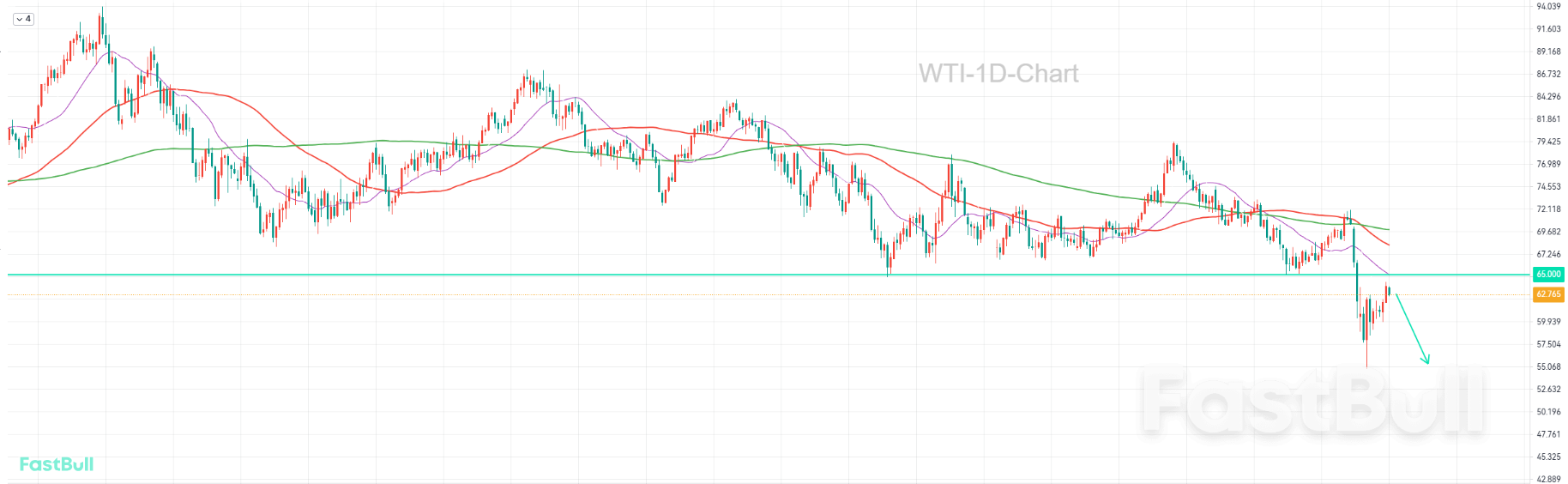
          Presented in the daily chart, WTI crude oil has broken above the $62.5 resistance level on positive sentiment, testing the next hurdle at $65.00. However, the moving average system maintains a bearish alignment, signaling an overarching downward trend. The rally's upside is likely capped.
          Currently, if WTI weakens below $65.00 after a rebound, the prior downtrend will resume. In the near term, wait for the rally to peak, then prioritize selling at highs.

          Trading Recommendations

          Trading direction: Sell
          Entry price: 62.90
          Target price: 51.20
          Stop loss: 65.50
          Valid Until: May 5, 2025, 23:00:00
          Support: 54.75/50.00
          Resistance: 64.13/65.00
          Risk Warnings and Disclaimers
          You understand and acknowledge that there is a high degree of risk involved in trading. Following any strategies or investment methods may lead to potential losses. The content on the site is provided by our contributors and analysts for information purposes only. You are solely responsible for determining whether any trading assets, securities, strategy, or any other product is suitable for investing based on your own investment objectives and financial situation.
          Add to Favorites
          Share

          Australian Dollar Rises Amid Trade Turmoil, Fed Uncertainty, and China's Upbeat Economic Data

          Warren Takunda

          Economic

          Summary:

          The Australian Dollar (AUD) climbed against the US Dollar (USD) as global markets responded to the People's Bank of China's (PBoC) decision to hold key lending rates steady.

          BUY AUDUSD
          Close Time
          CLOSED

          0.64099

          Entry Price

          0.65425

          TP

          0.63100

          SL

          0.66520 -0.00118 -0.18%

          10.2

          Pips

          Profit

          0.63100

          SL

          0.64201

          Exit Price

          0.64099

          Entry Price

          0.65425

          TP

          The Australian Dollar opened the week with renewed strength, recovering from prior session losses as it rode a wave of broad-based US Dollar weakness and a modest pickup in risk sentiment. This recovery came on the back of key decisions and data points from both China and the United States, as well as growing geopolitical friction that could reshape the near-term outlook for global trade.
          The People's Bank of China (PBoC) held its one-year Loan Prime Rate (LPR) unchanged at 3.10% and maintained the five-year rate at 3.60%, in a widely anticipated decision that signaled stability rather than further stimulus. While the decision itself did not shock the market, it provided reassurance that Beijing is confident in the current trajectory of its post-COVID recovery. For Australia, whose economy is heavily tethered to Chinese demand for raw materials, such as iron ore and coal, this was a subtle but meaningful vote of confidence.
          However, it was not just China’s monetary stance that shaped the market narrative. Tensions between Washington and Beijing surged again after the Biden administration moved to impose tariffs on Chinese vessels docking at US ports. This escalatory move, aimed ostensibly at protecting American shipping and port security, sent shivers through global logistics and raised the specter of a new chapter in the trade war saga.
          Yet, in a somewhat contradictory tone, President Donald Trump — who continues to influence economic policy discourse despite no longer holding office — announced that certain key technology products would be exempted from the proposed “reciprocal” tariffs. These exemptions primarily concern tech components produced in China, further underscoring Australia’s indirect exposure to any easing or tightening in US-China trade dynamics. Trump later noted that China had made conciliatory overtures and that he was “not looking to go higher on China tariffs,” adding a degree of market relief. He even expressed optimism that a deal could be reached in as little as three to four weeks, tempering the earlier tension with cautious hope.
          The net effect was clear: risk appetite improved, and the US Dollar began to slip, dragging the US Dollar Index (DXY) down to around 98.50 — its lowest level since April 2022. The sharp decline was exacerbated by a fall in the 2-year Treasury yield, which dropped more than 1% to 3.75%, reflecting investor expectations that the Federal Reserve may soon need to pivot its policy in light of a softening economy and cooling inflation.
          Indeed, the latest US Consumer Price Index (CPI) print confirmed that price pressures are moderating. Headline CPI eased to 2.4% year-on-year in March, down from 2.8% in February and below expectations of 2.6%. Core CPI, which strips out volatile food and energy components, came in at 2.8% versus a forecast of 3.0%. On a monthly basis, the headline figure dipped by 0.1%, while core prices edged up a mere 0.1%.
          While disinflation is broadly welcomed by the market, it now collides with worrying signs of economic fatigue. Federal Reserve Chair Jerome Powell cautioned that the US faces the dual risk of a stagnant economy alongside stubborn inflation — a stagflation scenario that complicates policy responses. Powell’s remarks were overshadowed, however, by reports that President Trump is mulling the possibility of removing Powell from his position, reflecting growing political frustration over the Fed’s cautious approach. White House economic adviser Kevin Hassett later confirmed that the idea was under discussion, although the immediate market reaction was relatively muted.
          In terms of labor market data, the picture remains mixed. Initial jobless claims for the week ending April 12 fell to 215,000 — better than expected — but continuing claims rose to 1.885 million, suggesting that while layoffs may be slowing, displaced workers are struggling to re-enter the workforce. This labor market dynamic, combined with softer inflation, suggests the Fed may face intensifying pressure to consider rate cuts sooner than previously planned.
          Back in Australia, the economic signals were similarly nuanced. The unemployment rate ticked up to 4.1% in March, just shy of expectations at 4.2%, while net job creation stood at 32,200 — a healthy figure but below the forecast of 40,000. At the same time, the Westpac Leading Index’s six-month annualized growth rate eased to 0.6% in March from 0.9% in February, hinting at some softening in forward-looking momentum.
          Minutes from the Reserve Bank of Australia’s (RBA) March 31–April 1 meeting revealed ongoing uncertainty around the timing of the next interest rate adjustment. While the Board flagged the upcoming May meeting as a potential opportunity to reassess policy, it emphasized that no decision had yet been made, pointing to the wide range of upside and downside risks that continue to confront the Australian economy.
          Meanwhile, China delivered a strong batch of macroeconomic data, providing crucial support for the Aussie. The Chinese economy expanded by 5.4% in the first quarter of 2025, matching the growth pace seen in the previous quarter and exceeding forecasts of 5.1%. On a quarterly basis, GDP rose 1.2%, slightly below the 1.4% estimate but still resilient. Retail sales in China surged by 5.9% year-on-year, comfortably beating the 4.2% forecast and February’s 4% print. Industrial production jumped by 7.7%, far outpacing both the prior month and market expectations. For Australia, these figures serve as a strong tailwind, given the nation’s reliance on Chinese demand for its exports.
          Technical AnalysisAustralian Dollar Rises Amid Trade Turmoil, Fed Uncertainty, and China's Upbeat Economic Data_1
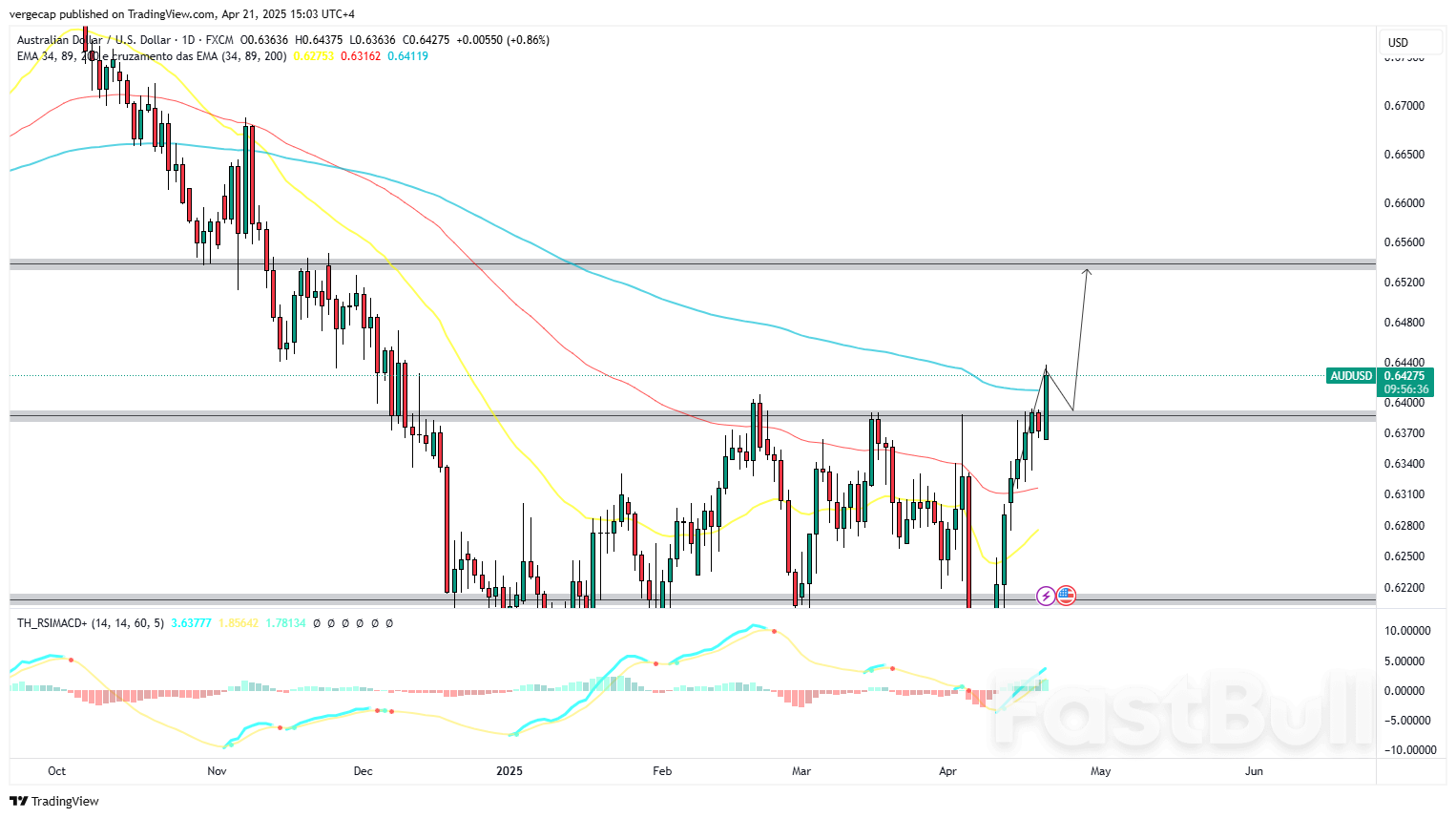
          Technically, the AUD/USD pair has shifted from a protracted downtrend to a confirmed bullish reversal. The pair broke above its recent consolidation range, which had served as a resistance zone between 0.63875 and 0.64100. That zone now acts as strong support. Prices are currently trading above all key exponential moving averages (EMAs), which are aligned in a bullish formation, with each average trending upward. This technical configuration signals strong upward momentum and improves the outlook for further gains.
          Moreover, the recent bullish engulfing candle at the breakout point confirms buyer interest and volume strength, lending credence to the view that this recovery is not merely a short-term bounce but the beginning of a more sustainable rally. The next significant resistance lies around 0.65425, a level where traders may begin to take profits.
          TRADE RECOMMENDATION
          BUY AUDUSD
          ENTRY PRICE: 0.64100
          STOP LOSS: 0.63100
          TAKE PROFIT: 0.65425
          Risk Warnings and Disclaimers
          You understand and acknowledge that there is a high degree of risk involved in trading. Following any strategies or investment methods may lead to potential losses. The content on the site is provided by our contributors and analysts for information purposes only. You are solely responsible for determining whether any trading assets, securities, strategy, or any other product is suitable for investing based on your own investment objectives and financial situation.
          Add to Favorites
          Share

          USD/CAD Slumps to Six-Month Low as Dollar Buckles Under Political Pressure

          Warren Takunda

          Economic

          Summary:

          The USD/CAD pair slumps to a six-month low near 1.3800 as political tensions in Washington rattle confidence in the U.S. Dollar.

          SELL USDCAD
          Close Time
          CLOSED

          1.38200

          Entry Price

          1.35000

          TP

          1.39500

          SL

          1.37700 0.00000 0.00%

          8.8

          Pips

          Profit

          1.35000

          TP

          1.38112

          Exit Price

          1.38200

          Entry Price

          1.39500

          SL

          The U.S. Dollar is under siege. On Monday, the USD/CAD currency pair extended its downside momentum, plunging to a six-month low near the psychologically significant 1.3800 mark during the European session. The move highlights a broader narrative unfolding in currency markets: investors are rapidly losing confidence in the Greenback, as political and institutional instability in Washington compounds fundamental economic concerns.
          At the heart of the latest selloff is a growing threat to the Federal Reserve’s independence. Reports have surfaced that U.S. President Donald Trump is weighing the removal of Fed Chair Jerome Powell — a move that has sparked alarm across global markets. Trump's dissatisfaction with Powell stems from the Fed’s refusal to cut interest rates despite persistent political pressure and elevated inflation expectations.
          This political interference is shaking the very foundation of the U.S. Dollar’s status as the world’s most trusted reserve currency. The U.S. Dollar Index (DXY), which tracks the performance of the Greenback against a basket of six major peers, has collapsed to a fresh three-year low, trading just above 98.00.
          The Dollar’s fall from grace is particularly stark when viewed in the context of Trump’s historically erratic trade policy. Despite recent reassurances from U.S. Commerce Secretary Howard Lutnick, who over the weekend said that “we're confident it will work out with China,” traders remain unconvinced that Washington will deliver a stable and reliable policy path forward. Trump’s oscillating rhetoric on tariffs and trade has not only muddled the macroeconomic outlook but also compromised trust in America’s institutional consistency.
          Meanwhile, north of the border, the Canadian Dollar is finding renewed strength, buoyed by fresh domestic optimism. Canadian Prime Minister Mark Carney, who is positioning himself as a fiscal stabilizer in a turbulent North American landscape, announced a plan to implement tax cuts and expand defense spending. These measures are widely viewed as an effort to reduce Canada’s economic reliance on the United States, particularly as the U.S. turns inward under Trump’s protectionist agenda.
          Carney’s fiscal stimulus proposals have been well received by investors, as they signal proactive economic management and a strategic pivot away from U.S.-centric trade dependencies. The combination of Canadian policy optimism and U.S. Dollar weakness has created a perfect storm that is driving USD/CAD lower.
          Technical AnalysisUSD/CAD Slumps to Six-Month Low as Dollar Buckles Under Political Pressure_1
          From a technical perspective, the USD/CAD pair is firmly entrenched in a bearish trajectory on the intraday chart. The pair has decisively broken below the critical 1.3850 support level, a key threshold that previously acted as a springboard for bullish reversals. The break is compounded by sustained price action below the 50-period Exponential Moving Average (EMA50), which continues to apply downward pressure.
          Adding to the bearish sentiment, the Relative Strength Index (RSI) has recently exited overbought territory, issuing fresh sell signals that point to continued weakness ahead. Should the pair breach the 1.3600 psychological barrier, the path will likely open toward deeper support at 1.3500, followed by the September 24th low of 1.3430.
          TRADE RECOMMENDATION
          SELL USDCAD
          ENTRY PRICE: 1.3820
          STOP LOSS: 1.3950
          TAKE PROFIT: 1.3500
          Risk Warnings and Disclaimers
          You understand and acknowledge that there is a high degree of risk involved in trading. Following any strategies or investment methods may lead to potential losses. The content on the site is provided by our contributors and analysts for information purposes only. You are solely responsible for determining whether any trading assets, securities, strategy, or any other product is suitable for investing based on your own investment objectives and financial situation.
          Add to Favorites
          Share

          Greenback Slumps Below 0.81 vs CHF as Traders Bet on Fed Easing and Flee Risk

          Warren Takunda

          Economic

          Summary:

          The USD/CHF pair crashed to levels not seen since January 2015 on Monday, weighed down by heightened fears of a U.S. recession, dovish Federal Reserve rate expectations, and renewed global trade uncertainty.

          SELL USDCHF
          Close Time
          CLOSED

          0.80900

          Entry Price

          0.78000

          TP

          0.82300

          SL

          0.79582 +0.00060 +0.08%

          140.0

          Pips

          Loss

          0.78000

          TP

          0.82301

          Exit Price

          0.80900

          Entry Price

          0.82300

          SL

          The U.S. Dollar opened the week under heavy pressure, as the USD/CHF pair tumbled to its lowest level in over a decade, sliding below the mid-0.8000s in the first half of Monday’s European session. The decline marks a significant technical and psychological breakdown for the pair, sending a clear signal that bearish momentum has taken firm control. What began as a quiet consolidation over the past week quickly erupted into a sharp sell-off, as the pair crashed through critical support levels, solidifying the view that the path of least resistance is now firmly to the downside.
          At the heart of the move lies a confluence of fundamental drivers. Global markets remain rattled by trade-related uncertainty, with investors growing increasingly wary of the long-term implications of U.S. President Donald Trump’s erratic trade policy maneuvers. The president’s unpredictable announcements, including tit-for-tat tariff threats and escalating rhetoric, have reignited fears of a full-blown global trade war. These concerns are having a pronounced impact on investor sentiment, as equity markets across major regions display a cautious, risk-averse tone.
          As risk appetite continues to wane, the Swiss Franc is once again emerging as a preferred destination for capital seeking shelter from volatility. The Franc’s reputation as a stable, reliable safe-haven asset has only grown stronger in this environment, attracting inflows from both institutional and retail investors alike. The CHF’s rally has been further bolstered by its relative insulation from the chaos affecting other G10 currencies, positioning it as a prime beneficiary of market defensiveness.
          Compounding the pressure on USD/CHF is the mounting concern over the trajectory of the U.S. economy. Analysts and investors alike are increasingly pricing in the likelihood of a recession as soft economic data continues to roll in. The combination of a cooling labor market, tepid consumer demand, and slowing industrial output has cast a long shadow over America’s near-term outlook. In this fragile context, markets are bracing for a return to policy easing from the Federal Reserve.
          Market expectations for Federal Reserve policy have shifted dramatically in recent weeks. Despite Fed Chair Jerome Powell’s hawkish remarks last week—where he suggested that the central bank remains in a position to hold rates steady pending greater clarity—investors are betting otherwise. Futures markets are now fully pricing in the possibility of at least 100 basis points of rate cuts through 2025, a sharp contrast to the Fed’s stated patience. The U.S. Dollar Index (DXY), which tracks the greenback against a basket of major currencies, has slumped to its lowest reading since April 2022 as a result, reflecting broad-based bearish sentiment toward the dollar.
          This macroeconomic backdrop has created fertile ground for a technical breakdown in USD/CHF, and the charts are now confirming what the fundamentals have been suggesting for weeks. The pair had been coiling within a bearish triangle pattern, repeatedly posting lower highs while clinging to a key support level near 0.8098. Monday’s move finally breached that base decisively, as a surge in bearish volume overwhelmed buyers and drove the pair into fresh multi-year lows.
          Technical AnalysisGreenback Slumps Below 0.81 vs CHF as Traders Bet on Fed Easing and Flee Risk_1
          Technically, the picture is unequivocally bearish. USD/CHF has remained below the 200-period exponential moving average, underscoring the strength of the downtrend. The most recent attempt to break through the falling resistance line of the triangle was swiftly rejected near the 34 EMA band, which served as a cap on bullish momentum. That rejection triggered a sharp influx of sell orders, driving prices lower in a high-volume move. At the same time, the Relative Strength Index (RSI) has remained firmly below 50 during the entirety of the consolidation, offering a steady confirmation of underlying bearish pressure.
          As the pair plunged through the former support at 0.8098 now converted into resistance—it printed a new low of 0.8068, confirming a fresh lower low in the ongoing downtrend. The technical implication is clear: what was once a floor has now become a ceiling, and traders are increasingly looking for confirmation of a "break and retest" setup to capitalize on further declines. A potential retest of the 0.8098 to 0.8114 zone in the coming sessions could provide short sellers with another entry point, provided the bearish momentum remains intact.
          TRADE RECOMMENDATION
          SELL USDCHF
          ENTRY PRICE: 0.8090
          STOP LOSS: 0.8230
          TAKE PROFIT: 0.7800
          Risk Warnings and Disclaimers
          You understand and acknowledge that there is a high degree of risk involved in trading. Following any strategies or investment methods may lead to potential losses. The content on the site is provided by our contributors and analysts for information purposes only. You are solely responsible for determining whether any trading assets, securities, strategy, or any other product is suitable for investing based on your own investment objectives and financial situation.
          Add to Favorites
          Share
          FastBull
          Copyright © 2025 FastBull Ltd

          728 RM B 7/F GEE LOK IND BLDG NO 34 HUNG TO RD KWUN TONG KLN HONG KONG

          TelegramInstagramTwitterfacebooklinkedin
          App Store Google Play Google Play
          Products
          Charts

          Chats

          Q&A with Experts
          Screeners
          Economic Calendar
          Data
          Tools
          Membership
          Features
          Function
          Markets
          Copy Trading
          Latest Signals
          Contests
          News
          Analysis
          24/7
          Columns
          Education
          Company
          Careers
          About Us
          Contact Us
          Advertising
          Help Center
          Feedback
          User Agreement
          Privacy Policy
          Business

          White Label

          Data API

          Web Plug-ins

          Poster Maker

          Affiliate Program

          Risk Disclosure

          The risk of loss in trading financial instruments such as stocks, FX, commodities, futures, bonds, ETFs and crypto can be substantial. You may sustain a total loss of the funds that you deposit with your broker. Therefore, you should carefully consider whether such trading is suitable for you in light of your circumstances and financial resources.

          No decision to invest should be made without thoroughly conducting due diligence by yourself or consulting with your financial advisors. Our web content might not suit you since we don't know your financial conditions and investment needs. Our financial information might have latency or contain inaccuracy, so you should be fully responsible for any of your trading and investment decisions. The company will not be responsible for your capital loss.

          Without getting permission from the website, you are not allowed to copy the website's graphics, texts, or trademarks. Intellectual property rights in the content or data incorporated into this website belong to its providers and exchange merchants.

          Not Logged In

          Log in to access more features

          FastBull Membership

          Not yet

          Purchase

          Become a signal provider
          Help Center
          Customer Service
          Dark Mode
          Price Up/Down Colors

          Log In

          Sign Up

          Position
          Layout
          Fullscreen
          Default to Chart
          The chart page opens by default when you visit fastbull.com