• Trade
  • Markets
  • Copy
  • Contests
  • News
  • 24/7
  • Calendar
  • Q&A
  • Chats
Trending
Screeners
SYMBOL
LAST
BID
ASK
HIGH
LOW
NET CHG.
%CHG.
SPREAD
SPX
S&P 500 Index
6811.71
6811.71
6811.71
6861.30
6801.50
-15.70
-0.23%
--
DJI
Dow Jones Industrial Average
48335.20
48335.20
48335.20
48679.14
48285.67
-122.84
-0.25%
--
IXIC
NASDAQ Composite Index
23080.12
23080.12
23080.12
23345.56
23012.00
-115.04
-0.50%
--
USDX
US Dollar Index
97.980
98.060
97.980
98.070
97.740
+0.030
+ 0.03%
--
EURUSD
Euro / US Dollar
1.17422
1.17430
1.17422
1.17686
1.17262
+0.00028
+ 0.02%
--
GBPUSD
Pound Sterling / US Dollar
1.33644
1.33654
1.33644
1.34014
1.33546
-0.00063
-0.05%
--
XAUUSD
Gold / US Dollar
4303.09
4303.50
4303.09
4350.16
4285.08
+3.70
+ 0.09%
--
WTI
Light Sweet Crude Oil
56.341
56.371
56.341
57.601
56.233
-0.892
-1.56%
--

Community Accounts

Signal Accounts
--
Profit Accounts
--
Loss Accounts
--
View More

Become a signal provider

Sell trading signals to earn additional income

View More

Guide to Copy Trading

Get started with ease and confidence

View More

Signal Accounts for Members

All Signal Accounts

Best Return
  • Best Return
  • Best P/L
  • Best MDD
Past 1W
  • Past 1W
  • Past 1M
  • Past 1Y

All Contests

  • All
  • Trump Updates
  • Recommend
  • Stocks
  • Cryptocurrencies
  • Central Banks
  • Featured News
Top News Only
Share

USA State Department: Rubio Signs Status Of Forces Agreement With Paraguayan Foreign Minister

Share

New York Fed Accepts $2.601 Billion Of $2.601 Billion Submitted To Reverse Repo Facility On Dec 15

Share

Turkey: Shoots Down A Drone In The Black Sea Using F-16 Fighter Jets

Share

Goldman Sachs Says They Believe That The Copper Price Is Vulnerable To An Ai-Linked Price Correction

Share

Goldman Sachs Upgrades 2026 Copper Price Forecast To $11400 From $10,650

Share

Attempts By Ukrainian Troops To Advance From The South-West To Outskirts Of Kupiansk Are Being Thwarted

Share

Russian Troops Control All Of Kupiansk - IFX Cites Russian Military

Share

On Monday (December 15), The South Korean Won Ultimately Rose 0.60% Against The US Dollar, Closing At 1468.91 Won. The Won Was On An Upward Trend Throughout The Day, Rising Significantly At 17:00 Beijing Time And Reaching A Daily High Of 1463.04 Won At 17:36

Share

Health Ministry: Israeli Forces Kill Palestinian Teen In West Bank

Share

New York Federal Reserve President Williams: Over Time, The Size Of Reserves Could Grow From $2.9 Trillion

Share

New York Fed President Williams: AI Valuations Are High, But There Is A Real Driving Factor

Share

New York Federal Reserve President Williams: The Job Market Is In Very Good Shape

Share

New York Fed President Williams: 'Very Supportive' Of USA Central Bank's Decision To Cut Interest Rates Last Week

Share

New York Fed President Williams: 'Too Early To Say' What Central Bank Should Do At January Meeting

Share

New York Fed President Williams: Strong Markets Part Of Reason Why Economy Will Grow Robustly In 2026

Share

New York Fed President Williams: What Constitutes Ample Reserves Will Change Over Time

Share

New York Fed President Williams: Market Valuations 'Elevated,' But There Are Reasons For Pricing

Share

New York Fed President Williams: Ample Reserves System Working Very Well

Share

New York Fed President Williams: Some Signs That Parts Of Underlying Economy Not As Strong As GDP Data Suggests

Share

New York Fed President Williams: Expects Coming Job Data Will Show Gradual Cooling

TIME
ACT
FCST
PREV
Japan Tankan Small Manufacturing Outlook Index (Q4)

A:--

F: --

P: --

Japan Tankan Large Non-Manufacturing Outlook Index (Q4)

A:--

F: --

P: --

Japan Tankan Large Manufacturing Outlook Index (Q4)

A:--

F: --

P: --

Japan Tankan Small Manufacturing Diffusion Index (Q4)

A:--

F: --

P: --

Japan Tankan Large-Enterprise Capital Expenditure YoY (Q4)

A:--

F: --

P: --

U.K. Rightmove House Price Index YoY (Dec)

A:--

F: --

P: --

China, Mainland Industrial Output YoY (YTD) (Nov)

A:--

F: --

P: --

China, Mainland Urban Area Unemployment Rate (Nov)

A:--

F: --

P: --

Saudi Arabia CPI YoY (Nov)

A:--

F: --

P: --

Euro Zone Industrial Output YoY (Oct)

A:--

F: --

P: --

Euro Zone Industrial Output MoM (Oct)

A:--

F: --

P: --

Canada Existing Home Sales MoM (Nov)

A:--

F: --

P: --

Canada National Economic Confidence Index

A:--

F: --

P: --

Canada New Housing Starts (Nov)

A:--

F: --

P: --
U.S. NY Fed Manufacturing Employment Index (Dec)

A:--

F: --

P: --

U.S. NY Fed Manufacturing Index (Dec)

A:--

F: --

P: --

Canada Core CPI YoY (Nov)

A:--

F: --

P: --

Canada Manufacturing Unfilled Orders MoM (Oct)

A:--

F: --

P: --

U.S. NY Fed Manufacturing Prices Received Index (Dec)

A:--

F: --

P: --

U.S. NY Fed Manufacturing New Orders Index (Dec)

A:--

F: --

P: --

Canada Manufacturing New Orders MoM (Oct)

A:--

F: --

P: --

Canada Core CPI MoM (Nov)

A:--

F: --

P: --

Canada Trimmed CPI YoY (SA) (Nov)

A:--

F: --

P: --

Canada Manufacturing Inventory MoM (Oct)

A:--

F: --

P: --

Canada CPI YoY (Nov)

A:--

F: --

P: --

Canada CPI MoM (Nov)

A:--

F: --

P: --

Canada CPI YoY (SA) (Nov)

A:--

F: --

P: --

Canada Core CPI MoM (SA) (Nov)

A:--

F: --

P: --

Canada CPI MoM (SA) (Nov)

A:--

F: --

P: --

Federal Reserve Board Governor Milan delivered a speech
U.S. NAHB Housing Market Index (Dec)

A:--

F: --

P: --

Australia Composite PMI Prelim (Dec)

--

F: --

P: --

Australia Services PMI Prelim (Dec)

--

F: --

P: --

Australia Manufacturing PMI Prelim (Dec)

--

F: --

P: --

Japan Manufacturing PMI Prelim (SA) (Dec)

--

F: --

P: --

U.K. 3-Month ILO Employment Change (Oct)

--

F: --

P: --

U.K. Unemployment Claimant Count (Nov)

--

F: --

P: --

U.K. Unemployment Rate (Nov)

--

F: --

P: --

U.K. 3-Month ILO Unemployment Rate (Oct)

--

F: --

P: --

U.K. Average Weekly Earnings (3-Month Average, Including Bonuses) YoY (Oct)

--

F: --

P: --

U.K. Average Weekly Earnings (3-Month Average, Excluding Bonuses) YoY (Oct)

--

F: --

P: --

France Services PMI Prelim (Dec)

--

F: --

P: --

France Composite PMI Prelim (SA) (Dec)

--

F: --

P: --

France Manufacturing PMI Prelim (Dec)

--

F: --

P: --

Germany Services PMI Prelim (SA) (Dec)

--

F: --

P: --

Germany Manufacturing PMI Prelim (SA) (Dec)

--

F: --

P: --

Germany Composite PMI Prelim (SA) (Dec)

--

F: --

P: --

Euro Zone Composite PMI Prelim (SA) (Dec)

--

F: --

P: --

Euro Zone Services PMI Prelim (SA) (Dec)

--

F: --

P: --

Euro Zone Manufacturing PMI Prelim (SA) (Dec)

--

F: --

P: --

U.K. Services PMI Prelim (Dec)

--

F: --

P: --

U.K. Manufacturing PMI Prelim (Dec)

--

F: --

P: --

U.K. Composite PMI Prelim (Dec)

--

F: --

P: --

Euro Zone ZEW Economic Sentiment Index (Dec)

--

F: --

P: --

Germany ZEW Current Conditions Index (Dec)

--

F: --

P: --

Germany ZEW Economic Sentiment Index (Dec)

--

F: --

P: --

Euro Zone Trade Balance (Not SA) (Oct)

--

F: --

P: --

Euro Zone ZEW Current Conditions Index (Dec)

--

F: --

P: --

Euro Zone Trade Balance (SA) (Oct)

--

F: --

P: --

Euro Zone Total Reserve Assets (Nov)

--

F: --

P: --

U.K. Inflation Rate Expectations

--

F: --

P: --

Q&A with Experts
    • All
    • Chatrooms
    • Groups
    • Friends
    Connecting
    .
    .
    .
    Type here...
    Add Symbol or Code

      No matching data

      All
      Trump Updates
      Recommend
      Stocks
      Cryptocurrencies
      Central Banks
      Featured News
      • All
      • Russia-Ukraine Conflict
      • Middle East Flashpoint
      • All
      • Russia-Ukraine Conflict
      • Middle East Flashpoint
      Search
      Products

      Charts Free Forever

      Chats Q&A with Experts
      Screeners Economic Calendar Data Tools
      Membership Features
      Data Warehouse Market Trends Institutional Data Policy Rates Macro

      Market Trends

      Market Sentiment Order Book Forex Correlations

      Top Indicators

      Charts Free Forever
      Markets

      News

      News Analysis 24/7 Columns Education
      From Institutions From Analysts
      Topics Columnists

      Latest Views

      Latest Views

      Trending Topics

      Top Columnists

      Latest Update

      Signals

      Copy Rankings Latest Signals Become a signal provider AI Rating
      Contests
      Brokers

      Overview Brokers Assessment Rankings Regulators News Claims
      Broker listing Forex Brokers Comparison Tool Live Spread Comparison Scam
      Q&A Complaint Scam Alert Videos Tips to Detect Scam
      More

      Business
      Events
      Careers About Us Advertising Help Center

      White Label

      Data API

      Web Plug-ins

      Affiliate Program

      Awards Institution Evaluation IB Seminar Salon Event Exhibition
      Vietnam Thailand Singapore Dubai
      Fans Party Investment Sharing Session
      FastBull Summit BrokersView Expo
      Recent Searches
        Top Searches
          Markets
          News
          Analysis
          User
          24/7
          Economic Calendar
          Education
          Data
          • Names
          • Latest
          • Prev

          View All

          No data

          Scan to Download

          Faster Charts, Chat Faster!

          Download App
          English
          • English
          • Español
          • العربية
          • Bahasa Indonesia
          • Bahasa Melayu
          • Tiếng Việt
          • ภาษาไทย
          • Français
          • Italiano
          • Türkçe
          • Русский язык
          • 简中
          • 繁中
          Open Account
          Search
          Products
          Charts Free Forever
          Markets
          News
          Signals

          Copy Rankings Latest Signals Become a signal provider AI Rating
          Contests
          Brokers

          Overview Brokers Assessment Rankings Regulators News Claims
          Broker listing Forex Brokers Comparison Tool Live Spread Comparison Scam
          Q&A Complaint Scam Alert Videos Tips to Detect Scam
          More

          Business
          Events
          Careers About Us Advertising Help Center

          White Label

          Data API

          Web Plug-ins

          Affiliate Program

          Awards Institution Evaluation IB Seminar Salon Event Exhibition
          Vietnam Thailand Singapore Dubai
          Fans Party Investment Sharing Session
          FastBull Summit BrokersView Expo

          Asian and European Shares Shine as Wall St Withers

          Warren Takunda

          Economic

          Summary:

          Oil prices hit a two-week high amid U.S. strikes on Yemen and central bank meetings this week. U.S. stock futures dropped, while Asian markets rose on positive data and fiscal plans in Germany.

          Oil prices struck a two-week high on Monday, U.S. stock futures slid while those in Asia charged higher as investors weighed up the contrasting fortunes between the United States and the rest of the world.
          The week is a busy one with a series of central bank policy meetings, including by the U.S. Federal Reserve. It is widely expected to keep rates on hold when its meeting concludes on Wednesday.
          Over the weekend the U.S. defence secretary said the country would continue attacking Yemen's Houthis until they ended attacks on shipping, sending oil prices sharply higher in early Asia trade on Monday as investors worried about disruptions to supply.
          Brent futures and U.S. crude futures surged more than 1% in morning trade, before paring some of those gains on the prospect of an imminent end to the Ukraine war, which could bring more Russian energy supplies back to Western markets.
          U.S. President Donald Trump said he plans to speak to Russian President Vladimir Putin on Tuesday and discuss ending the war in Ukraine, after positive talks between U.S. and Russian officials in Moscow.
          Brent futures were last up 0.61% at $71.01 per barrel, while U.S. crude futures rose 0.63% to $67.60 a barrel.
          Elsewhere, futures pointed to a positive open in Europe.
          EUROSTOXX 50 futures gained 0.04%, while DAX futures advanced 0.22%. FTSE futures rose 0.15%.
          European stocks and its currency have in recent times drawn support from Germany's fiscal reset plan spanning a 500 billion euro ($540 billion) fund for infrastructure and changes to borrowing rules.
          The country's parliamentary budget committee on Sunday approved the bill, which will be voted upon in the lower house of Germany's parliament on Tuesday and by the upper house on Friday.
          The euro was perched near a five-month high on Monday and last bought $1.0883.
          "The idea of Germany's fiscal loosening being more in the (euro)'s price will be assessed on Tuesday when the Bundestag votes on the package. It would be very (euro) negative if it fails to pass," said Paul Mackel, global head of FX research at HSBC.
          In China, data on Monday showed retail sales growth quickened in January-February in a welcome sign for policymakers, though joblessness rose and factory output eased.
          Shares hardly reacted to the mixed data as investors awaited a press conference later in the day from Beijing's top planning agency and elsewhere for more details on measures to boost consumption.
          The CSI 300 blue-chip index last traded 0.26% lower, while the Shanghai Composite Indexgained 0.2%.
          Hong Kong's Hang Seng Index jumped 0.9%.
          China's State Council unveiled on Sunday a slew of measures including increasing residents' income and establishing a childcare subsidy scheme aimed at boosting domestic consumption.
          That came just days after the country's financial regulator promised to properly relax consumer credit quotas and loan terms as it offers long-term backing to make available large sums.
          "We think this year's attention to boosting consumption, combined with last year's relatively low base, will help consumption growth recover to mid-single-digit growth in 2025. Further upside would likely hinge on a sustainable recovery of consumption," said Lynn Song, ING's chief economist for Greater China.
          The yuan was last firm at 7.2384 per dollar in the onshore market.
          MSCI's broadest index of Asia-Pacific shares outside Japan climbed 0.9%, while Japan's Nikkei advanced 0.93%.

          U.S. DRUBBING

          While Asia stocks started the week on a strong note, over in the United States, futures pointed to a dour opening on Wall Street.
          Nasdaq futures were down 0.71%, while S&P 500 futures fell 0.63%.
          U.S. Treasury Secretary Scott Bessent said in an interview that aired on Sunday that there are "no guarantees" there will not be a recession in the United States, adding to investor worries of an impending economic downturn.
          A week earlier, Trump had declined to predict whether the U.S. could face a recession amid concerns about his tariff salvo.
          "When you've got the top two - President Trump and his right-hand man in terms of economic affairs - refuse to rule out a recession, it does warn us that there's more rocky times ahead," said IG's Sycamore.
          "And it suggests to me that they're willing to take this short-term pain for a longer-term win."
          Against a basket of currencies, the dollar languished near a five-month low at 103.72.
          Investor nerves and angst over the unpredictability of Trump's policies and their potential impact on U.S. growth have hampered the greenback, which has fallen more than 4% for the year so far.
          The yen eased slightly to 148.85 per dollar, ahead of the Bank of Japan's (BOJ) policy meeting this week where it is expected to keep rates on hold, though most economists expect further policy tightening later this year.
          Elsewhere, gold hovered near a record high and was last at $2,990.36 an ounce, having broken through the key $3,000 barrier for the first time on Friday as investors piled on to an historic rally in the safe-haven asset.

          Source: Reuters

          To stay updated on all economic events of today, please check out our Economic calendar
          Risk Warnings and Disclaimers
          You understand and acknowledge that there is a high degree of risk involved in trading. Following any strategies or investment methods may lead to potential losses. The content on the site is provided by our contributors and analysts for information purposes only. You are solely responsible for determining whether any trading assets, securities, strategy, or any other product is suitable for investing based on your own investment objectives and financial situation.
          Add to Favorites
          Share

          Markets Week Ahead: Will Central Banks Offer Investors a Positive Push?

          Warren Takunda

          Economic

          Major global stock market indices posted weekly losses as an escalating global trade war sparked risk-off sentiment. While risk appetite may have recovered somewhat following Friday’s rebound, investors will focus on interest rate decisions from the Federal Reserve (Fed), the Bank of Japan (BOJ), the Bank of England (BOE), the Swiss National Bank (SNB), and the People’s Bank of China (PBOC), navigating the market trajectory this week.
          The odds are now turning to the more dovish stance of these major central banks. Trump’s tariffs and his efforts to reduce the US deficit increased the risks of a global economic downturn. A more accommodative monetary policy could provide a further opportunity for stock markets to rebound. Typically, a “Fed put” could help Wall Street to recovery from a correction territory.

          The Fed to keep the rate on hold

          The Fed’s rate decision is set to be the most critical event for the financial markets. The reserve bank has lowered rates by 1 full percentage point to between 4.25% and 4.5% in 2024. In January, it paused the easing cycle due to a resilient labour market and sticky inflation. According to money market pricing, the Fed will likely keep the interest rate unchanged until June, which is sooner than the previously projected September. Trump’s tariffs deteriorated the economic outlook as recent data suggested that consumer sentiment plunged to a two-year low in the US amid inflation concerns. Furthermore, the US consumer price index (CPI) came in cooler than expected in February, also supporting the case for a sooner rate cut.
          While the Fed may express concerns about the economic outlook, it will likely emphasise the need for further evidence for sustainable cooling consumer prices. Hence, the bank’s guidance on its rate path will be a key driver for market sentiment. A dovish stance, or so-called “Fed put” may trigger a sharp rebound in the US stock markets, as occurred during Trump’s first term. This could also weaken the US dollar further and push up other currencies, particularly the euro.

          The BOE may keep rates steady

          The BOE is expected to keep the interest rate unchanged at 4.5% this week as inflation surged in January. However, the swaps rates show that the bank may cut the interest rate in May and August this year, more than previously projected, when only one cut was anticipated due to growth concerns in the UK.
          Additionally, the need to increase defence spending in Europe and Germany’s fiscal reform increased the odds for the European Central Bank to keep loosening monetary policy, likely promoting the BOE to follow suit.
          The British Pound surged against the US dollar, mirroring the trend of the euro on optimism toward increasing government spending. However, the sterling may have been overbought, facing risks of a correction in the near term.

          The BOJ to hold off on rate hikes

          The Bank of Japan will also likely hold onto its policy rate at 0.5% this week, pausing a hiking cycle that began in March last year. The BOJ raised the deposit rate for the third time in January, following hikes in March and June last year. However, Governor Ueda may express concerns about the economic impact of higher interest rates amid global trade uncertainties.
          The Japanese Yen surged as being seen as a haven asset this year, while the BOJ’s rate hikes also provided a bullish factor. Japan’s inflation remained sticky in January, with the core CPI printing at 3.2%. However, it may not change the expectations for the bank to slow down its rate hikes due to tariff threats.

          The SNB to lower the interest rate

          The Swiss National Bank is widely expected to further cut interest rates by 25 basis points to 0.25%, making the fifth consecutive time reduction since March 2024. The SNB is the first major central bank to commence an easing cycle amid cooling inflation and slowing down economic growth. However, it might be the last rate cut in this cycle as the bank is unlikely to return its interest rate to negative territory.

          China to hold rates unchanged

          The People’s Bank of China (PBOC) will likely keep its key lending rates – the 1-year and 5-year loan prime rates- unchanged at 3.1% and 3.6%. However, Beijing is expected to impose further stimulus policies amid rising trade tensions against the US. In the government annual meeting earlier in the month, Beijing set its economic growth target at 5% and raised the deficit level to a three-decade high of 4%.
          China is also set to release important economic data, including industrial production, retail sales, and fixed asset investment this week. These data will be critical indicators guiding the economic trajectory.

          Source: Euronews

          To stay updated on all economic events of today, please check out our Economic calendar
          Risk Warnings and Disclaimers
          You understand and acknowledge that there is a high degree of risk involved in trading. Following any strategies or investment methods may lead to potential losses. The content on the site is provided by our contributors and analysts for information purposes only. You are solely responsible for determining whether any trading assets, securities, strategy, or any other product is suitable for investing based on your own investment objectives and financial situation.
          Add to Favorites
          Share

          Euro-to-Dollar Week Ahead Forecast: Lion's Share of Gains Complete

          Warren Takunda

          Economic

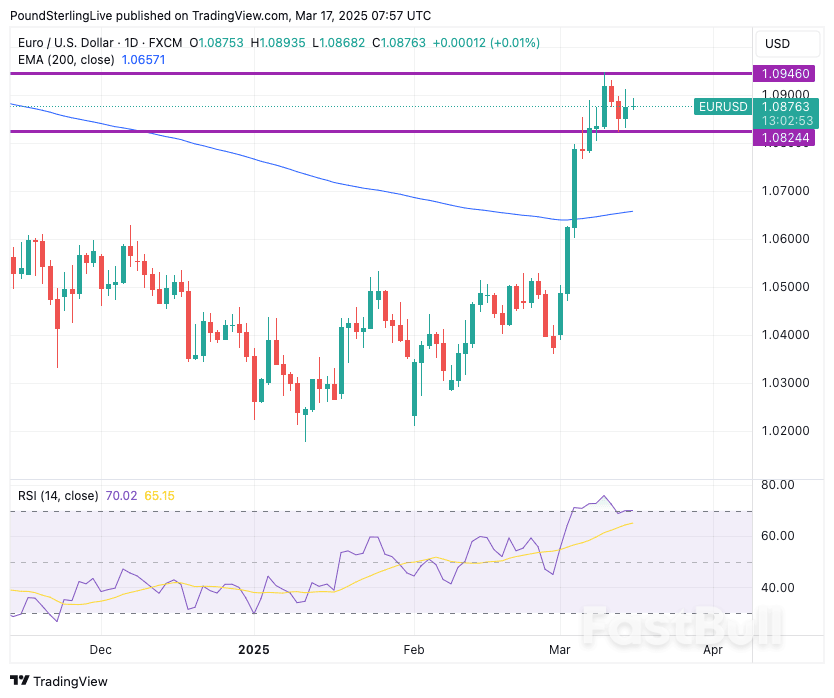
          The Euro-to-Dollar exchange rate's 2025 recovery accelerated last week, rising to its highest level since November on Tuesday, when it hit 1.0946.
          EUR/USD has broken above its 200-day moving average, shifting the exchange rate into an uptrend that advocates for a multi-week move higher.
          However, it became overbought on short-term timeframes with a Relative Strength Index (RSI) level tabove 70. It has since pared some of those gains as overbought conditions unwind and is quoted at 1.0878 at the start of the new week.
          For now, the pullback looks to be a consolidation in an uptrend as opposed to the start of a more protracted pullback.
          Dips are proving shallow, and the RSI is still pointed higher and advocating for more upside, even if it is still flirting with overbought conditions with a current reading of 70.
          The upside target for the week ahead is a retest of the 2025 high at 1.0946.
          Euro-to-Dollar Week Ahead Forecast: Lion's Share of Gains Complete_1

          Above: EURUSD at daily intervals.

          Support looks to be building at 1.0824, with three tests of this level recorded last week, suggesting this is where dips are being bought into.
          The overarching theme guiding price action in Euro-Dollar is the fading of the U.S. exceptionalism narrative that was so dominant in 2024, and this can continue.
          U.S. economic growth has slowed amidst policy uncertainty coming from the White House, with the April 02 tariff announcements being judged as a key risk.
          Markets judge that tariffs are unambiguously detrimental to the U.S. economic outlook, and the Dollar has struggled as Trump has pursued them.
          At the same time, Euro exchange rates have been bolstered by the unexpected shift in policy in Germany towards more spending in order to rejuvenate the country's infrastructure and defence sector.
          "The euro is benefiting from higher long-term yields and hopes for massive investment programmes. These could help to get the European (and especially the ailing German) economy back on track. After years of misery, this is finally a real glimmer of hope to stand up to the US dollar," says Birgit Henseler, an analyst at DZ Bank.
          The Euro found strength on Friday after it was confirmed that the Green Party are on board with incoming Chancellor Friedrich Merz's plans to borrow more to spend on defence and infrastructure.
          However, analysts warn of the potential for a more sober assessment of the outlook to emerge, which can weigh on the Euro.
          Davide Oneglia, analyst at TS Lombard, says the recent experience of the €100bn special fund for the German army shows that permitting new projects is a lengthy process in Germany.
          Currency analysts at Commerzbank warn the Euro could be set to fall "quite sharply" in the coming weeks as "euphoria" over Germany's spending plans are dealt a dose of reality.
          Commerzbank economists do not expect Germany's planned stimulus to have an effect until next year at the earliest. They also warn that Germany has historically struggled to spend, even when the money is made available.
          "This year, growth in the euro area could even be weaker if Trump follows through on his tariff announcements on EU imports in the near future. In short, we expect the EUR-USD exchange rate to fall quite sharply in the coming weeks," says Michael Pfister, FX Analyst at Commerzbank.
          U.S. tariffs on the EU remain a risk and could tip an export-oriented economy like Germany’s back into recession. This is according to a recent warning from Joachim Nagel, who serves as the President of the Deutsche Bundesbank and is a member of the Governing Council of the European Central Bank.
          While the charts suggest that the upside is preferred in the coming week, we think the lion's share of the rally is now complete, which is why the Week Ahead forecast is relatively contained.
          To be sure, the potential for a pullback is growing, but we're not confident that this is the week for it to happen.

          Source: Poundsterlinglive

          To stay updated on all economic events of today, please check out our Economic calendar
          Risk Warnings and Disclaimers
          You understand and acknowledge that there is a high degree of risk involved in trading. Following any strategies or investment methods may lead to potential losses. The content on the site is provided by our contributors and analysts for information purposes only. You are solely responsible for determining whether any trading assets, securities, strategy, or any other product is suitable for investing based on your own investment objectives and financial situation.
          Add to Favorites
          Share

          Crude Oil Prices Rise as Red Sea Tensions Intensify After US Strikes

          Warren Takunda

          Economic

          Crude oil prices jumped to their highest levels since 4 March following US military strikes on Yemen’s Houthi group at the Red Sea over the weekend.
          During the early Asian session, the West Texas Intermediate (WTI) futures at NYNEX rose as much as 1.5% to $68.19 per barrel, and the Brent futures at ICE jumped 1.42% to $71.58 per barrel before pulling back. The natural gas futures price also climbed nearly 1% to $4.14 per million British thermal units (MMBtu) during the same time frame.
          Additionally, China announced a special plan to boost domestic consumption, alongside a slew of positive economic data, adding to the demand optimism. China’s retail sales rose 4% in the first two months of this year, accelerating from a 3.7% increase in December.

          Houthi resumes Red Sea attacks

          The Red Sea and the Suez Canal are vital routes for oil and gas shipments between Europe, Asia, and North America. In late 2023, the Iran-backed Houthi group, designated as a Foreign Terrorist Organisation by the United States, launched attacks on commercial vessels in the Red Sea, following Israel’s retaliation against Hamas in Gaza. The Red Sea unrest had previously caused a surge in energy shipping costs, as oil and gas cargo shipments were forced to take longer routes. Last week, the group said it would resume attacks after the six-week ceasefire in Gaza as Israel halted all humanitarian aid.
          On Saturday, US President Donald Trump ordered military attacks on Houthi militia sites in Yemen in response to disruptions in shipping routes. He posted on the Truth Social that attacks on American vessels will not be tolerated. Pentagon chief Pete Hegseth said the US military strikes will be “unrelenting” until Houthis stops military attacks, during an interview on Fox News.

          Crude prices rebound from multi-year lows

          Earlier this month, crude prices fell to their lowest levels since November 2021 last week due to darkened economic outlooks amid an escalating global trade war. The ceasefire talks aimed at ending the war in Ukraine have also sparked concerns about a return of Russia’s production.
          In February, China imposed 10% levies on crude oil and 15% on liquified natural gas (LNG) from the US in response to Trump’s tariffs. Last week, Trump proceeded with a 10% tariff on Canadian oil. Meanwhile, the OPEC+ decided to start hiking its production by 138,000 barrels per day in April. These factors contributed to a plunge in crude prices, with both benchmarks experiencing sharp declines—Brent down 16% and WTI down 18% since mid-January.
          Last week, crude prices rebounded from their respective multi-year lows on news that the US will tighten sanctions on Iran. Iran accounts for 24% of the Middle East’s oil reserves and 12% of global reserves, according to the EIA. Its oil exports have increased since 2022, following Russia’s invasion of Ukraine, with current supply reaching 1.5 million barrels per day, or 1.4% of global production.
          Additionally, Russian President Vladimir Putin demands changes to the US ceasefire deal, also diminishing hopes for an immediate truce in the Ukraine war. A weakened US dollar and a potential oversold technical signal may have also supported the rebound.
          However, analysts expect the rebound in oil prices to be capped by economic concerns. “Lingering uncertainty over U.S. trade policy and mounting concerns about the economic outlook are capping risk appetite, limiting oil’s upside,” said Dilin Wu, a research analyst at Pepperstone.

          Oil supply to outpace demand in 2025

          However, the International Energy Agency warned last week that global oil supply could exceed demand by approximately 600,000 barrels per day in 2025, due to record production in the US and weakened demand amid rising global trade tensions, despite growing demand in China.
          US inventory data showed weekly stockpiles increased for six out of seven weeks since mid-January. Crude inventories rose by 1.45 million barrels in the week ending 7 March, following a 3.6 million build in the previous week. The US crude oil field production steadied at a near-record high of 13.58 million barrels per day in early March.

          Source: Euronews

          To stay updated on all economic events of today, please check out our Economic calendar
          Risk Warnings and Disclaimers
          You understand and acknowledge that there is a high degree of risk involved in trading. Following any strategies or investment methods may lead to potential losses. The content on the site is provided by our contributors and analysts for information purposes only. You are solely responsible for determining whether any trading assets, securities, strategy, or any other product is suitable for investing based on your own investment objectives and financial situation.
          Add to Favorites
          Share

          London Pre-Open: Stocks to Nudge Up Ahead of Busy Week of Central Bank Announcements

          Warren Takunda

          Stocks

          London stocks were set to nudge up at the open on Monday at the start of a busy week that includes a slew of central bank policy announcements, including the Bank of England, Bank of Japan and the US Federal Reserve.
          The FTSE 100 was called to open around five points higher.
          By Kathleen Brooks, research director at XTB, said: "Rarely is one man dominant for financial markets and for central banks, however, Donald Trump’s new economic policy means that he is centre stage as we wait to hear from a multitude of central bankers this week. Half of the G10 group of currencies have central bank meetings this week, including the Federal Reserve in the US, the Bank of England in the UK, the Bank of Japan, the Swiss National Bank and the Swedish Riksbank. Elsewhere, South Africa, Brazil, Russia and China will also announce their latest interest rate decisions.
          "The vast majority of central banks are expected to remain on hold. This week will be the first time that the world’s most important central bankers will collectively assess how President Trump’s trade policies will impact the global economy. We had a preview last week from ECB President Christine Lagarde, who said that there was a lot of uncertainty about the economic outlook, and that maintaining price stability in this ‘new era’ created by the US will be very hard for central bankers like herself.
          "This cautious tone is likely to be copied elsewhere, and only the Bank of Brazil is expected to raise interest rates this week, while the SNB in Switzerland is expected to cut rates. Rates in Brazil are expected to rise to a full percentage point to 14.25% from 13.25%, after annual inflation surged to 8.78% YoY in February, up from 7.27% in January, tariffs could add even more upward pressure to price growth.
          "The highlight of the week will undoubtedly be the Federal Reserve, which will announce its rate decision on Wednesday 19th March."
          In UK corporate news, defence contractor QinetiQ said it would take a £140m impairment charge as tough market conditions persisted into the fourth quarter, hitting work in its UK intelligence and US sectors resulting in further delays to a number of contract awards.
          It added that it had also identified a number of one-off, largely non-cash charges and provisions primarily relating to inventory and cost recovery in legacy US operations.
          Around £25-30m is included in updated underlying profit guidance for the year end and around £35-40m would be reported through exceptional items.
          AstraZeneca announced that it is spending up to $1bn to acquire Belgian biotech firm EsoBiotec, which it says has the potential to "transform" cell therapy.
          EsoBiotec’s in vivo delivery platform, administered through IV injection, is able to deliver genetic instructions to the T cells, programming them to recognise and attack cancer cells directly.
          The platform "empowers the immune system to attack cancers and could offer many more patients access to transformative cell therapy treatments delivered in just minutes rather than the current process which takes weeks", AstraZeneca said.

          Source: Sharecast

          Risk Warnings and Disclaimers
          You understand and acknowledge that there is a high degree of risk involved in trading. Following any strategies or investment methods may lead to potential losses. The content on the site is provided by our contributors and analysts for information purposes only. You are solely responsible for determining whether any trading assets, securities, strategy, or any other product is suitable for investing based on your own investment objectives and financial situation.
          Add to Favorites
          Share

          Asian Shares Advance After Wall St. Rallies to Its Best Day in Months, and China Reports Strong Data

          Warren Takunda

          Stocks

          Shares advanced Monday in Asia after U.S. stocks rallied to their best day since November’s election and China reported stronger than expected factory data.
          Chinese officials were due later in the day to brief reporters about Beijing’s efforts to get consumers to spend more. Economists say consumers must spend more to get the economy out of its doldrums, although most have advocated broader, more fundamental reforms to foster greater confidence and build their spending power.
          Hong Kong’s Hang Seng surged 1.3% to 24,276.64, and the Shanghai Composite index was up 0.6% at 3,429.30.
          China’s industrial output rose nearly 6% in the first two months of the year from a year earlier and retail sales were up 4%, the government reported Monday. But officials reported continued weakness in the property market, with home prices falling and investment in real estate down nearly 10% from a year earlier.
          In Tokyo, the Nikkei 225 index jumped 1.3% to 37,539.36, while the Kospi in Seoul leaped 1.7% to 2,608.68.
          Australia’s S&P/ASX 200 gained 0.6% to 7,838.20 and the Taiex in Taiwan was up 0.9%. Bangkok’s SET bucked the trend, falling 0.7%.
          On Friday, Wall Street’s roller coaster shot back upward, but not enough to keep the U.S. market from a fourth straight losing week, its longest such streak since August.
          The S&P 500 jumped 2.1% a day after closing more than 10% below its record for its first “ correction ” since 2023. It closed at 5,638.94.
          The U.S. stock market has been tumbling quickly since setting a record less than a month ago. The last time the index shot up that much was the day after President Donald Trump’s election, when Wall Street was focusing on the upsides of Trump’s return to the White House.
          The Dow Jones Industrial Average climbed 1.7%, to 41,488.19. The Nasdaq composite jumped 2.6% to 17,754.09.
          Ulta Beauty jumped 13.7% after the beauty products retailer reported stronger profit for the latest quarter than analysts expected.
          Gains for Big Tech stocks and companies in the artificial-intelligence industry also helped support the market. Such stocks have been under the most pressure in the recent sell-off after critics said their prices shot too high in the frenzy around AI.
          Nvidia rose 5.3% to trim its loss for 2025 so far below 10%. Apple climbed 1.8% to pare its loss for the week, which at one point had been on pace to be its worst since the 2020 COVID crash.
          It helped that the Senate made moves to prevent a possible partial shutdown of the U.S. government.
          But the heaviest uncertainty remains with Trump’s escalating trade war. There, the question is how much pain Trump will let the economy endure through tariffs and other policies in order to reshape the country and world as he wants. The president has said he wants manufacturing jobs back in the United States, along with a smaller U.S. government workforce and other fundamental changes.
          While stock prices may be close to finishing their reset to account for tariffs set to hit in April, Ma said concerns about how big an impact cutbacks in federal spending will have on the economy are “likely to remain for some time.”
          U.S. households and businesses have already reported drops in confidence because of all the uncertainties created by Trump’s barrage of on -again, off -again tariff announcements and other policies. That’s raised fears about a pullback in spending that could sap energy from the economy.
          Worries look to be only worsening among U.S. households, according to a preliminary survey released Friday by the University of Michigan. Its measure of consumer sentiment sank for a third straight month, mostly because of concerns about the future rather than complaints about the present. The job market and overall economy look relatively solid at the moment.
          In other dealings early Monday, U.S. benchmark crude oil gained 48 cents to $67.66 per barrel in electronic trading on the New York Mercantile Exchange.
          Brent crude, the international standard, added 49 cents to $71.07 per barrel.
          The U.S. dollar rose to 148.93 Japanese yen from 148.81 yen. The euro slipped to $1.0880 from $1.0882.

          Source: AP

          Risk Warnings and Disclaimers
          You understand and acknowledge that there is a high degree of risk involved in trading. Following any strategies or investment methods may lead to potential losses. The content on the site is provided by our contributors and analysts for information purposes only. You are solely responsible for determining whether any trading assets, securities, strategy, or any other product is suitable for investing based on your own investment objectives and financial situation.
          Add to Favorites
          Share

          March 17th Financial New

          FastBull Featured

          Daily News

          [Quick Facts]

          1. Houthi militants declare all U.S. aircraft carriers and naval vessels as targets
          2. Russian Official: 30-Day Ceasefire Proposal serves as a tactical respite for Ukrainian Forces
          3. Guindos: Current uncertainty exceeds the COVID-19 pandemic
          4. Germany unveils EUR500 billion fund fiscal blueprint, easing debt constraints
          5. The Washington, D.C. economy faces potential repercussions from federal workforce reductions
          6. Canadian Prime Minister Trudeau has formally resigned, ceasing his duties as the head of government
          7. U.S. consumer confidence fell for the third straight month, and one-year inflation expectations rose to the highest level in nearly two-and-a-half years

          [News Details]

          Houthi militants declare all U.S. aircraft carriers and naval vessels as targets
          On March 15, local time, U.S. President Donald Trump announced on his social media platform, "Truth Social," that he had ordered the U.S. military to take "decisive and forceful" military action against the Houthi militants. Trump stated that the Houthi attacks on U.S. vessels were "intolerable," and the U.S. would employ "overwhelming lethal force" until its objectives were achieved. The U.S. is currently conducting airstrikes against terrorist bases, leadership, and missile defense systems to safeguard American shipping, air, and naval assets, and to restore freedom of navigation. Trump warned that the Houthi attacks must cease.
          In response, on the evening of March 16, local time, Abdul-Malik al-Houthi, the leader of the Yemeni Houthi militants, declared that all U.S. aircraft carriers and naval vessels would be targeted by the Houthi forces, accusing the U.S. of turning the oceans into a battlefield and impacting international shipping lanes. He also indicated that the Houthi militants would escalate retaliatory measures if the U.S. continued its military actions against them.
          Russian Official: 30-Day ceasefire proposal serves as a tactical respite for Ukrainian Forces
          On March 16, a CCTV correspondent reported that according to Yuri Ushakov, aide to the Russian President, the 30-day ceasefire proposal concerning the Ukrainian conflict is merely intended to provide a strategic pause for the currently beleaguered Ukrainian military. Ushakov indicated that the ceasefire, proposed amidst the Russian military's ongoing advances across multiple fronts, could be interpreted as a maneuver to buy time for the Ukrainian forces to rearm and redeploy. Ushakov stated that Russia's position and concerns are well-documented, and have been communicated to the U.S.
          Guindos: Current uncertainty exceeds the COVID-19 pandemic
          European Central Bank Vice-President Luis de Guindos stated that the policies of U.S. President Trump have introduced greater economic uncertainty than during the COVID-19 pandemic. We must consider the uncertainty in the current environment, which is even higher than during the pandemic. We observe that the new U.S. administration is not entirely open to continuing multilateralism, which refers to cross-jurisdictional cooperation to find common solutions to shared problems. This represents a significant shift and a major source of uncertainty.
          Real wages have increased, inflation has decreased, interest rates have declined, and financing conditions have improved. However, the reality is that consumption has not rebounded. This is because consumers do not always react to the development of their short-term real disposable income. They also consider potential changes in the medium-term economy, which is overshadowed by uncertainty. The possibility of trade wars or broader geopolitical conflicts can impact consumer confidence.
          Germany unveils EUR500 billion fund fiscal blueprint, easing debt constraints
          On the 15th, Germany unveiled a fiscal proposal encompassing hundreds of billions of euros, advocating for the relaxation of the federal government's debt ceiling and the establishment of a special fund. This initiative aims to stimulate advancements in critical sectors such as infrastructure development, climate protection, and defense expenditures. The draft proposes amendments to the "debt brake" clause within Germany's Basic Law, with the revised government debt ceiling applicable to substantial outlays, including defense. Simultaneously, a special fund, totaling EUR500 billion, will be established through debt financing, earmarked for infrastructure projects like transportation and power grid enhancements.
          The Washington, D.C. economy faces potential repercussions from federal workforce reductions
          Economists have observed a surge in initial unemployment claims in the D.C. metropolitan area during February, possibly indicating job displacement due to outsourcing. Oxford Economics projects a reduction of 33,700 federal positions within the Washington metropolitan area by 2025. Allison Shrivastava, an economist at Indeed, cautions that the U.S. job market may struggle to absorb all displaced federal employees this year. The firm estimates that federal workforce reductions in the Washington metropolitan area will result in a US$4.9 billion loss in wages this year, given that federal employee compensation accounts for 1.6% of the region's total wages. The economic impact could be more severe when considering contractors and other groups indirectly reliant on government spending.
          The real estate market also suggests that more individuals may be leaving the metropolitan area during the Trump administration's workforce reduction period. Adam Kamins, director of regional economic research at Moody's, analyzes that consumer-facing sectors such as retail and hospitality have already begun to feel the downturn, with the economic impact expected to broaden later this year.
          Canadian Prime Minister Trudeau has formally resigned, ceasing his duties as the head of government
          On March 14, local time, Trudeau submitted his resignation to Governor-General Mary Simon. Reports indicate that Trudeau did not make a public appearance. Mark Carney, the newly elected leader of the Liberal Party of Canada, is scheduled to be sworn in later that day as Canada's 24th Prime Minister.
          U.S. consumer confidence fell for the third straight month, and one-year inflation expectations rose to the highest level in nearly two-and-a-half years
          The preliminary reading of the University of Michigan's Consumer Sentiment Index for March, released last Friday, registered at 57.9 (prior reading 64.7, forecast 63.1), marking the lowest level since July 2022 and representing a third consecutive month of decline.
          Furthermore, the preliminary estimate for 1-year inflation expectations was 4.9% (prior reading 4.3%, forecast 4.2%), the highest since the end of 2022; the preliminary estimate for 5-year inflation expectations was 3.9% (prior reading 3.5%, forecast 3.4%).
          These figures indicate a deepening of consumer unease regarding the economic outlook. Joanne Hsu, the director of the Surveys of Consumers at the University of Michigan, noted that many consumers cited uncertainties related to policy and other economic factors. The frequent fluctuations in economic policy make it difficult for consumers to make reasonable plans for the future, regardless of their political affiliations.
          The erosion of consumer confidence has triggered apprehension among investors, economists, and corporate executives, who anticipate that this instability could curtail consumer spending, thereby impeding economic expansion. The prevailing economic uncertainty is, in part, attributable to shifts in the Trump administration's policies, including tariff adjustments. Market participants are closely monitoring whether these policies will ultimately lead to a decoupling of consumer confidence and spending, resulting in more pronounced economic repercussions. The persistence of a downward trend in consumer expenditure remains to be seen, and if sustained, could further decelerate inflation, influencing the Federal Reserve's monetary policy decisions.

          [Today's Focus]

          UTC+8 20:30 U.S. Retail Sales Monthly Rate for February
          Risk Warnings and Disclaimers
          You understand and acknowledge that there is a high degree of risk involved in trading. Following any strategies or investment methods may lead to potential losses. The content on the site is provided by our contributors and analysts for information purposes only. You are solely responsible for determining whether any trading assets, securities, strategy, or any other product is suitable for investing based on your own investment objectives and financial situation.
          Add to Favorites
          Share
          FastBull
          Copyright © 2025 FastBull Ltd

          728 RM B 7/F GEE LOK IND BLDG NO 34 HUNG TO RD KWUN TONG KLN HONG KONG

          TelegramInstagramTwitterfacebooklinkedin
          App Store Google Play Google Play
          Products
          Charts

          Chats

          Q&A with Experts
          Screeners
          Economic Calendar
          Data
          Tools
          Membership
          Features
          Function
          Markets
          Copy Trading
          Latest Signals
          Contests
          News
          Analysis
          24/7
          Columns
          Education
          Company
          Careers
          About Us
          Contact Us
          Advertising
          Help Center
          Feedback
          User Agreement
          Privacy Policy
          Business

          White Label

          Data API

          Web Plug-ins

          Poster Maker

          Affiliate Program

          Risk Disclosure

          The risk of loss in trading financial instruments such as stocks, FX, commodities, futures, bonds, ETFs and crypto can be substantial. You may sustain a total loss of the funds that you deposit with your broker. Therefore, you should carefully consider whether such trading is suitable for you in light of your circumstances and financial resources.

          No decision to invest should be made without thoroughly conducting due diligence by yourself or consulting with your financial advisors. Our web content might not suit you since we don't know your financial conditions and investment needs. Our financial information might have latency or contain inaccuracy, so you should be fully responsible for any of your trading and investment decisions. The company will not be responsible for your capital loss.

          Without getting permission from the website, you are not allowed to copy the website's graphics, texts, or trademarks. Intellectual property rights in the content or data incorporated into this website belong to its providers and exchange merchants.

          Not Logged In

          Log in to access more features

          FastBull Membership

          Not yet

          Purchase

          Become a signal provider
          Help Center
          Customer Service
          Dark Mode
          Price Up/Down Colors

          Log In

          Sign Up

          Position
          Layout
          Fullscreen
          Default to Chart
          The chart page opens by default when you visit fastbull.com