• Trade
  • Markets
  • Copy
  • Contests
  • News
  • 24/7
  • Calendar
  • Q&A
  • Chats
Trending
Screeners
SYMBOL
LAST
BID
ASK
HIGH
LOW
NET CHG.
%CHG.
SPREAD
SPX
S&P 500 Index
6816.97
6816.97
6816.97
6861.30
6801.50
-10.44
-0.15%
--
DJI
Dow Jones Industrial Average
48360.24
48360.24
48360.24
48679.14
48285.67
-97.80
-0.20%
--
IXIC
NASDAQ Composite Index
23105.96
23105.96
23105.96
23345.56
23012.00
-89.20
-0.38%
--
USDX
US Dollar Index
97.950
98.030
97.950
98.070
97.740
0.000
0.00%
--
EURUSD
Euro / US Dollar
1.17461
1.17469
1.17461
1.17686
1.17262
+0.00067
+ 0.06%
--
GBPUSD
Pound Sterling / US Dollar
1.33709
1.33719
1.33709
1.34014
1.33546
+0.00002
0.00%
--
XAUUSD
Gold / US Dollar
4302.11
4302.45
4302.11
4350.16
4285.08
+2.72
+ 0.06%
--
WTI
Light Sweet Crude Oil
56.318
56.348
56.318
57.601
56.233
-0.915
-1.60%
--

Community Accounts

Signal Accounts
--
Profit Accounts
--
Loss Accounts
--
View More

Become a signal provider

Sell trading signals to earn additional income

View More

Guide to Copy Trading

Get started with ease and confidence

View More

Signal Accounts for Members

All Signal Accounts

Best Return
  • Best Return
  • Best P/L
  • Best MDD
Past 1W
  • Past 1W
  • Past 1M
  • Past 1Y

All Contests

  • All
  • Trump Updates
  • Recommend
  • Stocks
  • Cryptocurrencies
  • Central Banks
  • Featured News
Top News Only
Share

Goldman Sachs Says They Believe That The Copper Price Is Vulnerable To An Ai-Linked Price Correction

Share

Goldman Sachs Upgrades 2026 Copper Price Forecast To $11400 From $10,650

Share

Attempts By Ukrainian Troops To Advance From The South-West To Outskirts Of Kupiansk Are Being Thwarted

Share

Russian Troops Control All Of Kupiansk - IFX Cites Russian Military

Share

On Monday (December 15), The South Korean Won Ultimately Rose 0.60% Against The US Dollar, Closing At 1468.91 Won. The Won Was On An Upward Trend Throughout The Day, Rising Significantly At 17:00 Beijing Time And Reaching A Daily High Of 1463.04 Won At 17:36

Share

Health Ministry: Israeli Forces Kill Palestinian Teen In West Bank

Share

New York Federal Reserve President Williams: Over Time, The Size Of Reserves Could Grow From $2.9 Trillion

Share

New York Fed President Williams: AI Valuations Are High, But There Is A Real Driving Factor

Share

New York Federal Reserve President Williams: The Job Market Is In Very Good Shape

Share

New York Fed President Williams: 'Very Supportive' Of USA Central Bank's Decision To Cut Interest Rates Last Week

Share

New York Fed President Williams: 'Too Early To Say' What Central Bank Should Do At January Meeting

Share

New York Fed President Williams: Strong Markets Part Of Reason Why Economy Will Grow Robustly In 2026

Share

New York Fed President Williams: What Constitutes Ample Reserves Will Change Over Time

Share

New York Fed President Williams: Market Valuations 'Elevated,' But There Are Reasons For Pricing

Share

New York Fed President Williams: Ample Reserves System Working Very Well

Share

New York Fed President Williams: Some Signs That Parts Of Underlying Economy Not As Strong As GDP Data Suggests

Share

New York Fed President Williams: Expects Coming Job Data Will Show Gradual Cooling

Share

Ukraine President Zelenskiy: Monitoring Of Ceasefire Should Be Part Of Security Guarantees

Share

Ukraine President Zelenskiy: Ukraine Needs Clear Understanding On Security Guarantees Before Taking Any Decisions Regarding Frontlines

Share

U.S. Commerce Secretary Rutnick Praised Korea Zinc Co. Ltd., Stating That The United States Will Have Priority Access To The Company's Products In 2026

TIME
ACT
FCST
PREV
Japan Tankan Small Manufacturing Outlook Index (Q4)

A:--

F: --

P: --

Japan Tankan Large Non-Manufacturing Outlook Index (Q4)

A:--

F: --

P: --

Japan Tankan Large Manufacturing Outlook Index (Q4)

A:--

F: --

P: --

Japan Tankan Small Manufacturing Diffusion Index (Q4)

A:--

F: --

P: --

Japan Tankan Large-Enterprise Capital Expenditure YoY (Q4)

A:--

F: --

P: --

U.K. Rightmove House Price Index YoY (Dec)

A:--

F: --

P: --

China, Mainland Industrial Output YoY (YTD) (Nov)

A:--

F: --

P: --

China, Mainland Urban Area Unemployment Rate (Nov)

A:--

F: --

P: --

Saudi Arabia CPI YoY (Nov)

A:--

F: --

P: --

Euro Zone Industrial Output YoY (Oct)

A:--

F: --

P: --

Euro Zone Industrial Output MoM (Oct)

A:--

F: --

P: --

Canada Existing Home Sales MoM (Nov)

A:--

F: --

P: --

Canada National Economic Confidence Index

A:--

F: --

P: --

Canada New Housing Starts (Nov)

A:--

F: --

P: --
U.S. NY Fed Manufacturing Employment Index (Dec)

A:--

F: --

P: --

U.S. NY Fed Manufacturing Index (Dec)

A:--

F: --

P: --

Canada Core CPI YoY (Nov)

A:--

F: --

P: --

Canada Manufacturing Unfilled Orders MoM (Oct)

A:--

F: --

P: --

U.S. NY Fed Manufacturing Prices Received Index (Dec)

A:--

F: --

P: --

U.S. NY Fed Manufacturing New Orders Index (Dec)

A:--

F: --

P: --

Canada Manufacturing New Orders MoM (Oct)

A:--

F: --

P: --

Canada Core CPI MoM (Nov)

A:--

F: --

P: --

Canada Trimmed CPI YoY (SA) (Nov)

A:--

F: --

P: --

Canada Manufacturing Inventory MoM (Oct)

A:--

F: --

P: --

Canada CPI YoY (Nov)

A:--

F: --

P: --

Canada CPI MoM (Nov)

A:--

F: --

P: --

Canada CPI YoY (SA) (Nov)

A:--

F: --

P: --

Canada Core CPI MoM (SA) (Nov)

A:--

F: --

P: --

Canada CPI MoM (SA) (Nov)

A:--

F: --

P: --

Federal Reserve Board Governor Milan delivered a speech
U.S. NAHB Housing Market Index (Dec)

A:--

F: --

P: --

Australia Composite PMI Prelim (Dec)

--

F: --

P: --

Australia Services PMI Prelim (Dec)

--

F: --

P: --

Australia Manufacturing PMI Prelim (Dec)

--

F: --

P: --

Japan Manufacturing PMI Prelim (SA) (Dec)

--

F: --

P: --

U.K. 3-Month ILO Employment Change (Oct)

--

F: --

P: --

U.K. Unemployment Claimant Count (Nov)

--

F: --

P: --

U.K. Unemployment Rate (Nov)

--

F: --

P: --

U.K. 3-Month ILO Unemployment Rate (Oct)

--

F: --

P: --

U.K. Average Weekly Earnings (3-Month Average, Including Bonuses) YoY (Oct)

--

F: --

P: --

U.K. Average Weekly Earnings (3-Month Average, Excluding Bonuses) YoY (Oct)

--

F: --

P: --

France Services PMI Prelim (Dec)

--

F: --

P: --

France Composite PMI Prelim (SA) (Dec)

--

F: --

P: --

France Manufacturing PMI Prelim (Dec)

--

F: --

P: --

Germany Services PMI Prelim (SA) (Dec)

--

F: --

P: --

Germany Manufacturing PMI Prelim (SA) (Dec)

--

F: --

P: --

Germany Composite PMI Prelim (SA) (Dec)

--

F: --

P: --

Euro Zone Composite PMI Prelim (SA) (Dec)

--

F: --

P: --

Euro Zone Services PMI Prelim (SA) (Dec)

--

F: --

P: --

Euro Zone Manufacturing PMI Prelim (SA) (Dec)

--

F: --

P: --

U.K. Services PMI Prelim (Dec)

--

F: --

P: --

U.K. Manufacturing PMI Prelim (Dec)

--

F: --

P: --

U.K. Composite PMI Prelim (Dec)

--

F: --

P: --

Euro Zone ZEW Economic Sentiment Index (Dec)

--

F: --

P: --

Germany ZEW Current Conditions Index (Dec)

--

F: --

P: --

Germany ZEW Economic Sentiment Index (Dec)

--

F: --

P: --

Euro Zone Trade Balance (Not SA) (Oct)

--

F: --

P: --

Euro Zone ZEW Current Conditions Index (Dec)

--

F: --

P: --

Euro Zone Trade Balance (SA) (Oct)

--

F: --

P: --

Euro Zone Total Reserve Assets (Nov)

--

F: --

P: --

U.K. Inflation Rate Expectations

--

F: --

P: --

Q&A with Experts
    • All
    • Chatrooms
    • Groups
    • Friends
    Connecting
    .
    .
    .
    Type here...
    Add Symbol or Code

      No matching data

      All
      Trump Updates
      Recommend
      Stocks
      Cryptocurrencies
      Central Banks
      Featured News
      • All
      • Russia-Ukraine Conflict
      • Middle East Flashpoint
      • All
      • Russia-Ukraine Conflict
      • Middle East Flashpoint
      Search
      Products

      Charts Free Forever

      Chats Q&A with Experts
      Screeners Economic Calendar Data Tools
      Membership Features
      Data Warehouse Market Trends Institutional Data Policy Rates Macro

      Market Trends

      Market Sentiment Order Book Forex Correlations

      Top Indicators

      Charts Free Forever
      Markets

      News

      News Analysis 24/7 Columns Education
      From Institutions From Analysts
      Topics Columnists

      Latest Views

      Latest Views

      Trending Topics

      Top Columnists

      Latest Update

      Signals

      Copy Rankings Latest Signals Become a signal provider AI Rating
      Contests
      Brokers

      Overview Brokers Assessment Rankings Regulators News Claims
      Broker listing Forex Brokers Comparison Tool Live Spread Comparison Scam
      Q&A Complaint Scam Alert Videos Tips to Detect Scam
      More

      Business
      Events
      Careers About Us Advertising Help Center

      White Label

      Data API

      Web Plug-ins

      Affiliate Program

      Awards Institution Evaluation IB Seminar Salon Event Exhibition
      Vietnam Thailand Singapore Dubai
      Fans Party Investment Sharing Session
      FastBull Summit BrokersView Expo
      Recent Searches
        Top Searches
          Markets
          News
          Analysis
          User
          24/7
          Economic Calendar
          Education
          Data
          • Names
          • Latest
          • Prev

          View All

          No data

          Scan to Download

          Faster Charts, Chat Faster!

          Download App
          English
          • English
          • Español
          • العربية
          • Bahasa Indonesia
          • Bahasa Melayu
          • Tiếng Việt
          • ภาษาไทย
          • Français
          • Italiano
          • Türkçe
          • Русский язык
          • 简中
          • 繁中
          Open Account
          Search
          Products
          Charts Free Forever
          Markets
          News
          Signals

          Copy Rankings Latest Signals Become a signal provider AI Rating
          Contests
          Brokers

          Overview Brokers Assessment Rankings Regulators News Claims
          Broker listing Forex Brokers Comparison Tool Live Spread Comparison Scam
          Q&A Complaint Scam Alert Videos Tips to Detect Scam
          More

          Business
          Events
          Careers About Us Advertising Help Center

          White Label

          Data API

          Web Plug-ins

          Affiliate Program

          Awards Institution Evaluation IB Seminar Salon Event Exhibition
          Vietnam Thailand Singapore Dubai
          Fans Party Investment Sharing Session
          FastBull Summit BrokersView Expo

          Bitcoin Price Shows Weakness, But New BTC Whales Have Created Solid Support At $56,400

          Samantha Luan

          Cryptocurrency

          Summary:

          Bitcoin’s realized capitalization data shows nearly 50% of realized cap is dominated by short-term holders, new investors.
          Bitcoin (BTC) price downside momentum continues to gain strength, giving sidelined and late bulls a chance to buy the dip. The market remains focussed on the oncoming halving, expected to kick off the next bull cycle. For the meantime, however, spot BTC ETFs remain the main play in the market.

          New Bitcoin whales have created solid support at $56,400

          Bitcoin price is down a fraction in the last day with trading volume dropping nearly 20%. It continues to slide lower after losing critical support due to the midline of the ascending parallel channel. Amid falling buying pressure, BTC is likely to provide a lower buying opportunity before the next leg up.
          With reports that spot BTC exchange-traded funds (ETFs) raked in more than $2.5 billion dollars in net inflows last week alone, ascribed to institutional FOMO, their buyer congestion level could be the pivot BTC is looking for before a trend reversal.
          Ki Young Ju, founder and CEO at CryptoQuant, indicates the new whales bought Bitcoin at $56,400 on average mostly via spot ETFs, whereas the old whales, who acquired BTC pre- spot Bitcoin ETFs, entered near $21,300.
          The new TradFi whales include customers of BlackRock and Fidelity. As different generations of whales foray into the BTC market at various price points, the diversity in investment strategies and perspectives within the crypto space becomes apparent.
          In a March 17 report by CryptoQuant, researchers determined, “The enthusiasm and accumulation of Bitcoin by new investors have sharply increased” during the recent month, with short-term holders only holding just about 48% of the Realized Cap distribution in the Bitcoin market.
          While this increase is bullish for BTC, it also points to the likelihood of a correction once these short-term holders decide it is time to sell.

          Bitcoin price outlook with BTC fate in the hands of short-term holders

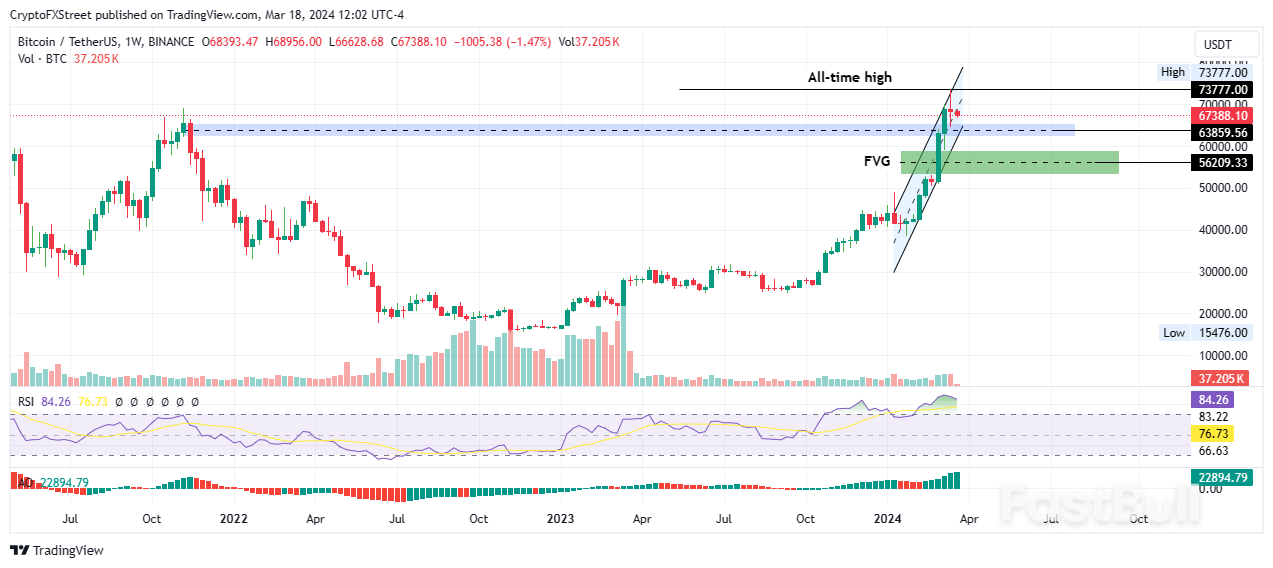
          Bitcoin price has breached a key support, flipping the midline of the ascending channel into resistance. The market is leaning toward the downside in the short term, providing sidelined investors a low entry point as the countdown to the halving continues, approximately 31 days out.
          The Relative Strength Index (RSI) is leaning south, forming a dome to signify falling momentum. Coupled with the dwindling size of the volume indicator, this shows that the upward trajectory is losing steam.
          Nevertheless, Welles Wilders, the father of several technical indicators, says an asset is only ripe for selling when the RSI crosses below 70. Traders with current open long positions for BTC should probably leave them open as the upside potential remains viable.
          Those looking to open new long positions, however, should probably exercise caution as the overbought status, seen with the RSI above 70, puts Bitcoin price in high risk of an extended fall.
          If BTC price slips below the $63,859 mean threshold, it could roll over to the weekly imbalance extending from $59,005 to $52,985. Notice that Young Ju’s $56,400 buyer congestion level falls within this range.Bitcoin Price Shows Weakness, But New BTC Whales Have Created Solid Support At $56,400_1
          Conversely, if traders looking to buy the correction decide it is now time to enter, the ensuing buying pressure could send Bitcoin price north. Flipping the midline of the channel back into support could set the tone for a continuation, with Bitcoin price likely to reclaim the $73,777 peak on Binance Exchange.
          In a highly bullish case, the gains could extend to $75,000 or higher to set a new all-time high at $80,000. Such a move would denote a 20% move above current levels.
          Even as the $80,000 target seems likely for Bitcoin price with the oncoming halving, Standard Chartered has presented an overly ambitious target of $150,000 for BTC this year and $250,000 by 2025.

          Source:FXStreet

          Risk Warnings and Disclaimers
          You understand and acknowledge that there is a high degree of risk involved in trading. Following any strategies or investment methods may lead to potential losses. The content on the site is provided by our contributors and analysts for information purposes only. You are solely responsible for determining whether any trading assets, securities, strategy, or any other product is suitable for investing based on your own investment objectives and financial situation.
          Add to Favorites
          Share

          Closing Gap: Japan's Benchmark Index Aligns with Nikkei 225 as Era of Negative Rates Concludes

          Ukadike Micheal

          Economic

          Stocks

          Following the decision to raise interest rates for the first time since 2007, Japan's benchmark Topix index surged by 0.6 percent on Tuesday, narrowing the gap with its exporter-oriented counterpart, the Nikkei 225 index. This move, announced by the country's central bank, signified a notable shift in monetary policy after years of ultra-low interest rates aimed at stimulating economic growth. Investors, both domestic and international, closely watched the market reaction, anticipating potential impacts on various sectors of the Japanese economy.
          The Topix index, representing a broader spectrum of Japanese stocks, experienced gains as investors responded positively to the central bank's decision. Conversely, the Nikkei 225 index, comprised predominantly of export-driven companies, remained flat, reflecting concerns about the potential impact of higher borrowing costs on these sectors.
          The yen, which has maintained multi-decade lows, depreciated further against the US dollar, dropping by 0.6 percent to ¥150.02. This decline in the currency value continues to benefit Japan's exporters, which are predominantly represented in the Nikkei 225 index. A weaker yen makes Japanese goods more competitive in international markets, boosting the profitability of export-oriented companies.
          From a technical perspective, the decision by Japan's central bank to raise interest rates marks a significant shift in monetary policy. For years, the bank pursued an accommodative monetary stance, including negative interest rates and large-scale asset purchases, to combat deflationary pressures and stimulate economic growth. However, with signs of inflationary pressures building and concerns about financial stability, the bank deemed it necessary to begin tightening monetary policy.
          The move is likely to have implications for various sectors of the economy, particularly those sensitive to changes in borrowing costs and exchange rates. Export-oriented industries, which have thrived in the low-interest-rate environment and favorable currency conditions, may face challenges adjusting to higher borrowing costs. The cost of financing operations and capital investments could increase, potentially impacting profit margins and investment decisions.
          However, a stronger domestic economy driven by increased consumer spending could offset some of these effects. Higher interest rates may encourage saving and investment, leading to a more balanced market environment. Domestic-focused sectors such as retail, real estate, and services could benefit from improved consumer confidence and spending, contributing to overall economic growth.
          Investors are closely monitoring the impact of this policy change on stock market dynamics, particularly the performance of the Nikkei 225 index relative to the broader Topix index. While exporters may experience short-term volatility as they adapt to changing conditions, the long-term outlook for Japan's equity market remains positive, supported by improving economic fundamentals.
          The narrowing gap between Japan's benchmark indices following the central bank's decision reflects the complex interplay between monetary policy, currency dynamics, and sectoral performance. While challenges lie ahead for export-driven industries, the broader market sentiment remains optimistic, underscoring the resilience of Japan's economy in the face of changing global conditions. Investors should remain vigilant and adapt their strategies accordingly to navigate the evolving market landscape.

          Source: Financial Times

          To stay updated on all economic events of today, please check out our Economic calendar
          Risk Warnings and Disclaimers
          You understand and acknowledge that there is a high degree of risk involved in trading. Following any strategies or investment methods may lead to potential losses. The content on the site is provided by our contributors and analysts for information purposes only. You are solely responsible for determining whether any trading assets, securities, strategy, or any other product is suitable for investing based on your own investment objectives and financial situation.
          Add to Favorites
          Share

          [RBA] March Rate Decision: Keeping Interest Rates Unchanged for Three Consecutive Times

          FastBull Featured

          Remarks of Officials

          The Reserve Bank of Australia (RBA) decided to leave the cash rate target unchanged at 4.35% at its March policy meeting on March 19, local time. The Monetary Policy Statement showed:
          Inflation continues to moderate but remains high. Driven by moderating goods inflation, the headline inflation was eased over recent months, but services inflation remains elevated. At present, there is a continuous surplus of economic demand, and the cost pressure on domestic labor and non-labor input is greater.
          Conditions in the labor market continue to ease gradually, although they remain tight. Wages growth appears to have peaked with indications it will moderate over the year ahead. Inflation is still weighing on people’s real incomes and household consumption growth is weak.
          Although inflation is moderating, the economic outlook remains uncertain. After recent declines, real incomes have stabilized and are expected to grow from here, which is expected to support growth in consumption later in the year. Growth in unit labor costs remains very high. It has begun to moderate slightly as measured productivity growth has picked up but whether this trend will be sustained is uncertain.
          The central forecasts are for inflation to return to the target range of 2–3 per cent in 2025, and to the midpoint in 2026. Services price inflation is expected to decline gradually as demand moderates and growth in labor and non-labor costs eases. Employment is expected to continue to grow moderately, and the unemployment rate is expected to increase a bit further.
          To date, medium-term inflation expectations have been consistent with the inflation target, but the rate path of returning inflation to target within a reasonable timeframe remains uncertain. The Board is not ruling anything in or out. The Board will rely upon the data and the evolving assessment of risks.

          RBA March Rate Decision

          Risk Warnings and Disclaimers
          You understand and acknowledge that there is a high degree of risk involved in trading. Following any strategies or investment methods may lead to potential losses. The content on the site is provided by our contributors and analysts for information purposes only. You are solely responsible for determining whether any trading assets, securities, strategy, or any other product is suitable for investing based on your own investment objectives and financial situation.
          Add to Favorites
          Share

          Italian Bond Party Turns Blind Eye to Deficit Disasters

          Kevin Du

          Economic

          Central Bank

          Bond

          'Don't worry, be happy' sums up the current approach of financial markets to Italian debt, with investors determined to lock in high returns on Rome's government bonds and turning a blind eye as its public finances veer out of control.
          The budget deficit in the euro zone's third largest economy stood at 7.2% of output last year, data showed this month, more than double the estimated average of 3.2% for the 20-nation bloc and massively overshooting for a second consecutive year.
          Yet the gap between the yield on Italy's sovereign bonds and equivalent German paper - a closely-watched sign of investor confidence in riskier Italian assets - narrowed last week to 1.15 percentage points (115 basis points), a 26-month low.
          So what is going on, and how long will it last?
          Most analysts say the outperformance of Italy's bonds is driven mainly by interest rate expectations and European Central Bank policy, and has little to do with Rome's economy and public finances.
          "The spread keeps tightening as investors rush to lock in yields close to levels not seen for over a decade," said Erjon Satko, rate strategist at BofA.
          With markets pricing in ECB interest rate cuts from June, potential buyers are lured by the returns still offered by Italian BTP bonds and see country risk capped by the prospect of ECB measures to reduce spreads if needed.
          The central bank has never used its Transmission Protection Instrument introduced in July 2022 to avoid market fragmentation, but the very presence of the backstop is driving investor behaviour.
          "We are now in what I call a nationalisation of the European bond market where a market maker - the ECB - can potentially stop any speculation against sovereign debt," said Christopher Dembik, senior investment advisor at Pictet AM.
          "Investors know it's always a bad idea to bet against a central bank ... we are in a completely new paradigm, a new world," he said, adding the market will continue to ignore Italy's fundamentals for the foreseeable future.

          DEBT WARNINGS

          Some other analysts are less upbeat. Commerzbank said in a note to clients on Friday Italy's bond rally is likely to peter out in the second half of the year due to a worsening outlook for growth and public debt.
          Citibank also warned this month that the recent decline in Italy's debt-to-GDP ratio, which has helped reassure investors Rome is a safe bet, "is bound to ease, if not reverse, in the coming years due to stubbornly high funding needs."
          At 2.9 trillion euros ($3.16 trillion), Rome's debt is one of the largest in the world, amounting to 137% of gross domestic product at the end of last year, the second highest ratio in the euro zone after Greece's.
          Despite this debt mountain, as soon as Prime Minister Giorgia Meloni took office in 2022 she hiked the following year's budget deficit target to 4.5% of GDP from the 3.4% goal she inherited from her predecessor, former ECB chief Mario Draghi.
          The fiscal gap eventually came in at 7.2%.
          The ratios from 2020-2023 were an eye-watering 9.4%, 8.7%, 8.6% and 7.2%, levels not seen in Italy since the mid-1990s.
          Yet markets, which in previous years hammered Rome at the slightest hint of fiscal ill discipline, totally shrugged off this month's 39-billion-euro deficit miss.
          "If we had had a negative surprise like this a year and a half ago, while interest rates were rising, it could have had a different impact," said Filippo Mormando, fixed income strategist at Spanish bank BBVA.

          GREEN SUBSIDIES BREAK THE BANK

          The main reason for Rome's deficit overshoots is a tax relief scheme for green home improvements that has proved infinitely more costly than anticipated.
          Introduced in 2020, the so-called 'Superbonus' was originally supposed to cost 35 billion euros over 15 years, but the Treasury now estimates a staggering 150 billion euros have already been spent.
          Most worrying is that the scheme will weigh on public accounts through 2035 as beneficiaries continue to deduct the building work from their tax bills, exerting steady upward pressure on the public debt.
          Italy's debt-GDP measure has declined from a 2020 peak due to the post-pandemic growth rebound and the surge in inflation. Both factors have now all but disappeared.
          "The debt ratio is likely to increase significantly from now on without a noticeable reduction in the budget deficit," said Commerzbank analyst Marco Wagner.
          Analysts see Italian growth of just 0.7% this year, versus Rome's official 1.2% forecast.
          Yet for now, even if they are dancing on an Italian Titanic, bond investors seem determined to keep on dancing.
          "We are in a cycle of portfolio adjustment that began at the end of last year and will last for weeks if not months," said BBVA's Mormando. "That means there will continue to be plenty of buyers of Italian debt."

          Source: Reuters

          To stay updated on all economic events of today, please check out our Economic calendar
          Risk Warnings and Disclaimers
          You understand and acknowledge that there is a high degree of risk involved in trading. Following any strategies or investment methods may lead to potential losses. The content on the site is provided by our contributors and analysts for information purposes only. You are solely responsible for determining whether any trading assets, securities, strategy, or any other product is suitable for investing based on your own investment objectives and financial situation.
          Add to Favorites
          Share

          RBA Keeps Interest Rates on Hold at 4.35pc But Says 'It Will Be Some Time' Before Inflation within Target Band

          Devin

          Central Bank

          Economic

          The Reserve Bank has left interest rates on hold amid signs that growth in the economy has dramatically slowed down following 13 interest rate rises since May 2022.
          The cash rate remains at 4.35 per cent, and while the central bank gave no clear indication of where it was headed next, saying it was "not ruling anything in or out", many economists are predicting the RBA will start cutting interest rates in the second half of this year as inflation continues to moderate.
          Some have pushed out their forecasts for rate cuts to November.
          Based on an average variable rate of 6.39 per cent for a loan over 25 years, the impact of 13 rate hikes since May 2022 has taken monthly repayments on a $500,000 loan up by $1,210 a month, and those on a $750,000 loan up by $1,815 a month.
          If the RBA does cut the cash rate later this year, and the banks pass this rate cut on in full, then someone with a $500,000 mortgage with 25 years remaining would see their monthly repayments go down by $76 in the first cut and by $152 if there were two cuts.
          While there is no certainty about when interest rates may fall, there are fears the impact of previous rate rises may slow down the economy more than anticipated.
          The Reserve Bank, the federal government and Treasury have spent much of the past two years focused on fighting inflation, but now the challenge is to ensure that growth doesn’t slow down so forcefully that it tips Australia into a recession.
          On a per person basis – that is accounting for population growth - the economy has plunged deeper into a per-person recession.

          RBA says it's 'not ruling anything in or out'

          In its statement today explaining why the board decided to leave the cash rate unchanged, the RBA noted "inflation continues to moderate but remains high".
          It said "while there are encouraging signs that inflation is moderating, the economic outlook remains uncertain" and the "Board needs to be confident that inflation is moving sustainably towards the target range".
          To date, medium-term inflation expectations have been consistent with the inflation target and it is important that this remains the case.
          It said the central bank's forecasts were for inflation to return to the target range of 2 to 3 per cent in 2025, and to the midpoint in 2026.
          "The Board expects that it will be some time yet before inflation is sustainably in the target range," it said.
          "The path of interest rates that will best ensure that inflation returns to target in a reasonable time frame remains uncertain and the Board is not ruling anything in or out."
          "The Board will rely upon the data and the evolving assessment of risks," it said, adding that it "remains resolute in its determination to return inflation to target".
          NAB's head of market economics, Tapas Strickland, said the statement read "less hawkish" and the RBA was unlikely to move to cut rates until later in the year.
          NAB expects the first rate cut in November 2024, with a gradual cutting cycle to 3.1 per cent by end 2025.
          "There was nothing in today’s post-meeting statement to suggest a real possibility of a rate cut in first quarter 2024, with a late second quarter 2024 cut more realistic," he said.
          "Governor Michelle Bullock in recent parliamentary testimony noted it would be good to have a couple of quarters of inflation prints to be more confident, which assuming activity remains resilient, puts the first rate cut in late 2024."
          He said the RBA was indicating an "optionality, rather than an outright bias to hike".
          UBS economists also don't expect the RBA will start cutting until November.
          "UBS also still expect the first rate cut of 25 basis points in November, followed by a relatively slow easing cycle of 25 basis points per quarter, to 3.10 by the end of 2025," UBS said in an economic note released after the rates decision.
          "This reflects our view that domestic/wage inflation will be somewhat sticky amid ongoing booming public demand, large increases in wages for the regulated and public sectors, likely significant additional fiscal stimulus .. due around mid-2024 plus large household tax cuts from July."
          But CBA's head of Australian economics Gareth Aird said they expect rate cuts a bit sooner in September.
          "We have 75 basis points of rate cuts in our profile in late 2024 and a further 75 basis point of easing in the first quarter of 2025, which would take the cash rate to 2.85 per cent," he said.

          Signs of a slowing economy

          The RBA said there were indications of a slowing economy, but that "inflation is still weighing on people's real incomes and household consumption growth is weak, as is dwelling investment."
          However, higher interest rates were "working to establish a more sustainable balance between aggregate demand and supply in the economy".
          It said, "real incomes have stabilised and are expected to grow from here, which is expected to support growth in consumption later in the year."
          Services price inflation would decline gradually as demand moderates, while unemployment would increase.
          "Domestically, there are uncertainties regarding the lags in the effect of monetary policy and how firms' pricing decisions and wages will respond to the slower growth in the economy at a time of excess demand, and while the labour market remains tight," it said.
          "Accordingly, conditions in the labour market continue to ease gradually," it said.
          Wages growth, it said, appears to have peaked "with indications it will moderate over the year ahead".
          There was still also a high level of uncertainty around the outlook for the Chinese economy and the implications of ongoing conflicts in Ukraine and the Middle East.

          Source: ABC News

          To stay updated on all economic events of today, please check out our Economic calendar
          Risk Warnings and Disclaimers
          You understand and acknowledge that there is a high degree of risk involved in trading. Following any strategies or investment methods may lead to potential losses. The content on the site is provided by our contributors and analysts for information purposes only. You are solely responsible for determining whether any trading assets, securities, strategy, or any other product is suitable for investing based on your own investment objectives and financial situation.
          Add to Favorites
          Share

          China's Bonds Boom as Investors Face 'Asset Famine'

          Devin

          Bond

          Economic

          Yields at the longer end of China's bond market have been crunched to record lows by the weight of available money, and bankers say savings bonds are selling out almost instantly to retail investors who queue up outside branches before dawn.
          The moves are welcome for borrowers, especially the central government which is paying just 3% interest on 30-year debt.
          But they also illustrate the fragility of economic expectations - because traders see further rate cuts ahead - and of confidence, given investors of all stripes are plunging into safe financial products instead of more productive assets.
          Batches of savings bonds were "gone in seconds", said a state banker in Shanghai, thanks to three-year rates of 2.38%, which are only marginally better than term deposit rates.
          Thirty-year Chinese government bond yields are down nearly 40 basis points this year, hitting a record low of below 2.4% in March. They came within a whisker of dropping below 10-year yields, which also have hit 22-year troughs.
          China has been trying for years to nudge money out of banks and into growth assets with measures such as rate cuts. But those efforts have been met with resistance as a downturn in real estate has sapped appetite for all but the safest investments.
          One Shanghai bond brokerage trader described the situation as an "asset famine," with very little else for financial institutions to buy while deposits soar and loan growth slides.
          Both the trader and the banker requested anonymity as they are not authorised to speak publicly.
          The bond trader noted that much of the demand at the longer end was from financial institutions looking for somewhere to park deposits that nobody wants to borrow. Data published last week showed lending growth at a record low 10.1% in February.
          Chinese banks held a record 291 trillion yuan ($40 trillion) on deposit at the end of February, according to central bank data, and deposit growth is outpacing loans.
          Foreign investors have been buyers too, but own less than 3% of the market and do not tend to drive price movements.
          Analysts such as ANZ senior strategist Xing Zhaopeng said recent central bank market operations to drain cash from the banking system by declining to roll over policy loans showed authorities were aware of the cash logjam.
          A net 94 billion yuan was withdrawn through a central bank's bond instrument from the banking system in March - China's first such move since 2022.
          "The move echoed (wording in this year's) annual government work report to 'avoid idling funds stuck' in the banking system," said Xing, referring to a phrase last mentioned in 2020's report.
          China's central bank also said this month it made a routine survey of rural lenders' bond books to "guide... focus on their main responsibilities", including rural areas and small businesses.
          To be sure, the prices allow the central government to secure long-term funding at low cost, which it can use to benefit the country, and issuances are expected to steady the market.
          Yet low rates complicate efforts to support the yuan and has analysts wary - if not yet worried - of a market that's becoming inflated by so much money looking for a home.
          "With long duration positions congested and curves flat, we are cautious near term," said Ju Wang, head of greater China FX and rates strategy at BNP Paribas. "Medium-term, a correction in China bonds could offer opportunities to re-load duration longs as (the) monetary easing cycle is not over."

          Source: Reuters

          To stay updated on all economic events of today, please check out our Economic calendar
          Risk Warnings and Disclaimers
          You understand and acknowledge that there is a high degree of risk involved in trading. Following any strategies or investment methods may lead to potential losses. The content on the site is provided by our contributors and analysts for information purposes only. You are solely responsible for determining whether any trading assets, securities, strategy, or any other product is suitable for investing based on your own investment objectives and financial situation.
          Add to Favorites
          Share

          Bond Market Sees Inflation as A Wild Card for Easing Timetable at Fed Meeting

          Cohen

          Central Bank

          Economic

          Bond

          While bond investors expect the U.S. Federal Reserve to keep rates unchanged at its policy announcement on Wednesday, the market reaction could hinge on what Fed officials indicate about stubborn inflation and if their signals get more hawkish about the timing and extent of any easing this year.
          Stronger-than-expected economic growth and stickier inflation this year has led investors to push back expectations on the U.S. central bank's first rate cut to June, from May, and reduce bets on how many cuts are likely this year.
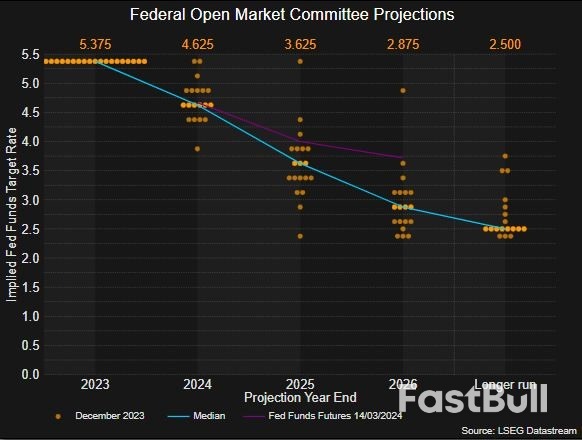
          Traders are now pricing in three 25 basis points cuts, in line with Fed policymakers' median expectations made in December. The Fed is due to give updated economic projections and refresh its "dot plot" graphing policymakers' interest rate projections at the meeting.
          "What will be really interesting to see is if the Fed is still comfortable in the dot plots to still be showing the possibility of three rate cuts for this year," said Matt Eagan, head of the full direction team at Loomis, Sayles & Co. "Or will they start to say we've got to push back against this a little bit longer."
          Bond Market Sees Inflation as A Wild Card for Easing Timetable at Fed Meeting_1Benchmark 10-year Treasury yields rose to a near one-month high of 4.328% on Monday and have jumped from 4.052% a week ago as traders adjust for the possibility of a more hawkish Fed.
          The Fed pivoted to a more dovish outlook in December on growing confidence that inflation was on track to its 2% annual target.
          Inflation has since picked up, though analysts note that recent hotter-than-expected consumer and producer price index reports likely reflected seasonal factors.
          Powell said after the Fed's January meeting that the central bank wants more confidence that inflation will continue to decline before cutting rates.
          "The Fed doesn't want to break anything," said Padhraic Garvey, regional head of research, Americas at ING, adding that when inflation gets closer to 2% the Fed will likely "use that opportunity as one to get rates off the highs."
          In the meantime, the Fed may caution about the prospect of near-term rate cuts.
          "The main focus is which way they lean," said Stephen Gola, head of U.S. Treasuries Sales & Trading at StoneX Group.
          An unexpected uptick in unemployment last month could keep the Fed circumspect on growth, offsetting some of the inflation concerns.
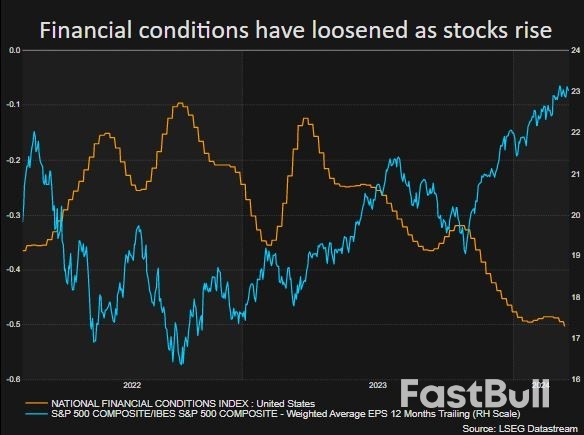
          Another possibility is that Powell could adopt a more hawkish tone by referencing loose financial conditions as stock markets hit records and corporate credit draws enthusiastic demand.
          "He didn't say it (in January) but stocks have only gone higher and I think they're going to struggle to achieve what they want to achieve as long as that's the case," Gola said.
          Powell in November cited financial conditions when higher Treasury bond yields, mortgage rates and other financing costs were having a tightening impact on the economy. His comments were interpreted as potentially leading the Fed to hike rates less than expected.Bond Market Sees Inflation as A Wild Card for Easing Timetable at Fed Meeting_2

          How Much More QT?

          The Fed may also signal that it is getting closer to tapering its quantitative tightening (QT) program, in which it allows bonds to roll off its balance sheet without replacement.
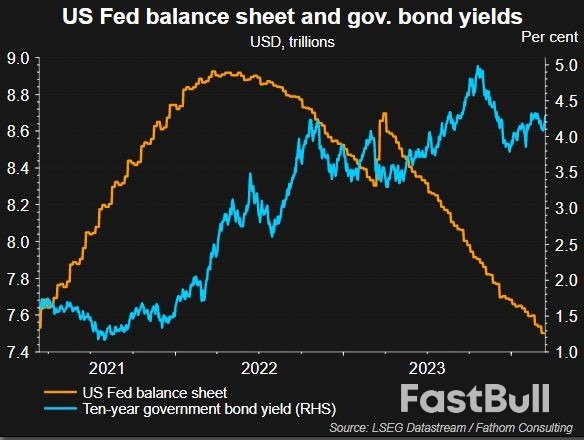
          QT is meant to remove excess liquidity created by record bond purchases designed to stimulate the economy during COVID-related business shutdowns. So far QT has helped shrink the Fed's balance sheet to $7.5 trillion from a peak of around $9 trillion.
          With ample liquidity remaining in the market, Garvey said there is no urgency to address the issue.
          "In our calculations we've still got about $1 trillion worth of excess liquidity in the system," Garvey said. "If I saw the Fed getting concerned about taking liquidity away too fast it would lead me to get a bit concerned that they've seen something that we're not seeing in the system."
          The Fed may also expand on Fed Governor Christopher Waller's comments that it may look to shift its mix of purchases to hold more shorter-dated Treasuries instead of mortgage-backed debt.
          "Longer maturities have a bigger effect on the market," said Eagan. By reducing duration but still buying Treasuries, they can potentially decrease the market impact "without upsetting the plumbing of the liquidity within the banking system," he said.Bond Market Sees Inflation as A Wild Card for Easing Timetable at Fed Meeting_3

          Source: Reuters

          To stay updated on all economic events of today, please check out our Economic calendar
          Risk Warnings and Disclaimers
          You understand and acknowledge that there is a high degree of risk involved in trading. Following any strategies or investment methods may lead to potential losses. The content on the site is provided by our contributors and analysts for information purposes only. You are solely responsible for determining whether any trading assets, securities, strategy, or any other product is suitable for investing based on your own investment objectives and financial situation.
          Add to Favorites
          Share
          FastBull
          Copyright © 2025 FastBull Ltd

          728 RM B 7/F GEE LOK IND BLDG NO 34 HUNG TO RD KWUN TONG KLN HONG KONG

          TelegramInstagramTwitterfacebooklinkedin
          App Store Google Play Google Play
          Products
          Charts

          Chats

          Q&A with Experts
          Screeners
          Economic Calendar
          Data
          Tools
          Membership
          Features
          Function
          Markets
          Copy Trading
          Latest Signals
          Contests
          News
          Analysis
          24/7
          Columns
          Education
          Company
          Careers
          About Us
          Contact Us
          Advertising
          Help Center
          Feedback
          User Agreement
          Privacy Policy
          Business

          White Label

          Data API

          Web Plug-ins

          Poster Maker

          Affiliate Program

          Risk Disclosure

          The risk of loss in trading financial instruments such as stocks, FX, commodities, futures, bonds, ETFs and crypto can be substantial. You may sustain a total loss of the funds that you deposit with your broker. Therefore, you should carefully consider whether such trading is suitable for you in light of your circumstances and financial resources.

          No decision to invest should be made without thoroughly conducting due diligence by yourself or consulting with your financial advisors. Our web content might not suit you since we don't know your financial conditions and investment needs. Our financial information might have latency or contain inaccuracy, so you should be fully responsible for any of your trading and investment decisions. The company will not be responsible for your capital loss.

          Without getting permission from the website, you are not allowed to copy the website's graphics, texts, or trademarks. Intellectual property rights in the content or data incorporated into this website belong to its providers and exchange merchants.

          Not Logged In

          Log in to access more features

          FastBull Membership

          Not yet

          Purchase

          Become a signal provider
          Help Center
          Customer Service
          Dark Mode
          Price Up/Down Colors

          Log In

          Sign Up

          Position
          Layout
          Fullscreen
          Default to Chart
          The chart page opens by default when you visit fastbull.com