• Trade
  • Markets
  • Copy
  • Contests
  • News
  • 24/7
  • Calendar
  • Q&A
  • Chats
Trending
Screeners
SYMBOL
LAST
BID
ASK
HIGH
LOW
NET CHG.
%CHG.
SPREAD
SPX
S&P 500 Index
6827.42
6827.42
6827.42
6899.86
6801.80
-73.58
-1.07%
--
DJI
Dow Jones Industrial Average
48458.04
48458.04
48458.04
48886.86
48334.10
-245.98
-0.51%
--
IXIC
NASDAQ Composite Index
23195.16
23195.16
23195.16
23554.89
23094.51
-398.69
-1.69%
--
USDX
US Dollar Index
97.950
98.030
97.950
98.500
97.950
-0.370
-0.38%
--
EURUSD
Euro / US Dollar
1.17394
1.17409
1.17394
1.17496
1.17192
+0.00011
+ 0.01%
--
GBPUSD
Pound Sterling / US Dollar
1.33707
1.33732
1.33707
1.33997
1.33419
-0.00148
-0.11%
--
XAUUSD
Gold / US Dollar
4299.39
4299.39
4299.39
4353.41
4257.10
+20.10
+ 0.47%
--
WTI
Light Sweet Crude Oil
57.233
57.485
57.233
58.011
56.969
-0.408
-0.71%
--

Community Accounts

Signal Accounts
--
Profit Accounts
--
Loss Accounts
--
View More

Become a signal provider

Sell trading signals to earn additional income

View More

Guide to Copy Trading

Get started with ease and confidence

View More

Signal Accounts for Members

All Signal Accounts

Best Return
  • Best Return
  • Best P/L
  • Best MDD
Past 1W
  • Past 1W
  • Past 1M
  • Past 1Y

All Contests

  • All
  • Trump Updates
  • Recommend
  • Stocks
  • Cryptocurrencies
  • Central Banks
  • Featured News
Top News Only
Share

US Envoy Witkoff Says A Lot Of Progress Was Made At Berlin Talks On Russia/Ukraine War

Share

Syria's President Sharaa Sends Condolences To Trump Over Killing Of USA Soldiers In Syria - Syrian Presidency

Share

ECOWAS Commission President: ECOWAS Rejects Guinea-Bissau Junta Transition Plan, Demands Return To Constitutional Order

Share

On Sunday (December 14), The Bangladesh DSE Broad Index Closed Down 0.62% At 4932.97 Points

Share

US President Trump: A New Federal Reserve Chairman Will Be Chosen Soon

Share

US President Trump: Inflation Is “completely Offset” And You Don’t Want To See Deflation

Share

Trump: Will Be A Lot Of Damage Done To The People That Attacked Troops In Syria

Share

Trump: Terrible Attack In Bondi Beach

Share

Interior Ministry - Syria Arrests Five Suspects In Shooting Of USA And Syrian Troops In Palmyra

Share

France Says Conditions For EU Vote On MERCOSUR Deal Not Yet Met, Despite Recent Progress — Prime Minister's Office

Share

CEO: Tokyo Gas To Steer More Than Half Of Overseas Investments To US In Next 3 Years

Share

In The Past 24 Hours, The Marketvector Digital Asset 100 Small Cap Index Fell By 2.63%, Holding Steady Near The Daily Low Of 3868.93 Points Refreshed At 23:32 Beijing Time, And Has Continued To Fluctuate Downwards Since 12:00

Share

White House National Economic Council Director Kevin Hassett: Economic Data Indicates That The U.S. CPI Is Moving Toward The Federal Reserve's 2% Target

Share

Hamas Says Israel's Killing Of Senior Commander Threatens Ceasefire

Share

Source: Germany's Merz Greets Zelenskiy, Umerov, Kushner, Witkoff At Chancellery In Berlin

Share

[Over 20 Automakers, Including Jike, Xiaomi, And Wenjie, Announce Purchase Tax Guarantee, Saving Up To 15,000 Yuan] Starting January 1, 2026, The Purchase Tax For New Energy Vehicles Will Be Reduced From Full Exemption To A 50% Reduction. Currently, The Vehicle Purchase Tax Is 10%, And The 50% Reduction For New Energy Vehicles Means An Effective Tax Rate Of 5%. The Tax Exemption Cap Will Also Decrease From 30,000 Yuan To 15,000 Yuan. Faced With The Certain Increase In Costs And Uncertain Subsidy Details, The Market Has Proactively "jumped The Gun." Over 20 Automakers, Including Jike, Xiaomi, And Wenjie, Have Launched "purchase Tax Guarantee" Policies, Promising To Make Up The Tax Difference For Customers Who Place Orders Before The End Of The Year And Have Them Delivered Next Year, With A Maximum Amount Of 15,000 Yuan

Share

South Korea Imports 10.8 Million T Of Crude In November Versus 11.3 Million T Year Ago

Share

Qatar's Al Mana Holding Launches $200 Million Project To Produce Sustainable Aviation Fuel In Egypt's Ain Sokhna - Egypt Statement

Share

Israeli Foreign Ministry: One Israeli Citizen Among Dead In Australia Shooting Attack

Share

Israeli Prime Minister Netanyahu: He Warned Australia Prime Minister About Antisemitism

TIME
ACT
FCST
PREV
U.K. Trade Balance (Oct)

A:--

F: --

P: --

U.K. Services Index MoM

A:--

F: --

P: --

U.K. Construction Output MoM (SA) (Oct)

A:--

F: --

P: --

U.K. Industrial Output YoY (Oct)

A:--

F: --

P: --

U.K. Trade Balance (SA) (Oct)

A:--

F: --

P: --

U.K. Trade Balance EU (SA) (Oct)

A:--

F: --

P: --

U.K. Manufacturing Output YoY (Oct)

A:--

F: --

P: --

U.K. GDP MoM (Oct)

A:--

F: --

P: --

U.K. GDP YoY (SA) (Oct)

A:--

F: --

P: --

U.K. Industrial Output MoM (Oct)

A:--

F: --

P: --

U.K. Construction Output YoY (Oct)

A:--

F: --

P: --

France HICP Final MoM (Nov)

A:--

F: --

P: --

China, Mainland Outstanding Loans Growth YoY (Nov)

A:--

F: --

P: --

China, Mainland M2 Money Supply YoY (Nov)

A:--

F: --

P: --

China, Mainland M0 Money Supply YoY (Nov)

A:--

F: --

P: --

China, Mainland M1 Money Supply YoY (Nov)

A:--

F: --

P: --

India CPI YoY (Nov)

A:--

F: --

P: --

India Deposit Gowth YoY

A:--

F: --

P: --

Brazil Services Growth YoY (Oct)

A:--

F: --

P: --

Mexico Industrial Output YoY (Oct)

A:--

F: --

P: --

Russia Trade Balance (Oct)

A:--

F: --

P: --

Philadelphia Fed President Henry Paulson delivers a speech
Canada Building Permits MoM (SA) (Oct)

A:--

F: --

P: --

Canada Wholesale Sales YoY (Oct)

A:--

F: --

P: --

Canada Wholesale Inventory MoM (Oct)

A:--

F: --

P: --

Canada Wholesale Inventory YoY (Oct)

A:--

F: --

P: --

Canada Wholesale Sales MoM (SA) (Oct)

A:--

F: --

P: --

Germany Current Account (Not SA) (Oct)

A:--

F: --

P: --

U.S. Weekly Total Rig Count

A:--

F: --

P: --

U.S. Weekly Total Oil Rig Count

A:--

F: --

P: --

Japan Tankan Large Non-Manufacturing Diffusion Index (Q4)

--

F: --

P: --

Japan Tankan Small Manufacturing Outlook Index (Q4)

--

F: --

P: --

Japan Tankan Large Non-Manufacturing Outlook Index (Q4)

--

F: --

P: --

Japan Tankan Large Manufacturing Outlook Index (Q4)

--

F: --

P: --

Japan Tankan Small Manufacturing Diffusion Index (Q4)

--

F: --

P: --

Japan Tankan Large Manufacturing Diffusion Index (Q4)

--

F: --

P: --

Japan Tankan Large-Enterprise Capital Expenditure YoY (Q4)

--

F: --

P: --

U.K. Rightmove House Price Index YoY (Dec)

--

F: --

P: --

China, Mainland Industrial Output YoY (YTD) (Nov)

--

F: --

P: --

China, Mainland Urban Area Unemployment Rate (Nov)

--

F: --

P: --

Saudi Arabia CPI YoY (Nov)

--

F: --

P: --

Euro Zone Industrial Output YoY (Oct)

--

F: --

P: --

Euro Zone Industrial Output MoM (Oct)

--

F: --

P: --

Canada Existing Home Sales MoM (Nov)

--

F: --

P: --

Euro Zone Total Reserve Assets (Nov)

--

F: --

P: --

U.K. Inflation Rate Expectations

--

F: --

P: --

Canada National Economic Confidence Index

--

F: --

P: --

Canada New Housing Starts (Nov)

--

F: --

P: --

U.S. NY Fed Manufacturing Employment Index (Dec)

--

F: --

P: --

U.S. NY Fed Manufacturing Index (Dec)

--

F: --

P: --

Canada Core CPI YoY (Nov)

--

F: --

P: --

Canada Manufacturing Unfilled Orders MoM (Oct)

--

F: --

P: --

Canada Manufacturing New Orders MoM (Oct)

--

F: --

P: --

Canada Core CPI MoM (Nov)

--

F: --

P: --

Canada Manufacturing Inventory MoM (Oct)

--

F: --

P: --

Canada CPI YoY (Nov)

--

F: --

P: --

Canada CPI MoM (Nov)

--

F: --

P: --

Canada CPI YoY (SA) (Nov)

--

F: --

P: --

Canada Core CPI MoM (SA) (Nov)

--

F: --

P: --

Canada CPI MoM (SA) (Nov)

--

F: --

P: --

Q&A with Experts
    • All
    • Chatrooms
    • Groups
    • Friends
    Connecting
    .
    .
    .
    Type here...
    Add Symbol or Code

      No matching data

      All
      Trump Updates
      Recommend
      Stocks
      Cryptocurrencies
      Central Banks
      Featured News
      • All
      • Russia-Ukraine Conflict
      • Middle East Flashpoint
      • All
      • Russia-Ukraine Conflict
      • Middle East Flashpoint
      Search
      Products

      Charts Free Forever

      Chats Q&A with Experts
      Screeners Economic Calendar Data Tools
      Membership Features
      Data Warehouse Market Trends Institutional Data Policy Rates Macro

      Market Trends

      Market Sentiment Order Book Forex Correlations

      Top Indicators

      Charts Free Forever
      Markets

      News

      News Analysis 24/7 Columns Education
      From Institutions From Analysts
      Topics Columnists

      Latest Views

      Latest Views

      Trending Topics

      Top Columnists

      Latest Update

      Signals

      Copy Rankings Latest Signals Become a signal provider AI Rating
      Contests
      Brokers

      Overview Brokers Assessment Rankings Regulators News Claims
      Broker listing Forex Brokers Comparison Tool Live Spread Comparison Scam
      Q&A Complaint Scam Alert Videos Tips to Detect Scam
      More

      Business
      Events
      Careers About Us Advertising Help Center

      White Label

      Data API

      Web Plug-ins

      Affiliate Program

      Awards Institution Evaluation IB Seminar Salon Event Exhibition
      Vietnam Thailand Singapore Dubai
      Fans Party Investment Sharing Session
      FastBull Summit BrokersView Expo
      Recent Searches
        Top Searches
          Markets
          News
          Analysis
          User
          24/7
          Economic Calendar
          Education
          Data
          • Names
          • Latest
          • Prev

          View All

          No data

          Scan to Download

          Faster Charts, Chat Faster!

          Download App
          English
          • English
          • Español
          • العربية
          • Bahasa Indonesia
          • Bahasa Melayu
          • Tiếng Việt
          • ภาษาไทย
          • Français
          • Italiano
          • Türkçe
          • Русский язык
          • 简中
          • 繁中
          Open Account
          Search
          Products
          Charts Free Forever
          Markets
          News
          Signals

          Copy Rankings Latest Signals Become a signal provider AI Rating
          Contests
          Brokers

          Overview Brokers Assessment Rankings Regulators News Claims
          Broker listing Forex Brokers Comparison Tool Live Spread Comparison Scam
          Q&A Complaint Scam Alert Videos Tips to Detect Scam
          More

          Business
          Events
          Careers About Us Advertising Help Center

          White Label

          Data API

          Web Plug-ins

          Affiliate Program

          Awards Institution Evaluation IB Seminar Salon Event Exhibition
          Vietnam Thailand Singapore Dubai
          Fans Party Investment Sharing Session
          FastBull Summit BrokersView Expo

          China’s State Buying May Fade After Sentiment Improves As ‘Hot Money’ Trickles Into Stock Market

          Cohen

          Stocks

          Economic

          Summary:

          China’s state-backed funds have bought at least US$57 billion of onshore stocks via exchange-traded funds tracking the underlying CSI 300 Index, according to UBS.

          Downwards pressure on China’s stocks may resume after the ongoing parliamentary meeting concludes, as state buying is set to taper off now that the key benchmark has scaled a psychologically important level, to allow market forces to operate freely, analysts say.
          The national team, a term that refers to state-backed buyers, will probably slow its pace of purchases after the Shanghai Composite Index holds up above the 3,000-mark, with no surprises at the annual legislative National People’s Congress (NPC), analysts led by Chen Shujin at Jefferies wrote in a report on Tuesday.
          Saxo Markets shares a similar view, saying that state buying of index-weighted companies ignored the weakness in medium and small-capitalisation stocks, a vast majority of which were in decline.
          At the annual parliamentary meeting, China set a GDP growth target of around 5 per cent for 2024, in-line with market expectations but investors were concerned about the lack of drivers to boost demand and inflation, as the 3 per cent deficit target meant little room for stimulation in the fiscal policy.
          “They had to do something to shore up the markets otherwise all confidence could have been lost,” said Nitin Dialdas, chief investment officer at Mandarin Capital Ventures. “Whether it has a long-term positive impact on the market performance itself we shall see, but for the short-term something has to be done. They need to find ways for the consumer to get some confidence back and not feel that they are losing income and money everywhere. It was just a stabilisation tool.”
          The strength of the rebound, after the Shanghai Composite rose 13 per cent from a four-year low, had been doubted after Premier Li Qiang’s first government work report delivered at the opening session of the NPC on Tuesday failed to impress traders. Meanwhile, the scrapping of the premier’s press conference, a three-decade-old fixture on the last day of the NPC, triggered concerns about the diminishing role of the State Council in policymaking amid fears policy would become more unpredictable.
          Chen at Jefferies also warned that more listed companies are likely to adopt a strategy of “kitchen sinking” – where businesses consolidate all negative headlines and release it at one go – that may result in snowballing losses at the forthcoming earnings season.
          Meanwhile, China’s state-backed funds including Central Huijin Investment have bought at least 410 billion yuan (US$57 billion) of onshore stocks via exchange-traded funds tracking the underlying CSI 300 Index of bigger companies this year, according to the estimate by UBS Group.
          While the state intervention has so far lifted sentiment and halted a record streak of six month of selling by overseas investors, some Wall Street firms remain cautious about the outlook for yuan-denominated stocks. Goldman Sachs’s wealth-management unit advised its clients not to invest in these stocks due to a persistent growth slowdown, opaque policymaking and doubts about the reliability of macroeconomic data.

          Source:scmp

          To stay updated on all economic events of today, please check out our Economic calendar
          Risk Warnings and Disclaimers
          You understand and acknowledge that there is a high degree of risk involved in trading. Following any strategies or investment methods may lead to potential losses. The content on the site is provided by our contributors and analysts for information purposes only. You are solely responsible for determining whether any trading assets, securities, strategy, or any other product is suitable for investing based on your own investment objectives and financial situation.
          Add to Favorites
          Share

          Gold Soars to Unprecedented Heights, Establishing a New Historical Pinnacle

          Chandan Gupta

          Traders' Opinions

          Commodity

          Fundamental Analysis

          Gold futures recently reached unprecedented heights, buoyed by a confluence of factors such as evolving monetary policies, geopolitical tensions, and the global economic landscape. This surge was mirrored by Bitcoin, hitting a new peak on gold trading platforms.
          Observing the gold market, prices have not only recovered from 2024's initial losses but have surged over 3%, marking a noteworthy turnaround. In the past year alone, the yellow metal has experienced a remarkable 16% increase. In a curious contrast, silver, gold's sibling commodity, witnessed a reduction in gains and a shift to negative territory, with silver futures dipping to $23.92 per ounce.
          Despite silver's recent decline, its performance over the past twelve months reflects a robust 13% increase. Notably, gold reached a historic milestone by closing above the $2,100 per ounce mark, propelled by a weakened US dollar and declining Treasury yields on a fateful Monday.
          The weakening of the US Dollar Index (DXY), down to 103.80, is a significant factor contributing to gold's ascent. A weaker dollar generally favors dollar-denominated commodities, making them more affordable for foreign investors. The index's 2.45% rise since the year's outset is a backdrop to these market dynamics.
          The intricate dance of gold prices is also influenced by US Treasury yields, which experienced a notable retreat across the board. The 10-year yield, down by 8.2 basis points to 4.137%, holds particular relevance, impacting the opportunity cost of holding gold as it doesn't generate returns. Two-year and 30-year notes followed suit, reaching 4.552% and 4.276%, respectively.
          Several contributors propelled gold prices, encompassing global economic risks, geopolitical tensions, and Federal Reserve policy shifts. The CME FedWatch tool now indicates a 65% likelihood of a June rate hike, up from 55% a week ago. This shift in investor expectations correlates with hotter inflation data and robust economic growth. Eyes are now on critical economic indicators, including the February jobs report, and the anticipated testimony of Federal Reserve Chairman Jerome Powell before the House and Senate.
          As the gold market navigates these multifaceted influences, it remains a fascinating arena for investors and analysts alike. The interplay of monetary policies, global events, and economic indicators paints a dynamic picture, driving both gold and its counterparts into uncharted territory. This moment, where financial intricacies meet real-world events, invites investors to keep a keen eye on the ever-shifting landscape of precious metals.

          Technical Analysis

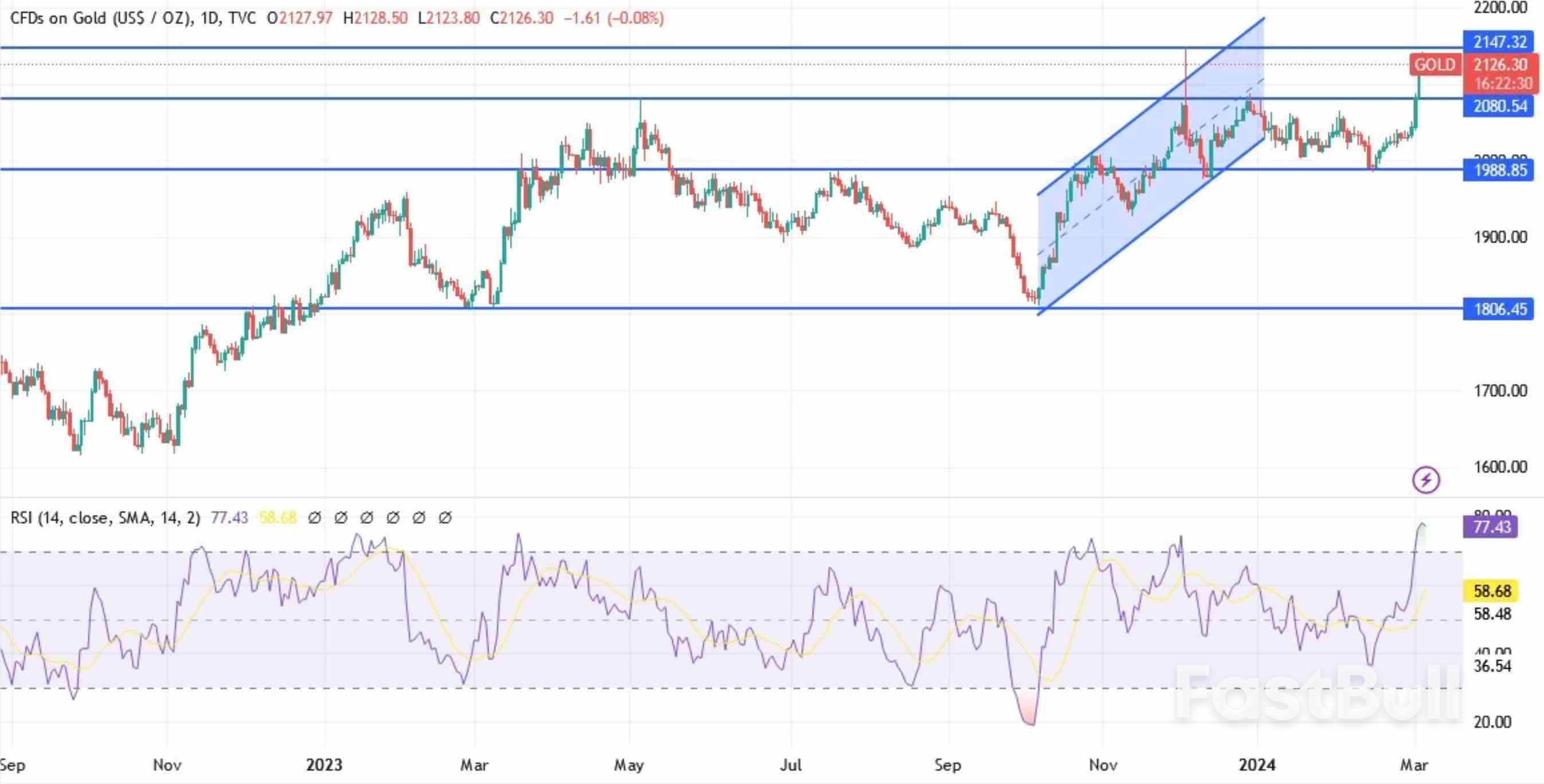
          The gold market is currently experiencing a noteworthy upswing, achieving record highs and drawing considerable attention from investors. The recent surge has propelled various technical indicators into overbought levels, indicating a strong and bullish market sentiment. However, it's crucial to note that a potential resurgence of the US dollar could introduce opportunities for profit-taking in the gold sector.
          Over the past five sessions, the gold price has exhibited significant gains, registering an impressive increase of nearly $100. This surge can be attributed to a combination of factors, including heightened geopolitical tensions, expectations of monetary easing, and concerns about a potential downturn in stock markets. Market observers are particularly intrigued by the magnitude of this recent move, speculating that momentum might be playing a substantial role in driving the gold price upward.
          At present, the key resistance levels for gold are identified at $2138 and $2155 per ounce. To gauge the sustainability of the current upward trend, a close analysis of the daily chart is essential. Breaking this trend would hinge on the metal's ability to remain above the critical $2000 level, a pivotal threshold that investors are closely monitoring for potential shifts in market dynamics.
          The uncertainty surrounding the timing of the US Federal Reserve's policy shift has significantly influenced the gold market since mid-February. Although the precise timeline remains uncertain, signals pointing toward the Fed's approach have bolstered market sentiment. Recent data from swaps markets indicates a roughly 60% probability of a rate cut in June, marking an increase from earlier projections.
          The low borrowing costs prevailing in the market are traditionally favorable for gold, given its non-interest-bearing nature. This economic backdrop enhances the appeal of the yellow metal, attracting investors seeking alternative assets. However, the lingering uncertainty regarding the sustainability of gold's recent surge has prompted some analysts to question the longevity of this upward trajectory.Gold Soars to Unprecedented Heights, Establishing a New Historical Pinnacle_1
          Risk Warnings and Disclaimers
          You understand and acknowledge that there is a high degree of risk involved in trading. Following any strategies or investment methods may lead to potential losses. The content on the site is provided by our contributors and analysts for information purposes only. You are solely responsible for determining whether any trading assets, securities, strategy, or any other product is suitable for investing based on your own investment objectives and financial situation.
          Add to Favorites
          Share

          "Quantitative Tightening" Or "Operation Twist" Is Coming Up. What Are The Implications For Bonds?

          SAXO

          Economic

          Bond

          Central Bank

          Last week, Federal Reserve Christopher Waller's speech discussed Quantitative Tightening (QT) in the past, the present, and the future. Yet, the following remarks were particularly important for bond markets:
          1. The Fed’s agency MBS holdings should go to zero
          2. US Treasury holdings should shift toward a larger share of shorter-dated Treasury securities.
          To understand how such comments affect US Treasury and the yield curve, it is essential to know that today, T-Bills holdings are less than 5% of US Treasury Fed holdings and less than 3% of total Fed security holdings. Before the Global Financial Crisis (GFC), they comprised a third of the Federal Reserve portfolio.
          Although Waller doesn't clearly state whether he would like to go back to a composition similar to the one seen before the GFC, it’s clear that he would like to limit QT to runoffs in MBS and coupon US Treasuries and avoid any runoff in T-Bills.
          The issue is that QT is running at a rate of $60 billion US Treasuries per month and $15 billion agency MBS per month. The way QT works is that coupon bonds and notes are run off before T-Bills, but when the redemption of notes and bonds does not reach $60 billion, then T-Bills will be run off up to the $60 billion cap.
          According to the Federal Reserve redemption schedule, US note and bond redemptions will meet or exceed QT’s cap in only five out of twelve months. If the current pace of QT remains unchanged, T-Bills will be runoff for roughly $170 billion in a year."Quantitative Tightening" Or "Operation Twist" Is Coming Up. What Are The Implications For Bonds?_1
          In 2019, MBS securities exceeding the QT cap were reinvested in US Treasuries in the secondary markets up to $20 billion; anything above that amount was reinvested in MBS. While one might think that the central bank today could opt for the same solution, it won't be able to do so this time. For the remainder of 2024, there will be only $14 billion of MBS redemptions, resulting in an average of a little over $1 billion per month, well below the $15 billion monthly QT cap.
          Therefore, for the Federal Reserve not to reduce short-term Treasury holdings further, it would need to decrease the QT cap and redirect the debt exceeding the QT cap towards short-term US Treasuries
          rather than rolling over the amount in proportion to the amount of SOMA securities scheduled to mature on those dates.
          Another option would be to engage in a reverse "Operation Twist." The Federal Reserve implemented Operation Twist in the second quarter of 2012, which implies the simultaneous selling of short-term bonds to purchase long-term Treasuries.
          Either way, QT tapering is indispensable and may come as soon as the next FOMC meeting on March 20th. Indeed, the Fed RRP facility has fallen below $500 billion this month for the first time since 2021, and the BTFP facility expires this month.
          QT tapering or operation twist might be coming exactly as the US Treasury is increasing its T-Bill shares above the 20% guideline.

          "QT tapering" and "Operation Twist Reverse": consequences on the yield curve.

          The above is likely to result in a steeper yield curve. However, the big question is whether QT tapering or operation twist is going to be bullish for long-term US Treasuries, especially the ultra-long part of the yield curve, where many investors have put their money at work in the past couple of years, positioning for an early and aggressive rate cutting cycle. Even during February, when markets were pushing against expectations of more than three rate cuts in 2024, TLT (iShares 20+ Year Treasury Bond ETF) saw inflows of $776 million.
          Although the announcement of QT tapering per se is dovish, as it alludes to easier upcoming monetary policies, long-term US Treasury yields will be able to decline only once the market is confident that inflation is on a sustainable path to 2%. Moreover, considering that the US Treasury is maintaining coupon issuance to pandemic-like levels in the year's second quarter, long-term yields look more likely to rise rather than fall.
          Yet, the front part of the yield curve up to 7 years offers an appealing entry point, as policymakers' reluctance to tighten the economy further and reduce liquidity in the system will likely favor this part of the yield curve. We continue to remain cautious."Quantitative Tightening" Or "Operation Twist" Is Coming Up. What Are The Implications For Bonds?_2
          To stay updated on all economic events of today, please check out our Economic calendar
          Risk Warnings and Disclaimers
          You understand and acknowledge that there is a high degree of risk involved in trading. Following any strategies or investment methods may lead to potential losses. The content on the site is provided by our contributors and analysts for information purposes only. You are solely responsible for determining whether any trading assets, securities, strategy, or any other product is suitable for investing based on your own investment objectives and financial situation.
          Add to Favorites
          Share

          Crypto Enthusiasts Rejoice as Bitcoin Hits Record High: But Is the Rally Sustainable?

          Warren Takunda

          Economic

          Traders' Opinions

          Cryptocurrency

          Crypto Enthusiasts Rejoice as Bitcoin Hits Record High: But Is the Rally Sustainable?_1Cryptocurrency enthusiasts are jubilant as Bitcoin recently hit an all-time high, surpassing $69,000. This milestone marks a significant moment for believers who weathered the storm of a tumultuous 2022, marred by industry downturns and corporate bankruptcies. However, the question looms: Is crypto truly experiencing a resurgence, or are there underlying differences between this rally and the previous boom?
          The collapse of cryptocurrencies in the past was a sobering reality check for many investors. The frenzy of 2021, characterized by extravagant marketing campaigns and celebrity endorsements, gave way to a harsh reality in 2022. Scandals and fraud rocked the industry, leading to significant losses for those heavily invested in digital assets. The collapse of FTX crypto exchange in November 2022, costing customers billions, marked the nadir of this downturn.
          Bitcoin's remarkable rebound since then can be attributed to several factors. A pivotal moment arrived in August when a court ruling opened the doors for financial institutions to offer Bitcoin-based investment products, namely exchange-traded funds (ETFs). These ETFs provided a safer avenue for investors to participate in crypto markets without directly owning digital currencies, thereby mitigating some of the risks associated with traditional crypto investments.
          Unlike the 2021 boom fueled by retail investors seeking quick gains, this resurgence is marked by institutional support. Bitcoin's rally has been buoyed by endorsements from major financial players like BlackRock and Fidelity, both of which offer Bitcoin ETFs. This institutional backing signals a shift towards a more mature and stable market, with potential for sustained growth.
          However, despite the optimism surrounding Bitcoin's surge, uncertainties linger regarding the broader crypto industry's future. Regulatory challenges loom large, with federal agencies scrutinizing platforms and digital currencies beyond Bitcoin. Lawsuits filed by the Securities and Exchange Commission against Coinbase and other major players underscore the regulatory hurdles that could impede the industry's growth trajectory.
          Crypto enthusiasts remain bullish, projecting further gains for Bitcoin in the coming months, with some even forecasting a price surpassing $100,000. Yet, the industry's long-term prospects hinge on navigating regulatory complexities and building trust among regulators and investors alike.
          In conclusion, while Bitcoin's recent rally signals a potential resurgence for cryptocurrencies, the road ahead is fraught with challenges. Regulatory clarity and institutional acceptance will play pivotal roles in shaping the industry's trajectory, determining whether crypto truly emerges from its past shadows into a new era of legitimacy and stability.
          To stay updated on all economic events of today, please check out our Economic calendar
          Risk Warnings and Disclaimers
          You understand and acknowledge that there is a high degree of risk involved in trading. Following any strategies or investment methods may lead to potential losses. The content on the site is provided by our contributors and analysts for information purposes only. You are solely responsible for determining whether any trading assets, securities, strategy, or any other product is suitable for investing based on your own investment objectives and financial situation.
          Add to Favorites
          Share

          Russia’s Chinese Yuan Funding Lifeline Is Getting Too Expensive

          Alex

          Economic

          Yuan financing is becoming costly and sparse in Russia, choking off a pathway to foreign capital for companies that are already facing much higher domestic interest rates and a wave of debt due this year.
          Two years after the invasion of Ukraine isolated Russia from the Western financial system, major energy and mining companies have come to rely on the yuan for most of their foreign-currency needs. But even as yields on China’s benchmark government bonds hover around a two-decade low, insufficient yuan liquidity in Russia and demand for the currency from importers are contributing to higher borrowing expenses.
          The funding dilemma leaves companies like Russia’s biggest miner, MMC Norilsk Nickel PJSC, choosing between expensive ruble funding or the rising cost of domestic yuan debt.Russia’s Chinese Yuan Funding Lifeline Is Getting Too Expensive_1
          Russia more than doubled its benchmark last year, saddling corporate borrowers with as much as 1.2 trillion rubles ($13 billion) in extra debt-servicing costs, according to Moscow-based consultancy Yakov & Partners.
          “Given current realities, the average cost of debt will be raising,” Sergey Malyshev, Nornickel’s chief financial officer, said in a statement sent to reporters last month.
          Nornickel’s interest payments are set to reach $1 billion in 2024 after $800 million in 2023 — compared with $315 million in 2021, the last full year before the war. The burden is nearly as intense for the largest oil producer, Rosneft PJSC, pushing it to accelerate debt repayments after interest consumed 50% more money in the fourth quarter than a year earlier.

          Not Widespread

          After their debut in 2022, yuan bonds “haven’t yet become widespread” in the Russian market, the central bank said in a report published Monday. It listed limited free liquidity in yuan among lenders and the need to offer higher yields as factors “restraining potential interest in such placements among investors and issuers.”
          The volume of Russian corporate yuan bonds – all sold on the domestic market — almost stalled in the final three quarters of last year and reached the equivalent of 800 billion rubles, according to the Russian central bank. And although loans in the Chinese currency nearly quadrupled to a record $46 billion in 2023, their share in corporate credit portfolios was still only in single digits.
          The average yield on yuan securities for issuers went up by nearly 2 percentage points in the course of last year and approached 6%, according to the Bank of Russia.
          The short-term cost of borrowing yuan on the Moscow Exchange has been so volatile that it spiked to 15.7% on March 1 before dropping to 4.1% three days later, according to calculations by Bloomberg Economics. The reluctance of major Chinese banks to link Moscow’s yuan market with offshore markets is most likely a key factor, according to Bloomberg economist Alexander Isakov.

          What Bloomberg Economics Says...

          “Yuan liquidity in Moscow is becoming more scarce and its costs more volatile. Yuan shortages in the Russian financial system indicate emerging problems for growing yuan lending for domestic banks — two years after the start of the war they still struggle to attract a sufficiently large and stable yuan deposit base.”
          —Alexander Isakov, Russia economist.
          Yuan bond issuance in 2022-2023 represented a “cheap source of funding,” according to Alexey Tretyakov, one of the founders of Aricapital in Moscow.
          Facing a worsening yuan liquidity crunch, Russian lenders have had to turn to the central bank’s Chinese currency swaps to meet their needs, resulting in a “significant increase in yuan funding costs,” Tretyakov said. “A continued deficit could lead to a further rise in yuan bond yields,” he said.
          Russian companies also haven’t borrowed within China itself, according to data compiled by Bloomberg, because capital controls there complicate the repatriation of money abroad. They haven’t sold yuan securities like panda or dim sum bonds since 2018 after 11 such issues in the prior eight years.
          The barriers are proving too high to overcome even for the government, which has spent years planning its own yuan bonds. Finance Minister Anton Siluanov said in a February interview with RIA Novosti that discussions with China over taking out loans in yuan also have yet to produce results.
          Chinese lenders including Industrial and Commercial Bank of China Ltd. — the world’s biggest by assets — have been ramping up their exposure to Russia through offshore branches. ICBC’s Russian subsidiary alone saw a five-fold increase in total local assets from the start of 2022 and through Oct. 1 last year, according to the latest data published by the Bank of Russia.Russia’s Chinese Yuan Funding Lifeline Is Getting Too Expensive_2
          The strain on Russian corporate coffers risks depriving industries of capital in a year when refinancing needs are sharply on the rise. Despite stellar profits, companies are feeling the pinch after the government imposed new export taxes to help fund the war, further undermining the benefit of a weaker ruble that helped drive record margins.
          “High rates mean that the companies will be more careful with investments that require significant debt capital,” said Dmitry Kazakov, analyst at BCS in Moscow.

          Source:Bloomberg

          To stay updated on all economic events of today, please check out our Economic calendar
          Risk Warnings and Disclaimers
          You understand and acknowledge that there is a high degree of risk involved in trading. Following any strategies or investment methods may lead to potential losses. The content on the site is provided by our contributors and analysts for information purposes only. You are solely responsible for determining whether any trading assets, securities, strategy, or any other product is suitable for investing based on your own investment objectives and financial situation.
          Add to Favorites
          Share

          Australian Dollar Surges on GDP Data, Heightens Expectations of RBA Rate Cut

          Warren Takunda

          Central Bank

          Traders' Opinions

          Economic

          Forex

          Australian Dollar Surges on GDP Data, Heightens Expectations of RBA Rate Cut_1The Australian Dollar exhibited strength in response to the latest Australian GDP data, reinforcing the belief among analysts that the Reserve Bank of Australia (RBA) is poised to implement an interest rate cut in line with other major central banks.
          The Pound to Australian Dollar exchange rate experienced a modest decline, settling at 1.9484, subsequent to the Australian Bureau of Statistics (ABS) report indicating a 1.5% year-on-year increase in Australia's economic output, surpassing the anticipated 1.4% rise.
          While the fourth quarter of 2023 saw a growth of 0.2% quarter-to-quarter, a slight decrease from the previous quarter's 0.3% uptick and falling short of the consensus estimate of 0.3%, the Australian Dollar demonstrated strength against most currency counterparts following the data release. However, this surge is likely attributed to the broader strength observed in commodity currencies such as the New Zealand Dollar and the Canadian Dollar.
          The Australian Dollar to U.S. Dollar exchange rate climbed by a third of a percent to 0.6523, brushing off the GDP figures, indicating resilience amidst prevailing market sentiments.
          Despite the positive market reaction, the prevailing sentiment among analysts remains bearish towards the Australian Dollar outlook. The GDP release underscores signs of economic softness, reinforcing expectations of imminent RBA rate cuts. Real GDP growth of 0.2% quarter-to-quarter and a year-on-year increase of 1.5% fell short of expectations, while household consumption figures also disappointed, growing by a mere 0.1% quarter-to-quarter.
          Market forecasts align with the likelihood of RBA rate cuts commencing in September, following similar moves by the Federal Reserve, European Central Bank, and Bank of England. Elevated Australian bond yields relative to peers offer temporary support to the AUD, but analysts caution against underestimating the potential economic slowdown, advocating for a more aggressive rate cut approach by the RBA.
          While the market has priced in a September rate cut, expectations diverge regarding the pace of subsequent easing cycles. Analysts anticipate downward revisions to RBA rate cut projections, which could weigh on the Australian Dollar, potentially pushing the AUD/USD exchange rate towards 0.64 in the near term.
          Moreover, the resilience of the GBP/USD pair in 2024 hints at further upside for the GBP/AUD exchange rate. The trajectory of the Australian Dollar hinges on Chinese growth trends and shifts in U.S. interest rate expectations, with upcoming events such as Fed Chair Powell's testimony and the Friday jobs report holding significant influence.
          The recent boost in confidence towards a potential June rate cut by the Fed following below-consensus U.S. ISM services PMI data could sustain momentum for the Australian Dollar and its commodity counterparts, paving the way for further upside if such expectations materialize.
          To stay updated on all economic events of today, please check out our Economic calendar
          Risk Warnings and Disclaimers
          You understand and acknowledge that there is a high degree of risk involved in trading. Following any strategies or investment methods may lead to potential losses. The content on the site is provided by our contributors and analysts for information purposes only. You are solely responsible for determining whether any trading assets, securities, strategy, or any other product is suitable for investing based on your own investment objectives and financial situation.
          Add to Favorites
          Share

          China Defends 5% Goal, Vows Vigorous Effort To Grow Economy

          Cohen

          Central Bank

          Economic

          A top Chinese official defended his nation’s plan to grow the economy by around 5% this year, a day after the ambitious target was met with skepticism by some economists.
          The goal is a “positive target that can well be attained through vigorous effort,” Zheng Shanjie, Chairman of the National Development and Reform Commission, said at a press briefing in Beijing on Wednesday.
          He was joined at the event on the sidelines of the National People’s Congress, an annual meeting of China’s rubber-stamp parliament, by officials including Pan Gongsheng, governor of the People’s Bank of China, and Finance Minister Lan Fo’an.
          The officials’ comments will be scrutinized by investors seeking details on how President Xi Jinping’s government will repeat last year’s expansion rate in more challenging circumstances without unleashing broad stimulus. Markets were disappointed by the lack of forceful steps announced at the opening of the legislature on Tuesday, while analysts surveyed by Bloomberg ahead of the confab only expected the economy to expand by 4.6% in 2024.
          The joint press briefing was the first time in at least a decade that so many economic ministers shared a stage for one conference during the legislative session. Previously, officials typically held briefings in much smaller groups, except for pandemic years when many skipped conferences.
          Zheng said China’s plans to issue 1 trillion yuan ($139 billion) of ultra-long special central government bonds this year will drive investment and consumption. He added that China’s “high-quality development” is seeing progress and bringing new competitive advantages, giving the economy a stronger foundation for growth.
          Premier Li Qiang’s yearly report to China’s highest-profile annual political meeting kept the fiscal stimulus broadly the same as last year, and avoided aggressive moves to boost consumption or lift a slumping property sector. China’s No. 2 official didn’t directly address the Asian nation’s slide into its longest deflation streak since the 1990s.
          The People’s Bank of China is expected to deliver more moderate cuts to interest rates and banks’ required reserves this year. The central bank has used surprise easing steps — such as a record cut to a key mortgage rate — to squeeze more value out of its policy actions in recent months.
          Officials managing the world’s second-largest economy are grappling with record low consumer confidence, falling home prices and an increasingly competitive job market. That’s weighed on consumption and led to a price war among retailers, which has been hampered by weakening overseas demand that saw annual exports decline for the first time since 2016 last year.

          Source:Bloomberg

          To stay updated on all economic events of today, please check out our Economic calendar
          Risk Warnings and Disclaimers
          You understand and acknowledge that there is a high degree of risk involved in trading. Following any strategies or investment methods may lead to potential losses. The content on the site is provided by our contributors and analysts for information purposes only. You are solely responsible for determining whether any trading assets, securities, strategy, or any other product is suitable for investing based on your own investment objectives and financial situation.
          Add to Favorites
          Share
          FastBull
          Copyright © 2025 FastBull Ltd

          728 RM B 7/F GEE LOK IND BLDG NO 34 HUNG TO RD KWUN TONG KLN HONG KONG

          TelegramInstagramTwitterfacebooklinkedin
          App Store Google Play Google Play
          Products
          Charts

          Chats

          Q&A with Experts
          Screeners
          Economic Calendar
          Data
          Tools
          Membership
          Features
          Function
          Markets
          Copy Trading
          Latest Signals
          Contests
          News
          Analysis
          24/7
          Columns
          Education
          Company
          Careers
          About Us
          Contact Us
          Advertising
          Help Center
          Feedback
          User Agreement
          Privacy Policy
          Business

          White Label

          Data API

          Web Plug-ins

          Poster Maker

          Affiliate Program

          Risk Disclosure

          The risk of loss in trading financial instruments such as stocks, FX, commodities, futures, bonds, ETFs and crypto can be substantial. You may sustain a total loss of the funds that you deposit with your broker. Therefore, you should carefully consider whether such trading is suitable for you in light of your circumstances and financial resources.

          No decision to invest should be made without thoroughly conducting due diligence by yourself or consulting with your financial advisors. Our web content might not suit you since we don't know your financial conditions and investment needs. Our financial information might have latency or contain inaccuracy, so you should be fully responsible for any of your trading and investment decisions. The company will not be responsible for your capital loss.

          Without getting permission from the website, you are not allowed to copy the website's graphics, texts, or trademarks. Intellectual property rights in the content or data incorporated into this website belong to its providers and exchange merchants.

          Not Logged In

          Log in to access more features

          FastBull Membership

          Not yet

          Purchase

          Become a signal provider
          Help Center
          Customer Service
          Dark Mode
          Price Up/Down Colors

          Log In

          Sign Up

          Position
          Layout
          Fullscreen
          Default to Chart
          The chart page opens by default when you visit fastbull.com