• Trade
  • Markets
  • Copy
  • Contests
  • News
  • 24/7
  • Calendar
  • Q&A
  • Chats
Trending
Screeners
SYMBOL
LAST
BID
ASK
HIGH
LOW
NET CHG.
%CHG.
SPREAD
SPX
S&P 500 Index
6827.42
6827.42
6827.42
6899.86
6801.80
-73.58
-1.07%
--
DJI
Dow Jones Industrial Average
48458.04
48458.04
48458.04
48886.86
48334.10
-245.98
-0.51%
--
IXIC
NASDAQ Composite Index
23195.16
23195.16
23195.16
23554.89
23094.51
-398.69
-1.69%
--
USDX
US Dollar Index
97.950
98.030
97.950
98.500
97.950
-0.370
-0.38%
--
EURUSD
Euro / US Dollar
1.17394
1.17409
1.17394
1.17496
1.17192
+0.00011
+ 0.01%
--
GBPUSD
Pound Sterling / US Dollar
1.33707
1.33732
1.33707
1.33997
1.33419
-0.00148
-0.11%
--
XAUUSD
Gold / US Dollar
4299.39
4299.39
4299.39
4353.41
4257.10
+20.10
+ 0.47%
--
WTI
Light Sweet Crude Oil
57.233
57.485
57.233
58.011
56.969
-0.408
-0.71%
--

Community Accounts

Signal Accounts
--
Profit Accounts
--
Loss Accounts
--
View More

Become a signal provider

Sell trading signals to earn additional income

View More

Guide to Copy Trading

Get started with ease and confidence

View More

Signal Accounts for Members

All Signal Accounts

Best Return
  • Best Return
  • Best P/L
  • Best MDD
Past 1W
  • Past 1W
  • Past 1M
  • Past 1Y

All Contests

  • All
  • Trump Updates
  • Recommend
  • Stocks
  • Cryptocurrencies
  • Central Banks
  • Featured News
Top News Only
Share

Iranian Media Says 18 Crew Members Of Foreign Tanker Seized In Gulf Of Oman Over Carrying 'Smuggled Fuel' Detained

Share

Regional Governor: Two Killed In Ukrainian Drone Strike On Russia's Saratov

Share

Chinese Foreign Ministry - China Foreign Minister Met With United Arab Emirates Counterpart On Dec 12

Share

China's Central Financial And Economic Affairs Commission Deputy Director: Will Expand Export And Increase Import In 2026

Share

Thai Leader Anutin: Landmine Blast That Killed Thai Soldiers 'Not A Roadside Accident'

Share

Thai Leader Anutin: Thailand To Continue Military Action Until 'We Feel No More Harm'

Share

Cambodian Prime Minister Hun Manet Says He Had Phone Calls With Trump And Malaysian Leader Anwar About Ceasefire

Share

Cambodia's Hun Manet Says USA, Malaysia Should Verify 'Which Side Fired First' In Latest Conflict

Share

Cambodia's Hun Manet: Cambodia Maintains Its Stance In Seeking Peaceful Resolution Of Disputes

Share

Nasdaq Companies: Allergan, Ferrovia, Insmed, Monolithic Power Systems, Seagate Technology, And Western Digital Will Be Added To The NASDAQ 100 Index. Biogen, CdW, GlobalFoundries, Lululemon, ON Semiconductor, And Tradedesk Will Be Removed From The NASDAQ 100 Index

Share

Witkoff Headed To Berlin This Weekend To Meet With Zelenskiy, European Leaders -Wsj Reporter On X

Share

Russia Attacks Two Ukrainian Ports, Damaging Three Turkish-Owned Vessels

Share

[Historic Flooding Occurs In At Least Four Rivers In Washington State Due To Days Of Torrential Rains] Multiple Areas In Washington State Have Been Hit By Severe Flooding Due To Days Of Torrential Rains, With At Least Four Rivers Experiencing Historic Flooding. Reporters Learned On The 12th That The Floods Caused By The Torrential Rains In Washington State Have Destroyed Homes And Closed Several Highways. Experts Warn That Even More Severe Flooding May Occur In The Future. A State Of Emergency Has Been Declared In Washington State

Share

Trump Says Proposed Free Economic Zone In Donbas Would Work

Share

Trump: I Think My Voice Should Be Heard

Share

Trump Says Will Be Choosing New Fed Chair In Near Future

Share

Trump Says Proposed Free Economic Zone In Donbas Complex But Would Work

Share

Trump Says Land Strikes In Venezuela Will Start Happening

Share

US President Trump: Thailand And Cambodia Are In A Good Situation

Share

State Media: North Korean Leader Kim Hails Troops Returning From Russia Mission

TIME
ACT
FCST
PREV
U.K. Trade Balance Non-EU (SA) (Oct)

A:--

F: --

P: --

U.K. Trade Balance (Oct)

A:--

F: --

P: --

U.K. Services Index MoM

A:--

F: --

P: --

U.K. Construction Output MoM (SA) (Oct)

A:--

F: --

P: --

U.K. Industrial Output YoY (Oct)

A:--

F: --

P: --

U.K. Trade Balance (SA) (Oct)

A:--

F: --

P: --

U.K. Trade Balance EU (SA) (Oct)

A:--

F: --

P: --

U.K. Manufacturing Output YoY (Oct)

A:--

F: --

P: --

U.K. GDP MoM (Oct)

A:--

F: --

P: --

U.K. GDP YoY (SA) (Oct)

A:--

F: --

P: --

U.K. Industrial Output MoM (Oct)

A:--

F: --

P: --

U.K. Construction Output YoY (Oct)

A:--

F: --

P: --

France HICP Final MoM (Nov)

A:--

F: --

P: --

China, Mainland Outstanding Loans Growth YoY (Nov)

A:--

F: --

P: --

China, Mainland M2 Money Supply YoY (Nov)

A:--

F: --

P: --

China, Mainland M0 Money Supply YoY (Nov)

A:--

F: --

P: --

China, Mainland M1 Money Supply YoY (Nov)

A:--

F: --

P: --

India CPI YoY (Nov)

A:--

F: --

P: --

India Deposit Gowth YoY

A:--

F: --

P: --

Brazil Services Growth YoY (Oct)

A:--

F: --

P: --

Mexico Industrial Output YoY (Oct)

A:--

F: --

P: --

Russia Trade Balance (Oct)

A:--

F: --

P: --

Philadelphia Fed President Henry Paulson delivers a speech
Canada Building Permits MoM (SA) (Oct)

A:--

F: --

P: --

Canada Wholesale Sales YoY (Oct)

A:--

F: --

P: --

Canada Wholesale Inventory MoM (Oct)

A:--

F: --

P: --

Canada Wholesale Inventory YoY (Oct)

A:--

F: --

P: --

Canada Wholesale Sales MoM (SA) (Oct)

A:--

F: --

P: --

Germany Current Account (Not SA) (Oct)

A:--

F: --

P: --

U.S. Weekly Total Rig Count

A:--

F: --

P: --

U.S. Weekly Total Oil Rig Count

A:--

F: --

P: --

Japan Tankan Large Non-Manufacturing Diffusion Index (Q4)

--

F: --

P: --

Japan Tankan Small Manufacturing Outlook Index (Q4)

--

F: --

P: --

Japan Tankan Large Non-Manufacturing Outlook Index (Q4)

--

F: --

P: --

Japan Tankan Large Manufacturing Outlook Index (Q4)

--

F: --

P: --

Japan Tankan Small Manufacturing Diffusion Index (Q4)

--

F: --

P: --

Japan Tankan Large Manufacturing Diffusion Index (Q4)

--

F: --

P: --

Japan Tankan Large-Enterprise Capital Expenditure YoY (Q4)

--

F: --

P: --

U.K. Rightmove House Price Index YoY (Dec)

--

F: --

P: --

China, Mainland Industrial Output YoY (YTD) (Nov)

--

F: --

P: --

China, Mainland Urban Area Unemployment Rate (Nov)

--

F: --

P: --

Saudi Arabia CPI YoY (Nov)

--

F: --

P: --

Euro Zone Industrial Output YoY (Oct)

--

F: --

P: --

Euro Zone Industrial Output MoM (Oct)

--

F: --

P: --

Canada Existing Home Sales MoM (Nov)

--

F: --

P: --

Euro Zone Total Reserve Assets (Nov)

--

F: --

P: --

U.K. Inflation Rate Expectations

--

F: --

P: --

Canada National Economic Confidence Index

--

F: --

P: --

Canada New Housing Starts (Nov)

--

F: --

P: --

U.S. NY Fed Manufacturing Employment Index (Dec)

--

F: --

P: --

U.S. NY Fed Manufacturing Index (Dec)

--

F: --

P: --

Canada Core CPI YoY (Nov)

--

F: --

P: --

Canada Manufacturing Unfilled Orders MoM (Oct)

--

F: --

P: --

Canada Manufacturing New Orders MoM (Oct)

--

F: --

P: --

Canada Core CPI MoM (Nov)

--

F: --

P: --

Canada Manufacturing Inventory MoM (Oct)

--

F: --

P: --

Canada CPI YoY (Nov)

--

F: --

P: --

Canada CPI MoM (Nov)

--

F: --

P: --

Canada CPI YoY (SA) (Nov)

--

F: --

P: --

Canada Core CPI MoM (SA) (Nov)

--

F: --

P: --

Q&A with Experts
    • All
    • Chatrooms
    • Groups
    • Friends
    Connecting
    .
    .
    .
    Type here...
    Add Symbol or Code

      No matching data

      All
      Trump Updates
      Recommend
      Stocks
      Cryptocurrencies
      Central Banks
      Featured News
      • All
      • Russia-Ukraine Conflict
      • Middle East Flashpoint
      • All
      • Russia-Ukraine Conflict
      • Middle East Flashpoint
      Search
      Products

      Charts Free Forever

      Chats Q&A with Experts
      Screeners Economic Calendar Data Tools
      Membership Features
      Data Warehouse Market Trends Institutional Data Policy Rates Macro

      Market Trends

      Market Sentiment Order Book Forex Correlations

      Top Indicators

      Charts Free Forever
      Markets

      News

      News Analysis 24/7 Columns Education
      From Institutions From Analysts
      Topics Columnists

      Latest Views

      Latest Views

      Trending Topics

      Top Columnists

      Latest Update

      Signals

      Copy Rankings Latest Signals Become a signal provider AI Rating
      Contests
      Brokers

      Overview Brokers Assessment Rankings Regulators News Claims
      Broker listing Forex Brokers Comparison Tool Live Spread Comparison Scam
      Q&A Complaint Scam Alert Videos Tips to Detect Scam
      More

      Business
      Events
      Careers About Us Advertising Help Center

      White Label

      Data API

      Web Plug-ins

      Affiliate Program

      Awards Institution Evaluation IB Seminar Salon Event Exhibition
      Vietnam Thailand Singapore Dubai
      Fans Party Investment Sharing Session
      FastBull Summit BrokersView Expo
      Recent Searches
        Top Searches
          Markets
          News
          Analysis
          User
          24/7
          Economic Calendar
          Education
          Data
          • Names
          • Latest
          • Prev

          View All

          No data

          Scan to Download

          Faster Charts, Chat Faster!

          Download App
          English
          • English
          • Español
          • العربية
          • Bahasa Indonesia
          • Bahasa Melayu
          • Tiếng Việt
          • ภาษาไทย
          • Français
          • Italiano
          • Türkçe
          • Русский язык
          • 简中
          • 繁中
          Open Account
          Search
          Products
          Charts Free Forever
          Markets
          News
          Signals

          Copy Rankings Latest Signals Become a signal provider AI Rating
          Contests
          Brokers

          Overview Brokers Assessment Rankings Regulators News Claims
          Broker listing Forex Brokers Comparison Tool Live Spread Comparison Scam
          Q&A Complaint Scam Alert Videos Tips to Detect Scam
          More

          Business
          Events
          Careers About Us Advertising Help Center

          White Label

          Data API

          Web Plug-ins

          Affiliate Program

          Awards Institution Evaluation IB Seminar Salon Event Exhibition
          Vietnam Thailand Singapore Dubai
          Fans Party Investment Sharing Session
          FastBull Summit BrokersView Expo

          Courts Order Trump to Keep Paying Food Stamps Amid Shutdown

          Manuel

          Political

          Summary:

          The federal government sends SNAP funds to states to administer to eligible residents, who receive the money each month via a benefits card they can use to pay for groceries, similar to a bank debit card.

          Two federal judges ruled the Trump administration’s decision to suspend food-aid benefits for tens of millions of Americans during the government shutdown is likely unlawful and that US officials must use contingency funding to at least partially keep the program operational.
          US District Judge John McConnell in Rhode Island on Friday announced in court that he would order the US Department of Agriculture to distribute a pool of emergency funding “as soon as possible” for November benefits. He also urged the administration to explore tapping other sources of federal dollars to ensure the program is fully funded.
          “It’s clear that when compared to the millions of people that will go without funds for food, versus the agency’s desire not to use contingency funds in case there’s a hurricane need, the balances of those equities clearly goes on the side of ensuring that people are fed,” McConnell said.
          Minutes earlier in Boston, US District Judge Indira Talwani issued a written ruling that rejected the administration’s stance that it is legally barred from tapping into billions of dollars in alternative funding sources to keep the program running during the budget impasse in Congress.
          Both cases involve lawsuits seeking to keep federal dollars flowing to the Supplemental Nutrition Assistance Program, or SNAP. The agriculture department, which administers the program, had said it would halt benefits starting in November until Congress approves a new spending deal.
          More than 42 million people in 22 million households nationwide receive SNAP benefits, according to government data. Advocates argued in court that a suspension of benefits would exacerbate food insecurity across the country, on top of the strain already facing the millions of federal workers who haven’t received paychecks since the shutdown began on Oct. 1.
          McConnell said it was “very clear” that it was unlawful for the government to refuse to use the contingency funds, which had been earmarked during the first Trump administration to be tapped if there was a shutdown.
          The contingency fund has $5.25 billion, according to the Justice Department. The program costs $8 billion to $9 billion a month. States fund additional administrative costs.

          Another Funding Source

          In ordering the use of the backup funds, McConnell also said the government must determine if it can supplement that limited pool of money with another fund that includes customs receipts that Democratic officials have said contains more than $23 billion.
          If the government declined to tap those other funds, the judge said it is required to determine how to allocate partial payments.
          Talwani stopped short of formally ordering the department to fully fund program benefits for November. Instead, she gave US officials until Nov. 3 to file a report on whether they would authorize at least partially funding the program using a contingency fund now that they had her legal conclusions.
          Talwani also ordered a timeline for delivering the benefits and asked whether the government would use other sources to complete payouts.
          McConnell’s order came in a case brought by nonprofits and Democratic-led cities, while Talwani’s came in a lawsuit brought by more than two dozen Democratic-led states and the District of Columbia.

          Get Government Open

          Trump economic adviser Kevin Hassett said the Trump administration disagreed with the rulings that will force the government to tap the contingency funds before the shutdown is resolved.
          “We don’t have our emergency funds in case we have a hurricane or we have an emergency, a food emergency,” Hassett said in remarks on Fox News. “And so we have got to get the government open.”
          The Agriculture Department did not immediately respond to a request for comment. A Justice Department spokesperson declined to comment.
          Although Republicans control both chambers of Congress, they need support from several Democrats to clear procedural hurdles in the Senate and pass a new spending bill. Most Senate Democrats have been united in pressing for a budget deal to include a renewal of expiring health insurance subsidies.
          Skye Perryman, president of Democracy Forward, which represented the coalition suing in Rhode Island, said in a statement that McConnell’s “ruling protects millions of families, seniors and veterans from being used as leverage in a political fight and upholds the principle that no one in America should go hungry.”
          Massachusetts Attorney General Andrea Joy Campbell said in a statement that although Talwani’s order “marks a much-needed step in the right direction, our residents will still feel the devastating impacts of the federal government’s disregard for their health and wellbeing as they wait for the court’s order to be implemented.”

          Skeptical Judge

          During arguments on Thursday, Talwani was skeptical of the government’s stance that officials are legally barred from using billions of dollars in available contingency funds.
          Congress was trying “to protect the American people,” Talwani said of the additional dollars that lawmakers previously approved to sit in reserve. “What Congress was trying to do is, if you don’t have enough money, we’ll tighten our belt,” she said, not jeopardize people’s wellbeing because of a “political game.”
          The federal government sends SNAP funds to states to administer to eligible residents, who receive the money each month via a benefits card they can use to pay for groceries, similar to a bank debit card.
          The administration was able to fully provide October benefits before the shutdown began at the start of the new fiscal year on Oct. 1. As the budget impasse dragged on, however, the department told states to stop taking steps to make the benefits available for November.
          The lawsuits center on SNAP contingency money that Congress approved long before the shutdown started. Congress also designated money for child nutrition programs from the proceeds of import tariffs that the states say also could be used. The administration recently transferred $300 million from that fund to keep the Women, Infants, and Children (WIC) program running during the shutdown.
          The Agriculture Department has maintained that it can only use the contingency money to “supplement” existing funds that Congress approved to pay for SNAP benefits in a specific fiscal year. The reserve money isn’t available now that there’s no longer funds left from the previous fiscal year, the government said.
          The challengers argued the government must exhaust available funding sources before halting payments for a program that Congress deemed mandatory. They said the government’s stance conflicted with guidance that the department published before the shutdown stating that the reserve funds would be available to keep the program running.
          The cases are Massachusetts v. Department of Agriculture, 25-cv-13165, US District Court, District of Massachusetts (Boston) and Rhode Island State Council of Churches v. Rollins, 25-cv-569, US District Court, District of Rhode Island (Providence).

          Source: Bloomberg

          Risk Warnings and Disclaimers
          You understand and acknowledge that there is a high degree of risk involved in trading. Following any strategies or investment methods may lead to potential losses. The content on the site is provided by our contributors and analysts for information purposes only. You are solely responsible for determining whether any trading assets, securities, strategy, or any other product is suitable for investing based on your own investment objectives and financial situation.
          Add to Favorites
          Share

          Bitcoin Breaks October Streak With First Monthly Loss Since 2018

          Manuel

          Cryptocurrency

          Bitcoin on Friday was on track for a monthly loss in October for the first time since 2018, snapping a seven-year streak of gains that had earned the month a lucky reputation among cryptocurrency traders.
          Bitcoin, the world's largest cryptocurrency, is set for a nearly 5% decline this month, as the digital asset has struggled in recent weeks amid broader market jitters and muted investor risk appetite.
          Cryptocurrencies "came into October, tracking gold, tracking stocks near all-time highs, and then as uncertainty hit people for the first time maybe this year, they didn't rotate back into bitcoin en masse," said Adam McCarthy, a senior research analyst at digital market data provider Kaiko.
          October saw the largest crypto liquidation in history after U.S. President Donald Trump announced a 100% tariff on Chinese imports and threatened export controls on critical software.
          Bitcoin fell as low as $104,782.88 during the October 10-11 period, after setting a fresh record high just days earlier above $126,000.
          "That washout on the 10th, it really reminded people that this asset class is very narrow," said McCarthy. "It's bitcoin and (ether), and even those can still have 10% drawdowns in 15, 20 minutes."
          A whirlwind October is set to end with spooked investors unsure of the global monetary policy path in the near term, as the U.S. Federal Reserve pushed back against market bets that it would continue to cut rates this year as the government shutdown blocks crucial economic data.
          Meanwhile, several influential figures have expressed concerns about high valuations in equity markets. JPMorgan Chase CEO Jamie Dimon earlier this month warned of a heightened risk of a significant correction in the U.S. stock market within the next six months to two years.
          "Participants remain hesitant as they process what has become the largest liquidation event on record. This caution persists amid ongoing speculation about specific vulnerabilities that may still exist in the system," said Jake Ostrovskis, head of trading firm Wintermute's over-the-counter desk.
          Despite its October decline, bitcoin is still up more than 16% so far this year.
          Cryptocurrencies have generally enjoyed a boost this year as Trump has embraced digital assets, which has led to the dismissal of a spate of lawsuits against prominent crypto platforms and a shift by Trump's financial regulators to create specialized rules to accommodate digital assets.

          Source: Reuters

          Risk Warnings and Disclaimers
          You understand and acknowledge that there is a high degree of risk involved in trading. Following any strategies or investment methods may lead to potential losses. The content on the site is provided by our contributors and analysts for information purposes only. You are solely responsible for determining whether any trading assets, securities, strategy, or any other product is suitable for investing based on your own investment objectives and financial situation.
          Add to Favorites
          Share

          New Prison Report Flouts Claim FTX Could Have Repaid Customers From $25B in Assets

          Manuel

          Cryptocurrency

          Sam Bankman-Fried is again challenging the core narrative of his downfall: that FTX was insolvent when it collapsed in November 2022.
          In a 15-page report written from prison and dated Sept. 30, the convicted founder claimed the exchange “was never insolvent” but merely trapped in a “liquidity crisis” after customers pulled $5 billion in two days.
          He argued that FTX and its trading arm, Alameda Research, together held $25 billion in assets and $16 billion in equity value against about $13 billion in liabilities. According to him, his firms had enough to repay customers in full if the company had been allowed to continue operating.
          He wrote: “FTX always had sufficient assets to repay all customers, in kind, and provide significant value to equity holders as well. That is what would have happened if lawyers hadn’t taken over FTX.”
          Instead, Bankman-Fried blames outside counsel and new CEO John J. Ray III for pushing FTX into Chapter 11 before rescue financing could be completed.
          His framing of FTX’s issue as a liquidity problem, rather than insolvency, serves to soften allegations of fraud and redirects blame toward the legal team that froze operations.
          If accepted, it transforms the implosion from one of misused deposits into a fixable bank run cut short by overzealous lawyers.

          Solvency by hindsight

          In his report, Bankman-Fried treats FTX’s frozen portfolio as if it had survived intact through the entire 2023–25 market recovery.
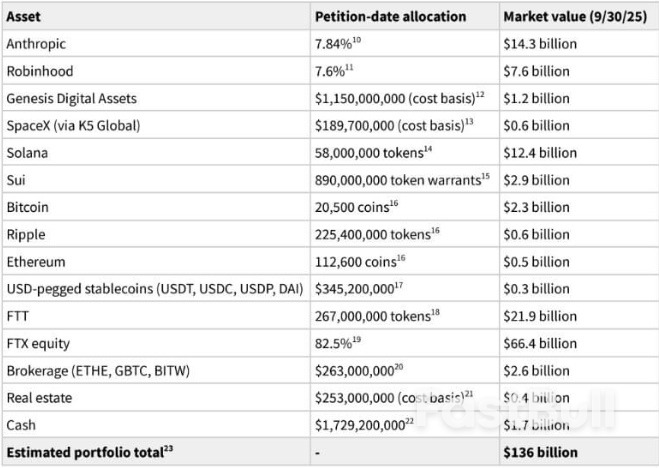
          He reprices the bankrupt firm’s holdings in Solana, Robinhood, Sui, Anthropic, and even the now-worthless FTT token at current values, suggesting that by the end of this year, the basket would be worth roughly $136 billion. This would easily cover the $25 billion he cites in customer and creditor claims.New Prison Report Flouts Claim FTX Could Have Repaid Customers From $25B in Assets_1
          From there, he insists, everyone could have been paid “in full, in kind,” and equity investors would still have walked away with billions.
          However, that reasoning is flawed as it is “solvency by bull market.”
          Bankruptcy law doesn’t allow a failed company to keep trading for years in the hope that rising prices will repair its balance sheet. Once Chapter 11 is filed, claims are frozen at the petition date, converted to dollars, and pursued through recovery, not speculation.
          As former FTX general counsel Ryne Miller pointed out: “That week in November 2022, assets on hand were nothing near adequate, and the founders were fabricating asset lists (and desperately chasing new investors). The coins were gone, folks. Your coins were gone. That’s why bankruptcy happened.”
          This means that much of FTX’s portfolio was built with commingled customer funds. No court would have permitted those assets to remain at risk while management gambled on a rebound.
          Bankman-Fried’s math only works if regulators and creditors had let an exchange under criminal and liquidity stress keep operating normally for two more years, a scenario that borders on fantasy.

          The FTX reboot that never happened

          The same optimism underlies his claim that FTX was “shut down too early.”
          Bankman-Fried insists the exchange was still earning about $3 million a day and nearly $1 billion a year when Ray halted operations. He also maintains that management had identified $6 billion to $8 billion in emergency financing that could have closed the hole “by the end of November 2022.”
          That line of argument assumes FTX remained a going concern, that trading would have continued, customers would have stayed, and the venture portfolio could have avoided fire-sale discounts.
          But by mid-November, the exchange faced a complete collapse of confidence. Counterparties were fleeing, licenses were suspended, and law enforcement agencies were circling. Under those conditions, keeping FTX live would have risked deeper losses and regulatory backlash.
          However, industry experts noted that the bankruptcy estate chose the safer route of freezing accounts, preserving what remained, and pursuing orderly asset recovery under court supervision.
          In fact, Miller suggested that the bankruptcy estate’s decision helped salvage some value, rather than destroying it.
          According to him, the estate’s disciplined management of FTX’s Solana and Anthropic stakes, both of which appreciated sharply in the recovery, became one of the main reasons creditors may now be made whole.
          This means that Bankman-Fried’s portrait of a profitable firm unfairly shuttered by lawyers overlooks those realities. His assumptions about ongoing revenue and investor confidence belong to a world that no longer exists once trust evaporates.

          Competing timelines, competing truths

          At its core, the dispute centers on which timeline defines the company’s reality.
          Bankman-Fried measures solvency by 2025 asset prices and a business that never closed. The bankruptcy estate measures it by what remained in November 2022.
          On the estate’s timeline, FTX faced an $8 billion hole, assets were illiquid or overstated, and fresh funding efforts had stalled. Freezing operations and converting claims to dollars were the only fair course.
          On Bankman-Fried’s timeline, the act of intervention caused the damage as lawyers “commandeered” the company, sold assets into a rising market, incurred nearly $1 billion in fees, and “destroyed” over $120 billion in hypothetical upside.
          That inversion turns the cleanup into the culprit. It reframes a standard court-supervised wind-down as a hostile takeover that allegedly vaporized future value.
          Yet the central fact remains unchanged: when customers demanded their money, FTX was unable to pay. Everything else is retroactive storytelling.
          As blockchain investigator ZachXBT frames it: “SBF is just trying to weaponize the fact that every FTX asset / investment has gone up from picobottom Nov 2022 prices when they factually could not pay out users at the time of bankruptcy and instead point the bankruptcy team as the true villain.”

          Source: Cryptoslate

          Risk Warnings and Disclaimers
          You understand and acknowledge that there is a high degree of risk involved in trading. Following any strategies or investment methods may lead to potential losses. The content on the site is provided by our contributors and analysts for information purposes only. You are solely responsible for determining whether any trading assets, securities, strategy, or any other product is suitable for investing based on your own investment objectives and financial situation.
          Add to Favorites
          Share

          Trump Says Carney Apologized for Ad, But Talks Still On Hold

          Manuel

          Political

          Economic

          US President Donald Trump said he received an apology from Canadian Prime Minister Mark Carney over a television ad that opposed tariffs, but suggested that trade talks between the two countries won’t restart.
          Asked by reporters aboard Air Force One whether negotiations between the White House and Carney’s government would resume, Trump said: “No, but I have a very good relationship. I like him a lot, but you know, what they did was wrong. He was very nice. He apologized for what they did with the commercial.”
          The Canadian dollar fluctuated after the comments and traded at C$1.4018 per US dollar shortly before 2 p.m. New York time, the lowest intraday level in a week. Economic data released by Statistics Canada on Friday showed the trade battle is taking a toll on the economy, with the numbers pointing to just 0.4% annualized growth in the third quarter.
          Earlier Friday, US Energy Secretary Chris Wright said the goal is for the US and Canada to return to the table after talks broke off last week, and for the countries to cooperate more closely on oil, gas and critical minerals.
          There has been friction in the talks between Canada and the US “for some good reasons,” Wright told reporters at the Group of Seven energy and environment ministers’ meeting in Toronto on Friday.
          Trump called off the negotiations last week after the province of Ontario aired an anti-tariff advertisement in the US that drew from a 1987 radio address by former President Ronald Reagan. Trump also threatened an additional 10% tariff on Canada.
          Before the breakdown, Carney said the two countries had been progressing on a deal on steel and aluminum sectoral tariffs, as well as energy. Carney had pitched Trump on reviving the Keystone XL pipeline project.
          “Unfortunately we’ve had some bumps on the road,” Wright said. “I would say the goal is to bring those back together and I think to see cooperation between the United States and Canada across critical minerals, across oil and gas.”
          Trump has also said recently that he’s satisfied with the current trade arrangement between the US and Canada, which includes US import taxes on autos, lumber, steel and aluminum, along with a 35% tariff on other goods not shipped under the US-Mexico-Canada Agreement that Trump signed during his first term.

          Source: Bloomberg

          To stay updated on all economic events of today, please check out our Economic calendar
          Risk Warnings and Disclaimers
          You understand and acknowledge that there is a high degree of risk involved in trading. Following any strategies or investment methods may lead to potential losses. The content on the site is provided by our contributors and analysts for information purposes only. You are solely responsible for determining whether any trading assets, securities, strategy, or any other product is suitable for investing based on your own investment objectives and financial situation.
          Add to Favorites
          Share

          What are rare earth minerals, and why are they central to Trump’s trade deal with China?

          Adam

          Commodity

          Economic

          The US trade deal with China seeks to resolve a major sticking point of their ongoing trade war: rare-earth minerals.
          Despite multiple rounds of talks with US trade negotiators over the past several months, China continued to slow-walk promises to the Trump administration that it would free up crucial rare-earth metals, and earlier guarantees of expedited rare-earth licenses to US companies never materialized. Beijing even tightened earlier this month its controls by massively expanding its restrictions..
          Under Thursday’s deal, China agreed to roll back those newly imposed rules, though the initial restrictions unveiled in April appear to remain in place.
          The tussle over rare earths precedes the current administration; China for years has built up near-total control of the minerals as part of its wider industrial policy.
          Here’s what you need to know about rare earths.
          What are rare earths, and are they actually ‘rare?’
          Rare earths include 17 metallic elements in the periodic table made up of scandium, yttrium and the lanthanides.
          The name “rare earths” is a bit of a misnomer, as the materials are found throughout the Earth’s crust. They are more abundant than gold, but they are difficult and costly to extract and process and are also environmentally damaging.
          What are rare earths used for?
          Rare earths are ubiquitous in everyday technologies, from smartphones to wind turbines to LED lights and flat-screen TVs. They’re crucial for batteries in electric vehicles, as well as MRI scanners and cancer treatments.
          Rare earths are also essential for the US military. They’re used in F-35 fighter jets, submarines, lasers, satellites, Tomahawk missiles and more, according to a 2025 research note from CSIS.
          Where do rare earths come from?
          Sixty-one percent of mined rare earth production comes from China, according to the International Energy Agency, and the country controls 92% of the global output in the processing stage.
          There are two types of rare earths, categorized by their atomic weights: heavy and light. Heavy rare earths are more scarce, and the United States doesn’t have the capability to separate rare earths after extraction.
          “Until the start of the year, whatever heavy rare earths we did mine in California, we still sent to China for separation,” Gracelin Baskaran, director of the Critical Minerals Security Program at the Center for Strategic and International Studies, told CNN.
          However, the Trump administration’s announcement of sky-high tariffs on China in April derailed this process. “China has shown a willingness to weaponize” America’s reliance on China for rare earth separation, she said.
          The US has one operational rare earth mine in California, according to Baskaran.
          Why do rare earths matter in the trade war?
          Beijing is using rare earths as major leverage in the trade war, and its latest restrictions were a major topic of conversation when Xi and Trump met Thursday at the APEC summit in South Korea.
          Earlier this month, China added five rare-earth elements – holmium, erbium, thulium, europium, ytterbium, and related magnets and materials – to its existing control list, requiring export licenses. That makes the total amount of restricted rare earths to 12. China also required licenses to export rare earth manufacturing technologies out of the country.
          It’s not the first time this year that Chinese restrictions on rare earths have angered Trump. In June, Trump said on Truth Social that China violated a trade truce as Beijing kept its export controls on seven rare earth minerals and associated products.
          The export controls could have a major impact, since the US is heavily reliant on China for rare earths. Between 2020 and 2023, 70% of US imports of rare earth compounds and metals came from the country, according to a US Geological Survey report.
          But China’s latest restrictions were seen as a dramatic escalation in Trump’s trade war between the world’s two biggest economic powers.

          Source: cnn

          To stay updated on all economic events of today, please check out our Economic calendar
          Risk Warnings and Disclaimers
          You understand and acknowledge that there is a high degree of risk involved in trading. Following any strategies or investment methods may lead to potential losses. The content on the site is provided by our contributors and analysts for information purposes only. You are solely responsible for determining whether any trading assets, securities, strategy, or any other product is suitable for investing based on your own investment objectives and financial situation.
          Add to Favorites
          Share

          Small Cap Stocks Have Been Lifted by Unprofitable Companies. Can They Continue Climbing?

          Adam

          Stocks

          The froth in U.S. stock markets can be seen in small companies too.
          The Russell 2000 index has outperformed the S&P 500 since this year's April troughs, hitting records this week thanks to bets that interest-rate cuts can keep them climbing. Those hopes have fueled optimism that small-caps—generally, those with market capitalizations between $250 million and $2 billion—will continue to climb.
          But under the hood of the index, some investors see reasons for concern. Unprofitable companies in the Russell 2000 had surged about 19% this year through Oct. 21, more than double the 9% gain for profitable firms, according to Oren Shiran, portfolio manager of the Lazard US Systematic Small Cap Equity ETF (SYZ). And the S&P 600—the small-cap index that requires positive earnings—is up about 2% for the year as of Thursday's close, lower than rates offered by low-risk CDs.
          Investor enthusiasm over the prospect of lower interest rates, which tend to benefit small companies, may have driven the speculative rally, Shiran said in an interview with Investopedia. (Federal Reserve Chair Jerome Powell tempered rate-cut expectations this week after the Fed trimmed its key rate for the second time in as many months, but market participants still expect more cuts are coming.)
          Why This Matters to Investors
          Small-cap rallies have been disappointingly short-lived in the past few years, but experts in that size group say they now have greater conviction that those companies will deliver bigger gains than their larger peers.
          In spite of the speculative lift, fund managers continue to make a case for small-cap stocks, because they are expected to show stronger earnings growth following two years of relatively little movement in profits.
          Also, small-cap valuations remained relatively attractive at the end of the third quarter even after its run-up from April lows. That shows in two ways—the Russell 2000's total market capitalization as a percentage of the total market index Russell 3000 is at 4.4%, substantially lower than the historical average of 7.6% since late 1984, according to Royce Investment Partners. And small-cap valuations compared to large-caps as measured by enterprise value to earnings before interest and taxes, after stripping out companies with profit losses, are near 25-year lows, the firm said. Meanwhile, the Russell 2000's estimated 2025 earnings is expected to rise over 25%, more than double the Russell 1000's 10%.
          A strong U.S. economy is generally seen as particularly helpful to smaller companies, which tend to have less international business. There's uncertainty in that "recent jobs numbers have been underwhelming, consumer confidence is still wobbly and manufacturing data has been sluggish," Francis Gannon, Royce's co-chief investment officer wrote in a quarterly note earlier this month. "However, consumers continue to spend, the economy is growing, and access to capital has widened with the reduction in rates."
          The concerns about small-caps echo those leveled at stocks generally, with indexes at records, but unlike their large counterparts, they haven't had their time in the spotlight for years. If asset prices and historical returns revert to their long-term averages, per mean reversion theory, then small-cap stocks should continue running.

          Source: finance.yahoo

          Risk Warnings and Disclaimers
          You understand and acknowledge that there is a high degree of risk involved in trading. Following any strategies or investment methods may lead to potential losses. The content on the site is provided by our contributors and analysts for information purposes only. You are solely responsible for determining whether any trading assets, securities, strategy, or any other product is suitable for investing based on your own investment objectives and financial situation.
          Add to Favorites
          Share

          Google is finding answers to its AI questions

          Adam

          Economic

          If Google has already moved past its most perilous legal challenge and wiggled out of the perception of playing catch-up to its rivals, the remaining question is one of search economics: How can Google make money from AI without dismantling the foundation of its search business?
          In every quarter this year, and most resoundingly this week, Google's answer to that existential question is that artificial intelligence will expand its users' appetites for information. Google's AI assistant, AI overviews, and AI Mode may eventually supplant the legacy search bar that has built the company. But the search giant's first $100 billion quarter suggests cannibalization isn't the right frame for Google's AI transition. Augmentation is more like it.
          The stock rose 5% following a triumphant report that exceeded expectations and thrust Google's parent Alphabet back into the Big Tech spotlight. Where several of its peers flunked the initial rush after earnings as investors recoiled from ballooning AI spending, Google powered through it. The stock is neck and neck with Nvidia as the best-performing member of the "Magnificent Seven" so far this year, enjoying a gain of more than 50%.
          "Alphabet's execution on artificial intelligence, evidenced by strong traction for its Gemini app, which has more than 650 million monthly users, along with its ability to deliver solid advertising revenue, continues to drive results while refuting the AI-led disruption narrative," Morningstar senior equity analyst Malik Ahmed Khan wrote in a note on Thursday.
          Dan Ives, an analyst at Wedbush, was similarly bullish on Google's search business. The record quarter was a show of strength and marks an inflection point of moving past legal troubles that had weighed on its valuation and escaping the laggard's position in the AI race.
          "Concerns around the impact of genAI on the business are fading, and following a favorable regulatory outcome for the Search business in the DOJ case last month, we are increasingly constructive on the longer-term durability of the segment," Ives wrote in a note on Thursday.
          Investors' reaction to Big Tech's nonstop capex spree can seem fickle. But a reliable way to win approval is to present dazzling earnings, softening the blow of a bigger AI bill, or in Google's case, showing that even gargantuan investments are already paying off. Alphabet increased its capital expenditures forecast for the year to a high point of $93 billion from its previous estimate of $85 billion. Alphabet CFO Anat Ashkenazi emphasized that customer demand for AI technology exceeds supply.
          The company has another ace up its sleeve. Or several. As Bank of America analysts Justin Post and Nitin Bansal wrote in a note after earnings, early-stage bets, including Waymo and quantum computing, offer long-term opportunities that are not reflected in Google's valuation.
          Yes, Google has had its share of consumer product failures (Google Plus, RIP). And even Apple called it quits on its car project. But Google is good at the things it's good at.
          And right now, that's convincing people that the company will be at the center of the AI story.

          Source: finance.yahoo

          To stay updated on all economic events of today, please check out our Economic calendar
          Risk Warnings and Disclaimers
          You understand and acknowledge that there is a high degree of risk involved in trading. Following any strategies or investment methods may lead to potential losses. The content on the site is provided by our contributors and analysts for information purposes only. You are solely responsible for determining whether any trading assets, securities, strategy, or any other product is suitable for investing based on your own investment objectives and financial situation.
          Add to Favorites
          Share
          FastBull
          Copyright © 2025 FastBull Ltd

          728 RM B 7/F GEE LOK IND BLDG NO 34 HUNG TO RD KWUN TONG KLN HONG KONG

          TelegramInstagramTwitterfacebooklinkedin
          App Store Google Play Google Play
          Products
          Charts

          Chats

          Q&A with Experts
          Screeners
          Economic Calendar
          Data
          Tools
          Membership
          Features
          Function
          Markets
          Copy Trading
          Latest Signals
          Contests
          News
          Analysis
          24/7
          Columns
          Education
          Company
          Careers
          About Us
          Contact Us
          Advertising
          Help Center
          Feedback
          User Agreement
          Privacy Policy
          Business

          White Label

          Data API

          Web Plug-ins

          Poster Maker

          Affiliate Program

          Risk Disclosure

          The risk of loss in trading financial instruments such as stocks, FX, commodities, futures, bonds, ETFs and crypto can be substantial. You may sustain a total loss of the funds that you deposit with your broker. Therefore, you should carefully consider whether such trading is suitable for you in light of your circumstances and financial resources.

          No decision to invest should be made without thoroughly conducting due diligence by yourself or consulting with your financial advisors. Our web content might not suit you since we don't know your financial conditions and investment needs. Our financial information might have latency or contain inaccuracy, so you should be fully responsible for any of your trading and investment decisions. The company will not be responsible for your capital loss.

          Without getting permission from the website, you are not allowed to copy the website's graphics, texts, or trademarks. Intellectual property rights in the content or data incorporated into this website belong to its providers and exchange merchants.

          Not Logged In

          Log in to access more features

          FastBull Membership

          Not yet

          Purchase

          Become a signal provider
          Help Center
          Customer Service
          Dark Mode
          Price Up/Down Colors

          Log In

          Sign Up

          Position
          Layout
          Fullscreen
          Default to Chart
          The chart page opens by default when you visit fastbull.com