• Trade
  • Markets
  • Copy
  • Contests
  • News
  • 24/7
  • Calendar
  • Q&A
  • Chats
Trending
Screeners
SYMBOL
LAST
BID
ASK
HIGH
LOW
NET CHG.
%CHG.
SPREAD
SPX
S&P 500 Index
6827.42
6827.42
6827.42
6899.86
6801.80
-73.58
-1.07%
--
DJI
Dow Jones Industrial Average
48458.04
48458.04
48458.04
48886.86
48334.10
-245.98
-0.51%
--
IXIC
NASDAQ Composite Index
23195.16
23195.16
23195.16
23554.89
23094.51
-398.69
-1.69%
--
USDX
US Dollar Index
97.900
97.980
97.900
98.070
97.890
-0.050
-0.05%
--
EURUSD
Euro / US Dollar
1.17426
1.17433
1.17426
1.17447
1.17262
+0.00032
+ 0.03%
--
GBPUSD
Pound Sterling / US Dollar
1.33847
1.33856
1.33847
1.33882
1.33546
+0.00140
+ 0.10%
--
XAUUSD
Gold / US Dollar
4343.26
4343.60
4343.26
4350.16
4294.68
+43.87
+ 1.02%
--
WTI
Light Sweet Crude Oil
57.289
57.319
57.289
57.601
57.194
+0.056
+ 0.10%
--

Community Accounts

Signal Accounts
--
Profit Accounts
--
Loss Accounts
--
View More

Become a signal provider

Sell trading signals to earn additional income

View More

Guide to Copy Trading

Get started with ease and confidence

View More

Signal Accounts for Members

All Signal Accounts

Best Return
  • Best Return
  • Best P/L
  • Best MDD
Past 1W
  • Past 1W
  • Past 1M
  • Past 1Y

All Contests

  • All
  • Trump Updates
  • Recommend
  • Stocks
  • Cryptocurrencies
  • Central Banks
  • Featured News
Top News Only
Share

Russia's Nornickel Sees Global Palladium Market Balanced In 2025, Sees Deficit At 0.2 Moz Including Investments

Share

Russia's Nornickel Sees 2026 Global Palladium Market Deficit At 0.1 Moz Excluding Investments

Share

European Central Bank: Total Value Of Fraud Increased To €4.2 Billion In 2024 From €3.5 Billion In 2023

Share

European Central Bank Report On Payment Fraud: Strong Authentication Remains Effective But Fraudsters Are Adapting

Share

Indian Rupee Ends At Record Closing Low Of 90.7250 Per USA Dollar, Down 0.3% On Day

Share

Romania's Current Account Deficit Widens To 24.64 Billion Euros In Jan-Oct Versus Revised Deficit Of 23.64 Billion Euros In Jan-Oct Year Ago - Central Bank Data

Share

According To A Fox News Reporter, The U.S. Senate Will Hold A Procedural Vote On The Annual Defense Bill Today

Share

India's Nov Gold Imports At $4.02 Billion

Share

India's Nov Oil Imports At $ 14.12 Billion

Share

Kremlin: Ukraine Not Joining NATO Is One Of The Key Questions, But Subject To Special Discussion

Share

Kremlin: After Talks In Berlin Between USA, Europeans And Ukraine, We Expect The USA To Update Moscow On Proposals

Share

EU Official: Witkoff And Kushner Begin Briefing EU Foreign Ministers On Gaza Via Videoconference

Share

Russian Defence Ministry Says Russian Forces Capture Pishchane In Ukraine's Dnipropetrovsk Region

Share

London Metal Exchange: Intends To Publish A Consultation On The Proposed Changes To Our Rules In Response To The Regime Early In2026

Share

London Metal Exchange: Announces Publication Of Update Describing How The London Metal Exchange Plans To Implement The Fca Policy Statement 25/1 On Commodity Reform

Share

USA - Listed Shares Of Gold Miners Rise Premarket After Gold Rises About 1%

Share

The Council Of The European Union: In Light Of The Situation In Venezuela, The Council Decided Today To Extend The Existing Restrictions For Another Year, Until 10 January 2027

Share

Ivory Coast 2025/26 Cocoa Arrivals Reached 894000 T By December 14 Versus 895000 T Year Ago - Exporters' Estimate

Share

Ishares MSCI Chile ETF Up 3.9% Premarket After Jose Antonio Kast Wins Chile's Presidential Election On Sunday

Share

Spain's Debt-To-GDP Ratio Falls To 103.2% In Third Quarter 2025

TIME
ACT
FCST
PREV
China, Mainland M2 Money Supply YoY (Nov)

A:--

F: --

P: --

China, Mainland M0 Money Supply YoY (Nov)

A:--

F: --

P: --

China, Mainland M1 Money Supply YoY (Nov)

A:--

F: --

P: --

India CPI YoY (Nov)

A:--

F: --

P: --

India Deposit Gowth YoY

A:--

F: --

P: --

Brazil Services Growth YoY (Oct)

A:--

F: --

P: --

Mexico Industrial Output YoY (Oct)

A:--

F: --

P: --

Russia Trade Balance (Oct)

A:--

F: --

P: --

Philadelphia Fed President Henry Paulson delivers a speech
Canada Building Permits MoM (SA) (Oct)

A:--

F: --

P: --

Canada Wholesale Sales YoY (Oct)

A:--

F: --

P: --

Canada Wholesale Inventory MoM (Oct)

A:--

F: --

P: --

Canada Wholesale Inventory YoY (Oct)

A:--

F: --

P: --

Canada Wholesale Sales MoM (SA) (Oct)

A:--

F: --

P: --

Germany Current Account (Not SA) (Oct)

A:--

F: --

P: --

U.S. Weekly Total Rig Count

A:--

F: --

P: --

U.S. Weekly Total Oil Rig Count

A:--

F: --

P: --

Japan Tankan Small Manufacturing Outlook Index (Q4)

A:--

F: --

P: --

Japan Tankan Large Non-Manufacturing Diffusion Index (Q4)

A:--

F: --

P: --

Japan Tankan Large Non-Manufacturing Outlook Index (Q4)

A:--

F: --

P: --

Japan Tankan Large Manufacturing Outlook Index (Q4)

A:--

F: --

P: --

Japan Tankan Small Manufacturing Diffusion Index (Q4)

A:--

F: --

P: --

Japan Tankan Large Manufacturing Diffusion Index (Q4)

A:--

F: --

P: --

Japan Tankan Large-Enterprise Capital Expenditure YoY (Q4)

A:--

F: --

P: --

U.K. Rightmove House Price Index YoY (Dec)

A:--

F: --

P: --

China, Mainland Industrial Output YoY (YTD) (Nov)

A:--

F: --

P: --

China, Mainland Urban Area Unemployment Rate (Nov)

A:--

F: --

P: --

Saudi Arabia CPI YoY (Nov)

A:--

F: --

P: --

Euro Zone Industrial Output YoY (Oct)

A:--

F: --

P: --

Euro Zone Industrial Output MoM (Oct)

A:--

F: --

P: --

Canada Existing Home Sales MoM (Nov)

A:--

F: --

P: --

Euro Zone Total Reserve Assets (Nov)

--

F: --

P: --

U.K. Inflation Rate Expectations

--

F: --

P: --

Canada National Economic Confidence Index

--

F: --

P: --

Canada New Housing Starts (Nov)

--

F: --

P: --

U.S. NY Fed Manufacturing Employment Index (Dec)

--

F: --

P: --

U.S. NY Fed Manufacturing Index (Dec)

--

F: --

P: --

Canada Core CPI YoY (Nov)

--

F: --

P: --

Canada Manufacturing Unfilled Orders MoM (Oct)

--

F: --

P: --

U.S. NY Fed Manufacturing Prices Received Index (Dec)

--

F: --

P: --

U.S. NY Fed Manufacturing New Orders Index (Dec)

--

F: --

P: --

Canada Manufacturing New Orders MoM (Oct)

--

F: --

P: --

Canada Core CPI MoM (Nov)

--

F: --

P: --

Canada Trimmed CPI YoY (SA) (Nov)

--

F: --

P: --

Canada Manufacturing Inventory MoM (Oct)

--

F: --

P: --

Canada CPI YoY (Nov)

--

F: --

P: --

Canada CPI MoM (Nov)

--

F: --

P: --

Canada CPI YoY (SA) (Nov)

--

F: --

P: --

Canada Core CPI MoM (SA) (Nov)

--

F: --

P: --

Canada CPI MoM (SA) (Nov)

--

F: --

P: --

Federal Reserve Board Governor Milan delivered a speech
U.S. NAHB Housing Market Index (Dec)

--

F: --

P: --

Australia Composite PMI Prelim (Dec)

--

F: --

P: --

Australia Services PMI Prelim (Dec)

--

F: --

P: --

Australia Manufacturing PMI Prelim (Dec)

--

F: --

P: --

Japan Manufacturing PMI Prelim (SA) (Dec)

--

F: --

P: --

U.K. 3-Month ILO Employment Change (Oct)

--

F: --

P: --

U.K. Unemployment Claimant Count (Nov)

--

F: --

P: --

U.K. Unemployment Rate (Nov)

--

F: --

P: --

Q&A with Experts
    • All
    • Chatrooms
    • Groups
    • Friends
    Connecting
    .
    .
    .
    Type here...
    Add Symbol or Code

      No matching data

      All
      Trump Updates
      Recommend
      Stocks
      Cryptocurrencies
      Central Banks
      Featured News
      • All
      • Russia-Ukraine Conflict
      • Middle East Flashpoint
      • All
      • Russia-Ukraine Conflict
      • Middle East Flashpoint
      Search
      Products

      Charts Free Forever

      Chats Q&A with Experts
      Screeners Economic Calendar Data Tools
      Membership Features
      Data Warehouse Market Trends Institutional Data Policy Rates Macro

      Market Trends

      Market Sentiment Order Book Forex Correlations

      Top Indicators

      Charts Free Forever
      Markets

      News

      News Analysis 24/7 Columns Education
      From Institutions From Analysts
      Topics Columnists

      Latest Views

      Latest Views

      Trending Topics

      Top Columnists

      Latest Update

      Signals

      Copy Rankings Latest Signals Become a signal provider AI Rating
      Contests
      Brokers

      Overview Brokers Assessment Rankings Regulators News Claims
      Broker listing Forex Brokers Comparison Tool Live Spread Comparison Scam
      Q&A Complaint Scam Alert Videos Tips to Detect Scam
      More

      Business
      Events
      Careers About Us Advertising Help Center

      White Label

      Data API

      Web Plug-ins

      Affiliate Program

      Awards Institution Evaluation IB Seminar Salon Event Exhibition
      Vietnam Thailand Singapore Dubai
      Fans Party Investment Sharing Session
      FastBull Summit BrokersView Expo
      Recent Searches
        Top Searches
          Markets
          News
          Analysis
          User
          24/7
          Economic Calendar
          Education
          Data
          • Names
          • Latest
          • Prev

          View All

          No data

          Scan to Download

          Faster Charts, Chat Faster!

          Download App
          English
          • English
          • Español
          • العربية
          • Bahasa Indonesia
          • Bahasa Melayu
          • Tiếng Việt
          • ภาษาไทย
          • Français
          • Italiano
          • Türkçe
          • Русский язык
          • 简中
          • 繁中
          Open Account
          Search
          Products
          Charts Free Forever
          Markets
          News
          Signals

          Copy Rankings Latest Signals Become a signal provider AI Rating
          Contests
          Brokers

          Overview Brokers Assessment Rankings Regulators News Claims
          Broker listing Forex Brokers Comparison Tool Live Spread Comparison Scam
          Q&A Complaint Scam Alert Videos Tips to Detect Scam
          More

          Business
          Events
          Careers About Us Advertising Help Center

          White Label

          Data API

          Web Plug-ins

          Affiliate Program

          Awards Institution Evaluation IB Seminar Salon Event Exhibition
          Vietnam Thailand Singapore Dubai
          Fans Party Investment Sharing Session
          FastBull Summit BrokersView Expo

          Fed's Powell Announces Policy Framework Tweaks for Changed Economic Landscape

          Glendon

          Forex

          Economic

          Summary:

          Nodding toward significant changes in the economic landscape over the last five years, Federal Reserve Chair Jerome Powell on Friday announced an updated operating framework for the U.S. central bank that reflects the return of higher inflation pressures and reduced prospect of near zero short-term interest rates.

          Nodding toward significant changes in the economic landscape over the last five years, Federal Reserve Chair Jerome Powell on Friday announced an updated operating framework for the U.S. central bank that reflects the return of higher inflation pressures and reduced prospect of near zero short-term interest rates.

          Announcing the changes in a speech to be delivered to the Jackson Hole economic symposium in Wyoming, Powell said "there is a great deal of continuity with past statements" in the new framework.

          "We continue to believe that monetary policy must be forward-looking and consider the lags in its effects on the economy" and that the Fed must balance risks to both its job and inflation mandates when setting monetary policy, Powell said. He added that setting numerical goals for things like the ideal level of employment is "unwise."

          The new operating edict moves away from what had been an omnipresent challenge of monetary policy having to operate at very low interest rates due to what had been a period of very low inflation relative to the Fed's 2% target, the landscape that informed its 2020 policy review.

          Powell said in the new framework "we removed language" about the low-rate environment and "we returned to a framework of flexible inflation targeting and eliminated the 'makeup' strategy" featured in the 2020 framework, the last time the Fed updated its overall operating principles.

          "Our revised statement emphasizes our commitment to act forcefully to ensure that longer-term inflation expectations remain well-anchored, to the benefit of both sides of our dual mandate," Powell added.

          The review of the central bank's operating principles was widely expected. The minutes from the central bank's July 29-30 policy meeting, released on Wednesday, had noted the overhaul "would be designed to be robust across a wide range of economic conditions."

          That was a nod to the fact that the last iteration was quickly overrun by the events of the COVID-19 pandemic. The agenda advanced then said the Fed would allow inflation to overshoot the 2% target to make up for periods when the central bank had fallen short of the goal.

          Powell said under the new principles "we take into account the extent of departures from our goals and the potentially different time horizons over which each is projected to return to a level consistent with our dual mandate."

          IMPACT OF PANDEMIC

          The last framework was adopted in the context of a Fed that at that time had been contending with an extended period of very weak inflation pressures, which had in turn led to a long period of very low short-term interest rates. Low rates complicated the Fed's ability to respond to economic shocks.

          Source: Yahoo Finance

          To stay updated on all economic events of today, please check out our Economic calendar
          Risk Warnings and Disclaimers
          You understand and acknowledge that there is a high degree of risk involved in trading. Following any strategies or investment methods may lead to potential losses. The content on the site is provided by our contributors and analysts for information purposes only. You are solely responsible for determining whether any trading assets, securities, strategy, or any other product is suitable for investing based on your own investment objectives and financial situation.
          Add to Favorites
          Share

          US Stops Issuing Visas For Commercial Truck Drivers

          Samantha Luan

          Economic

          Political

          The US is immediately pausing the issuance of all worker visas for commercial truck drivers, US Secretary of State Marco Rubio said on Thursday."The increasing number of foreign drivers operating large tractor-trailer trucks on US roads is endangering American lives and undercutting the livelihoods of American truckers," Rubio said in a post on X.

          The administration of President Donald Trump has taken a series of steps to address concerns about foreign truck drivers who do not speak English. Trump in April signed an executive order directing enforcement of a rule requiring commercial drivers in the US to meet English-proficiency standards.

          Earlier this week, Transportation Secretary Sean Duffy said the Federal Motor Carrier Safety Administration (FMCSA) has launched an investigation into a crash on a Florida highway that killed three people. The crash involved a driver who was an Indian national and did not speak English or have legal authorisation to be in the US, according to Florida and US officials.

          Harjinder Singh has been charged with three counts of vehicular homicide and police said he attempted to make an illegal U-turn through an “Official Use Only” access point blocking traffic and causing the fatal crash that resulted in the deaths of three people in a minivan that struck the truck.Florida officials took custody of Singh in California to return him to the state to face charges.

          A lawyer for Singh could not immediately be identified.

          While the English-proficiency standard for truckers was already longstanding US law, Trump's executive order in April reversed 2016 guidance that inspectors not place commercial drivers out of service if their only violation was lack of English.Duffy has said that failing to adequately enforce driver qualification standards poses serious safety concerns and increases the likelihood of crashes.

          FMCSA said in 2023 that about 16% of US truck drivers were born outside the US. Last month, Reuters reported that Mexican truck drivers in the border city of Ciudad Juarez have begun studying English in efforts to comply with the Trump order.

          Source: Theedgemarkets

          To stay updated on all economic events of today, please check out our Economic calendar
          Risk Warnings and Disclaimers
          You understand and acknowledge that there is a high degree of risk involved in trading. Following any strategies or investment methods may lead to potential losses. The content on the site is provided by our contributors and analysts for information purposes only. You are solely responsible for determining whether any trading assets, securities, strategy, or any other product is suitable for investing based on your own investment objectives and financial situation.
          Add to Favorites
          Share

          Should We Worry About Falling US Bank Reserves?

          Adam

          Economic

          In September 2019, the system creaked as the Fed had gone too far with bank reserves reduction. We’re facing a similar challenge in the coming months as the Treasury replenishes its cash buffer. We identify a range from $2.5tr to $3tr within which bank reserves can settle, likely at the upper end. And if there’s an issue, the Fed can always rebuild them
          Here’s Why US Bank Reserves Today Are So Much Higher Than They Were. And Why They Are Now Falling
          Before the Great Financial Crisis (GFC) bank reserves were typically around $0.2tr, as banks only held cash at the Fed for regulatory reasons – the Fed paid zero percent interest on them. The GFC prompted a number of phases of Fed bond buying – quantitative easing (QE) – which meant banks built reserves (other side of the QE trade).
          To facilitate this, the Fed remunerated banks at a newly introduced rate on reserves (currently 4.4%). Fast forward to the subsequent pandemic-induced QE, and the US banking system has become structurally characterized as a large reserve volume one.
          At the same time, recent years have allowed the Federal Reserve to slowly deflate the excess of liquidity, predominantly through the reverse repo facility. This facility allows market participants to post excess liquidity at the Federal Reserve. At its peak in 2022/2023, some $2.5tr of overnight liquidity routinely went back to the Fed.
          Mostly as a consequence of post-pandemic quantitative tightening (QT), these balances are now running at below $50bn. More recently, it’s been given a further push lower, as the lift of the debt ceiling allowed the US Treasury to issue more bills for the purpose of rebuilding its cash buffer.
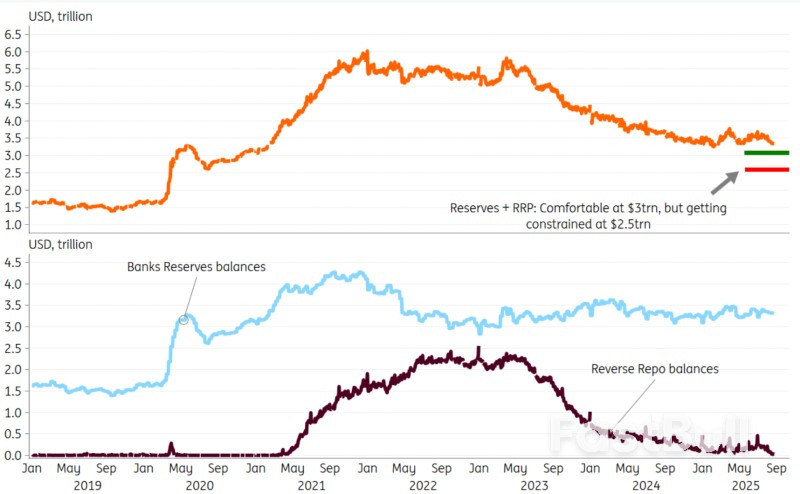
          With reverse repo facility balances approaching zero, and with the US Treasury continuing to rebuild its cash buffer, the likely next phase sees this show up in reductions in bank reserves. Bank reserves are currently running at $3.3tr. They actually peaked at over $4tr in 2021 as the Fed’s QE programme saw a crescendo.
          Since 2022, bank reserves have been broadly steady, albeit within a wide $0.5tr range. Why? Because up till now, most of the unwind of post-pandemic excess liquidity happened through reductions in balances going back to the Fed on the reverse repo facility.
          Ahead Bank Reserves Can Lurch Lower as the Treasury Rebuilds Its Cash Buffer at the Fed
          Going forward, bank reserves will be far more responsive to liquidity variations. The policy push here is the c.$20bn that continues to roll off the Fed’s balance sheet through what is now quite a tame QT-lite.
          But the biggest direct liquidity push of late is coming from the US Treasury, as the build in their cash buffer has a counterpart in lower bank reserves. That Treasury cash buffer is now at $550bn. It could get to $800bn (a staging area in the past). If it did, it would mean bank reserves falling by $250bn, pulling bank reserves down towards $3tr. Should we worry about this?
          The last time the Fed actively allowed bank reserves to fall was during the QE unwind (QT) that finally concluded in 2019. In September of that year, the Fed discovered that they had gone too far. Bank reserves had been halved to $1.4tr by then, and at that month end there was a severe disruption as the market struggled to deal with a dearth of liquidity, manifesting in a huge spike in repo rates.
          The system basically haemorrhaged, partly driven by a relatively moderate corporate tax payment need of some $120bn. So what did the Fed do in response? They went ahead and rebuilt bank reserves through repo, and ultimately by buying T-bills. That’s the recipe; rebuild reserves if seen to be too low. The Fed has likely learnt from this experience.
          The Big Question Is Whether This Can Become a Problem, and at What Level Does the System Creak (As It Did Before)
          The follow-on question is what level of bank reserves are comfortable? To help answer this question we can refer back to the 2019 experience, which can at the very least identify a floor where reserves would be too low. Far from perfect, but one thing we can do is make a judgement on reserves based off them a percent of GDP.
          In September 2019, that percent hit a low of 6.5%. That was forced back up towards 8% as the Fed rebuilt reserves. That type of level should be considered an absolute floor.
          Calibrating this to today and projecting over the coming six month, that would equate to a bank reserves balance of some $2.5tr (at 8%). Then 9% reserves would be $2.8tr, while 10% would be $3.1trn. Simplistically, if 8% is a floor, then 9% offers some comfort to that floor, while 10% is likely very comfortable. The current level of bank reserves is $3.3tr, so we’re comfortably above the most conservative level of $3.1tr.
          What if the US Treasury goes ahead of adds a further $250bn to its cash buffer? Basically, this would bring bank reserves to the conservative 10% area. We should be fine there. At the same time, QT is shaving reserves by some $20bn per month (note that the $35bn cap on MBS roll-offs is rarely hit).
          That can further eat into reserves. That said, it seems to us that even then, circumstances are relatively comfortable. It may in fact also turn out that 9% is a doable level of bank reserves as percent of GDP, equating to $2.8tr of reserves.
          Identifying the Range $2.5tr (tight) to $3tr (Comfortable)
          The top chart is bank reserves plus the reverse repo balances
          Should We Worry About Falling US Bank Reserves?_1
          Bottom Line, the System Can Handle a Fall in Reserves. Worst Case, the Fed Rebuilds Them
          In the end though, the Fed is likely to be super conservative here. The US is a high reserves banking system, and the Fed will not want to be seen to be leaving the market short. If there was the evolution of a shortage, the Fed would engage in a rebuild of reserves.
          They could do this in a temporary fashion through the Fed’s standing repo facility (currently broadly unused), or in a more permanent fashion through buying bills. They could also do this through buying bonds, but might prefer not to, as it could be construed as QE.
          By all means watch this space, as it’s important for the proper functioning of the system. But we would be of the opinion that the Fed is on the case, and will manage to avoid a repeat of September 2019.

          Source: investing

          To stay updated on all economic events of today, please check out our Economic calendar
          Risk Warnings and Disclaimers
          You understand and acknowledge that there is a high degree of risk involved in trading. Following any strategies or investment methods may lead to potential losses. The content on the site is provided by our contributors and analysts for information purposes only. You are solely responsible for determining whether any trading assets, securities, strategy, or any other product is suitable for investing based on your own investment objectives and financial situation.
          Add to Favorites
          Share

          European Markets Turn Cautiously Optimistic Ahead of Powell Speech

          Warren Takunda

          Stocks

          Leading European stock markets reflected a cautiously positive sentiment on Friday as investors watched for progress on Ukraine peace talks and awaited a speech from US Federal Reserve chair Jerome Powell. He will speak on Friday at Jackson Hole, where central bankers gather for their annual meeting.
          Markets also digested details of an EU-US trade truce and better-than-expected business activity data, announced on Thursday.
          Despite the news that the German economy shrank more than initially estimated in the second quarter, the German DAX changed direction and made up its earlier losses, gaining around 0.1% after 11.00 CEST.
          The FTSE 100, though trading in negative territory all morning, also followed suit and changed course, gaining a few points by late morning.
          The Paris CAC 40 was up 0.2%, the Madrid IBEX 35 rose by 0.4%, and the European benchmark STOXX 600 increased by 0.2%.
          As for the London blue chip index, the early morning slight dip appeared to be just a small correction. "The FTSE 100 saw a subdued start on Friday after achieving a record close above 9,300 yesterday,” said AJ Bell investment analyst Dan Coatsworth in his note.
          Investors are focusing on the message Federal Reserve chair Jerome Powell might deliver at the Jackson Hole summit in Wyoming.
          “Investors had been expecting a rate cut from the Fed next month so if Powell were to say anything suggesting rates might be kept on hold, it could see stocks come under greater pressure," said Coatsworth. He added that robust PMI data from the US on Thursday pointed to a strong economy, potentially reducing the chances of the Fed lowering borrowing costs.
          A cut in interest rates would be the first of the year and it would give asset prices and the economy a boost — but it could also risk worsening inflation.
          The Fed has been hesitant to cut interest rates this year out of fear that President Donald Trump's tariffs could push inflation higher, but a surprisingly weak report on employment growth earlier this month suddenly shifted focus towards the job market. Trump, meanwhile, has forcefully pushed for cuts to interest rates, directing fierce criticism towards Powell.

          US markets closed in a gloomy mood

          On Wall Street on Thursday, the S&P 500 slipped 0.4% to 6,370.17, continuing a gradual decline since a record on 14 August. The Dow Jones Industrial Average dropped 0.3% to 44,875.50, and the Nasdaq composite fell 0.3% to 21,100.31.
          In other dealings early on Friday, the US dollar rose to 148.48 Japanese yen, from 148.37 yen. The euro slipped to $1.1590 from $1.1606.
          Meanwhile, oil prices fell by midday in Europe; the US benchmark crude lost 0.2% and was traded at $63.38 per barrel. Brent crude, the international standard, also was down by 0.2% at $67.52 per barrel.
          Oil prices moved higher yesterday, "as the initial enthusiasm over progress towards a ceasefire between Russia and Ukraine continues to fade", said ING in a note. Expectations of increased global uncertainty are driven by the difficulties of setting up a Putin-Zelensky summit and securing potential security guarantees for Ukraine.

          Asian markets were also mixed on Friday

          Asian shares were also mixed on Friday. In Tokyo, the Nikkei 225 rose less than 0.1% to 42,633.29 after Japan's core inflation rate slowed to 3.1% in July, from 3.3% in June.
          ING Economics said in a note that price pressures were broadly in line with market consensus. Inflation staying above 3% raises the likelihood of a rate hike as soon as October, it said.
          In Chinese markets, Hong Kong's Hang Seng index rose 0.9% to 25,339.14. The Shanghai composite index climbed 1.5% to 3,825.76.
          South Korea's Kospi added 0.9% to 3,168.73. Australia's S&P/ASX 200 fell 0.6% to 8,967.40 as traders sold to lock in gains after the benchmark surged to record highs in recent trading sessions.

          Source: Euronews

          Risk Warnings and Disclaimers
          You understand and acknowledge that there is a high degree of risk involved in trading. Following any strategies or investment methods may lead to potential losses. The content on the site is provided by our contributors and analysts for information purposes only. You are solely responsible for determining whether any trading assets, securities, strategy, or any other product is suitable for investing based on your own investment objectives and financial situation.
          Add to Favorites
          Share

          The U.S.-EU Deal Is Here. Europe's Businesses Remain on Edge

          Michelle

          Economic

          The U.S. and European Union granted businesses some desperately sought after clarity as they shared fresh details on their trade agreement on Thursday, but questions remain about whether the deal can really be trusted.

          Thursday's update broadly echoed the framework announced by the U.S. and EU in July, which called for 15% tariffs as well as pledges for Brussels to amp up spending and investment in the U.S. New details include a cap of 15% tariffs on pharmaceuticals, lumber and semiconductors. Autos will face the same rate, but only after the EU makes legislation changes to reduce its industrial duties.

          However, EU Trade Commissioner Maros Sefcovic on Thursday suggested the framework was just the beginning, leaving the door open for future changes to the deal.

          Missing details

          Despite providing some much-needed clarity, there are still various smaller, yet crucial, aspects missing from the current framework.

          A muted market reaction from pharmaceuticals on Thursday highlighted investor skepticism and there was no mention of the wine and spirits sector in the deal.

          "A lot of the details remain to be worked out," Penny Naas, who leads on the German Marshall Fund's allied strategic competitiveness work, told CNBC, pointing to for example so-called 'rules of origin.'

          "These rules determine where value is most added to a product that contains multiple parts from multiple countries, and when it can be labeled 'European' or 'American,'" she explained. Naas noted that these rules come into play when it comes to for example transshipments — a process in which goods might originate from one country, but are then sent to another for final shipment to the U.S.

          Carsten Brzeski, ING's global head of macro, meanwhile pointed out uncertainties "stemming from formalities and procedures at customs," which he says are particularly impacting small and medium-sized enterprises.

          Some companies are already facing issues in this regard, with firms having to "recruit tariff specialists in order to clarify the new customs requirements," he said.

          Trump's flip-flopping

          Another concern is U.S. President Donald Trump's history of fact-paced changes of heart and policy shifts, Antonio Fatás, professor of economics at the European Institute of Business Administration (INSEAD), told CNBC.

          The president for example doubled steep steel tariffs overnight, and later quietly expanded their scope.

          Elsewhere, Switzerland was victim to the president's erratic decision making, with the country reportedly having been extremely close to a deal, which was then however pulled by Trump as he slapped 39% duties on Swiss exports to the U.S. almost overnight.

          "The real issue for business is how to define a long-term strategy with a country that is no longer a reliable partner," Fatás said. "What used to be the most reliable partner for Europe has now become one of the most volatile, if not the worst, when it comes to economic policies," he added.

          The German Marshall Fund's Naas also flagged this as a risk for businesses.

          "This deal does not include any enforcement provisions, nor will it be codified by Congress, which means it could change at the direction of the U.S. President," she said.

          Naas pointed to Section 232 tariffs as an example, with Trump having changed tariff rates on some products "at a moment's notice, and the Administration has expanded the scope to cover other products without warning."

          To trust or not to trust?

          Businesses are therefore left with a key question: to trust or not to trust the deal.

          While Thursday's statement adds some clarity, the deal "remains fragile and could quickly dissolve," ING's Brzeski said in a note after the announcement. "The agreement contains numerous elements that could spark future tensions and escalation. Implementation, monitoring and enforcement of many of the intentions is not always clear," he added.

          Naas echoed the calls for caution. While the U.S.-EU agreement appears "more likely to be stable" than some of Trump's other tariff policies like sectoral duties, it "will require the EU to remain on "good behavior" or else risk a sudden change," she said.

          In addition to the uncertainties about the stability of the U.S.-EU deal, businesses are also contending with questions regarding various global shifts in the market, according to Gregor Hirt, multi-asset chief investment officer at Allianz Global Investors.

          He told CNBC businesses are facing several key questions: "Is the US heading toward a recession or even worse, stagflation, and how resilient will companies' margin be in this kind of environment, especially considering the high market valuation in the US? Moreover, what further tools do policymakers have to counter a potential downturn, for example in terms of deregulation or specific sector 'incentives'?"

          "And, finally, how will the shift away from global trade liberalisation and institutionalize framework affect long-term investment and supply chain strategies?" Hirt said, adding that these tariff-related issues are also key for companies ability to plan in the current environment.

          Source: CNBC

          To stay updated on all economic events of today, please check out our Economic calendar
          Risk Warnings and Disclaimers
          You understand and acknowledge that there is a high degree of risk involved in trading. Following any strategies or investment methods may lead to potential losses. The content on the site is provided by our contributors and analysts for information purposes only. You are solely responsible for determining whether any trading assets, securities, strategy, or any other product is suitable for investing based on your own investment objectives and financial situation.
          Add to Favorites
          Share

          Natural Gas and Oil Forecast: Brent Eyes $70 Test, WTI Holds Gains, Gas Stuck in Bearish Zone

          Adam

          Commodity

          Market Overview

          WTI crude oil held above $63.5 per barrel on Friday, pacing for its first weekly gain in three weeks amid strong U.S. demand signals and broader geopolitical tensions. U.S. stockpiles posted their sharpest nationwide draw since mid-June, though a build at Cushing hinted at weaker underlying demand.
          Refinery runs and robust exports contributed to the decline. Meanwhile, natural gas prices remained pressured as markets assessed supply risks alongside global uncertainty.
          Traders also awaited Federal Reserve Chair Powell’s Jackson Hole remarks for policy guidance, which could further sway energy demand and market direction.

          Natural Gas Price Forecast

          Natural Gas and Oil Forecast: Brent Eyes $70 Test, WTI Holds Gains, Gas Stuck in Bearish Zone_1Natural Gas (NG) Price Chart

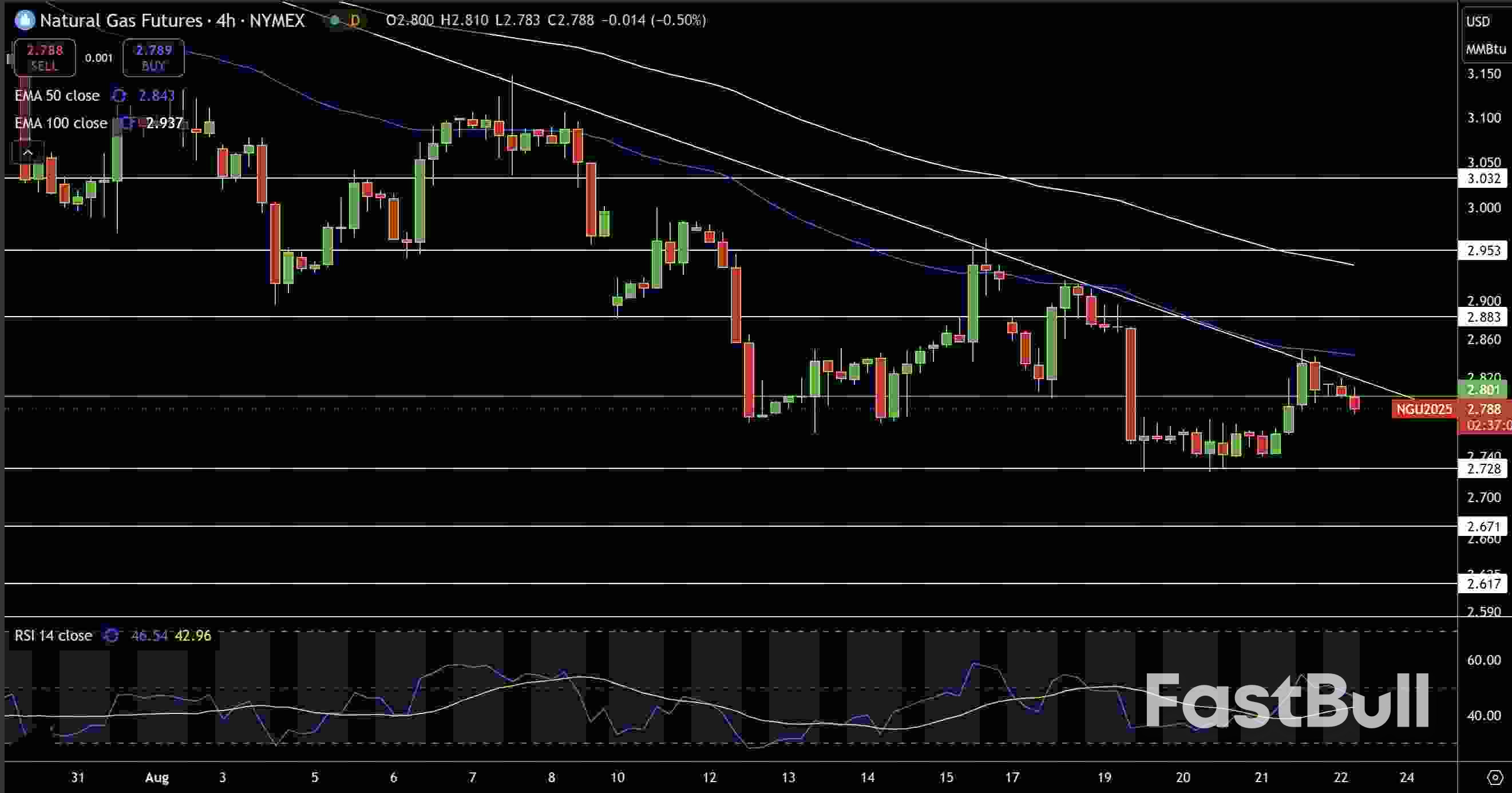
          Natural gas futures ($NG) are trading at $2.78, slipping under trendline resistance after failing to sustain above $2.80. The 50-EMA ($2.84) and 100-EMA ($2.93) continue to slope downward, reinforcing bearish momentum. Support sits at $2.72 and $2.67, with a break lower exposing $2.61.
          RSI at 46 signals weak momentum, staying below neutral, while repeated lower highs highlight ongoing downside pressure. Bulls need a decisive close above $2.88 to target $2.95 and $3.03, but until then, the bias remains cautious to bearish.
          For now, natural gas is stuck in a downtrend, with sellers maintaining control unless price reclaims key moving averages and breaks the descending structure.

          WTI Oil Price Forecast

          Natural Gas and Oil Forecast: Brent Eyes $70 Test, WTI Holds Gains, Gas Stuck in Bearish Zone_2WTI Price Chart

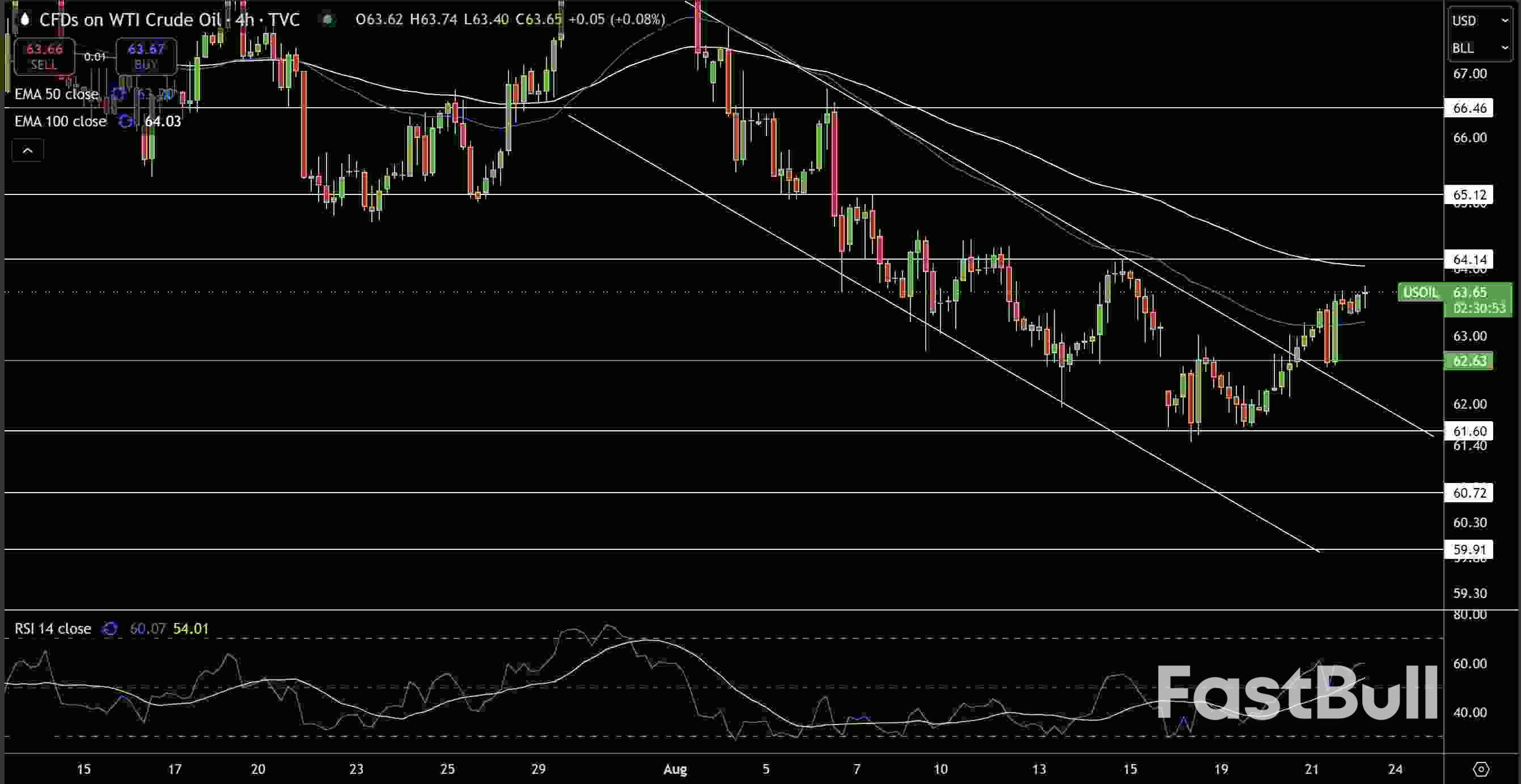
          WTI crude oil ($USOIL) is testing resistance at $64.14 after rebounding from support at $62.63. The price has broken out of its descending channel, suggesting buyers are regaining control. Both the 50-EMA ($63.20) and 100-EMA ($64.03) are acting as near-term pivots, with the market attempting to hold above them.
          RSI at 60 signals moderate bullish momentum, though not yet overbought. A clear move above $64.14 could open the path toward $65.12 and $66.46, while failure to hold $62.63 risks a pullback to $61.60.
          For now, crude oil is in a cautious recovery phase, with traders watching if bulls can sustain pressure above the EMAs for further upside.

          Brent Oil Price Forecast

          Natural Gas and Oil Forecast: Brent Eyes $70 Test, WTI Holds Gains, Gas Stuck in Bearish Zone_3Brent Price Chart

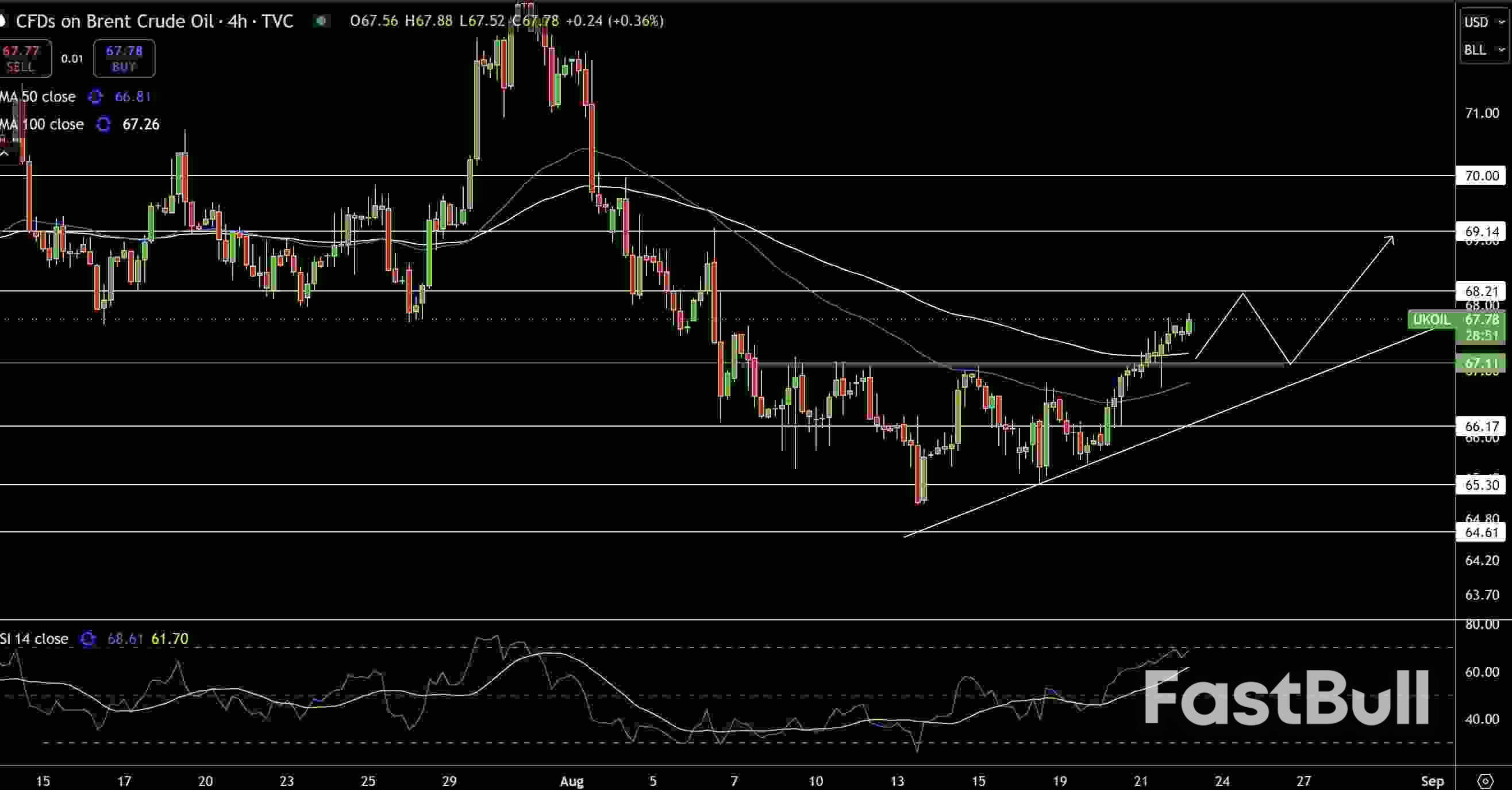
          Brent crude ($UKOIL) is trading at $67.78, testing resistance at $68.21 after a steady climb supported by a rising trendline. The 50-EMA ($66.81) and 100-EMA ($67.26) are converging, reinforcing short-term support at $67.11. A breakout above $68.21 could open the path toward $69.14 and the psychological $70.00 mark.
          RSI at 68 suggests strong bullish momentum but nearing overbought conditions, hinting at possible pullbacks before further gains. If price fails to sustain above $67.11, downside levels lie at $66.17 and $64.61.
          For now, Brent remains in a recovery phase, with buyers in control as long as price holds above the rising trendline and key EMA levels.

          Source: fxempire

          Risk Warnings and Disclaimers
          You understand and acknowledge that there is a high degree of risk involved in trading. Following any strategies or investment methods may lead to potential losses. The content on the site is provided by our contributors and analysts for information purposes only. You are solely responsible for determining whether any trading assets, securities, strategy, or any other product is suitable for investing based on your own investment objectives and financial situation.
          Add to Favorites
          Share

          Bank of England to Cut in November Say These Economists

          Warren Takunda

          Central Bank

          Markets headed into this week thinking the Bank of England could still sneak in another interest rate cut before the year is out, even if the August 07 policy meeting caused reason to be more cautious.
          However, this week's above-consensus inflation print appears to have convinced the market that November is now off, with the odds of such a cut now less than 50/50.
          However, some economists have looked at the data in detail and calibrated it against the Bank of England's guidance, and reckon a cut is still likely in November.
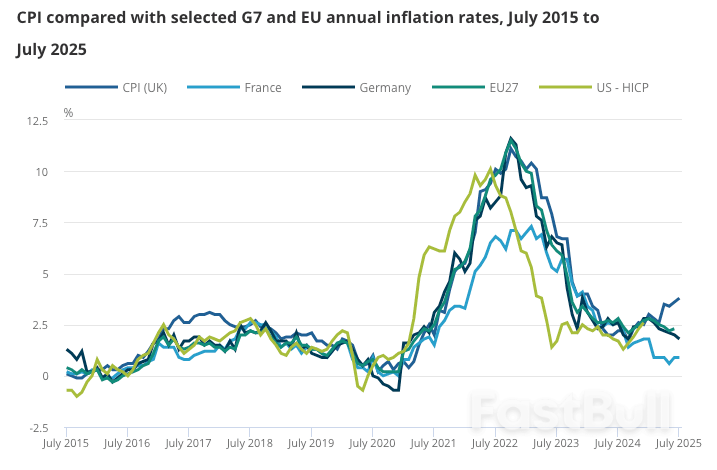
          Morgan Stanley says the Bank of England will look through the July spike in prices, noting that strong air fares helped the surprise above-consensus outcome of 3.8% year-on-year in headline CPI.
          Indeed, the outcome is still in line with the Bank's August forecasts. Even strong food price inflation - 4.9% y/y - was in line with expectations. Services CPI, which the Bank pays close attention to rose to 5.0% from 4.7% y/y.
          "To us, the marginal news today is that the June inflexion in underlying services inflation was halted. For the BoE, we think, there is not much in here to change existing priors. We look for the next cut in November," says Bruna Skarica, an economist at Morgan Stanley.
          Bank of England to Cut in November Say These Economists_1

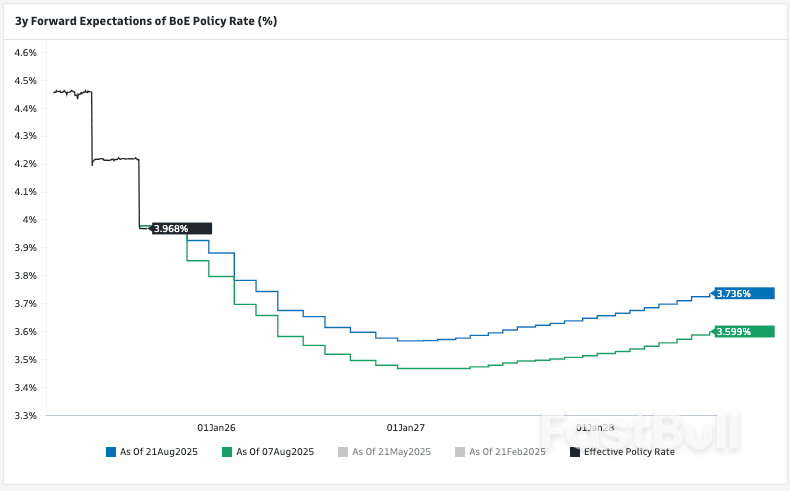
          Above: Market-implied expectations show investors see less cuts ahead.

          Oxford Economics is also not willing to shift its stance on the UK outlook based on Wednesday's inflation figures, saying the above-consensus reading was the result of seasonal factors that should soon fade.
          Oxford Economics forecasts inflation to average 3.5% this year and 2.8% in 2026. "There was little in the way of genuine news that shifted the monetary policy debate in either a more hawkish or dovish direction," says Andrew Goodwin, Chief UK Economist at Oxford Economics.
          "We continue to think that several more Bank Rate cuts are likely over the next 18 months. However, there's now considerable uncertainty around the timing of those moves, and a scenario in which the MPC slowly feels its way to a neutral level over a long time horizon is becoming more compelling," adds Goodwin.
          Economists at UniCredit are particularly 'dovish' on the outlook for UK interest rates, still expecting two rates cuts over the rest of this year and 75bp of cuts next year, more than financial markets expect.
          Bank of England to Cut in November Say These Economists_2

          Above: UK inflation is trending higher, whereas it's closing in on target in other countries.

          Daniel Vernazza, Chief International Economist at UniCredit in London, acknowledges that the 2025 cuts might be skipped, but this is merely a delay and not a reduction in the total to come.
          From a financial markets standpoint, this is an important call, as it implies cuts will be backloaded, hinting at notable GBP downside to come.
          "We see the bank rate ending next year at 2.75%, which we see as broadly neutral. At the time of writing, financial markets are pricing only a 70% probability of 25bp cut in the remainder of this year, and only 40bp of cuts by the end of next year, to 3.6%," says Vernazza.
          HSBC economists expect the Bank to cut rates to 3.0% by Q3 2026, implying four more cuts spread over that period.
          According to HSBC's FX Strategist, Nick Andrews, this should weaken GBP versus the EUR. "Given the impact of government policies on growth and inflation over the last year, we also think the Autumn Budget poses a risk to GBP over the coming months."
          However, not all economists are convinced and are inclined to err on the side of the market in expecting limited scope for further rate cuts, based on the observation that the economy isn't exactly crying out for support.
          "We still expect the MPC to remain on hold for the rest of 2025, which is slightly tighter policy than the current market pricing of 0.5 cuts by December," says Robert Wood, Chief UK Economist at Pantheon Macroeconomics.
          "Major data in the UK have increasingly outperformed over the course of the year," he explains.

          Source: Poundsterlinglive

          Risk Warnings and Disclaimers
          You understand and acknowledge that there is a high degree of risk involved in trading. Following any strategies or investment methods may lead to potential losses. The content on the site is provided by our contributors and analysts for information purposes only. You are solely responsible for determining whether any trading assets, securities, strategy, or any other product is suitable for investing based on your own investment objectives and financial situation.
          Add to Favorites
          Share
          FastBull
          Copyright © 2025 FastBull Ltd

          728 RM B 7/F GEE LOK IND BLDG NO 34 HUNG TO RD KWUN TONG KLN HONG KONG

          TelegramInstagramTwitterfacebooklinkedin
          App Store Google Play Google Play
          Products
          Charts

          Chats

          Q&A with Experts
          Screeners
          Economic Calendar
          Data
          Tools
          Membership
          Features
          Function
          Markets
          Copy Trading
          Latest Signals
          Contests
          News
          Analysis
          24/7
          Columns
          Education
          Company
          Careers
          About Us
          Contact Us
          Advertising
          Help Center
          Feedback
          User Agreement
          Privacy Policy
          Business

          White Label

          Data API

          Web Plug-ins

          Poster Maker

          Affiliate Program

          Risk Disclosure

          The risk of loss in trading financial instruments such as stocks, FX, commodities, futures, bonds, ETFs and crypto can be substantial. You may sustain a total loss of the funds that you deposit with your broker. Therefore, you should carefully consider whether such trading is suitable for you in light of your circumstances and financial resources.

          No decision to invest should be made without thoroughly conducting due diligence by yourself or consulting with your financial advisors. Our web content might not suit you since we don't know your financial conditions and investment needs. Our financial information might have latency or contain inaccuracy, so you should be fully responsible for any of your trading and investment decisions. The company will not be responsible for your capital loss.

          Without getting permission from the website, you are not allowed to copy the website's graphics, texts, or trademarks. Intellectual property rights in the content or data incorporated into this website belong to its providers and exchange merchants.

          Not Logged In

          Log in to access more features

          FastBull Membership

          Not yet

          Purchase

          Become a signal provider
          Help Center
          Customer Service
          Dark Mode
          Price Up/Down Colors

          Log In

          Sign Up

          Position
          Layout
          Fullscreen
          Default to Chart
          The chart page opens by default when you visit fastbull.com