• Trade
  • Markets
  • Copy
  • Contests
  • News
  • 24/7
  • Calendar
  • Q&A
  • Chats
Trending
Screeners
SYMBOL
LAST
BID
ASK
HIGH
LOW
NET CHG.
%CHG.
SPREAD
SPX
S&P 500 Index
6814.87
6814.87
6814.87
6861.30
6801.50
-12.54
-0.18%
--
DJI
Dow Jones Industrial Average
48360.66
48360.66
48360.66
48679.14
48285.67
-97.38
-0.20%
--
IXIC
NASDAQ Composite Index
23092.70
23092.70
23092.70
23345.56
23012.00
-102.46
-0.44%
--
USDX
US Dollar Index
97.970
98.050
97.970
98.070
97.740
+0.020
+ 0.02%
--
EURUSD
Euro / US Dollar
1.17436
1.17444
1.17436
1.17686
1.17262
+0.00042
+ 0.04%
--
GBPUSD
Pound Sterling / US Dollar
1.33687
1.33697
1.33687
1.34014
1.33546
-0.00020
-0.01%
--
XAUUSD
Gold / US Dollar
4303.02
4303.36
4303.02
4350.16
4285.08
+3.63
+ 0.08%
--
WTI
Light Sweet Crude Oil
56.354
56.384
56.354
57.601
56.233
-0.879
-1.54%
--

Community Accounts

Signal Accounts
--
Profit Accounts
--
Loss Accounts
--
View More

Become a signal provider

Sell trading signals to earn additional income

View More

Guide to Copy Trading

Get started with ease and confidence

View More

Signal Accounts for Members

All Signal Accounts

Best Return
  • Best Return
  • Best P/L
  • Best MDD
Past 1W
  • Past 1W
  • Past 1M
  • Past 1Y

All Contests

  • All
  • Trump Updates
  • Recommend
  • Stocks
  • Cryptocurrencies
  • Central Banks
  • Featured News
Top News Only
Share

New York Fed Accepts $2.601 Billion Of $2.601 Billion Submitted To Reverse Repo Facility On Dec 15

Share

Turkey: Shoots Down A Drone In The Black Sea Using F-16 Fighter Jets

Share

Goldman Sachs Says They Believe That The Copper Price Is Vulnerable To An Ai-Linked Price Correction

Share

Goldman Sachs Upgrades 2026 Copper Price Forecast To $11400 From $10,650

Share

Attempts By Ukrainian Troops To Advance From The South-West To Outskirts Of Kupiansk Are Being Thwarted

Share

Russian Troops Control All Of Kupiansk - IFX Cites Russian Military

Share

On Monday (December 15), The South Korean Won Ultimately Rose 0.60% Against The US Dollar, Closing At 1468.91 Won. The Won Was On An Upward Trend Throughout The Day, Rising Significantly At 17:00 Beijing Time And Reaching A Daily High Of 1463.04 Won At 17:36

Share

Health Ministry: Israeli Forces Kill Palestinian Teen In West Bank

Share

New York Federal Reserve President Williams: Over Time, The Size Of Reserves Could Grow From $2.9 Trillion

Share

New York Fed President Williams: AI Valuations Are High, But There Is A Real Driving Factor

Share

New York Federal Reserve President Williams: The Job Market Is In Very Good Shape

Share

New York Fed President Williams: 'Very Supportive' Of USA Central Bank's Decision To Cut Interest Rates Last Week

Share

New York Fed President Williams: 'Too Early To Say' What Central Bank Should Do At January Meeting

Share

New York Fed President Williams: Strong Markets Part Of Reason Why Economy Will Grow Robustly In 2026

Share

New York Fed President Williams: What Constitutes Ample Reserves Will Change Over Time

Share

New York Fed President Williams: Market Valuations 'Elevated,' But There Are Reasons For Pricing

Share

New York Fed President Williams: Ample Reserves System Working Very Well

Share

New York Fed President Williams: Some Signs That Parts Of Underlying Economy Not As Strong As GDP Data Suggests

Share

New York Fed President Williams: Expects Coming Job Data Will Show Gradual Cooling

Share

Ukraine President Zelenskiy: Monitoring Of Ceasefire Should Be Part Of Security Guarantees

TIME
ACT
FCST
PREV
Japan Tankan Small Manufacturing Outlook Index (Q4)

A:--

F: --

P: --

Japan Tankan Large Non-Manufacturing Outlook Index (Q4)

A:--

F: --

P: --

Japan Tankan Large Manufacturing Outlook Index (Q4)

A:--

F: --

P: --

Japan Tankan Small Manufacturing Diffusion Index (Q4)

A:--

F: --

P: --

Japan Tankan Large-Enterprise Capital Expenditure YoY (Q4)

A:--

F: --

P: --

U.K. Rightmove House Price Index YoY (Dec)

A:--

F: --

P: --

China, Mainland Industrial Output YoY (YTD) (Nov)

A:--

F: --

P: --

China, Mainland Urban Area Unemployment Rate (Nov)

A:--

F: --

P: --

Saudi Arabia CPI YoY (Nov)

A:--

F: --

P: --

Euro Zone Industrial Output YoY (Oct)

A:--

F: --

P: --

Euro Zone Industrial Output MoM (Oct)

A:--

F: --

P: --

Canada Existing Home Sales MoM (Nov)

A:--

F: --

P: --

Canada National Economic Confidence Index

A:--

F: --

P: --

Canada New Housing Starts (Nov)

A:--

F: --

P: --
U.S. NY Fed Manufacturing Employment Index (Dec)

A:--

F: --

P: --

U.S. NY Fed Manufacturing Index (Dec)

A:--

F: --

P: --

Canada Core CPI YoY (Nov)

A:--

F: --

P: --

Canada Manufacturing Unfilled Orders MoM (Oct)

A:--

F: --

P: --

U.S. NY Fed Manufacturing Prices Received Index (Dec)

A:--

F: --

P: --

U.S. NY Fed Manufacturing New Orders Index (Dec)

A:--

F: --

P: --

Canada Manufacturing New Orders MoM (Oct)

A:--

F: --

P: --

Canada Core CPI MoM (Nov)

A:--

F: --

P: --

Canada Trimmed CPI YoY (SA) (Nov)

A:--

F: --

P: --

Canada Manufacturing Inventory MoM (Oct)

A:--

F: --

P: --

Canada CPI YoY (Nov)

A:--

F: --

P: --

Canada CPI MoM (Nov)

A:--

F: --

P: --

Canada CPI YoY (SA) (Nov)

A:--

F: --

P: --

Canada Core CPI MoM (SA) (Nov)

A:--

F: --

P: --

Canada CPI MoM (SA) (Nov)

A:--

F: --

P: --

Federal Reserve Board Governor Milan delivered a speech
U.S. NAHB Housing Market Index (Dec)

A:--

F: --

P: --

Australia Composite PMI Prelim (Dec)

--

F: --

P: --

Australia Services PMI Prelim (Dec)

--

F: --

P: --

Australia Manufacturing PMI Prelim (Dec)

--

F: --

P: --

Japan Manufacturing PMI Prelim (SA) (Dec)

--

F: --

P: --

U.K. 3-Month ILO Employment Change (Oct)

--

F: --

P: --

U.K. Unemployment Claimant Count (Nov)

--

F: --

P: --

U.K. Unemployment Rate (Nov)

--

F: --

P: --

U.K. 3-Month ILO Unemployment Rate (Oct)

--

F: --

P: --

U.K. Average Weekly Earnings (3-Month Average, Including Bonuses) YoY (Oct)

--

F: --

P: --

U.K. Average Weekly Earnings (3-Month Average, Excluding Bonuses) YoY (Oct)

--

F: --

P: --

France Services PMI Prelim (Dec)

--

F: --

P: --

France Composite PMI Prelim (SA) (Dec)

--

F: --

P: --

France Manufacturing PMI Prelim (Dec)

--

F: --

P: --

Germany Services PMI Prelim (SA) (Dec)

--

F: --

P: --

Germany Manufacturing PMI Prelim (SA) (Dec)

--

F: --

P: --

Germany Composite PMI Prelim (SA) (Dec)

--

F: --

P: --

Euro Zone Composite PMI Prelim (SA) (Dec)

--

F: --

P: --

Euro Zone Services PMI Prelim (SA) (Dec)

--

F: --

P: --

Euro Zone Manufacturing PMI Prelim (SA) (Dec)

--

F: --

P: --

U.K. Services PMI Prelim (Dec)

--

F: --

P: --

U.K. Manufacturing PMI Prelim (Dec)

--

F: --

P: --

U.K. Composite PMI Prelim (Dec)

--

F: --

P: --

Euro Zone ZEW Economic Sentiment Index (Dec)

--

F: --

P: --

Germany ZEW Current Conditions Index (Dec)

--

F: --

P: --

Germany ZEW Economic Sentiment Index (Dec)

--

F: --

P: --

Euro Zone Trade Balance (Not SA) (Oct)

--

F: --

P: --

Euro Zone ZEW Current Conditions Index (Dec)

--

F: --

P: --

Euro Zone Trade Balance (SA) (Oct)

--

F: --

P: --

Euro Zone Total Reserve Assets (Nov)

--

F: --

P: --

U.K. Inflation Rate Expectations

--

F: --

P: --

Q&A with Experts
    • All
    • Chatrooms
    • Groups
    • Friends
    Connecting
    .
    .
    .
    Type here...
    Add Symbol or Code

      No matching data

      All
      Trump Updates
      Recommend
      Stocks
      Cryptocurrencies
      Central Banks
      Featured News
      • All
      • Russia-Ukraine Conflict
      • Middle East Flashpoint
      • All
      • Russia-Ukraine Conflict
      • Middle East Flashpoint
      Search
      Products

      Charts Free Forever

      Chats Q&A with Experts
      Screeners Economic Calendar Data Tools
      Membership Features
      Data Warehouse Market Trends Institutional Data Policy Rates Macro

      Market Trends

      Market Sentiment Order Book Forex Correlations

      Top Indicators

      Charts Free Forever
      Markets

      News

      News Analysis 24/7 Columns Education
      From Institutions From Analysts
      Topics Columnists

      Latest Views

      Latest Views

      Trending Topics

      Top Columnists

      Latest Update

      Signals

      Copy Rankings Latest Signals Become a signal provider AI Rating
      Contests
      Brokers

      Overview Brokers Assessment Rankings Regulators News Claims
      Broker listing Forex Brokers Comparison Tool Live Spread Comparison Scam
      Q&A Complaint Scam Alert Videos Tips to Detect Scam
      More

      Business
      Events
      Careers About Us Advertising Help Center

      White Label

      Data API

      Web Plug-ins

      Affiliate Program

      Awards Institution Evaluation IB Seminar Salon Event Exhibition
      Vietnam Thailand Singapore Dubai
      Fans Party Investment Sharing Session
      FastBull Summit BrokersView Expo
      Recent Searches
        Top Searches
          Markets
          News
          Analysis
          User
          24/7
          Economic Calendar
          Education
          Data
          • Names
          • Latest
          • Prev

          View All

          No data

          Scan to Download

          Faster Charts, Chat Faster!

          Download App
          English
          • English
          • Español
          • العربية
          • Bahasa Indonesia
          • Bahasa Melayu
          • Tiếng Việt
          • ภาษาไทย
          • Français
          • Italiano
          • Türkçe
          • Русский язык
          • 简中
          • 繁中
          Open Account
          Search
          Products
          Charts Free Forever
          Markets
          News
          Signals

          Copy Rankings Latest Signals Become a signal provider AI Rating
          Contests
          Brokers

          Overview Brokers Assessment Rankings Regulators News Claims
          Broker listing Forex Brokers Comparison Tool Live Spread Comparison Scam
          Q&A Complaint Scam Alert Videos Tips to Detect Scam
          More

          Business
          Events
          Careers About Us Advertising Help Center

          White Label

          Data API

          Web Plug-ins

          Affiliate Program

          Awards Institution Evaluation IB Seminar Salon Event Exhibition
          Vietnam Thailand Singapore Dubai
          Fans Party Investment Sharing Session
          FastBull Summit BrokersView Expo

          ‘Free Fall’: Nightmare Coming Our Way As Iron Ore Price Bottoms Out

          Alex

          Commodity

          Summary:

          The golden goose of the Australian economy is taking a hammering and it could spell big trouble for everyday Aussies.
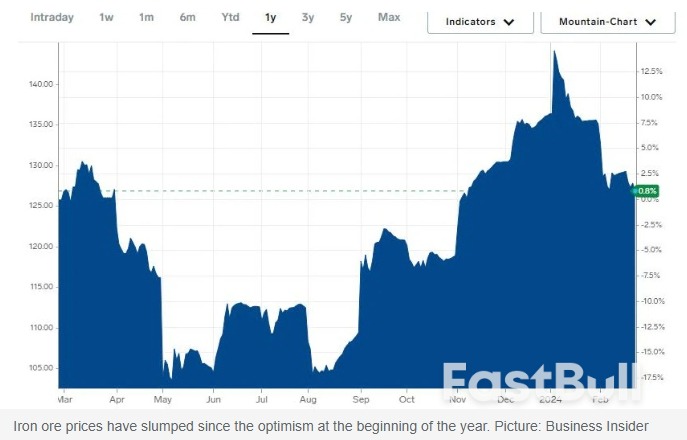
          The backbone of Australia’s export economy that generates a massive proportion of Australia’s tax dollars is in free fall as our most precious commodity — iron ore — sinks to worryingly new lows.
          The red dirt is the golden goose of the Australian economy and pockets the nation $124 billion a year.
          It is used to make steel, which in turn is used to create buildings, infrastructure, ships, trains, cars, machines and electrical appliances.
          It’s all stuff that China smashes out in massive numbers and it means our two countries are bound together on iron ore in a mutual dependency.
          However, this week a major problem has hit the nation’s miners as iron ore fell to the lowest price since October — after dropping almost 9 per cent last week alone.
          This is bad news for everyday Aussies as WA’s iron ore miners contribute a major proportion of Australia’s tax take — estimated to be nearly 18 per cent of the nationwide total tax income.
          If you look back to the start of the year, it was estimated a multi-month surge in iron ore prices would deliver Treasurer Jim Chalmers as much as $18 billion in extra tax revenue.
          This raised hopes of a second federal budget surplus and funding another round of subsidies for voters.
          At that time, iron ore had rallied to $US145 per tonne, its highest price since April 2022. It was hoped that China’s economic recovery was gaining momentum thanks to a combination of monetary and fiscal stimulus.
          However, expectations have now come crashing down as the money hasn’t been forthcoming from Beijing.
          Bloomberg reports local governments in China have so far appeared reluctant or unable to borrow more. That’s fuelling expectations Beijing may pick up the slack and take on more debt.
          As a consequence, the price has slid 12 per cent at the start of the year — with the price now sitting at $US127.
          MB Fund and MB Super chief strategist David Llewellyn-Smith said iron ore was in “free fall”.
          But it could get much, much worse.
          The biggest concern outside of China’s woes is that an iron ore oversupply is likely to flood the market from next year as the massive Simandou mine in Africa starts exporting and delivering ore.
          According to Forbes, a well-connected Australian fund manager said the increase in iron ore supply could potentially knock $US50 a tonne off the price, driving it down to around $US80.
          If correct, the analysis of Yarra Capital could trigger a 49 per cent fall in the earnings of Aussie mining giants BHP and Rio Tinto and a 65 per cent fall in the earnings of Fortescue.‘Free Fall’: Nightmare Coming Our Way As Iron Ore Price Bottoms Out_1
          The slump in China has come at a bad time too given that March and April are typically busy months for construction.
          In a move that is sparking concern Vale SA, the world’s second-largest iron ore producer, is looking to increase its sales outside of China. This means miners are worried China may not bounce back as previously expected.
          In fact, experts say China’s economy is in the doldrums.
          Losses on the Shanghai stock market on Monday came despite Beijing saying it wanted to boost sales of cars, appliances and other consumer products in “piecemeal incentives to stimulate the economy,” noted National Australia Bank senior currencies strategist Rodrigo Catril.
          Government interventions have stabilised the market, with Chinese stocks rebounding from early February lows.
          But underlying weakness means “investors are crying out for larger economic supports to be rolled out,” Moody’s Analytics economist Harry Murphy Cruise told AFP.
          Market players are watching to see if extra spending and an ambitious growth target will be announced in March to help China’s economy gain momentum through the year, according to Mr Cruise.
          In Australia meanwhile, the market has reacted poorly to the news coming out of China.
          BHP’s share price has dropped 5.93 per cent in the past month and Rio Tinto’s has dropped 7.14 per cent over the same period.

          Source:news

          Risk Warnings and Disclaimers
          You understand and acknowledge that there is a high degree of risk involved in trading. Following any strategies or investment methods may lead to potential losses. The content on the site is provided by our contributors and analysts for information purposes only. You are solely responsible for determining whether any trading assets, securities, strategy, or any other product is suitable for investing based on your own investment objectives and financial situation.
          Add to Favorites
          Share

          Australia CPI Unexpectedly Lower Than Forecast At 3.4%

          Zi Cheng

          Traders' Opinions

          Economic

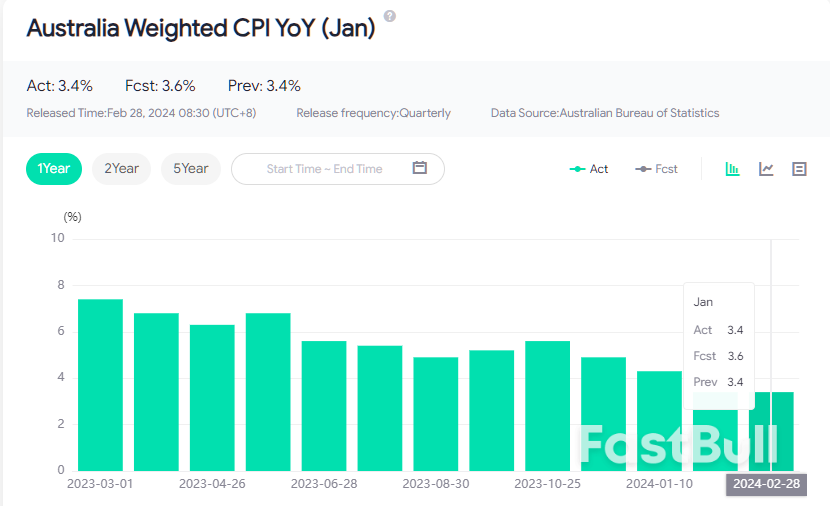
          In January, inflation remained unchanged at a two-year low, supported by declining prices for meat and seafood, fueling speculation that the Reserve Bank might accelerate interest rate cuts.
          According to the Australian Bureau of Statistics, the consumer price index for January stood at 3.4%. Economists had projected an increase to 3.6% from December's 3.4%.
          Australia CPI Unexpectedly Lower Than Forecast At 3.4%_1
          Annual inflation in the food and non-alcoholic beverages category saw a slight uptick to 4.4% last month from 4% in December. However, prices for meat and seafood experienced a 2% decrease compared to the previous year, slightly deeper than December's 1.9% decline.
          Government intervention also played a role in mitigating some of the price escalations. For example, in January, electricity prices were 0.8% higher than the previous year, with rebates helping to temper the increase.
          "Excluding the impact of rebates, electricity prices would have surged by 15.3% over the twelve months leading to January 2024," noted Michelle Marquardt, head of prices statistics at the ABS.
          Meanwhile, rental costs continued their significant upward trajectory, matching December's 7.4% increase from January 2023, as vacancy rates remained historically low in certain capitals.
          Treasurer Jim Chalmers highlighted the government's role in mitigating rent increases, stating that rents would have risen by 9.1% without the Commonwealth Rent Assistance boost. Chalmers emphasized that while inflation trends were encouraging, challenges persisted for households.
          Monthly CPI data can exhibit greater volatility compared to quarterly figures due to the partial nature of the ABS survey of goods and services. Nevertheless, they offer insights into inflationary pressures within the economy.
          The Reserve Bank aims to ensure that inflation remains on track to return within its target range of 2%-3% by next year and around 2.5% by 2026. Despite raising its cash rate 13 times between May 2022 and November 2023 to a 12-year high of 4.35%, the bank observed in the minutes from its February board meeting that goods price inflation had declined more than anticipated, while services inflation remained elevated and was expected to decrease gradually.
          Ahead of the CPI release, investors estimated a minimal 5% chance of a rate cut by the RBA at its upcoming meeting on 18-19 March, according to the ASX's rates tracker. Following a review of its operations released last year, the RBA board will now convene eight times a year instead of eleven.
          Market reactions to today's CPI figures were subdued, with the Australian dollar holding steady near 65.5 US cents, and the stock market maintaining its slight losses for the day, hovering around 0.1%.
          To stay updated on all economic events of today, please check out our Economic calendar
          Risk Warnings and Disclaimers
          You understand and acknowledge that there is a high degree of risk involved in trading. Following any strategies or investment methods may lead to potential losses. The content on the site is provided by our contributors and analysts for information purposes only. You are solely responsible for determining whether any trading assets, securities, strategy, or any other product is suitable for investing based on your own investment objectives and financial situation.
          Add to Favorites
          Share

          New Zealand Keep Interest Rate Same As Previous At 5.5%

          Zi Cheng

          Traders' Opinions

          Economic

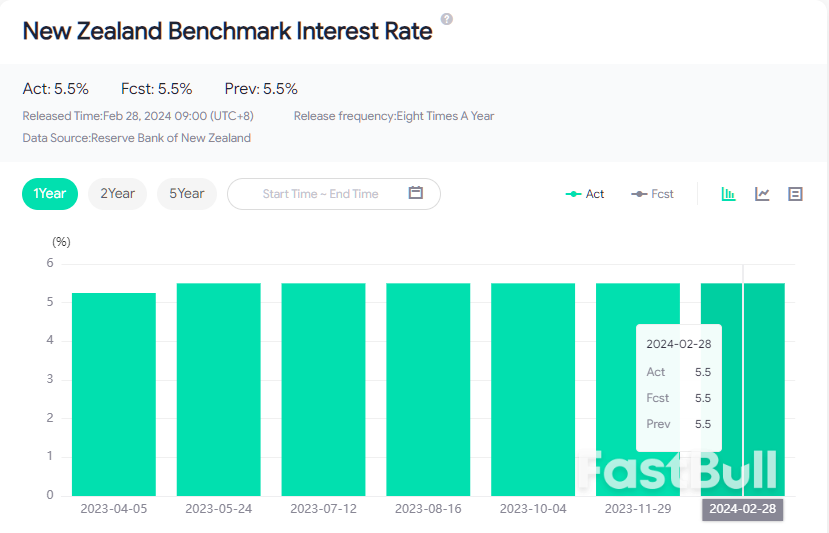
          New Zealand's central bank decided to leave interest rates untouched and eased its stance on potential rate hikes in response to indications of diminishing inflationary pressures. Consequently, the domestic currency experienced a decline.
          On Wednesday in Wellington, the Reserve Bank's Monetary Policy Committee, as anticipated by 22 out of 24 economists surveyed by Bloomberg, maintained the Official Cash Rate at 5.5%. The bank's latest projections suggest a slightly reduced likelihood of a rate hike occurring this year, with no anticipated cuts until 2025.
          New Zealand Keep Interest Rate Same As Previous At 5.5%_1
          The RBNZ is hesitant to consider a shift towards monetary easing due to the enduring nature of price pressures, coupled with concerns that heightened inflation expectations might solidify. New Zealand's inflation rate, standing at 4.7%, significantly surpasses the bank's 2% target and exceeds that of numerous comparable economies.
          The RBNZ anticipates that annual consumer price index inflation will align with its target range by the third quarter of 2024.
          In its statement, the RBNZ emphasized the necessity of maintaining current tight monetary policy measures to mitigate the risk of inflation expectations rising, while simultaneously avoiding undue volatility in output, employment, interest rates, and the exchange rate.
          Furthermore, the central bank acknowledged that persistent factors such as high interest rates, stubborn inflation, and subdued international demand continue to apply pressure on the New Zealand economy, contributing to a tempering effect on inflationary trends.
          Following the RBNZ's decision, the New Zealand dollar depreciated by 0.8%, as the bank's stance was perceived as less hawkish than what the markets had anticipated. Notably, the RBNZ refrained from signaling any further interest rate hikes during this announcement.
          Between August 2021 and May 2023, the RBNZ had increased its official cash rate by a cumulative 525 basis points, positioning itself as one of the first major central banks to address the post-COVID surge in inflation.
          However, the progression of major cyclones in early 2023 disrupted the bank's efforts to combat inflation to some extent, as price pressures surged in the aftermath of reconstruction efforts following these disasters.
          The central bank anticipates modest economic growth for the current year, reassuring that the economy will avoid recession, supported by robust immigration levels. New Zealand witnessed its most significant annual population increase since the conclusion of World War II in 2023.
          To stay updated on all economic events of today, please check out our Economic calendar
          Risk Warnings and Disclaimers
          You understand and acknowledge that there is a high degree of risk involved in trading. Following any strategies or investment methods may lead to potential losses. The content on the site is provided by our contributors and analysts for information purposes only. You are solely responsible for determining whether any trading assets, securities, strategy, or any other product is suitable for investing based on your own investment objectives and financial situation.
          Add to Favorites
          Share

          Oil Eases As Fed Caution Outweighs Talk Of OPEC+ Cut Extensions

          Samantha Luan
          Oil prices slipped in early Asian trade on Wednesday as the prospect of a delayed U.S. rate cutting cycle offset the boost provided by talk of extensions to production cuts from OPEC+.
          Brent crude futures fell 38 cents, or 0.45%, to $83.27 a barrel by 0110 GMT, while U.S. West Texas Intermediate crude futures (WTI) were down 35 cents, or 0.44%, to $78.52 a barrel.
          Investor sentiment has continued to be influenced by signals of a later start to U.S. rate cuts due to concerns over persistent inflation.
          On Tuesday, Federal Reserve Governor Michelle Bowman signalled she is in no rush to cut U.S. interest rates, particularly given upside risks to inflation that could stall progress on controlling price pressures or even lead to their resurgence.
          This followed similar remarks from Kansas City Federal Reserve Bank President Jeffrey Schmid on Monday. High borrowing costs typically reduce economic growth and oil demand.
          On Tuesday, U.S. President Biden said Israel has agreed to halt military activities in Gaza for the Muslim holy month of Ramadan. However, Israel and Hamas as well as Qatari mediators all sounded notes of caution about progress towards a truce in Gaza.
          Attacks on ships in the Red Sea by Iran-aligned Houthis in Yemen in support of the Palestinians have increased freight rates and shipping times. A negotiated ceasefire in Gaza could lead to easing tensions in the global shipping artery.
          Prices for both crude benchmarks rose more than $1 per barrel on Tuesday after Reuters reported that the Organization of the Petroleum Exporting Countries and allies led by Russia (OPEC+) will consider extending voluntary oil output cuts into the second quarter, to provide additional support for the market. Two sources said the cuts could be in place until the end of the year.
          Last November, OPEC+ agreed to voluntary cuts totalling about 2.2 million barrels per day (bpd) for the first quarter this year, led by Saudi Arabia rolling over its own voluntary cut.
          Also on Tuesday, Russian authorities announced a six-month ban on gasoline exports from March 1 to compensate for rising demand from consumers and farmers and to allow for planned maintenance of refineries.

          Source:Reuters

          Risk Warnings and Disclaimers
          You understand and acknowledge that there is a high degree of risk involved in trading. Following any strategies or investment methods may lead to potential losses. The content on the site is provided by our contributors and analysts for information purposes only. You are solely responsible for determining whether any trading assets, securities, strategy, or any other product is suitable for investing based on your own investment objectives and financial situation.
          Add to Favorites
          Share

          Consumer Confidence Slips In February Over Potential Recession Anxiety

          Samantha Luan

          Economic

          American consumers are feeling less confident this month as concerns over a possible recession grew despite most recent data pointing to a healthy U.S. economy.
          The Conference Board, a business research group, said Tuesday that its consumer confidence index fell to 106.7 from a revised 110.9 in January. Analysts had been forecasting that the index remained steady from January to February. The decline in the index comes after three straight months of improvement.
          The index measures both Americans’ assessment of current economic conditions and their outlook for the next six months.
          The index measuring Americans short-term expectations for income, business and the job market fell to 79.8 from 81.5 in January. A reading under 80 often signals an upcoming recession.
          Consumers’ view of current conditions also retreated, falling to 147.2 from 154.9.
          The decline in consumer confidence this month comes as somewhat of a surprise as the economy continues to show resilience in the face of higher interest rates and inflation. Though price growth has receded considerably in the past year, inflation remains above the Federal Reserve’s 2% target.
          Consumer spending accounts for about 70% of U.S. economic activity, so economists pay close attention to consumer behavior as they take measure of the broader economy.
          Overall, confidence is barely above the average from last year, which was 105.4, according to Stephen Stanley, an economist at Santander, a bank.
          Americans were slightly less worried about food and gas prices last month, the Conference Board said, but expressed more concern about jobs and the ongoing presidential campaign.
          Consumers’ expectations of future inflation fell to their lowest level since March 2020. Lower inflation expectations are a positive sign because they can become self-fulfilling: If people expect prices to rise rapidly in the months ahead, they may accelerate their purchases, which can fuel more price hikes.
          Yet even as inflation concerns wane, the proportion of Americans who said jobs were “easy to get” fell.
          “In the case of jobs, the market is still strong, it’s just much less strong than a year ago when job swapping for higher pay was easy,” said Robert Frick, an economist at the Navy Federal Credit Union. “And now the contentious election season is coming closer into view, and national elections strongly influence perceptions of the economy.”
          In a bid to combat four-decade high inflation in the wake of the pandemic, the Federal Reserve raised its benchmark rate 11 times beginning in March 2022. However, the central bank has left rates alone at its last four meetings and is expected to start cutting rates later this year, which is expected to further boost an already strong economy.
          The government reported last month that the nation’s economy grew at an unexpectedly brisk 3.3% annual pace from October through December as Americans showed a continued willingness to spend freely.
          Despite some recent high-profile layoffs, the labor market continues to churn out jobs. U.S. employers added 353,000 jobs in January and the unemployment rate stayed at 3.7%, just above a half-century low.
          Though most economists did not anticipate a decline in consumer confidence this month, there doesn’t appear to be great concern that an uptick in pessimism will be sustained.
          “Overall, consumers are set to benefit from declining interest rates as the Fed starts to lower the target range this year,” said Rubeela Farooqi, chief U.S. economist at High Frequency Economics, “which should be supportive of sentiment over time.”
          In another contradictory twist, the number of people in the Conference Board’s survey who said they planned to make a big-ticket purchase like a car or major appliance in the next six months rose.

          Source:Newslooks

          To stay updated on all economic events of today, please check out our Economic calendar
          Risk Warnings and Disclaimers
          You understand and acknowledge that there is a high degree of risk involved in trading. Following any strategies or investment methods may lead to potential losses. The content on the site is provided by our contributors and analysts for information purposes only. You are solely responsible for determining whether any trading assets, securities, strategy, or any other product is suitable for investing based on your own investment objectives and financial situation.
          Add to Favorites
          Share

          Gold Price Creeps Lower, Holds Narrow Range Before US GDP Release

          Alex

          Commodity

          Forex

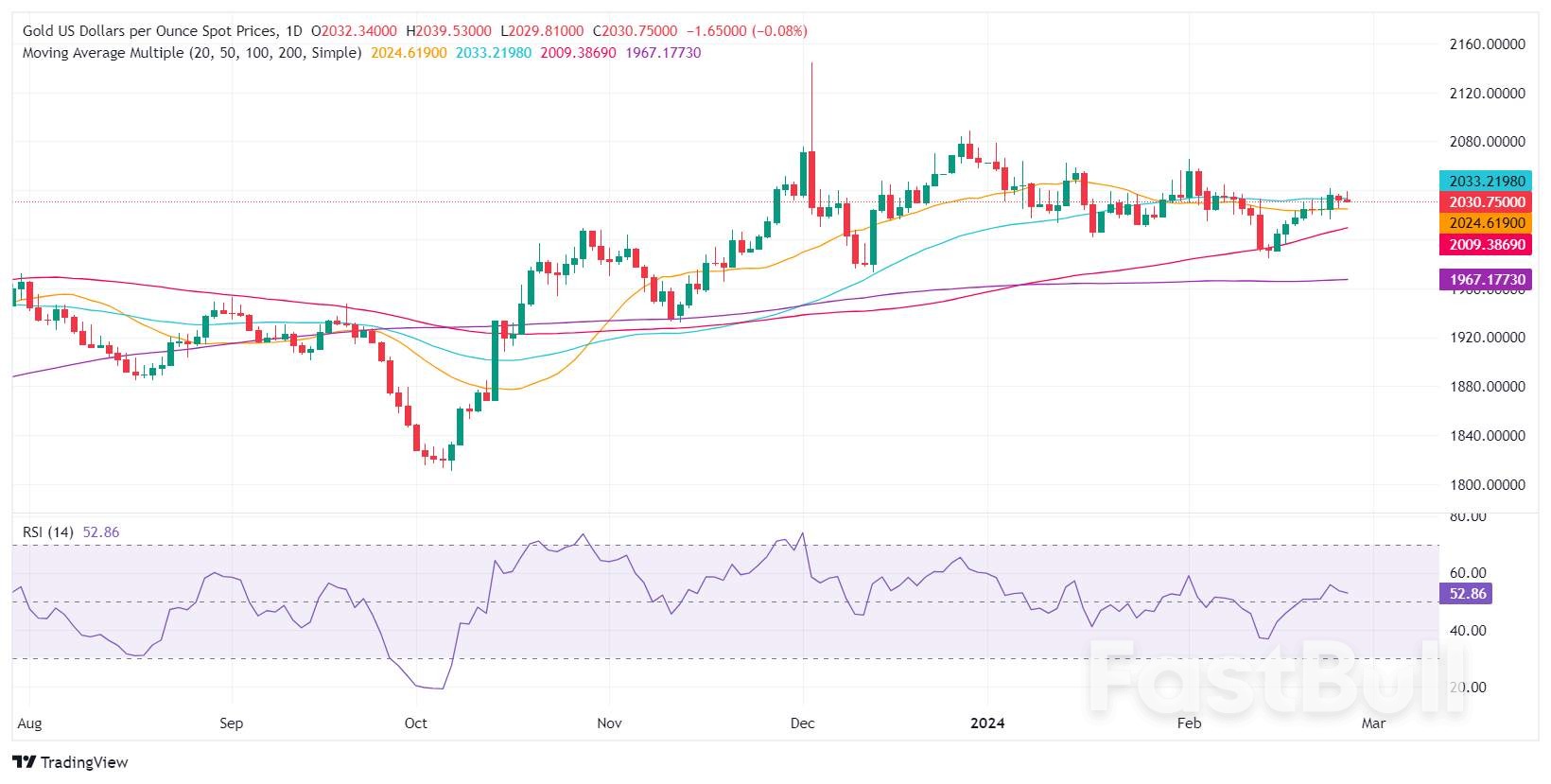
          Gold price modestly gains but is stuck in a narrow range in Tuesday's mid-North American session, underpinned by the fall in US Treasury bond yields. Consequently, the Greenback (USD) weakens, as the US Dollar Index (DXY), which tracks the currency against six other currencies, drops 0.05%. At the time of writing, XAU/USD trades at $2,034.88, gaining 0.18%.
          The yellow metal hovers around the 50-day Simple Moving Average (SMA) at $2,033.48 as investors brace for the release of the latest Personal Consumption Expenditures (PCE) report, the Federal Reserve’s (Fed) gauge to measure inflation. That and the latest Gross Domestic Product (GDP) data could be the catalysts that prompt Gold’s price to exit the trading range within the $2,020-$2,050 area.
          Earlier, the US Department of Commerce revealed that Durable Goods Orders in January plummeted sharply even worse than expected, which could set the tone for Q1 2024 GDP data. Meanwhile, Home Prices data were mixed as buyer demand picked up.

          Daily digest market movers: Gold advance prompted by soft US Dollar undermined by lower US yields

          US Durable Goods Orders dropped -6.1% MoM, more than the -4.5% contraction expected and the -0.3% dip observed in December.
          The S&P/Case Shiller Home Price Index for December rose 6.1% YoY, outpacing estimates of 6% and November’s 5.4% reading.
          Previous data releases in the week:US New Home Sales rose by 1.5% from 0.651M to 0.661M, less than the 0.68M expected.The Dallas Fed Manufacturing Index for February contracted -11.3 though it improved compared to January’s -27.4 shrinkage, suggesting that business activity is recovering.
          Federal Reserve Governor Michelle Bowman said she’s in no rush to cut rates, given upside risks to inflation that could stall progress or cause a resurgence in price pressure.
          Bowman said that inflation would decline “slowly,” adding that she will remain “cautious in my approach to considering future changes in the stance of policy.”
          Interest rate speculators have priced out a Fed rate cut in March and May. For June, the odds of a 25 basis point rate cut are at 49.7%.
          Investors are pricing in 85 basis points of easing throughout 2024.

          Technical analysis: Gold stays firm near 50-day SMAGold Price Creeps Lower, Holds Narrow Range Before US GDP Release_1

          Gold is trading sideways as XAU/USD has failed to break above the $2,035 psychological resistance level for the last 12 days. Nevertheless, the upward bias remains intact, and if buyers reclaim the $2,035 level, that could open the door to challenge the psychological $2,050 figure. Key resistance levels up next would be the February 1 high at $2,065.60, ahead of the December 28 high at $2,088.48.
          On the flipside, if Gold falls below the February 16 swing low of $2,016.15, XAU/USD would dive toward the October 27 daily high-turned-support at $2,009.42. Once cleared, that will expose key technical support levels like the 100-day SMA at $2,009.56, followed by the 200-day SMA at $1,967.09.

          Source:FXStreet

          Risk Warnings and Disclaimers
          You understand and acknowledge that there is a high degree of risk involved in trading. Following any strategies or investment methods may lead to potential losses. The content on the site is provided by our contributors and analysts for information purposes only. You are solely responsible for determining whether any trading assets, securities, strategy, or any other product is suitable for investing based on your own investment objectives and financial situation.
          Add to Favorites
          Share

          XAU/USD Gold Price Indicates Impending Strong Surge in Performance Signals

          Chandan Gupta

          Traders' Opinions

          Commodity

          In the latest developments on the commodities front, gold futures faced a setback at the onset of the final trading week in February. The futures market held its ground against expectations of a pivotal move by the US Federal Reserve in the ongoing tightening cycle. Investors are on high alert as they brace for two pivotal reports this week - the US GDP and inflation figures.
          Gold's current standing places it around the resistance level of $2036 per ounce. Weekly gains of approximately 1% have been achieved, yet a year-to-date decrease of 1.4% has been noted since the beginning of the year. Meanwhile, its sibling commodity, silver, dipped below $23 per ounce, marking a 3.7% decline last week and contributing to a 6% loss since the year's commencement.
          The market sentiment took a hit as expectations grew regarding a delay in further US interest rate cuts. Federal Reserve policymakers hinted at the possibility of maintaining a patient approach, potentially keeping US interest rates elevated for a prolonged period. This has led to a shift in investor expectations, with a 52% likelihood now placed on a US interest rate cut in June, contrary to earlier predictions of a cut in early March.
          The impact is evident in the rising yields on US Treasury bonds, with the ten-year bond reaching 4.27%, a 2 basis point increase in the two-year bond to 4.71%, and stability in the thirty-year bond yield at 4.38%. Gold, being sensitive to interest rate fluctuations, faces challenges as it grapples with the changing economic landscape.
          Investors are closely monitoring two crucial data points this week - the second estimate of US GDP for Q4, expected to be 3.3%, and the Personal Consumption Expenditures (PCE) Price Index, anticipated to rise by 0.3%. The Core PCE Price Index, excluding volatile energy and food components, is expected to increase by 0.4%.
          Despite a weaker US dollar, gold failed to capitalize on the situation. The US Dollar Index (DXY) fell to 103.84, down from the opening at 103.94. Although the DXY recorded a 0.5% drop last week, it remains up by 2.5% year to date. The falling US dollar typically benefits dollar-denominated goods, making them more affordable for foreign investors. However, the intricate relationship between gold and the US dollar continues to evolve.
          In other metal markets, copper futures retreated to $3.828 per pound, while Platinum futures and Palladium futures dropped to $884.90 and $968.00 per ounce, respectively.
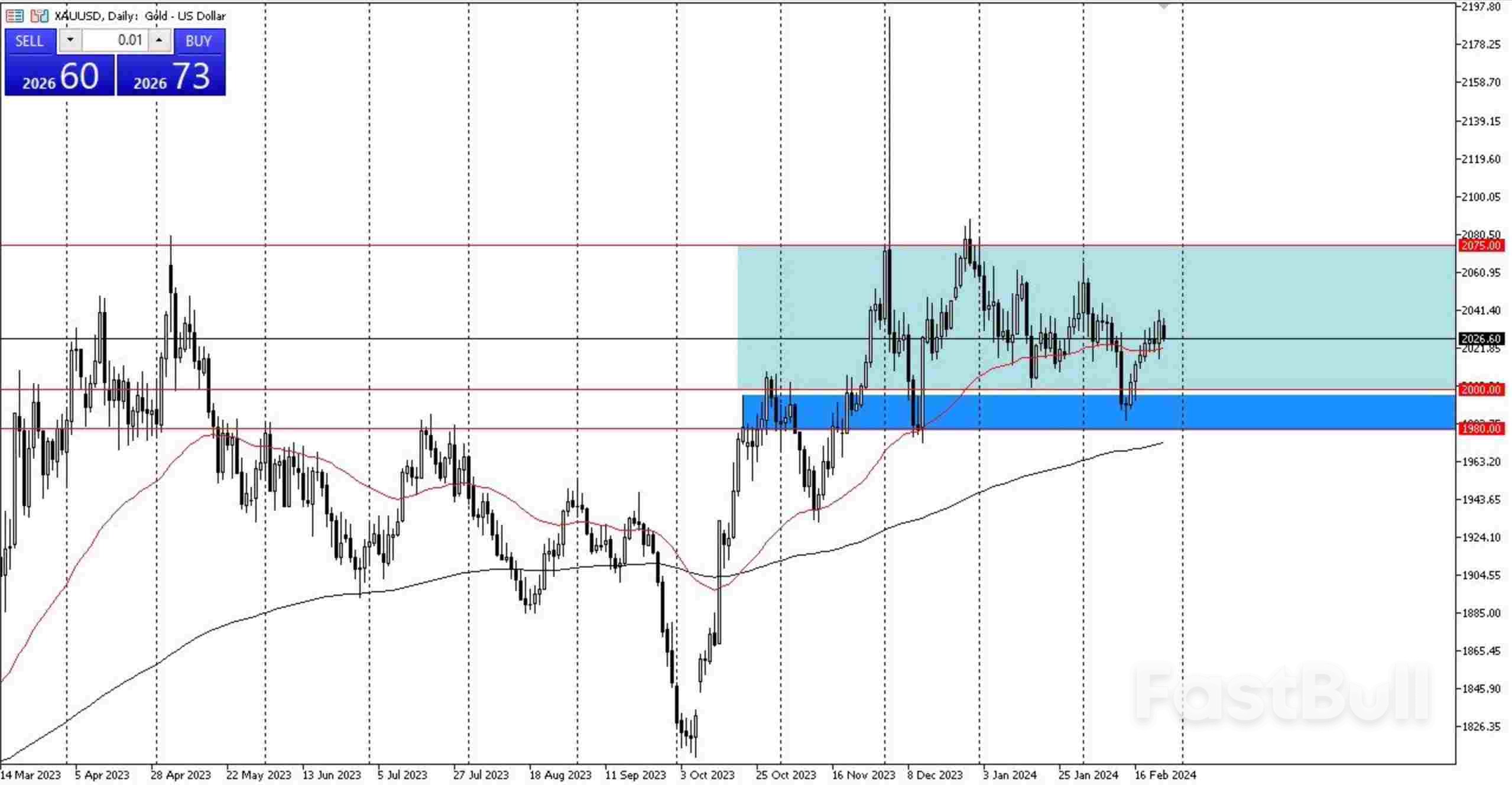
          From a technical standpoint, our analysis suggests no significant shift in the upward trend of gold prices. The daily chart indicates a series of narrow trading sessions, hinting at an impending strong movement in one of the two directions. The outcome of crucial American economic data this week is expected to trigger a robust reaction, potentially influencing the stability of the US dollar and, consequently, the performance of gold.
          As we assess the current scenario, the nearest resistance levels for gold stand at $2055 and $2070, offering potential control for bulls. Conversely, a deviation from the current trend would necessitate a move towards support levels of $2000 and $1985 per ounce.
          In conclusion, the intricate dance between economic indicators, market sentiment, and global events continues to shape the trajectory of gold and silver prices. The coming days promise both challenges and opportunities, with investors keenly awaiting the unfolding economic landscape.XAU/USD Gold Price Indicates Impending Strong Surge in Performance Signals_1
          Risk Warnings and Disclaimers
          You understand and acknowledge that there is a high degree of risk involved in trading. Following any strategies or investment methods may lead to potential losses. The content on the site is provided by our contributors and analysts for information purposes only. You are solely responsible for determining whether any trading assets, securities, strategy, or any other product is suitable for investing based on your own investment objectives and financial situation.
          Add to Favorites
          Share
          FastBull
          Copyright © 2025 FastBull Ltd

          728 RM B 7/F GEE LOK IND BLDG NO 34 HUNG TO RD KWUN TONG KLN HONG KONG

          TelegramInstagramTwitterfacebooklinkedin
          App Store Google Play Google Play
          Products
          Charts

          Chats

          Q&A with Experts
          Screeners
          Economic Calendar
          Data
          Tools
          Membership
          Features
          Function
          Markets
          Copy Trading
          Latest Signals
          Contests
          News
          Analysis
          24/7
          Columns
          Education
          Company
          Careers
          About Us
          Contact Us
          Advertising
          Help Center
          Feedback
          User Agreement
          Privacy Policy
          Business

          White Label

          Data API

          Web Plug-ins

          Poster Maker

          Affiliate Program

          Risk Disclosure

          The risk of loss in trading financial instruments such as stocks, FX, commodities, futures, bonds, ETFs and crypto can be substantial. You may sustain a total loss of the funds that you deposit with your broker. Therefore, you should carefully consider whether such trading is suitable for you in light of your circumstances and financial resources.

          No decision to invest should be made without thoroughly conducting due diligence by yourself or consulting with your financial advisors. Our web content might not suit you since we don't know your financial conditions and investment needs. Our financial information might have latency or contain inaccuracy, so you should be fully responsible for any of your trading and investment decisions. The company will not be responsible for your capital loss.

          Without getting permission from the website, you are not allowed to copy the website's graphics, texts, or trademarks. Intellectual property rights in the content or data incorporated into this website belong to its providers and exchange merchants.

          Not Logged In

          Log in to access more features

          FastBull Membership

          Not yet

          Purchase

          Become a signal provider
          Help Center
          Customer Service
          Dark Mode
          Price Up/Down Colors

          Log In

          Sign Up

          Position
          Layout
          Fullscreen
          Default to Chart
          The chart page opens by default when you visit fastbull.com