

Markets
News
Analysis
User
24/7
Economic Calendar
Education
Data
- Names
- Latest
- Prev



Signal Accounts for Members
All Signal Accounts
All Contests
 France Industrial Output MoM (SA) (Oct)
A:--
F: --
France Trade Balance (SA) (Oct)A:--
F: --
 Euro Zone Employment YoY (SA) (Q3)
A:--
F: --
 Canada Part-Time Employment (SA) (Nov)
A:--
F: --
P: --
Canada Unemployment Rate (SA) (Nov)A:--
F: --
P: --
Canada Full-time Employment (SA) (Nov)A:--
F: --
P: --
Canada Labor Force Participation Rate (SA) (Nov)A:--
F: --
P: --
Canada Employment (SA) (Nov)A:--
F: --
P: --
 U.S. PCE Price Index MoM (Sept)
A:--
F: --
P: --
U.S. Personal Income MoM (Sept)A:--
F: --
P: --
U.S. Core PCE Price Index MoM (Sept)A:--
F: --
P: --
U.S. PCE Price Index YoY (SA) (Sept)A:--
F: --
P: --
U.S. Core PCE Price Index YoY (Sept)A:--
F: --
P: --
U.S. Personal Outlays MoM (SA) (Sept)A:--
F: --
U.S. 5-10 Year-Ahead Inflation Expectations (Dec)A:--
F: --
P: --
U.S. Real Personal Consumption Expenditures MoM (Sept)A:--
F: --
U.S. Weekly Total Rig CountA:--
F: --
P: --
U.S. Weekly Total Oil Rig CountA:--
F: --
P: --
U.S. Consumer Credit (SA) (Oct)A:--
F: --
 China, Mainland Foreign Exchange Reserves (Nov)
A:--
F: --
P: --
 Japan Trade Balance (Oct)
A:--
F: --
P: --
Japan Nominal GDP Revised QoQ (Q3)A:--
F: --
P: --
China, Mainland Imports YoY (CNH) (Nov)A:--
F: --
P: --
China, Mainland Exports (Nov)A:--
F: --
P: --
China, Mainland Imports (CNH) (Nov)A:--
F: --
P: --
China, Mainland Trade Balance (CNH) (Nov)A:--
F: --
P: --
China, Mainland Exports YoY (USD) (Nov)A:--
F: --
P: --
China, Mainland Imports YoY (USD) (Nov)A:--
F: --
P: --
 Germany Industrial Output MoM (SA) (Oct)
A:--
F: --
Euro Zone Sentix Investor Confidence Index (Dec)A:--
F: --
P: --
Canada National Economic Confidence Index--
F: --
P: --
 U.K. BRC Like-For-Like Retail Sales YoY (Nov)
--
F: --
P: --
U.K. BRC Overall Retail Sales YoY (Nov)--
F: --
P: --
 Australia Overnight (Borrowing) Key Rate
--
F: --
P: --
RBA Rate Statement RBA Press Conference Germany Exports MoM (SA) (Oct)--
F: --
P: --
U.S. NFIB Small Business Optimism Index (SA) (Nov)--
F: --
P: --
 Mexico 12-Month Inflation (CPI) (Nov)
--
F: --
P: --
Mexico Core CPI YoY (Nov)--
F: --
P: --
Mexico PPI YoY (Nov)--
F: --
P: --
U.S. Weekly Redbook Index YoY--
F: --
P: --
U.S. JOLTS Job Openings (SA) (Oct)--
F: --
P: --
China, Mainland M1 Money Supply YoY (Nov)--
F: --
P: --
China, Mainland M0 Money Supply YoY (Nov)--
F: --
P: --
China, Mainland M2 Money Supply YoY (Nov)--
F: --
P: --
U.S. EIA Short-Term Crude Production Forecast For The Year (Dec)--
F: --
P: --
U.S. EIA Natural Gas Production Forecast For The Next Year (Dec)--
F: --
P: --
U.S. EIA Short-Term Crude Production Forecast For The Next Year (Dec)--
F: --
P: --
EIA Monthly Short-Term Energy Outlook U.S. API Weekly Gasoline Stocks--
F: --
P: --
U.S. API Weekly Cushing Crude Oil Stocks--
F: --
P: --
U.S. API Weekly Crude Oil Stocks--
F: --
P: --
U.S. API Weekly Refined Oil Stocks--
F: --
P: --
 South Korea Unemployment Rate (SA) (Nov)
--
F: --
P: --
Japan Reuters Tankan Non-Manufacturers Index (Dec)--
F: --
P: --
Japan Reuters Tankan Manufacturers Index (Dec)--
F: --
P: --
Japan Domestic Enterprise Commodity Price Index MoM (Nov)--
F: --
P: --
Japan Domestic Enterprise Commodity Price Index YoY (Nov)--
F: --
P: --
China, Mainland PPI YoY (Nov)--
F: --
P: --


No matching data

Latest Views
Latest Views
Trending Topics
Top Columnists
Latest Update
White Label
Data API
Web Plug-ins
Affiliate Program
View All
No data
Hong Kong will ease rules to promote virtual asset trading liquidity as part of the city's push to become a major fintech and digital asset hub, government officials said on Monday.

Hong Kong will ease rules to promote virtual asset trading liquidity as part of the city's push to become a major fintech and digital asset hub, government officials said on Monday.
Hong Kong's Securities and Futures Commission (SFC) will relax rules on Monday to allow locally licensed virtual asset trading platforms (VATP) to share global order books with affiliates overseas, Julia Leung, CEO of the securities watchdog, told the Hong Kong Fintech Week conference.
The move eases current rules that require VATP's order book - a list of buy and sell orders for virtual assets - to be ring-fenced in Hong Kong. The changes are designed to allow operations to tap global liquidity.
The relaxation comes as Hong Kong competes to become a global fintech and digital asset hub against rivals such as Singapore and the U.S. market, amid surging appetite for digital investments.
Meanwhile, Hong Kong's banking sector is poised to benefit from rising investment in digital transformation, according to the city's de-facto central bank.
"The momentum behind this transformation is underscored by substantial technological investment with total spending projected to reach more than HK$100 billion ($12.87 billion) every year in the next three years," said Eddie Yue, chief executive of Hong Kong Monetary Authority at the same forum.
As global economies grapple with persistent inflation, all eyes are on central banks and their crucial decisions. For cryptocurrency enthusiasts, understanding these macroeconomic shifts is paramount, as they often dictate the broader market sentiment and investment flows. The upcoming RBA interest rate decision in November is no exception, poised to deliver a 'hawkish hold' that could send ripples through the financial world, including digital asset markets. Let's delve into what this means for Australia and beyond.
The Reserve Bank of Australia (RBA) is at a critical juncture. After a period of aggressive rate hikes, the central bank has opted for a pause in recent months, allowing time for previous tightening to work through the economy. However, the latest inflation data has complicated this strategy, pushing market expectations towards a scenario where the RBA maintains a firm, or 'hawkish,' stance even if it doesn't raise rates immediately.
A 'hawkish hold' implies that while the cash rate might remain unchanged, the accompanying statement from the RBA will likely convey a strong bias towards further tightening if inflationary pressures do not subside. This communication strategy is designed to keep financial conditions tight and temper inflation expectations without necessarily delivering another rate hike immediately. Investors, including those in the crypto space, pay close attention to such nuances, as they signal future policy direction and risk appetite.
Key Considerations for the November Meeting:
The latest inflation figures from Australia's third quarter have been the primary catalyst for the shift in market expectations. The data revealed that inflation is proving to be more persistent than anticipated, particularly in key sectors. This 'stickiness' has challenged the RBA's previous narrative that inflation was on a clear path back to the target range of 2-3%.
Let's look at some of the key components that contributed to this elevated Australian inflation:
| Inflation Component | Q3 Performance (indicative) | Impact on RBA Decision |
|---|---|---|
| Services Inflation | Remained elevated, especially in areas like rents, insurance, and utilities. | Suggests underlying domestic demand pressures are strong, requiring sustained vigilance. |
| Goods Inflation | Showed some signs of easing but still above pre-pandemic levels. | Supply chain improvements are helping, but domestic pricing power remains a concern. |
| Wage Growth | Continued to accelerate, albeit gradually, contributing to services inflation. | A critical factor for the RBA, as sustained wage growth can fuel a wage-price spiral. |
| Fuel Prices | Recent spikes added to headline inflation pressures. | Volatile, but can influence consumer expectations and broader price setting. |
The challenge for the RBA is that while some global factors influencing inflation are easing, domestic demand and services inflation remain robust. This suggests that the economy might still be running 'too hot,' necessitating a cautious approach to monetary policy.
The decision to opt for a 'hawkish hold' is a strategic one, aimed at threading the needle between over-tightening and under-tightening. Given the persistent inflation, a direct rate hike would send a strong signal, but it also carries the risk of pushing the economy into a deeper slowdown than intended. Conversely, a dovish pause, or even a neutral one, might be misinterpreted by markets as a sign of complacency, potentially reigniting inflationary expectations.
Reasons for a Hawkish Hold:
This approach allows the RBA to continue assessing the lagged effects of previous rate hikes while signalling that the fight against inflation is far from over. It's a balancing act that requires clear communication to guide market expectations effectively.
The RBA's monetary policy decisions have profound implications for the broader economic outlook Australia. A hawkish hold, combined with sticky inflation, paints a picture of continued economic uncertainty, where growth might be subdued while living costs remain elevated.
Potential Impacts on the Australian Economy:
For investors, particularly those looking at the crypto market, Australia's economic health offers insights into broader global sentiment. A strong, stable economy with contained inflation is generally more conducive to risk-on assets, whereas persistent inflation and aggressive central bank action can lead to increased volatility.
How will financial markets react to a hawkish hold from the RBA? The immediate response often involves movements in the Australian Dollar (AUD), bond yields, and equity markets. For crypto investors, these traditional market reactions are important barometers of overall risk sentiment.
Expected Market Reactions:
It's crucial for market participants to not just focus on the rate decision itself but also on the RBA's forward guidance. Any hints about the likelihood of future hikes or the conditions under which they might occur will be heavily scrutinized. For instance, if the RBA explicitly states that 'further tightening may be required,' it sends a much stronger signal than a more ambiguous phrase.
The current economic climate presents both challenges and opportunities. For the RBA, the challenge is to tame inflation without stifling economic growth. For investors, it's about positioning portfolios to navigate this uncertainty.
Challenges:
Actionable Insights:
The RBA's November meeting is set to be a pivotal moment, with a 'hawkish hold' likely to be the chosen path. This strategy reflects the central bank's delicate balancing act: acknowledging persistent Australian inflation while assessing the lagged effects of previous tightening. For investors across all asset classes, including the dynamic world of cryptocurrencies, understanding this nuanced monetary policy stance is key to navigating the evolving economic outlook Australia. The RBA's commitment to price stability, even through a 'hawkish hold', underpins the long-term health of the Australian economy, and its implications resonate far beyond its borders. Staying informed and agile will be crucial in the months ahead.
To learn more about the latest Forex market trends, explore our article on key developments shaping interest rates and economic stability.
This post RBA's Crucial Dilemma: Navigating Australian Inflation with a Hawkish Hold first appeared on BitcoinWorld.
Bitcoin's monthly chart has recently exhibited a rare pattern marked by significant market indecision. The October candlestick presented an enormous price range between $103,600 and $126,000, catching both bulls and bears off guard. However, the month closed with a modest decline of only 3.8%. This wide price movement followed by a close near the month's opening price has been referred to as an "indecision candlestick" among analysts.
Some analysts view Bitcoin's current outlook as a potential bottom formation process. Since the start of 2023, the largest cryptocurrency has shown a gradual uptrend, differing from past sharp peak formations. Historically, Bitcoin peaks have often ended with sharp and short-lived rises, but now the situation may indicate a calm accumulation of strength. However, the element of indecision complicates the picture. This indecision is evident at the critical trendline combining the all-time highs of 2017 and 2021. Despite expectations of dominant buyers at these levels, market hesitation is significant.
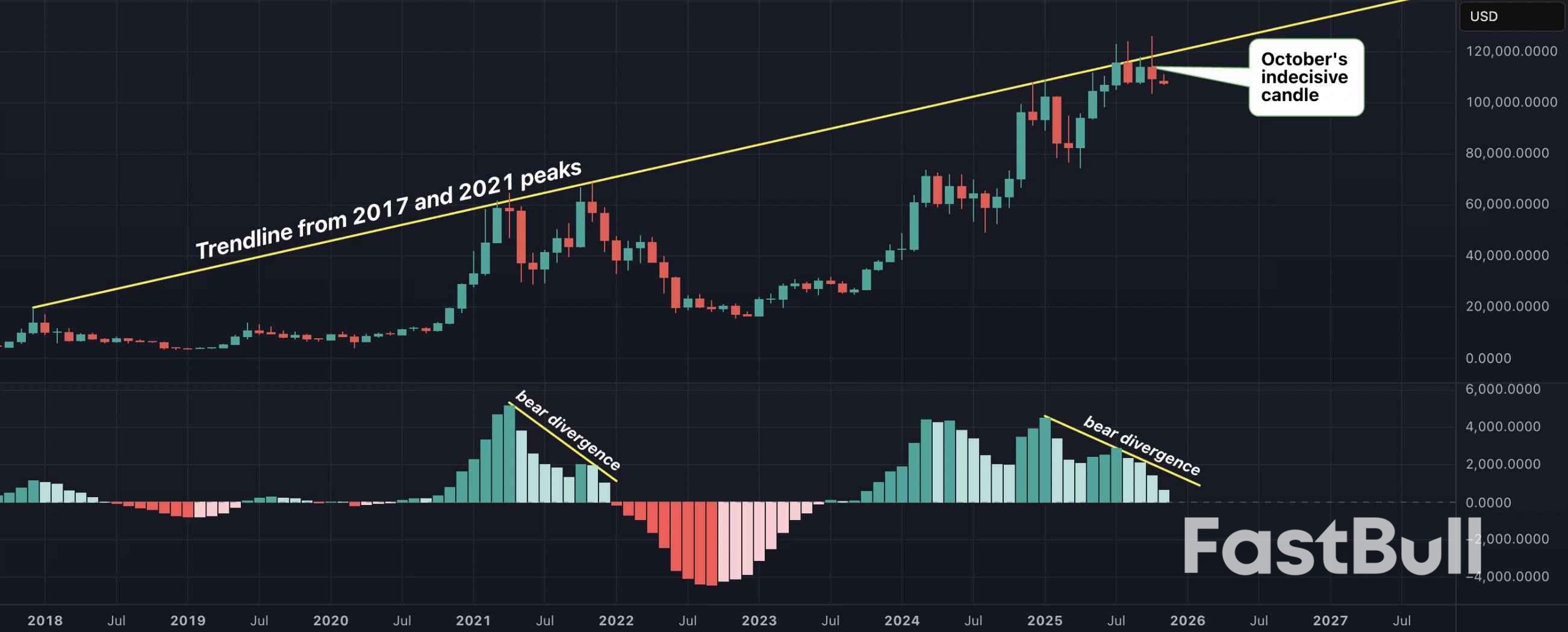
Additionally, the monthly MACD indicator's histogram reveals a weakening of bullish momentum. As the indicator reduces peaks above the zero line, it suggests a decrease in upward momentum. The new price peak seen in October was not confirmed by the MACD, recalling the warnings from the 2021 peak divergence.
The uncertain portrayal of Bitcoin is further highlighted by global developments. The interest rate cuts by the Federal Reserve and improving trade relations between Washington and Beijing would typically boost risk appetite. However, investors' cautious stance has weakened bullish expectations. Meanwhile, signals of recovery from the prolonged decline in the US Dollar Index (DXY) are increasing pressure on Bitcoin. Past instances of DXY strengthening have resulted in selling pressure across the cryptocurrency market.
The technical outlook suggests a weak scenario for an upward trend unless Bitcoin surpasses $116,000. Otherwise, the likelihood of a price pullback towards $100,000 is strengthening. Analysts agree that for the rising trend to continue, buyers need to regain control.
Asia's big manufacturing hubs struggled to fire up in October, business surveys showed on Monday, as weak U.S. demand and tariffs under President Donald Trump hit factory orders across the region.
While Trump's visit to Asia last week led to some progress in trade negotiations with large manufacturing economies such as China and South Korea, exporters continue to be cautious about U.S. demand.
Private-sector purchasing managers' indexes (PMIs) for October released on Monday showed manufacturing activity growing at a slower pace in China and falling in South Korea, with export orders in both countries declining.
Friday's official PMI survey showed China's factory activity falling for the seventh straight month, confirming suspicions that the earlier export rush to get ahead of U.S. tariffs had well and truly ended.
"The PMIs suggest that China's economy lost some momentum in October, with slower growth across manufacturing and construction," said Zichun Huang, China economist at Capital Economics. "Some of this weakness may reverse in the near term, but any boost to exports from the latest U.S.-China trade 'deal' is likely to be modest and wider headwinds to growth will persist."
In a meeting in South Korea last week, Trump and Chinese President Xi Jinping agreed to de-escalate tensions, including through a one-year delay in reciprocal tariffs, but the agreement does little to address a deeper divide between the two superpowers.
Policymakers in Beijing are looking to see whether China's $19 trillion economy is on track to hit its official 2025 growth target of around 5%, without needing to reach for further stimulus.
Trade data for September showed China's exports rising faster-than-expected, although this was mostly due to growth in new markets as U.S.-bound shipments tumbled 27% year-on-year.
Similarly, Seoul's trade deal with Trump announced last week secured lower U.S. tariffs on Korean goods, but was seen at best as a compromise that prevents Asia's fourth-largest economy from falling behind in global trade.
Elsewhere in Asia, continued declines were also seen in factory activity in Malaysia and Taiwan, PMIs showed, although Vietnam and Indonesia saw growth in their manufacturing sectors pick up.
728 RM B 7/F GEE LOK IND BLDG NO 34 HUNG TO RD KWUN TONG KLN HONG KONG


White Label
Data API
Web Plug-ins
Poster Maker
Affiliate Program
The risk of loss in trading financial instruments such as stocks, FX, commodities, futures, bonds, ETFs and crypto can be substantial. You may sustain a total loss of the funds that you deposit with your broker. Therefore, you should carefully consider whether such trading is suitable for you in light of your circumstances and financial resources.
No decision to invest should be made without thoroughly conducting due diligence by yourself or consulting with your financial advisors. Our web content might not suit you since we don't know your financial conditions and investment needs. Our financial information might have latency or contain inaccuracy, so you should be fully responsible for any of your trading and investment decisions. The company will not be responsible for your capital loss.
Without getting permission from the website, you are not allowed to copy the website's graphics, texts, or trademarks. Intellectual property rights in the content or data incorporated into this website belong to its providers and exchange merchants.
Not Logged In
Log in to access more features

FastBull Membership
Not yet
Purchase


Log In
Sign Up


