• Trade
  • Markets
  • Copy
  • Contests
  • News
  • 24/7
  • Calendar
  • Q&A
  • Chats
Trending
Screeners
SYMBOL
LAST
BID
ASK
HIGH
LOW
NET CHG.
%CHG.
SPREAD
SPX
S&P 500 Index
6827.42
6827.42
6827.42
6899.86
6801.80
-73.58
-1.07%
--
DJI
Dow Jones Industrial Average
48458.04
48458.04
48458.04
48886.86
48334.10
-245.98
-0.51%
--
IXIC
NASDAQ Composite Index
23195.16
23195.16
23195.16
23554.89
23094.51
-398.69
-1.69%
--
USDX
US Dollar Index
97.950
98.030
97.950
98.500
97.950
-0.370
-0.38%
--
EURUSD
Euro / US Dollar
1.17394
1.17409
1.17394
1.17496
1.17192
+0.00011
+ 0.01%
--
GBPUSD
Pound Sterling / US Dollar
1.33707
1.33732
1.33707
1.33997
1.33419
-0.00148
-0.11%
--
XAUUSD
Gold / US Dollar
4299.39
4299.39
4299.39
4353.41
4257.10
+20.10
+ 0.47%
--
WTI
Light Sweet Crude Oil
57.233
57.485
57.233
58.011
56.969
-0.408
-0.71%
--

Community Accounts

Signal Accounts
--
Profit Accounts
--
Loss Accounts
--
View More

Become a signal provider

Sell trading signals to earn additional income

View More

Guide to Copy Trading

Get started with ease and confidence

View More

Signal Accounts for Members

All Signal Accounts

Best Return
  • Best Return
  • Best P/L
  • Best MDD
Past 1W
  • Past 1W
  • Past 1M
  • Past 1Y

All Contests

  • All
  • Trump Updates
  • Recommend
  • Stocks
  • Cryptocurrencies
  • Central Banks
  • Featured News
Top News Only
Share

Ukraine President Zelenskiy: Security Guarantees Should Be Legally Binding

Share

Ukraine President Zelenskiy: US, European Security Guarantees Instead Of NATO Membership Is Compromise From Ukraine's Side

Share

Ukraine President Zelenskiy: There Won't Be A Peace Plan That Everyone Will Like, There Will Be Compromises

Share

Ukraine President Zelenskiy: He Has Had No US Reaction Yet To Revised Peace Proposals

Share

Kremlin Says NATO's Rutte Is Irresponsible To Talk Of War With Russia

Share

Israel Foreign Minister Saar: The Australian Government, Which Has Received Countless Warning Signs, Must Come To Its Senses

Share

Israel Foreign Minister Saar: Calls For 'Globalize The Intifada' Were Realized Today

Share

Zelenskiy Demands 'Dignified' Peace As US And Ukraine Officials Meet In Berlin

Share

Australia Opposition Leader: The Loss Of Life In Bondi Beach Shooting Is Significant

Share

Russian Defence Ministry Says Russian Forces Capture Varvarivka In Ukraine's Zaporizhzhia Region

Share

Israel President Herzog: Our Sisters And Brothers In Sydney Have Been Attacked By Vile Terrorists In A Very Cruel Attack On Jews Who Went To Light The First Candle Of Hanukkahon Bondi Beach

Share

Australia Prime Minister: I Just Have Spoken To The AFP Commissioner And The Nsw Premier. We Are Working With Nsw Police And Will Provide Further Updates As More Information Is Confirmed

Share

Australia Prime Minister: The Scenes In Bondi Are Shocking And Distressing. Police And Emergency Responders Are On The Ground Working To Save Lives. My Thoughts Are With Every Person Affected

Share

Petroleum Ministry: Egypt Proposes A Unified Arab Emergency Oil And Gas Purchases Mechanism

Share

Ukraine President Zelenskiy: Services Have Been Working To Restore Electricity, Heating, Water Supply To Regions Following Russian Strikes On Energy Infrastructure

Share

Hamas Gaza Chief Confirms Killing Of The Group's Senior Commander In Israeli Strike

Share

Foreign Ministry - Iran's Foreign Minister Araqchi To Visit Russia And Belarus In Coming Week

Share

Defence Ministry: Russia Downs 235 Ukrainian Drones Overnight

Share

Trump Isn't Certain His Economic Policies Will Translate To Midterm Wins

Share

The United States And Mexico Have Reached An Agreement On How To Resolve The Water Dispute In The Rio Grande Basin (which Borders Texas). Starting December 15, Mexico Will Supply The U.S. With An Additional 20.2 Acre-feet (a Unit Of Volume For Irrigation). The Agreement Seeks To “strengthen Water Management In The Rio Grande Basin” Within The Framework Of The 1944 Water Treaty

TIME
ACT
FCST
PREV
U.K. Trade Balance (Oct)

A:--

F: --

P: --

U.K. Services Index MoM

A:--

F: --

P: --

U.K. Construction Output MoM (SA) (Oct)

A:--

F: --

P: --

U.K. Industrial Output YoY (Oct)

A:--

F: --

P: --

U.K. Trade Balance (SA) (Oct)

A:--

F: --

P: --

U.K. Trade Balance EU (SA) (Oct)

A:--

F: --

P: --

U.K. Manufacturing Output YoY (Oct)

A:--

F: --

P: --

U.K. GDP MoM (Oct)

A:--

F: --

P: --

U.K. GDP YoY (SA) (Oct)

A:--

F: --

P: --

U.K. Industrial Output MoM (Oct)

A:--

F: --

P: --

U.K. Construction Output YoY (Oct)

A:--

F: --

P: --

France HICP Final MoM (Nov)

A:--

F: --

P: --

China, Mainland Outstanding Loans Growth YoY (Nov)

A:--

F: --

P: --

China, Mainland M2 Money Supply YoY (Nov)

A:--

F: --

P: --

China, Mainland M0 Money Supply YoY (Nov)

A:--

F: --

P: --

China, Mainland M1 Money Supply YoY (Nov)

A:--

F: --

P: --

India CPI YoY (Nov)

A:--

F: --

P: --

India Deposit Gowth YoY

A:--

F: --

P: --

Brazil Services Growth YoY (Oct)

A:--

F: --

P: --

Mexico Industrial Output YoY (Oct)

A:--

F: --

P: --

Russia Trade Balance (Oct)

A:--

F: --

P: --

Philadelphia Fed President Henry Paulson delivers a speech
Canada Building Permits MoM (SA) (Oct)

A:--

F: --

P: --

Canada Wholesale Sales YoY (Oct)

A:--

F: --

P: --

Canada Wholesale Inventory MoM (Oct)

A:--

F: --

P: --

Canada Wholesale Inventory YoY (Oct)

A:--

F: --

P: --

Canada Wholesale Sales MoM (SA) (Oct)

A:--

F: --

P: --

Germany Current Account (Not SA) (Oct)

A:--

F: --

P: --

U.S. Weekly Total Rig Count

A:--

F: --

P: --

U.S. Weekly Total Oil Rig Count

A:--

F: --

P: --

Japan Tankan Large Non-Manufacturing Diffusion Index (Q4)

--

F: --

P: --

Japan Tankan Small Manufacturing Outlook Index (Q4)

--

F: --

P: --

Japan Tankan Large Non-Manufacturing Outlook Index (Q4)

--

F: --

P: --

Japan Tankan Large Manufacturing Outlook Index (Q4)

--

F: --

P: --

Japan Tankan Small Manufacturing Diffusion Index (Q4)

--

F: --

P: --

Japan Tankan Large Manufacturing Diffusion Index (Q4)

--

F: --

P: --

Japan Tankan Large-Enterprise Capital Expenditure YoY (Q4)

--

F: --

P: --

U.K. Rightmove House Price Index YoY (Dec)

--

F: --

P: --

China, Mainland Industrial Output YoY (YTD) (Nov)

--

F: --

P: --

China, Mainland Urban Area Unemployment Rate (Nov)

--

F: --

P: --

Saudi Arabia CPI YoY (Nov)

--

F: --

P: --

Euro Zone Industrial Output YoY (Oct)

--

F: --

P: --

Euro Zone Industrial Output MoM (Oct)

--

F: --

P: --

Canada Existing Home Sales MoM (Nov)

--

F: --

P: --

Euro Zone Total Reserve Assets (Nov)

--

F: --

P: --

U.K. Inflation Rate Expectations

--

F: --

P: --

Canada National Economic Confidence Index

--

F: --

P: --

Canada New Housing Starts (Nov)

--

F: --

P: --

U.S. NY Fed Manufacturing Employment Index (Dec)

--

F: --

P: --

U.S. NY Fed Manufacturing Index (Dec)

--

F: --

P: --

Canada Core CPI YoY (Nov)

--

F: --

P: --

Canada Manufacturing Unfilled Orders MoM (Oct)

--

F: --

P: --

Canada Manufacturing New Orders MoM (Oct)

--

F: --

P: --

Canada Core CPI MoM (Nov)

--

F: --

P: --

Canada Manufacturing Inventory MoM (Oct)

--

F: --

P: --

Canada CPI YoY (Nov)

--

F: --

P: --

Canada CPI MoM (Nov)

--

F: --

P: --

Canada CPI YoY (SA) (Nov)

--

F: --

P: --

Canada Core CPI MoM (SA) (Nov)

--

F: --

P: --

Canada CPI MoM (SA) (Nov)

--

F: --

P: --

Q&A with Experts
    • All
    • Chatrooms
    • Groups
    • Friends
    Connecting
    .
    .
    .
    Type here...
    Add Symbol or Code

      No matching data

      All
      Trump Updates
      Recommend
      Stocks
      Cryptocurrencies
      Central Banks
      Featured News
      • All
      • Russia-Ukraine Conflict
      • Middle East Flashpoint
      • All
      • Russia-Ukraine Conflict
      • Middle East Flashpoint
      Search
      Products

      Charts Free Forever

      Chats Q&A with Experts
      Screeners Economic Calendar Data Tools
      Membership Features
      Data Warehouse Market Trends Institutional Data Policy Rates Macro

      Market Trends

      Market Sentiment Order Book Forex Correlations

      Top Indicators

      Charts Free Forever
      Markets

      News

      News Analysis 24/7 Columns Education
      From Institutions From Analysts
      Topics Columnists

      Latest Views

      Latest Views

      Trending Topics

      Top Columnists

      Latest Update

      Signals

      Copy Rankings Latest Signals Become a signal provider AI Rating
      Contests
      Brokers

      Overview Brokers Assessment Rankings Regulators News Claims
      Broker listing Forex Brokers Comparison Tool Live Spread Comparison Scam
      Q&A Complaint Scam Alert Videos Tips to Detect Scam
      More

      Business
      Events
      Careers About Us Advertising Help Center

      White Label

      Data API

      Web Plug-ins

      Affiliate Program

      Awards Institution Evaluation IB Seminar Salon Event Exhibition
      Vietnam Thailand Singapore Dubai
      Fans Party Investment Sharing Session
      FastBull Summit BrokersView Expo
      Recent Searches
        Top Searches
          Markets
          News
          Analysis
          User
          24/7
          Economic Calendar
          Education
          Data
          • Names
          • Latest
          • Prev

          View All

          No data

          Scan to Download

          Faster Charts, Chat Faster!

          Download App
          English
          • English
          • Español
          • العربية
          • Bahasa Indonesia
          • Bahasa Melayu
          • Tiếng Việt
          • ภาษาไทย
          • Français
          • Italiano
          • Türkçe
          • Русский язык
          • 简中
          • 繁中
          Open Account
          Search
          Products
          Charts Free Forever
          Markets
          News
          Signals

          Copy Rankings Latest Signals Become a signal provider AI Rating
          Contests
          Brokers

          Overview Brokers Assessment Rankings Regulators News Claims
          Broker listing Forex Brokers Comparison Tool Live Spread Comparison Scam
          Q&A Complaint Scam Alert Videos Tips to Detect Scam
          More

          Business
          Events
          Careers About Us Advertising Help Center

          White Label

          Data API

          Web Plug-ins

          Affiliate Program

          Awards Institution Evaluation IB Seminar Salon Event Exhibition
          Vietnam Thailand Singapore Dubai
          Fans Party Investment Sharing Session
          FastBull Summit BrokersView Expo

          How China-Saudi Defence Ties Are Evolving

          Alex

          Economic

          Political

          Summary:

          With a fresh Comprehensive Strategic Partnership in place between both states since 2022, Saudi Arabia’s Vision 2030 is also aligned with China’s BRI.

          On June 25, the Kingdom of Saudi Arabia’s defence minister Prince Khalid bin Salman visited Beijing, holding meetings with his Chinese counterpart Dong Jun as well as the Vice Chairman of China’s Central Military Commission Zhang Youxia.
          The two sides reportedly agreed to take bilateral military ties to a “higher level”, with the relationship between both armies being on a “fast-track” after multiple exchanges, joint drills and exercises, and personnel training”.
          This meeting is only the latest in a number of developments across the last five years that have shown a significant deepening of the Saudi-China relationship. In any case, China’s diplomatic stock in the Middle East grew substantially after it successfully negotiated a rapprochement between Riyadh and Tehran in 2023. However, a key marker of the evolution of the relationship has been a fresh effort to expand defence ties.
          This is even more so as it is the United States’ defence commitments to the Middle East that continue to be seen as ensuring its dominance as the primary security partner to Arab states such as Saudi Arabia whose economic relationship with China has grown by leaps and bounds; Saudi Arabia’s top imports are from China ($36.5 billion), with USA placed third ($11 billion). With a fresh Comprehensive Strategic Partnership in place between both states since 2022, Saudi Arabia’s Vision 2030 is also aligned with China’s Belt and Road Initiative.
          Now, China’s defence forays are aimed at taking advantage not only of US failings in the region but also the inherent desire across Middle Eastern states to diversify and indigenise military imports; note that deep relations with China are a common denominator across the Gulf – including Iran.
          Parallel to Bin Salman’s visit, senior military officers from multiple Arab states attended a seminar on “deeper” security cooperation with China. Held as part of the PLA’s International College of Defence Studies’ course on “The Future-oriented Arab-China Security Cooperation”, the course sensitises officers on Arab-China security cooperation as well as China’s Global Security Initiative. Such military interactions between both states have only increased - in October 2023, Saudi Arabia and China launched Exercise Blue Sword 2023 in southern China’s Guangdong province – a counter-terror naval special operations exercise.
          Moreover, China remains the front-runner in Saudi Arabia’s quest for a civilian nuclear programme, even as the kingdom holds out hope for a US-led project. These only supplement bilateral economic interactions. While China had announced in 2022 that it looks to buy oil in yuan instead of US dollars, on June 5, Riyadh joined the China-dominated Bank for International Settlements’ cross-border digital currency project — its latest effort in moving from the US dollar.
          There is also an indication of growing comfort in Riyadh while it expands ties with China and protects ties with the United States. While the Saudi investment minister stated in June 2023 that in Riyadh’s view, its relationships with China and USA complemented each other, the energy minister asserted a year ago that he “ignores” western criticism of increasing Saudi-China ties because “you will go where opportunity comes your way”.
          Note that even as the United States cleared the way for the sale of Patriot missile-defence systems to Saudi Arabia in 2022, it has consistently refused to sell ballistic missiles to Saudi Arabia, citing Missile Technology Control Regime concerns. This in turn has led Riyadh to develop its own ballistic missiles with Chinese assistance.
          The fact that ballistic missiles are now used as part of conventional conflicts, especially by armed non-state actors such as the Iran-backed Houthis, shows that concerns solely related to the nuclear capabilities of ballistic missiles, are outdated as the modern battlefield evolves. This only increases Riyadh’s need to take advantage of Chinese offers and the efficiency of equipment sales.
          More importantly, Riyadh continues to stay away from the US-led Operation Prosperity Guardian in the Red Sea, even as Washington tries to increase Riyadh’s stakes in potential diplomatic normalisation with Israel by offering a mutual defence treaty (currently being negotiated). It is this deal that stood out during Antony Blinken’s visit to the kingdom last month (explained here).
          With the treaty, Saudi Arabia might become the first non-NATO treaty partner of Washington in the Middle East. However, as Bilal Y Saab has also highlighted – the Saudi-US deal is dependent on the normalisation of ties with Israel which itself is now contingent on the creation of an independent Palestinian state – meaning that if even one leg of this triad fails, the other two fail as well. Even in an optimal geopolitical environment, such an arrangement for a full-fledged mutual defence pact is difficult to imagine as viable (even if agreed upon).
          As Chinese arms sales to the Middle East at large crossed 80% between 2013 and 2023, US officials were “quietly” warning Middle Eastern states against purchasing arms from China as it would undermine the US military’s integration with regional partners.
          In any case, CENTCOM Commander Michael Kurrilla publicly stated in the Senate Armed Services Committee in March 2023 that since Chinese arms sales move much faster (express shipping, financing, no end-user agreements) it hinders integration with US equipment. Hence, even if the cause for the purchase of Chinese arms (the need to diversify) is acceptable to Washington, the effect (operating both US and Chinese equipment) is not. Should Riyadh’s defence ties with Beijing reach critical mass sometime in the future, it is bound to raise unavoidable questions regarding the sale of US arms to Saudi Arabia, and even more so regarding a working defence pact.

          What, then, does this portend for geopolitics in the Gulf?

          Notwithstanding the myriad changes in the Middle East’s security landscape across the last decade, the consistent presence of US forces, backed by advanced assets and platforms (with one carrier strike group always present in the Northern Indian Ocean) has been the foremost reason for continued US dominance as the main security partner for most Arab states.
          The CENTCOM’s position in Bahrain, combined with the US’ long-time defence commitments provides it a large bank of trust and credibility, showing that Washington can commit resources. However, with Israel’s war on Gaza touching nine months and a relentless Houthi campaign against international shipping in the Red Sea, Riyadh is evidently (still) placing its bets on Beijing to weigh on Tehran for a cessation of Houthi attacks on ships headed to (and departing from) Saudi ports.
          As the Saudi defence minister reportedly discussed again this with his Chinese counterpart, note that Washington itself has tried leveraging Chinese influence on Iran for the same ends.
          A Saudi-US defence treaty is also an awkward endeavour for an administration whose President explicitly committed to making Riyadh a “pariah” on his 2020 campaign trail and actively downgraded the relationship that was achieved in the Trump era, over the last three years.
          The Saudi-US relationship was particularly tested when Saudi Arabia not only refused to boost oil production as Russia invaded Ukraine but rather decided to cut production (despite Biden’s personal overtures). Even if both states manage to put this past them, the pact’s inextricable reliance on Israel’s recognition of Palestine at a time when Israeli leaders are drifting farther away from that prospect makes it a distant hope, rather than an immediate expectation, unless Riyadh secures a standalone arrangement.
          Hence, even while the US can still retain its strategic ties with Saudi Arabia (with the possibility of further growth under a potential Trump 2.0 administration), China has little to lose and much to gain as it opens up its wares for the kingdom to inspect. In any case, the fact that China has limited defence commitments abroad (which is usually offered as a criticism), might just be Beijing’s asset – allowing it greater flexibility and efficiency at a crucial geopolitical juncture for the Middle East.

          Source:Hindustan Times

          To stay updated on all economic events of today, please check out our Economic calendar
          Risk Warnings and Disclaimers
          You understand and acknowledge that there is a high degree of risk involved in trading. Following any strategies or investment methods may lead to potential losses. The content on the site is provided by our contributors and analysts for information purposes only. You are solely responsible for determining whether any trading assets, securities, strategy, or any other product is suitable for investing based on your own investment objectives and financial situation.
          Add to Favorites
          Share

          Ten-Year Treasury Yields Edge Lower as Traders Await Powell Comments

          Warren Takunda

          Stocks

          Benchmark bond yields dipped early Tuesday ahead of comments from Federal Reserve Chair Jerome Powell and as traders awaited the first of several reports this week on the U.S. labor market.

          What's happening

          The yield on the 2-year Treasury rose 1 basis point to 4.766%. Yields move in the opposite direction to prices.The yield on the 10-year Treasury fell 1.3 basis points to 4.454%.The yield on the 30-year Treasury added 1.7 basis points to 4.615%.

          What's driving markets

          The dip in Treasury yields comes after the 10-year note on Monday rose to its highest in about a month - at one point brushing 4.50% - as traders shrugged off softer-than-expected manufacturing data and expressed concerns about a likely Donald Trump victory in November's presidential election.
          Investors are wary that wider government deficits are likely whoever wins the election, but with former president leading in the polls, the market is also concerned that his proposed imposition of 10% duties on all imports and minimum 60% tariffs on Chinese goods will stoke inflation, making bonds less attractive.
          "The TV debate against Biden and the Supreme Court's verdict yesterday, that a (former) president can only be tried for crimes he committed 'outside of his official responsibilities', are working in Trump's favor," said analysts at DWS in a morning note.
          "We won't debate either of these two points here, suffice to say that markets believe a second Trump term will be inflationary and will thus lead to higher 10-year rates," DWS added.
          Attention will turn back to monetary policy on Tuesday as investors wait to see what Powell has to say when he takes part in a panel discussion with ECB President Christine Lagarde and Roberto Campos Neto, governor of the Banco Central do Brazil, at 9:30 a.m. Eastern.
          "Given that several weaker than expected economic reports have come out since the last Fed meeting, I expect that Powell will reinforce his dovishness, and bond yields should reverse back lower," said Mark Newton, head of technical strategy at Fundstrat.
          The U.S. jobs opening report, or JOLTS, will be published at 10 a.m., the first of a raft of labor data this week which will culminate with Friday's nonfarm payrolls numbers.
          "This Friday's jobs report is the main risk for bond bulls, but projections are for rates to begin a very steep slide this month, so I feel that this number very well could miss and allow for rates to start to pull back," Fundstrat's Newton added.
          Ahead of all that, markets are pricing in a 91.2% probability that the Fed will leave interest rates unchanged at a range of 5.25% to 5.50% after its next meeting on July 31st, according to the CME FedWatch tool.
          The chances of at least a 25 basis point rate cut by the subsequent meeting in September is priced at 65.3%, up from 54.5% a month ago.

          Source: MarketWatch

          Risk Warnings and Disclaimers
          You understand and acknowledge that there is a high degree of risk involved in trading. Following any strategies or investment methods may lead to potential losses. The content on the site is provided by our contributors and analysts for information purposes only. You are solely responsible for determining whether any trading assets, securities, strategy, or any other product is suitable for investing based on your own investment objectives and financial situation.
          Add to Favorites
          Share

          PBOC Bond Trading Sets Floor, But Not Cease Market Chase, Analysts Say

          Samantha Luan

          Economic

          Central Bank

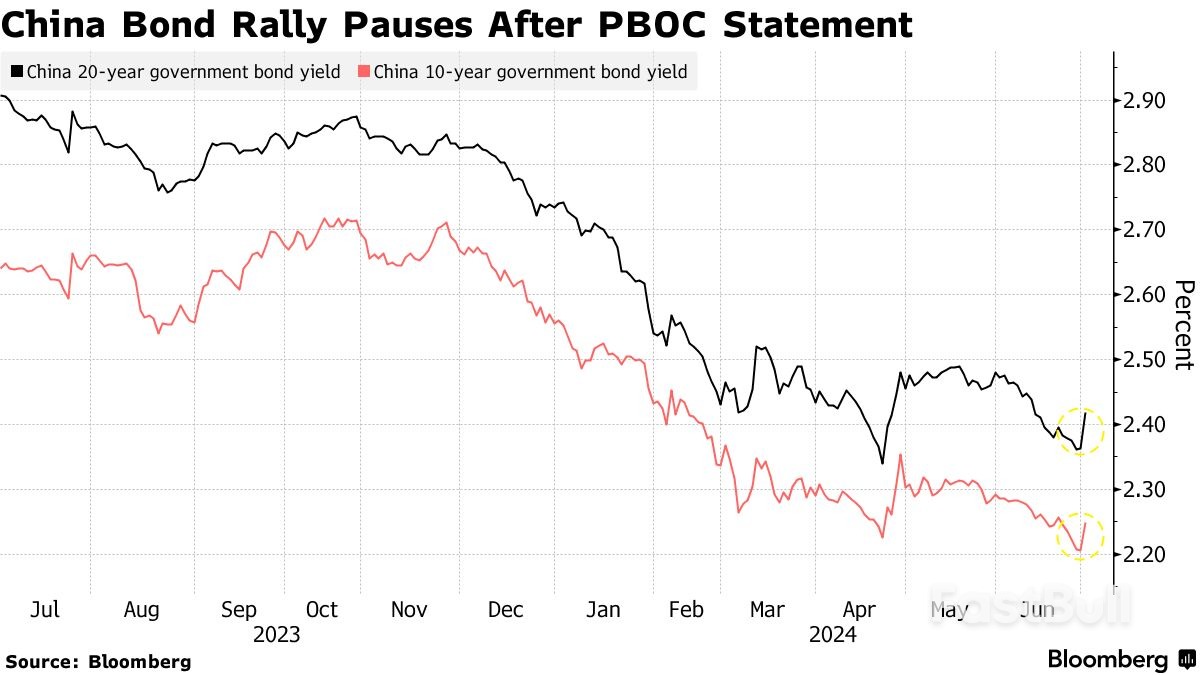
          China’s central bank’s plan to borrow bonds may slow but won’t quash their rally, as the fundamental reasons driving demand for debt are unlikely to reverse, according to analysts.
          The impact of the People’s Bank of China move may instead be to put a floor on yields and send them into a range, they said. Benchmark yields rebounded from a record low Monday after the PBOC said it would borrow government bonds from primary dealers, a sign it may be contemplating selling securities to cool down a hot bond market.
          “As the macro logic is still stabilizing growth and easing monetary policy, the simple reversal of the bond market doesn’t exist, as the possibility of rate cuts is still there,” said Sun Binbin, chief analyst of fixed-income research at Tianfeng Securities. “The overall trend of rates declining hasn’t changed.”
          The PBOC has been pushing back against China’s bond rally for months and hinted it may sell some of its own holdings to cool the advance in May. The idea of it trading bonds as a potential tool came to the market’s attention via an old speech by President Xi Jinping, although the operations are also seen as a longer-term plan for better liquidity management in the financial system.

          PBOC Bond Trading Sets Floor, But Not Cease Market Chase, Analysts Say_1
          Chinese sovereign bonds have gotten a boost from pessimism toward the world’s second-largest economy and expectations for further interest-rate cuts. The lack of alternative investment opportunities for onshore investors has also driven them into bonds as haven assets.
          The central bank’s move toward borrowing notes “is not purely intervention, but still some sort of caring,” Tianfeng’s Sun said.
          Huaxi Securities analysts led by Liu Yu said investors may now trade defensively in the short-term, using June’s yield levels as an anchor. Monday’s jump in yields may be a “one-time emotional release,” they wrote in a note, though longer-tenor yields may rebound some 10 basis points.
          China’s 10-year yield traded at 2.24% on Tuesday, up from an all-time low of 2.18% on Monday, according to data compiled by Bloomberg that goes back to 2002.
          For Zhou Guannan, an analyst at Huachuang Securities, the PBOC statement suggested it is eyeing 2.20% as a soft red line for the benchmark note and 2.40% for its 30-year equivalent.
          The 30-year bond saw a closing low of 2.42% in April and stood around 2.46% on Tuesday.
          “For the bond market, long-end yields face retracement pressure in the short term,” said Ming Ming, chief economist at Citic Securities. “In an environment where the lack of lucrative assets is still unchanged,” the attractiveness of medium- to short-tenor bonds may increase.

          Source:Bloomberg

          To stay updated on all economic events of today, please check out our Economic calendar
          Risk Warnings and Disclaimers
          You understand and acknowledge that there is a high degree of risk involved in trading. Following any strategies or investment methods may lead to potential losses. The content on the site is provided by our contributors and analysts for information purposes only. You are solely responsible for determining whether any trading assets, securities, strategy, or any other product is suitable for investing based on your own investment objectives and financial situation.
          Add to Favorites
          Share

          Goldman: Hedge Funds Sold Global Equities At The Fastest Pace In Two Years In June

          Cohen

          Economic

          Stocks

          Hedge funds continued to sell global equities for a third consecutive month in June, marking the fastest pace of selling since June 2022, according to Goldman Sachs’ prime brokerage desk. The sales were chiefly driven by short sales, as overall long flows remained relatively flat, Goldman said in a note.
          “Single Stocks were net sold for a second straight month and saw the largest notional net selling since Nov ‘22, driven by short sales outpacing long buys 4 to 1. 9 of 11 global sectors were net sold in June, led in notional terms by Info Tech, Financials, Real Estate, and Staples,” the note states.
          Macro products, including indices and exchange-traded funds (ETFs), were marginally net bought in June, driven by risk unwinds with short covers slightly exceeding long sales. Excluding mark-to-market adjustments, US-listed ETF shorts on the Prime book decreased by 6.8% in June, with significant short covering in Small Cap Equity, Financials, Industrials, Real Estate, and Health Care ETFs.
          “ETF shorts now make up 10.2% of the US equity short book (excl. Index products), the lowest level since Dec ‘19 and near five-year lows in the 3rd percentile,” compared to 11.1% at the end of May and 10.8% at the start of 2024, Goldman Sachs highlighted.
          In regional activity, hedge funds sold developed market (DM) Asia stocks for the first time in six months and at the fastest pace since September. All DM Asia markets were net sold, led by Singapore, Australia, Hong Kong, and Japan. North America and Europe also saw net selling in notional terms.
          Emerging market (EM) Asia was the most net bought region in June, continuing a trend of net buying in six of the last seven months. Korea and Taiwan were the most net bought markets, which outweighed net selling in China and Thailand.
          Chinese equities were net sold for the second month in a row, with net selling in American Depositary Receipts (ADRs) and H-shares surpassing net buying in A-shares.
          Sector-wise, 8 of 11 sectors were net sold in June, led by Technology, Media, and Telecom (TMT) and Consumers stocks.

          Source:Investing

          To stay updated on all economic events of today, please check out our Economic calendar
          Risk Warnings and Disclaimers
          You understand and acknowledge that there is a high degree of risk involved in trading. Following any strategies or investment methods may lead to potential losses. The content on the site is provided by our contributors and analysts for information purposes only. You are solely responsible for determining whether any trading assets, securities, strategy, or any other product is suitable for investing based on your own investment objectives and financial situation.
          Add to Favorites
          Share

          Bitcoin ETF Inflows Highest in a Month as Bitcoin Hovers Near $63K

          Warren Takunda

          Cryptocurrency

          United States-based spot Bitcoin exchange-traded funds (ETFs) recorded significant daily inflows of $129.45 million on July 1, marking the fifth consecutive day of positive flows.
          Spot Bitcoin ETFs in the U.S. were approved on Jan. 10 and started trading a day later. In the first couple of months, major ETF issuers had some of the biggest inflows and trading volumes, with the exception of the Grayscale Bitcoin Trust (GBTC), which has seen zero inflows or significant outflows since its conversion to an ETF.

          Bitcoin ETFs record fifth consecutive day of inflows

          The $129.45 million of inflows on July 1 is also the highest figure since June 7. As inflows turned positive, the BTC price reclaimed $63,000 after nearly three weeks of struggling to overcome the key resistance level of $62,000.
          Data from the crypto research platform SoSo Value shows that Fidelity’s Wise Origin Bitcoin Fund registered the highest inflow, with1,030 BTC worth $65 million, followed by the Bitwise Bitcoin ETF, with 650 BTC worth $41 million.
          The ARK 21Shares Bitcoin ETF had inflows of 205 BTC worth $13 million, with BlackRock’s iShares Bitcoin Trust and GBTC — the two largest spot Bitcoin ETFs by net asset value — seeing zero flows on Monday, June 1.
          July 1 marked the fifth consecutive day of net inflows for spot BTC ETFs after nearly seven days of outflows in the last week of June.Bitcoin ETF Inflows Highest in a Month as Bitcoin Hovers Near $63K_1

          Spot BTC ETF daily flows. Source: SoSoValue

          July is historically bullish for BTC

          June was a bearish month for Bitcoin ETFs and the BTC price. Spot Bitcoin ETFs recorded nine days of outflows and 10 days of inflows in the month, with the value of outflows significantly higher than that of inflows.
          The latest spot BTC ETF bullish rally coincided with Monday’s BTC price surge, which saw the price hit a new weekly high of $63,778.
          However, Bitcoin dipped below $63,000 again in the early hours of June 2, trading at $62,558 at the time of writing. Although BTC’s price has recovered from its weekly low below $60,000, it is still down over 15% from its all-time high of $73,750 in March.
          July has historically been a bullish month for Bitcoin, and with spot Ether ETF approvals likely just around the corner, the crypto market could see another bullish rally in the coming weeks.

          Source: Cointelegraph

          Risk Warnings and Disclaimers
          You understand and acknowledge that there is a high degree of risk involved in trading. Following any strategies or investment methods may lead to potential losses. The content on the site is provided by our contributors and analysts for information purposes only. You are solely responsible for determining whether any trading assets, securities, strategy, or any other product is suitable for investing based on your own investment objectives and financial situation.
          Add to Favorites
          Share

          ECB Considers Further Rate Cuts, But Eyes Inflation Target

          Alex

          Economic

          Central Bank

          The European Central Bank (ECB) will probably reduce interest rates further this year, with any additional easing contingent on inflation declining towards its 2 per cent target, a policymaker was quoted to have said.
          The ECB cut rates in June but said it would not do so again as inflation was already above 2 per cent and there was significant doubt whether the target would be met.
          While recent statistics paint a picture of continued wage and service price growth, Belgium’s central bank governor, Pierre Wunsch agrees that the initial cuts were simple decisions.
          Wunsch said a second-rate cut is likely “if we have no major negative surprises” based on current forecasts. He dismissed it as a statement that the ECB can wait until September for improved projections.
          Although inflation is expected to have eased marginally in June, the ECB is expecting a volatile trend from here on, possibly remaining at these levels for the rest of the year.
          This could delay further cuts until a more distinct downward trend towards 2 per cent emerges. “To continue with cuts, I would need to be more confident that inflation is declining from 2. 5 per cent towards something closer to 2 per cent,” Wunsch said.
          He raised worries about taking real interest rates below 1 per cent. At the moment, the ECB’s deposit rate stands at 3 per cent. 75 per cent, and markets expect one or two more this year, implying that there can be four cuts within the next 18 months.
          The economic trends suggest slow economic growth and sound markets, although France elects a far-right president. Wunsch admitted there might be more political instability as several countries are in for necessary fiscal correction after years of fiscal recklessness.“We now have five countries in excessive deficit procedures,” Wunsch said. “It will be difficult for all of them.”Nevertheless, Wunsch was scathing of the suggestion that the ECB would have to turn to buying bonds in an emergency due to political market pressure.
          Recent events have not represented unwarranted and disorderly market moves before intervention, and this is supported by the ECB officials.
          ‘We need to avoid any appearance of predictability; we cannot afford to imply any kind of mechanistic restrictions on our behaviour,’ Wunsch said. ’The judgment call depends on whether market movements are erratic and excessive’.

          Source:wionews

          To stay updated on all economic events of today, please check out our Economic calendar
          Risk Warnings and Disclaimers
          You understand and acknowledge that there is a high degree of risk involved in trading. Following any strategies or investment methods may lead to potential losses. The content on the site is provided by our contributors and analysts for information purposes only. You are solely responsible for determining whether any trading assets, securities, strategy, or any other product is suitable for investing based on your own investment objectives and financial situation.
          Add to Favorites
          Share

          Echoes of Dotcom Bubble Haunt AI-driven US Stock Market

          Alex

          Economic

          Stocks

          A U.S. stock rally supercharged by excitement over artificial intelligence is drawing comparisons with the dotcom bubble two decades ago, raising the question of whether prices have again been inflated by optimism over a revolutionary technology.
          AI fever, coupled with a resilient economy and stronger earnings, has lifted the S&P 500 index to fresh records this year following a run of more than 50% from its October 2022 low. The tech-heavy Nasdaq Composite index has gained over 70% since the end of 2022.
          While various metrics show stock valuations and investor exuberance have yet to hit peaks reached at the turn of the century, the similarities are easy to spot. A small group of massive tech stocks including AI chipmaker Nvidia symbolize today's market, recalling the "Four Horsemen" of the late 1990s: Cisco, Dell, Microsoft and Intel.
          The dizzying run in shares of Nvidia, which gained nearly 4,300% in a recent five-year period, stirred memories of how network equipment maker Cisco surged about 4,500% over five years leading up to its peak in 2000, according to a BTIG comparison of the two stocks.
          Valuations have grown as well, though many tech champions appear to be in far better financial shape than their dot-com counterparts of the late 1990s and early 2000s. Other measures, such as investor bullishness, have yet to reach the frothy heights of the turn of the century.
          The concern is that the AI-driven surge will end the same way as the dot-com boom - with an epic crash. After nearly quadrupling in just over three years, the Nasdaq Composite plunged almost 80% from its March 2000 peak to October 2002. The S&P 500, which doubled in a similar timeframe, collapsed nearly 50% in that period.
          While several internet stocks such as Amazon survived and eventually thrived, others never recovered.
          "No one exactly knows what will happen with artificial intelligence," said Sameer Samana, senior global market strategist at the Wells Fargo Investment Institute, noting the same uncertainty about the eventual long-term winners.
          Echoes of Dotcom Bubble Haunt AI-driven US Stock Market_1Echoing the dot-com boom, the information technology sector has swelled to 32% of the S&P 500's total market value, the largest percentage since 2000 when it rose to nearly 35%, according to LSEG Datastream. Just three companies, Microsoft, Apple and Nvidia, represent over 20% of the index.
          However, tech stocks are more modestly valued now than at the peak of the dot-com bubble, trading at 31 times forward earnings, compared to as high as 48 times in 2000, according to Datastream.
          Echoes of Dotcom Bubble Haunt AI-driven US Stock Market_2The difference is clear in the valuations of Nvidia and Cisco, a key provider of products supporting internet infrastructure, whose stock has yet to rescale its peaks of the dotcom boom.
          While both stocks have soared, Nvidia trades at 40 times forward earnings estimates, compared to Cisco's 131 level reached in March 2000, according to Datastream.
          Echoes of Dotcom Bubble Haunt AI-driven US Stock Market_3Capital Economics analysts also note that the current rally is being fueled more by solid earnings outlooks rather than growing valuations, a sign that fundamentals are more of a driver this time.
          Forward earnings per share in sectors containing today's market leaders - tech, communication services and consumer discretionary - have been growing faster since early 2023 than the rest of the market, a Capital Economics analysis showed. By contrast, expected earnings in the sectors grew at a similar pace to the rest of the market in the late 1990s and early 2000s, while their valuations soared faster than for other stocks.
          More broadly, the S&P 500's price-to-earnings ratio of 21 is well above its historical average but below the roughly 25 level reached in 1999 and 2000, according to Datastream.
          "Our base case is that this tech bubble won't burst until the valuation of the overall market has reached the sort of level that it did in 2000," Capital Economics analysts said in a note.
          Dotcom investors were much more euphoric by some measures. Bullish sentiment in the widely followed American Association of Individual Investors survey, often seen as a worrisome indicator at high levels, reached 75% in January 2000, just months before the market peaked. It recently stood at 44.5%, compared to its historical average of 37.5%.Echoes of Dotcom Bubble Haunt AI-driven US Stock Market_4
          While an AI bubble is not a foregone conclusion, many investors are wary that metrics could become even more stretched in coming months if U.S. growth remains robust and tech stocks continue charging higher.
          "There are a lot of similarities," said Mike O'Rourke, chief market strategist at JonesTrading. "When you have a bubble, usually it's rooted in ... some true, positive, fundamental development that is behind it and that creates that enthusiasm for people to pay any price for things."

          Source: Reuters

          To stay updated on all economic events of today, please check out our Economic calendar
          Risk Warnings and Disclaimers
          You understand and acknowledge that there is a high degree of risk involved in trading. Following any strategies or investment methods may lead to potential losses. The content on the site is provided by our contributors and analysts for information purposes only. You are solely responsible for determining whether any trading assets, securities, strategy, or any other product is suitable for investing based on your own investment objectives and financial situation.
          Add to Favorites
          Share
          FastBull
          Copyright © 2025 FastBull Ltd

          728 RM B 7/F GEE LOK IND BLDG NO 34 HUNG TO RD KWUN TONG KLN HONG KONG

          TelegramInstagramTwitterfacebooklinkedin
          App Store Google Play Google Play
          Products
          Charts

          Chats

          Q&A with Experts
          Screeners
          Economic Calendar
          Data
          Tools
          Membership
          Features
          Function
          Markets
          Copy Trading
          Latest Signals
          Contests
          News
          Analysis
          24/7
          Columns
          Education
          Company
          Careers
          About Us
          Contact Us
          Advertising
          Help Center
          Feedback
          User Agreement
          Privacy Policy
          Business

          White Label

          Data API

          Web Plug-ins

          Poster Maker

          Affiliate Program

          Risk Disclosure

          The risk of loss in trading financial instruments such as stocks, FX, commodities, futures, bonds, ETFs and crypto can be substantial. You may sustain a total loss of the funds that you deposit with your broker. Therefore, you should carefully consider whether such trading is suitable for you in light of your circumstances and financial resources.

          No decision to invest should be made without thoroughly conducting due diligence by yourself or consulting with your financial advisors. Our web content might not suit you since we don't know your financial conditions and investment needs. Our financial information might have latency or contain inaccuracy, so you should be fully responsible for any of your trading and investment decisions. The company will not be responsible for your capital loss.

          Without getting permission from the website, you are not allowed to copy the website's graphics, texts, or trademarks. Intellectual property rights in the content or data incorporated into this website belong to its providers and exchange merchants.

          Not Logged In

          Log in to access more features

          FastBull Membership

          Not yet

          Purchase

          Become a signal provider
          Help Center
          Customer Service
          Dark Mode
          Price Up/Down Colors

          Log In

          Sign Up

          Position
          Layout
          Fullscreen
          Default to Chart
          The chart page opens by default when you visit fastbull.com