

Markets
News
Analysis
User
24/7
Economic Calendar
Education
Data
- Names
- Latest
- Prev



Signal Accounts for Members
All Signal Accounts
All Contests
 France Trade Balance (SA) (Oct)
A:--
F: --
 Euro Zone Employment YoY (SA) (Q3)
A:--
F: --
 Canada Part-Time Employment (SA) (Nov)
A:--
F: --
P: --
Canada Unemployment Rate (SA) (Nov)A:--
F: --
P: --
Canada Full-time Employment (SA) (Nov)A:--
F: --
P: --
Canada Labor Force Participation Rate (SA) (Nov)A:--
F: --
P: --
Canada Employment (SA) (Nov)A:--
F: --
P: --
 U.S. PCE Price Index MoM (Sept)
A:--
F: --
P: --
U.S. Personal Income MoM (Sept)A:--
F: --
P: --
U.S. Core PCE Price Index MoM (Sept)A:--
F: --
P: --
U.S. PCE Price Index YoY (SA) (Sept)A:--
F: --
P: --
U.S. Core PCE Price Index YoY (Sept)A:--
F: --
P: --
U.S. Personal Outlays MoM (SA) (Sept)A:--
F: --
U.S. 5-10 Year-Ahead Inflation Expectations (Dec)A:--
F: --
P: --
U.S. Real Personal Consumption Expenditures MoM (Sept)A:--
F: --
U.S. Weekly Total Rig CountA:--
F: --
P: --
U.S. Weekly Total Oil Rig CountA:--
F: --
P: --
U.S. Consumer Credit (SA) (Oct)A:--
F: --
 China, Mainland Foreign Exchange Reserves (Nov)
A:--
F: --
P: --
 Japan Trade Balance (Oct)
A:--
F: --
P: --
Japan Nominal GDP Revised QoQ (Q3)A:--
F: --
P: --
China, Mainland Imports YoY (CNH) (Nov)A:--
F: --
P: --
China, Mainland Exports (Nov)A:--
F: --
P: --
China, Mainland Imports (CNH) (Nov)A:--
F: --
P: --
China, Mainland Trade Balance (CNH) (Nov)A:--
F: --
P: --
China, Mainland Exports YoY (USD) (Nov)A:--
F: --
P: --
China, Mainland Imports YoY (USD) (Nov)A:--
F: --
P: --
 Germany Industrial Output MoM (SA) (Oct)
A:--
F: --
Euro Zone Sentix Investor Confidence Index (Dec)A:--
F: --
P: --
Canada National Economic Confidence IndexA:--
F: --
P: --
 U.K. BRC Like-For-Like Retail Sales YoY (Nov)
--
F: --
P: --
U.K. BRC Overall Retail Sales YoY (Nov)--
F: --
P: --
 Australia Overnight (Borrowing) Key Rate
--
F: --
P: --
RBA Rate Statement RBA Press Conference Germany Exports MoM (SA) (Oct)--
F: --
P: --
U.S. NFIB Small Business Optimism Index (SA) (Nov)--
F: --
P: --
 Mexico 12-Month Inflation (CPI) (Nov)
--
F: --
P: --
Mexico Core CPI YoY (Nov)--
F: --
P: --
Mexico PPI YoY (Nov)--
F: --
P: --
U.S. Weekly Redbook Index YoY--
F: --
P: --
U.S. JOLTS Job Openings (SA) (Oct)--
F: --
P: --
China, Mainland M1 Money Supply YoY (Nov)--
F: --
P: --
China, Mainland M0 Money Supply YoY (Nov)--
F: --
P: --
China, Mainland M2 Money Supply YoY (Nov)--
F: --
P: --
U.S. EIA Short-Term Crude Production Forecast For The Year (Dec)--
F: --
P: --
U.S. EIA Natural Gas Production Forecast For The Next Year (Dec)--
F: --
P: --
U.S. EIA Short-Term Crude Production Forecast For The Next Year (Dec)--
F: --
P: --
EIA Monthly Short-Term Energy Outlook U.S. API Weekly Gasoline Stocks--
F: --
P: --
U.S. API Weekly Cushing Crude Oil Stocks--
F: --
P: --
U.S. API Weekly Crude Oil Stocks--
F: --
P: --
U.S. API Weekly Refined Oil Stocks--
F: --
P: --
 South Korea Unemployment Rate (SA) (Nov)
--
F: --
P: --
Japan Reuters Tankan Non-Manufacturers Index (Dec)--
F: --
P: --
Japan Reuters Tankan Manufacturers Index (Dec)--
F: --
P: --
Japan Domestic Enterprise Commodity Price Index MoM (Nov)--
F: --
P: --
Japan Domestic Enterprise Commodity Price Index YoY (Nov)--
F: --
P: --
China, Mainland PPI YoY (Nov)--
F: --
P: --
China, Mainland CPI MoM (Nov)--
F: --
P: --


No matching data

Latest Views
Latest Views
Trending Topics
Top Columnists
Latest Update
White Label
Data API
Web Plug-ins
Affiliate Program
View All
No data
London stocks fell as Trump’s 25% auto tariff hit markets, while Next surged after raising its sales outlook despite consumer caution.
U.S. President Donald Trump has announced a 25% tariff on all non-U.S. manufactured cars. This is a move to boost American manufacturing with cars built in the U.S. being exempt. This is part of his larger plan to adjust trade relations, with more tariffs set to roll out on April 2, dubbed "liberation day."
notably, the tariff will be applied on top of the existing 2.5% car tariff. Additionally, if parts are produced in the U.S. but the vehicle is not, those parts will be exempt from the tariff. On Wednesday, the White House confirmed that the tariffs will take effect on April 2, with collection beginning on April 3.
"What we're going to be doing is a 25 per cent tariff on all cars that are not made in the United States. This will be permanent," Trump said from the Oval Office. "We start off with a 2.5 per cent base, which is what we're at, and go to 25 per cent."
The White House announced that the tariff would apply to fully assembled cars and essential auto components, such as engines, transmissions, powertrain parts, and electrical components. The list may grow over time to include more items.
“We’re going to charge countries for doing business in our country and taking our jobs, taking our wealth, taking a lot of things that they’ve been taking over the years,” he added.
The tariff currently exempts automotive parts that comply with the U.S.-Mexico-Canada Agreement (USMCA), which allows mostly duty-free trade between the U.S. and its two largest trading partners.
Trump argues the tariffs will boost U.S. manufacturing and eliminate the "ridiculous" supply chain involving the U.S., Canada, and Mexico." Trump emphasized that the 25% tariff would simplify the process and help reduce U.S. debt significantly. He described the tariff as both a tax reduction and a way to improve the country's financial balance sheet in the near future.
In February, Trump hinted at upcoming auto tariffs, and by Monday, he confirmed they would be implemented soon. He also suggested that some reciprocal tariffs might be less severe than expected, saying they could even be lower than those other countries have imposed for years.
Howver, the decision has sparked concerns about market volatility. Interestingly, he clarified that Elon Musk did not have a role in advising on this auto tariff policy, despite earlier comments suggesting that tariffs could be "net neutral or maybe good for Tesla."
Foreign leaders quickly criticized the tariffs, signaling that Trump may be escalating a global trade war that could harm worldwide growth.
European Commission President Ursula von der Leyen described the move as "bad for businesses, worse for consumers, Canada's new Prime Minister, Mark Carney, criticized the U.S. trade move, vowing to defend Canadian workers and companies. Last year, Canada exported nearly C$50 billion in vehicles to the U.S., making autos a major export.
Ahead of Trump's announcement, shares of U.S.-listed automakers dropped due to concerns that tariffs could disrupt the global auto industry. The new levies are expected to raise car prices for consumers, potentially reducing sales and causing job losses. The U.S. auto industry depends on imported parts, and experts warn that these tariffs could make cars more expensive, limit choices for consumers, and result in fewer manufacturing jobs.
If the full cost of the new 25% auto tariff is passed onto consumers, the price of an imported vehicle could rise by $12,500, potentially contributing to overall inflation. Trump was voted back into the White House last year because voters believed he could bring down prices.
The auto tariffs are part of Trump’s broader plan to reshape global trade, with “reciprocal” taxes set to be imposed on April 2, matching tariffs and sales taxes charged by other countries.
(March 27): Gold prices rose on Thursday as US auto tariffs ratcheted up global trade tensions ahead of an April 2 deadline for reciprocal tariffs from the world's largest economy.
Spot gold was up 0.5% at US$3,033.20 an ounce, as of 0535 GMT. US gold futures gained 0.6% to US$3,039.
US President Donald Trump on Wednesday unveiled a 25% tariff on imported cars and light trucks starting next week, widening the global trade war.
Investors feared that Trump's reciprocal tariffs, expected to take effect on April 2, might fuel inflation, slow economic growth and heighten trade tensions.
Concerns over Trump's tariff policies catapulted gold to a record high of US$3,057.21 on March 20.
Aakash Doshi, global head of gold at SPDR ETF Strategy, expects gold will breach US$3,100 in the second quarter and "the market could potentially push another 8%-10% higher by end-2025 if the current macro and physical market tailwinds sustain for the yellow metal."
Goldman Sachs on Wednesday raised its end-2025 gold price forecast to US$3,300 per ounce from US$3,100, citing stronger-than-expected ETF inflows and sustained central bank demand.
Investors await the US personal consumption expenditures data, due on Friday, which could shed more light on the US interest rate path.
"The March high near US$3,057 is immediate resistance for gold prices. The US$3,100 figure follows next," said Ilya Spivak, head of global macro at Tastylive.
Last week, the US central bank held benchmark interest rate steady, but indicated it could cut rates later this year. Non-yielding bullion tends to thrive in a low interest-rate environment.
Minneapolis Federal Reserve Bank president Neel Kashkari said that while the US central bank has made a lot of progress bringing inflation down, "we have more work to do" to get inflation to the Fed's 2% target.
In a decisive move, the U.S. Senate has rolled back a contentious tax regulation that threatened the cryptocurrency market. During a late-night vote on Wednesday, 70 senators supported the repeal, while 28 were opposed. This regulation, which was imposed by the IRS, required decentralized finance (DeFi) platforms to operate under traditional securities broker rules, significantly affecting their operations.
The IRS regulation was introduced in December 2024, near the end of the Biden administration. It mandated that certain DeFi entities must gather and report transaction data, including issuing traditional income tax forms known as “Form 1099” to their users. The Treasury Department stated that this rule specifically targeted organizations interacting with decentralized protocols directly.
The backlash against this regulation was swift and fierce, with numerous stakeholders in the cryptocurrency sector expressing concern that it would stifle innovation and drive U.S.-based companies to seek opportunities abroad. Following the rule’s implementation, the DeFi Education Foundation, alongside several other organizations, initiated a lawsuit against the IRS, warning of severe market repercussions.
Senator Ted Cruz, alongside Representative Mike Carey, was instrumental in pushing for the repeal. The voting saw a coalition of Republicans and supportive Democratic figures, including Senate Minority Leader Chuck Schumer, unite for the cause. However, some Democrats took issue with the Republicans, claiming their actions aimed to weaken the IRS by not allocating sufficient budget.
The Senate’s actions highlight the growing recognition of the need to balance regulation with innovation in the cryptocurrency landscape. The support from both sides of the aisle suggests a collective acknowledgment of the importance of maintaining a robust and competitive market for digital currencies.
To get John Authers’ newsletter delivered directly to your inbox, sign up here.
Rachel Agonistes was painful to watch. Rachel Reeves, installed last year as Britain’s chancellor of the exchequer, has done what politicians of the left least want to do, and reduced welfare benefits for the poor. Cuts of £4.8 billion ($6.2 billion) understandably dominated coverage. They will be concentrated on 800,000 people with long-term physical or mental health conditions who have difficulty doing certain everyday tasks and receive personal independence payments (PIPs). The optics for a Labour administration could scarcely be worse.
That said, Reeves passed muster with the markets. She had gone on a media tour to break the bad tidings in advance, so they didn’t come as a surprise. She was also helped by a pleasant surprise on UK inflation, which has turned back down slightly:
Gilt yields dropped and the FTSE-100, alone among major European indexes, gained for the day, while a bad outing for sterling still left it almost exactly at $1.29, the level at which it has been trading most of this month. Reeves survives. But there are problems ahead, with another fiscal statement due in the fall.
Sam Cartwright of Societe Generale SA complained that the government was left “exposed to unfavourable movements in the forecast yet again.” He said that a fall in productivity in the Autumn Budget or proof that spending plans couldn’t be delivered “could force the Chancellor into raising taxes.”
That is a problem because Labour made a necessary election promise not to raise taxes on the working class. It’s also trying to keep within two fixed and self-imposed fiscal bounds: That the budget should be stable, so day-to-day spending is met by revenues, and that public sector net liabilities should be reduced as a share of gross domestic product by the end of the parliament. These rules were a needed inoculation after the bond market’s revolt at former Prime Minister Liz Truss’ unfunded tax cuts in 2022 — but led to extremely uncomfortable welfare cuts.
The UK’s non-partisan National Institute for Economic and Social Research argued in its response:
Operating with very little headroom, Reeves is vulnerable to further changes in the economic outlook. The Office for Budget Responsibility avers that 20% tariffs from the US would be enough to wipe out all the savings she has just made.
The contrast with Germany is stark. The UK elected a Labour government which is presiding over sharply tighter fiscal policy, while Germany just elected fiscal conservatives who are now overseeing a massive fiscal splurge. That’s not what the voters or even the politicians themselves had in mind.
But it’s critical to note that Reeves isn’t subject only to her own rules. Markets are also setting guidelines. Despite the huge change in the borrowing intentions of the two countries this month, the bond market still sees German debt as much, much safer. The extra yield required of the British has risen steadily, and is now about two percentage points; a big obstacle to borrowing that Reeves did not impose on herself:
Some of this is the continuing negative verdict on Brexit. As far as financial markets are concerned, Britain would have been a safer bet if it had stayed in the European Union. The consistency of this judgment is impressive. It’s now almost nine years since the UK voted to leave, sparking an unprecedented overnight nosedive for sterling. That’s held up, with the pound at a permanently lower level against the euro, and unable to get back above its level after the hectic referendum night:
Stock investors seem sure that German prospects have improved dramatically. Comparing British and German mid caps — most directly exposed to their domestic economy, as their ranks include few multinationals — is startling. Amid previous negativity around Germany, the FTSE 250 put in a period of outperformance. It’s given that all up, and then some, as the new German policy has taken shape:
Germany faces its own challenge, to spend these huge sums well. We have the first round of sentiment surveys since the wave of fiscal announcements. They suggest that business sentiment has improved, but perhaps not as much as might have been expected. The ZEW survey showed expectations at the highest level since the invasion of Ukraine, but the rival IFO survey was more constrained. Investors have plainly perked up a lot; the manufacturing PMI index remains at a level that normally means contraction:
For now, the market is still giving Germany rather more than the benefit of the doubt over a massive policy shift that could easily go wrong. The country is using that flexibility, which has been earned with a generation of arguably excessive austerity. Britain’s different policies have left Reeves without room to expand. She doesn’t get the benefit of any doubt, and she’s playing the miserable cards she’s been dealt about as well as anyone could hope.
Amid all the troubled waters of the global economy, oil is a calming influence. There’s a supply glut, even with production from countries like Iran, Venezuela and Russia largely on the sidelines. The new US administration has made forcing oil prices down one of its cardinal aims. And yet since March 3, Brent crude has climbed by more than 6.3%, on the brink of eliminating its losses for the year. At a time of rising anxiety, which would usually push oil upward, the stability cannot be ignored. The surge has defied events such as US attacks on Houthi rebels in the Red Sea and an increase in Russia’s output, which ordinarily should push prices down, while Israel’s return to war in Gaza could tilt the price upward:
Like Brent, the West Texas Intermediate benchmark has rallied this month, nudging about 5.6% gains. The US-brokered provisional ceasefire in the Russia-Ukraine war weighed only slightly on prices. With the Trump administration’s pledge to engineer lower oil prices, this may seem to be a step in the right direction.
But what most catches the eye is that the market seems to have put a floor under the crude price. WTI has at no point dropped below $65 per barrel since 2021 (see the chart below). That’s probably not a coincidence. Longview Economics’ Harry Colvin suggests this is the floor price because it’s the average breakeven production cost for US shale drillers.
If the administration isn’t happy with prices in this range and wants to force them lower, it will need to find a way to compensate investors to produce oil at what appears to be below their average breakeven cost:
WTI’s rally has been helped by a 3.3 million barrel drop in US commercial inventories – doubling analysts’ initial expectations of only 1.6 million barrels. The drawdown reported in the latest Energy Information Administration release coincides with strong domestic demand, unaffected as yet by tariff concerns. In the past week, US refineries processed, on average, 15.8 million barrels, reaching a utilization rate of 87%, a considerable rise from the previous output.
Geopolitics could determine oil’s direction from here. Pepperstone’s Quasar Elizundia suggests that the US threat to impose “secondary” 25% tariffs on other countries for their imports of Venezuelan crude has added pressure on the trade flow to China, the leading buyer. He also argues that new sanctions on Iran could tighten global supply, placing Saudi Arabia in a position to cover any supply shortfall:
Ultimately, proposed sanctions on Venezuela or Iran or an additional clampdown on Russia will likely offset OPEC+’s announcement of extra supply. OPEC+ countries, including Iraq, Kazakhstan and Russia, that exceeded their production targets are expected to cut back. If they don’t fully comply, BNP Paribas’ Aldo Spanier argues that the overall net effect would be looser balances and, hence, lower prices. The bank now sees Brent selling at $2 per barrel lower than its previous forecast:
What, then, is the basis for the ongoing mini rally? Longview Economics’ Colvin suggests that most of the buying is about the exposures that investors already have. His proprietary market timing model shows a buy, based on inputs that include positioning, sentiment, and a medium-term indicator of technical strength. That suggests oil prices can keep rallying for the next couple of months:
For consumers, a gloomy oil outlook is always good news at the pump and something they can live with. That, and the sheer stability of oil in a distinctly unstable world, is good news. But there are limits to how far down the price can go.
—Richard Abbey
I’ve been taking refuge in Desert Island Discs recently — the wonderful, now 75-year-old BBC radio show in which people are asked for the eight records they would want with them on a desert island, and explain why. It’s an extraordinarily revealing format. Recently the great Apple designer Jony Ive appeared, followed by one of my favorite novelists, William Boyd, then Cyndi Lauper (who wants to listen to Puccini more than anything else), and Professor Carl Jones, a biologist whose great claim is to have saved the Mauritius kestrel from extinction. There were only four birds left when he arrived on the island, and hundreds when he left decades later. The website also has handy lists, including this one of the nine most moving castaway interviews. It helped me during lockdown. Things are a tad frenetic now, and it’s coming in handy again.
The steady drip of tariff news from US President Donald Trump continued overnight, pushing US equities lower and weighing on risk sentiment globally. The tech-heavy NASDAQ led the decline with a drop of over 2%, while broader US indexes also closed in the red. In Asia, Japan’s Nikkei and South Korea’s Kospi followed with notable declines—particularly in auto stocks—while other regional bourses stayed relatively steady, suggesting selective impact.
Despite the equity selloff, currency markets have shown muted reactions so far. Major FX pairs and crosses are treading water, largely trapped within yesterday’s ranges. This suggests that while traders are alert to the evolving trade policy, many are experiencing tariff fatigue and are reluctant to reposition aggressively before next week’s pivotal developments.
The latest tariff news centers around a 25% duty on imported cars and light trucks “not made in the United States,” scheduled to take effect on April 3. However, the rollout comes with key exemptions. Automotive parts compliant with USMCA are spared, and all other auto parts imports are exempt until May 3 to allow time for administrative clarity. It’s a classic case of shock softened by implementation ambiguity.
The centerpiece remains April 2, which Trump has dubbed “liberation day” and “the big one,” when reciprocal tariffs will be formally announced. However, in a shift of tone, Trump now says the measures will be “very lenient,” and “less than the tariff they’ve been charging (the US) for decades,” hinting at a softer-than-expected rollout. That may explain the relatively calm tone in FX markets despite the ongoing trade drama.
In terms of currency performance this week, Canadian Dollar is leading the charge along with commodity currencies. Aussie and Kiwi follow, while traditional safe havens like Yen and Dollar are under pressure. Euro joins them as one of the weakest, while Sterling and Swiss Franc are in the middle of the pack.
Technically, the selloff in NASDAQ overnight is just continuation of the near-term consolidation pattern from the 17238.23 low. Another bounce toward 38.2% retracement of 2024.58 to 17238.23 at 18371.38 remains possible. But strong resistance at the 55 D EMA (now at 18688.06) should cap upside. The larger correction from the 20204.58 peak is still expected to resume eventually, with a break below 17238.23 at a later stage.
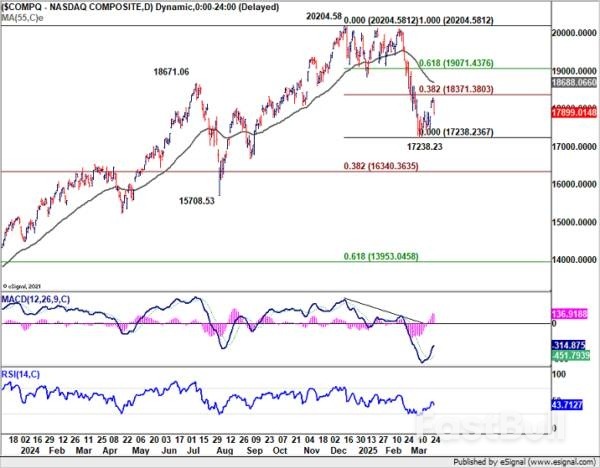
In Asia, at the time of writing, Nikkei is down -0.97%. Hong Kong HSI is up 0.79%. China Shanghai SSE is up 0.23%. Singapore Strait Times is up 0.41%. Japan 10-year JGB yield is up 0.006 at 1.593, approaching 1.6% mark. Overnight, DOW fell -0.31%. S&P 500 fell -1.12%. NASDAQ fell -2.04%. 10-year yield rose 0.031 to 4.338.
St. Louis Fed President Alberto Musalem warned that while the initial effects of import tariffs may be short-lived, their broader inflationary impact could linger. He stressed concern that underlying inflation may be influenced more persistently than expected, and if so, Fed might have to consider a tighter policy stance.
Although this isn’t his baseline scenario, Musalem emphasized that the Fed must remain vigilant to second-round effects from tariffs.
He noted that if inflation stays above the 2% target and the economy remains strong, the current “modestly restrictive” monetary stance would need to be maintained longer.
More significantly, “If the labor market remains resilient and the second-round effects from tariffs become evident, or if medium- to longer-term inflation expectations begin to increase actual inflation or its persistence, then modestly restrictive policy will be appropriate for longer or a more restrictive policy may need to be considered,” he said.
BoC’s March 12 Summary of Deliberations revealed that the decision to cut the policy rate by 25 bps to 2.75% was driven primarily by “tariff threats and elevated uncertainty”.
Governing Council members acknowledged that, under normal circumstances, holding the rate at 3% would have been appropriate. However, the impact of steel and aluminum tariffs, additional tariff threats, and the unpredictable stance of the US administration had begun to materially affect business and consumer decisions. This was “significantly weakening the near-term outlook”.
Looking ahead, BoC emphasized the complexity of the situation and the fluid nature of trade tensions. “It would not be appropriate to provide guidance on the future path for the policy interest rate,” the minutes noted.
Eurozone M3 money supply is the only feature in European session. Later in the day, US will release Q1 GDP final, goods trade balance, jobless claims and pending home sales.
Outlook in EUR/USD is unchanged that strong support is expected from 38.2% retracement of 1.0358 to 1.0953 at 1.0726 to completion the correction from 1.0953. On the upside, break of 1.0857 will bring retest of 1.0953 first. Firm break there will resume larger rise from 1.0176. However, sustained break of 1.0726 will bring deeper correction to 55 D EMA (now at 1.0630).

In the bigger picture, prior strong break of 55 W EMA (now at 1.0675) suggests that fall from 1.1274 (2024 high) has completed as a three wave correction to 1.0176. Rise from 0.9534 is still intact, and might be ready to resume. Decisive break of 1.1274 will target 100% projection of 0.9534 to 1.1274 from 1.0176 at 1.1916. Also, that will send EUR/USD through a multi-decade channel resistance will carries larger bullish implication. This will now be the favored case as long as 1.0531 resistance turned support holds.

728 RM B 7/F GEE LOK IND BLDG NO 34 HUNG TO RD KWUN TONG KLN HONG KONG


White Label
Data API
Web Plug-ins
Poster Maker
Affiliate Program
The risk of loss in trading financial instruments such as stocks, FX, commodities, futures, bonds, ETFs and crypto can be substantial. You may sustain a total loss of the funds that you deposit with your broker. Therefore, you should carefully consider whether such trading is suitable for you in light of your circumstances and financial resources.
No decision to invest should be made without thoroughly conducting due diligence by yourself or consulting with your financial advisors. Our web content might not suit you since we don't know your financial conditions and investment needs. Our financial information might have latency or contain inaccuracy, so you should be fully responsible for any of your trading and investment decisions. The company will not be responsible for your capital loss.
Without getting permission from the website, you are not allowed to copy the website's graphics, texts, or trademarks. Intellectual property rights in the content or data incorporated into this website belong to its providers and exchange merchants.
Not Logged In
Log in to access more features

FastBull Membership
Not yet
Purchase


Log In
Sign Up


