• Trade
  • Markets
  • Copy
  • Contests
  • News
  • 24/7
  • Calendar
  • Q&A
  • Chats
Trending
Screeners
SYMBOL
LAST
BID
ASK
HIGH
LOW
NET CHG.
%CHG.
SPREAD
SPX
S&P 500 Index
6848.51
6848.51
6848.51
6861.30
6843.84
+21.10
+ 0.31%
--
DJI
Dow Jones Industrial Average
48610.46
48610.46
48610.46
48679.14
48557.21
+152.42
+ 0.31%
--
IXIC
NASDAQ Composite Index
23251.43
23251.43
23251.43
23345.56
23240.37
+56.27
+ 0.24%
--
USDX
US Dollar Index
97.820
97.900
97.820
98.070
97.810
-0.130
-0.13%
--
EURUSD
Euro / US Dollar
1.17567
1.17574
1.17567
1.17596
1.17262
+0.00173
+ 0.15%
--
GBPUSD
Pound Sterling / US Dollar
1.33954
1.33962
1.33954
1.33970
1.33546
+0.00247
+ 0.18%
--
XAUUSD
Gold / US Dollar
4333.45
4333.79
4333.45
4350.16
4294.68
+34.06
+ 0.79%
--
WTI
Light Sweet Crude Oil
56.879
56.909
56.879
57.601
56.789
-0.354
-0.62%
--

Community Accounts

Signal Accounts
--
Profit Accounts
--
Loss Accounts
--
View More

Become a signal provider

Sell trading signals to earn additional income

View More

Guide to Copy Trading

Get started with ease and confidence

View More

Signal Accounts for Members

All Signal Accounts

Best Return
  • Best Return
  • Best P/L
  • Best MDD
Past 1W
  • Past 1W
  • Past 1M
  • Past 1Y

All Contests

  • All
  • Trump Updates
  • Recommend
  • Stocks
  • Cryptocurrencies
  • Central Banks
  • Featured News
Top News Only
Share

The Nasdaq Golden Dragon China Index Fell 0.9% In Early Trading

Share

The S&P 500 Opened 32.78 Points Higher, Or 0.48%, At 6860.19; The Dow Jones Industrial Average Opened 136.31 Points Higher, Or 0.28%, At 48594.36; And The Nasdaq Composite Opened 134.87 Points Higher, Or 0.58%, At 23330.04

Share

Miran: Goods Inflation Could Be Settling In At A Higher Level Than Was Normal Before The Pandemic, But That Will Be More Than Offset By Housing Disinflation

Share

Miran, Who Dissented In Favor Of A Larger Cut At Last Fed Meeting, Repeats Keeping Policy Too Tight Will Lead To Job Losses

Share

Miran: Does Not Think Higher Goods Inflation Is Mostly From Tariffs, But Acknowledges Does Not Have A Full Explanation For It

Share

Toronto Stock Index .GSPTSE Rises 67.16 Points, Or 0.21 Percent, To 31594.55 At Open

Share

Miran: Excluding Housing And Non-Market Based Items, Core Pce Inflation May Be Below 2.3%, “Within Noise” Of The Fed's 2% Target

Share

Polish State Assets Minister Balczun Says Jsw Needs Over USD 830 Million Financing To Keep Liquidity For A Year

Share

Miran: Prices Are “Once Again Stable” And Monetary Policy Should Reflect That

Share

Fed's Miran: Current Excess Inflation Is Not Reflective Of Underlying Supply And Demand In The Economy

Share

Portugal Treasury Puts 2026 Net Financing Needs At 13 Billion Euros, Up From 10.8 Billion In 2025

Share

Portugal Treasury Expects 2026 Net Financing Needs At 29.4 Billion Euros, Up From 25.8 Billion In 2025

Share

Bank Of America Says With Indonesia's Smelter Now Ramping Up, It Expects Aluminium Supply Growth To Accelerate To 2.6% Year On Year In 2026

Share

Bank Of America Expects A Deficit In Aluminium Next Year And Sees Prices Pushing Above $3000/T

Share

Fed Data - USA Effective Federal Funds Rate At 3.64 Percent On 12 December On $102 Billion In Trades Versus 3.64 Percent On $99 Billion On 11 December

Share

Brazil's Petrobras Says No Impact Seen On Oil, Petroleum Products Output As Workers Start Planned Strike

Share

Statement: US Travel Group Warns New Proposed Trump Administration Requirements For Foreign Tourists To Provide Social Media Histories Could Mean Millions Of People Opting Not To Visit

Share

Blackrock: Kerry White Will Become Head Of Citi Investment Management At Citi Wealth

Share

Blackrock: Rob Jasminski, Head Of Citi Investment Management, Has Joined With Team

Share

Blackrock: Effective Dec 15, Citi Investment Management Employees Will Join Blackrock

TIME
ACT
FCST
PREV
Japan Tankan Small Manufacturing Outlook Index (Q4)

A:--

F: --

P: --

Japan Tankan Large Non-Manufacturing Outlook Index (Q4)

A:--

F: --

P: --

Japan Tankan Large Manufacturing Outlook Index (Q4)

A:--

F: --

P: --

Japan Tankan Small Manufacturing Diffusion Index (Q4)

A:--

F: --

P: --

Japan Tankan Large Manufacturing Diffusion Index (Q4)

A:--

F: --

P: --

Japan Tankan Large-Enterprise Capital Expenditure YoY (Q4)

A:--

F: --

P: --

U.K. Rightmove House Price Index YoY (Dec)

A:--

F: --

P: --

China, Mainland Industrial Output YoY (YTD) (Nov)

A:--

F: --

P: --

China, Mainland Urban Area Unemployment Rate (Nov)

A:--

F: --

P: --

Saudi Arabia CPI YoY (Nov)

A:--

F: --

P: --

Euro Zone Industrial Output YoY (Oct)

A:--

F: --

P: --

Euro Zone Industrial Output MoM (Oct)

A:--

F: --

P: --

Canada Existing Home Sales MoM (Nov)

A:--

F: --

P: --

Canada National Economic Confidence Index

A:--

F: --

P: --

Canada New Housing Starts (Nov)

A:--

F: --

P: --
U.S. NY Fed Manufacturing Employment Index (Dec)

A:--

F: --

P: --

U.S. NY Fed Manufacturing Index (Dec)

A:--

F: --

P: --

Canada Core CPI YoY (Nov)

A:--

F: --

P: --

Canada Manufacturing Unfilled Orders MoM (Oct)

A:--

F: --

P: --

U.S. NY Fed Manufacturing Prices Received Index (Dec)

A:--

F: --

P: --

U.S. NY Fed Manufacturing New Orders Index (Dec)

A:--

F: --

P: --

Canada Manufacturing New Orders MoM (Oct)

A:--

F: --

P: --

Canada Core CPI MoM (Nov)

A:--

F: --

P: --

Canada Trimmed CPI YoY (SA) (Nov)

A:--

F: --

P: --

Canada Manufacturing Inventory MoM (Oct)

A:--

F: --

P: --

Canada CPI YoY (Nov)

A:--

F: --

P: --

Canada CPI MoM (Nov)

A:--

F: --

P: --

Canada CPI YoY (SA) (Nov)

A:--

F: --

P: --

Canada Core CPI MoM (SA) (Nov)

A:--

F: --

P: --

Canada CPI MoM (SA) (Nov)

A:--

F: --

P: --

Federal Reserve Board Governor Milan delivered a speech
U.S. NAHB Housing Market Index (Dec)

--

F: --

P: --

Australia Composite PMI Prelim (Dec)

--

F: --

P: --

Australia Services PMI Prelim (Dec)

--

F: --

P: --

Australia Manufacturing PMI Prelim (Dec)

--

F: --

P: --

Japan Manufacturing PMI Prelim (SA) (Dec)

--

F: --

P: --

U.K. 3-Month ILO Employment Change (Oct)

--

F: --

P: --

U.K. Unemployment Claimant Count (Nov)

--

F: --

P: --

U.K. Unemployment Rate (Nov)

--

F: --

P: --

U.K. 3-Month ILO Unemployment Rate (Oct)

--

F: --

P: --

U.K. Average Weekly Earnings (3-Month Average, Including Bonuses) YoY (Oct)

--

F: --

P: --

U.K. Average Weekly Earnings (3-Month Average, Excluding Bonuses) YoY (Oct)

--

F: --

P: --

France Services PMI Prelim (Dec)

--

F: --

P: --

France Composite PMI Prelim (SA) (Dec)

--

F: --

P: --

France Manufacturing PMI Prelim (Dec)

--

F: --

P: --

Germany Services PMI Prelim (SA) (Dec)

--

F: --

P: --

Germany Manufacturing PMI Prelim (SA) (Dec)

--

F: --

P: --

Germany Composite PMI Prelim (SA) (Dec)

--

F: --

P: --

Euro Zone Composite PMI Prelim (SA) (Dec)

--

F: --

P: --

Euro Zone Services PMI Prelim (SA) (Dec)

--

F: --

P: --

Euro Zone Manufacturing PMI Prelim (SA) (Dec)

--

F: --

P: --

U.K. Services PMI Prelim (Dec)

--

F: --

P: --

U.K. Manufacturing PMI Prelim (Dec)

--

F: --

P: --

U.K. Composite PMI Prelim (Dec)

--

F: --

P: --

Euro Zone ZEW Economic Sentiment Index (Dec)

--

F: --

P: --

Germany ZEW Current Conditions Index (Dec)

--

F: --

P: --

Germany ZEW Economic Sentiment Index (Dec)

--

F: --

P: --

Euro Zone Trade Balance (Not SA) (Oct)

--

F: --

P: --

Euro Zone ZEW Current Conditions Index (Dec)

--

F: --

P: --

Euro Zone Trade Balance (SA) (Oct)

--

F: --

P: --

U.S. Retail Sales MoM (Excl. Automobile) (SA) (Oct)

--

F: --

P: --

Q&A with Experts
    • All
    • Chatrooms
    • Groups
    • Friends
    Connecting
    .
    .
    .
    Type here...
    Add Symbol or Code

      No matching data

      All
      Trump Updates
      Recommend
      Stocks
      Cryptocurrencies
      Central Banks
      Featured News
      • All
      • Russia-Ukraine Conflict
      • Middle East Flashpoint
      • All
      • Russia-Ukraine Conflict
      • Middle East Flashpoint
      Search
      Products

      Charts Free Forever

      Chats Q&A with Experts
      Screeners Economic Calendar Data Tools
      Membership Features
      Data Warehouse Market Trends Institutional Data Policy Rates Macro

      Market Trends

      Market Sentiment Order Book Forex Correlations

      Top Indicators

      Charts Free Forever
      Markets

      News

      News Analysis 24/7 Columns Education
      From Institutions From Analysts
      Topics Columnists

      Latest Views

      Latest Views

      Trending Topics

      Top Columnists

      Latest Update

      Signals

      Copy Rankings Latest Signals Become a signal provider AI Rating
      Contests
      Brokers

      Overview Brokers Assessment Rankings Regulators News Claims
      Broker listing Forex Brokers Comparison Tool Live Spread Comparison Scam
      Q&A Complaint Scam Alert Videos Tips to Detect Scam
      More

      Business
      Events
      Careers About Us Advertising Help Center

      White Label

      Data API

      Web Plug-ins

      Affiliate Program

      Awards Institution Evaluation IB Seminar Salon Event Exhibition
      Vietnam Thailand Singapore Dubai
      Fans Party Investment Sharing Session
      FastBull Summit BrokersView Expo
      Recent Searches
        Top Searches
          Markets
          News
          Analysis
          User
          24/7
          Economic Calendar
          Education
          Data
          • Names
          • Latest
          • Prev

          View All

          No data

          Scan to Download

          Faster Charts, Chat Faster!

          Download App
          English
          • English
          • Español
          • العربية
          • Bahasa Indonesia
          • Bahasa Melayu
          • Tiếng Việt
          • ภาษาไทย
          • Français
          • Italiano
          • Türkçe
          • Русский язык
          • 简中
          • 繁中
          Open Account
          Search
          Products
          Charts Free Forever
          Markets
          News
          Signals

          Copy Rankings Latest Signals Become a signal provider AI Rating
          Contests
          Brokers

          Overview Brokers Assessment Rankings Regulators News Claims
          Broker listing Forex Brokers Comparison Tool Live Spread Comparison Scam
          Q&A Complaint Scam Alert Videos Tips to Detect Scam
          More

          Business
          Events
          Careers About Us Advertising Help Center

          White Label

          Data API

          Web Plug-ins

          Affiliate Program

          Awards Institution Evaluation IB Seminar Salon Event Exhibition
          Vietnam Thailand Singapore Dubai
          Fans Party Investment Sharing Session
          FastBull Summit BrokersView Expo

          Yen Slumps to Lowest Levels in 34 Years Against Dollar Prior to BOJ Meeting

          Ukadike Micheal

          Economic

          Forex

          Summary:

          On Thursday, the yen reached its lowest point in 34 years against the dollar and 16 years against the euro. Investors anticipate that the Bank of Japan's upcoming policy meeting, concluding on Friday, will lack sufficient hawkishness to bolster the Japanese currency.

          On Thursday, the yen plummeted to its lowest levels in 34 years against the dollar and 16 years against the euro, driven by investor anticipation of the Bank of Japan's policy meeting outcome. The dollar surged to a 34-year high of 155.74 yen, breaching a significant psychological threshold, while the euro reached a 16-year peak of 166.98 yen. Market participants view the breach of the 155 yen level as a potential trigger for Tokyo authorities to intervene, though the efficacy of such measures remains uncertain given prevailing market sentiment.
          Speculation regarding potential intervention by Japanese authorities has intensified, particularly as the yen's depreciation continues unabated. Concerns persist that even intervention may not suffice to stem the yen's decline, with some analysts suggesting a possible ascent to 160 yen against the dollar. BOJ Governor Kazuo Ueda is expected to exercise caution, mindful of previous instances where dovish remarks led to substantial yen depreciation, necessitating intervention to stabilize the currency.
          The prospect of prolonged low interest rates in Japan, coupled with expectations for delayed rate cuts in the United States, has further weighed on the yen. Despite expectations for a marginally hawkish outcome from the BOJ meeting, the prevailing economic environment suggests limited scope for significant yen appreciation. Policy tightening expectations and a persistently low terminal policy rate underscore the challenges facing the yen, which remains at historically depressed levels.
          Meanwhile, the dollar experienced some losses against other currencies following upbeat economic data from the eurozone and the UK earlier in the week. The euro and sterling strengthened in response to positive business activity indicators, exerting downward pressure on the dollar. Despite this, the dollar index, a measure of its value against a basket of currencies, remains relatively steady, albeit pulling away from recent lows.
          Investors are closely monitoring upcoming U.S. economic data, particularly the first quarter core gross domestic product (GDP) price deflator. This data point is seen as pivotal in providing insights into Friday's release of the Personal Consumption Expenditure (PCE) price index, which serves as the Federal Reserve's preferred inflation gauge. Any surprises in these figures could potentially influence market sentiment and impact currency valuations.
          In Asia, trading activity was subdued, with Australian markets closed for a holiday. The Australian dollar edged higher, buoyed by diminished expectations of rate cuts by the Reserve Bank of Australia following a softer-than-expected consumer price inflation reading for the first quarter. Similarly, the New Zealand dollar advanced, supported by positive market sentiment.
          The yen's decline to multi-year lows against major currencies reflects ongoing market expectations regarding the Bank of Japan's policy stance and broader economic conditions. Despite potential intervention by Japanese authorities, the yen's trajectory remains uncertain amid prevailing global economic trends and central bank policies. Market participants are closely monitoring upcoming economic data releases for further insights into currency market dynamics and potential trading opportunities.

          Source: Reuters

          To stay updated on all economic events of today, please check out our Economic calendar
          Risk Warnings and Disclaimers
          You understand and acknowledge that there is a high degree of risk involved in trading. Following any strategies or investment methods may lead to potential losses. The content on the site is provided by our contributors and analysts for information purposes only. You are solely responsible for determining whether any trading assets, securities, strategy, or any other product is suitable for investing based on your own investment objectives and financial situation.
          Add to Favorites
          Share

          [Germany] GfK: German Consumer Confidence Continues to Improve

          FastBull Featured

          Data Interpretation

          On April 25 local time, GfK released the latest German Consumer Confidence Index:
          The German Consumer Confidence Index for May stands at -24.2, compared to the expected -26 and the previous value of -27.3 (revised).
          The improving trend in German consumer confidence observed in April persists, with significant increases in income expectations, economic outlook, and willingness to purchase. Consumer confidence has improved for the third consecutive time, reaching its highest point in two years.
          Compared to previous periods, the improvement in consumer sentiment is primarily driven by better income expectations. In April, consumer income expectations rose for the third consecutive time, reaching 12.2. One of the reasons for the real income growth is significant increases in wages and government pensions, with expectations of further increases in the coming months. Additionally, the decline in inflation has enhanced the real purchasing power of households.
          However, despite the slight upward adjustment in economic expectations for the third consecutive time, the economy is still not experiencing sustained recovery from the consumers' perspective. Increased savings intentions hinder further improvement in the consumer environment. Although consumer confidence has improved, it remains at a very low level. This is reflected in the slight increase in the willingness to save, which gained 2.5 points and remained at an extremely high level of 14.9. Twelve months ago, the index was as low as 1.8, indicating an increase in savings intentions compared to a year ago.
          Consumers, facing multiple crises, lack confidence in future economic development. They perceive a lack of clear and credible prospects for the country's future development, which also leads to insufficient momentum in domestic demand.

          Germany GfK Consumer Confidence for May

          Risk Warnings and Disclaimers
          You understand and acknowledge that there is a high degree of risk involved in trading. Following any strategies or investment methods may lead to potential losses. The content on the site is provided by our contributors and analysts for information purposes only. You are solely responsible for determining whether any trading assets, securities, strategy, or any other product is suitable for investing based on your own investment objectives and financial situation.
          Add to Favorites
          Share

          JPY Weakness Extends

          Danske Bank

          Forex

          Economic

          In focus today

          In the US, today's focus will be on Q1 flash GDP data, where consensus expects growth to moderate to 2.4% Q/Q AR (Q4 3.4%). Private consumption has remained on a gradually cooling, yet steady trend, while private manufacturing investments and public state and local investments are still supported by past stimulus measures. That said, April PMI data released earlier this week suggested that Q2 has started on a relatively weaker footing.
          In the euro area, Isabel Schnabel will deliver the opening remarks for a monetary policy conference in Frankfurt. Christine Lagarde delivers a speech at a conference on the Capital Market Union in Paris. Today's list of ECB speakers also includes Vujcic, Nagel and Panetta. The ECB will also publish its economic bulletin today.
          In Sweden, we get the last NIER Economic Tendency Survey (at 9.00 CET) before the Riksbank's upcoming policy rate decision 8 May. Companies' pricing plans will be of high importance. Overall, companies' price plans are now compatible with an inflation rate of 2% (being in line with pre-pandemic averages), but there is perhaps a question mark around the services sector, where we saw an uptick in price plans last month. Riksbank's Aino Bunge participates in a seminar on “Functioning Payments in Crisis and War”. Despite the topic of the seminar, we will likely get some comments on monetary policy as Bunge will be available for journalists after the event (around 14.15 CET).
          The Central Bank of Turkey announce their rate decision, after their monetary policy meeting. Market consensus is in favour of unchanged interest rate, with some forecasters eyeing a possible hike.

          Economic and market news

          What happened overnight

          The JPY continues to weaken with USD/JPY hitting as high as 155.48 in overnight trading. The Japanese monetary and fiscal authorities have earlier said that they are concerned with the continuously weakening of the JPY, and have threatened to intervene in the market over several occasions, but we are still to see some action on the matter.

          What happened yesterday

          In the US, President Biden signed the USD 95 billion bill with military aid for Ukraine, Israel, and Taiwan. He later stated that some of the aid for Ukraine would be sent to them already Wednesday evening.
          Yesterday's fixed income sell-off has pushed 10y UST yield near recent highs. 10Y UST yields ended up by 5bp in 4.65% for the day.
          Meta, the company behind Facebook and Instagram, presented forecasts of higher AI expenses and lighter-than-expected revenue, leading to the share falling 10% in after-hours trading. Alphabet, the parent of Google, fell 3% in extended trading and Microsoft fell 2% as investors fear that they may have underestimated the costs of the AI race among big tech companies. Both companies will deliver financial statements for Q1 today.
          In Germany, the Ifo indicator showed that business sentiment increased more than expected in April to 89.4 (cons: 88.8, prior: 87.9). Both the assessment of the current situation and future expectations rose more than expected. Note that the index still indicates that the German economy is in contractionary territory.
          ECB's Nagel said that a June rate cut will not necessarily be followed by a series of rate cuts. He is still worried about a potential inflation rebound, especially service inflation, which has proved more persistent than goods inflation, and is driven by continued strong wage growth.Yesterday's market movements
          Equities. Global equities ended marginally higher yesterday after a bit of a roller-coaster ride in both Europe and US. It was a huge reporting day which helps explain the fairly rare mix of sector performance with financials, industrials and healthcare underperforming. The earnings season is peaking today, and that coupled with reports we saw in the afterhours yesterday means that we should prepare for yet another day micro dominating markets. In the US yesterday, Dow -0.1%, S&P 500 +0.02%, Nasdaq +0.1%, and Russell 2000 -0.4%. Asian markets are sharply down this morning, led lower by the afterhours earnings results from the US and even more so, the disappointing company guidance. European futuress are marginally lower this morning while US futures are dragged down by the tech sector.
          FI: The Bund curve continued bear-steepening in yesterday's session with the 10Y tenor up by 9bp for the day, closing at a 5-month high of 2.59%. The repricing happened gradually through the day without a clear catalyst triggering the move. The 10Y German auction yesterday was well-bid with BTC at 2.5. However, with Eurozone PMI/IFO data showing strong signs of recovery, additional uncertainty on the disinflationary trajectory is now evident in the remarks coming out from the hawkish ECB members.
          To stay updated on all economic events of today, please check out our Economic calendar
          Risk Warnings and Disclaimers
          You understand and acknowledge that there is a high degree of risk involved in trading. Following any strategies or investment methods may lead to potential losses. The content on the site is provided by our contributors and analysts for information purposes only. You are solely responsible for determining whether any trading assets, securities, strategy, or any other product is suitable for investing based on your own investment objectives and financial situation.
          Add to Favorites
          Share

          Japanese Yen Moved Beyond USD/JPY 155 for the First Time Since 1990

          Thomas

          Economic

          Bond

          Forex

          Markets

          Core bonds drifted away again yesterday. In the US, Treasuries reversed Tuesday's (disappointing) PMI-induced spike higher. Weakening demand and a slight tail at the US Treasury's record $70bn 5-yr Note sale kept UST's near intraday lows going into the close. The longer end of the curve underperformed with the front end locked in the run-up to next week's FOMC meeting and following a sharp, higher for longer, repositioning since mid-March.
          We argued before that at least some part of the market/investor community needs to be contemplating a rate hike instead of a cut as the Fed next move to push the US 2-yr yield back above the psychological 5% mark. US yields eventually added up to 4.4 bps for the 30-yr gauge which tested the YTD top at 4.8%. German Bunds extended their (consensus-beating Ifo) underperformance. German yield increased by 4.9 bps (2-yr) to 8.2 bps (30-yr).
          Unlike in the US, European money markets are still banking on (at least) three 25 bps ECB rate cuts this year. We continue to err on the hawkish side of this prognosis. The German 10-yr yield touched 2.6% for the first time since the end of November of last year. This level coincides with 62% retracement on the Q4 setback in yields. A break higher would be technically significant, opening the path for a full return to 3%. Contrary to Tuesday, EUR/USD failed to profit from the interest rate advantage with the pair closing near unchanged at 1.07. Major US and EMU equity benchmarks closed with minor losses.
          Overnight risk sentiment is strongly negatively impacted by a disappointing outlook in Q1 Meta earnings. Nasdaq futures suffer losses of 1.5%. Main Japanese and South Korean bourses record similar losses. The risk environment doesn't translate into stronger US Treasuries or a dollar, which both trade rather stable. The Japanese yen moved beyond USD/JPY 155 for the first time since 1990 yesterday with the pair currently changing hands at 155.66 in the run-up to tomorrow's BoJ policy meeting (including new growth and inflation forecasts).
          We don't think that any “hawkish” hints on “more” policy normalization down the road will be sufficient to save the ailing currency. It will likely take another hit which could prompt officials to move from verbal to effective interventions. As seen in the (recent) past, such moves often offer only temporary relief without backing from the BoJ.

          News & Views

          National Bank of Poland (NBP) policymaker Kotecki said that recent softer data is slowly tilting the interest rate debate in Poland toward rate cuts. Kotecki's base scenario nevertheless remains one where interest rates stay at current level until the end of this year. Recent macro indicators “minimally increase the probability of a rate cut, since it's clear that the economy isn't accelerating and is far from overheating”. After touching 2% in March, Kotecki expects inflation to be between 5.5% and 6% at the end of the year as the government scaled back subsidies to mitigated energy bills.
          In this scenario, the NBP could start discussing mild rate cuts if at the end of the year if inflation data show price growth returning to the NBP's target ‘for good' in H2 2025 or in early 2026. After a 1% cumulative rate cuts in September and October last year, the NBP since then kept its policy rate unchanged at 5.75% and indicated that rates were likely to stay on hold as inflation risks persist.
          South Korean growth beat expectations by a wide margin this morning. Activity accelerated to 1.3% Q/Q in Q1 2024 (vs 0.6% consensus) from 0.6% in Q4 2023, raising Y/Y growth from 2.2% to 3.4%. Growth in domestic demand was an important driver behind the solid growth performance with private expenditure rising 0.8% Q/Q. Government expenditure (0.7% Q/Q) and construction investment also added to the strong performance.
          Export growth continued at a solid 0.8% Q/Q. In a sector approach, manufacturing (1.2% Q/Q), construction (4.8% Q/Q) and services (0.7%) all show strong figures. In a first reaction, the Bank of Korea took a cautious approach. It admitted that growth seems to be stronger than int the February forecast and that current data will be incorporated in the new update in May. Still the BoK considers it too early to say if consumption has turned the corner. In March the BoK already acknowledged that there could be upside risk to its 2.1% forecast for this year. The BoK currently holds its policy rate at 3.5%. Stronger data might delay rate cuts that were expected for H2 this year.

          Graphs

          GE 10y yield
          Japanese Yen Moved Beyond USD/JPY 155 for the First Time Since 1990_1ECB President Lagarde clearly hinted at a summer (June?) rate cut and seems to have broad backing. EMU disinflation will continue the next two months and bring headline CPI (temporary) at/below the 2% target. Together with weak growth momentum, this gives backing to deliver a first 25 bps rate cut. A more bumpy inflation path in H2 2024 and the Fed's higher for longer strategy make follow-up move difficult.
          US 10y yield
          Japanese Yen Moved Beyond USD/JPY 155 for the First Time Since 1990_2The March dot plot contained several hawkish elements including a symbolically higher neutral rate. In our view they set the stage for a later (September at the earliest) start of a possibly shallower cutting cycle. Upcoming CPI readings (through base effects) and resilient eco data should confirm this. US yields continue to enjoy a solid bottom across the maturity spectrum, setting fresh YTD highs.
          EUR/USD
          Japanese Yen Moved Beyond USD/JPY 155 for the First Time Since 1990_3Economic divergence (US > EMU) and a likely desynchronized rate cut cycle with the ECB exceptionally taking the lead pulled EUR/USD towards the YTD low at 1.0695. Stronger-than-expected US March inflation figures forced a technical break, opening the path to last year's low at 1.0494.
          EUR/GBP
          Japanese Yen Moved Beyond USD/JPY 155 for the First Time Since 1990_4
          Debate at the Bank of England is focused at the timing of rate cuts. Most BoE members align with the ECB rather than with Fed view, suggesting that the disinflation process provides a window of opportunity to make policy less restrictive (in the near term). Sterling's downside turned more vulnerable with the topside of the sideways EUR/GBP 0.8493 – 0.8768 trading range serving as the first real technical reference.

          Source: KBC Bank

          To stay updated on all economic events of today, please check out our Economic calendar
          Risk Warnings and Disclaimers
          You understand and acknowledge that there is a high degree of risk involved in trading. Following any strategies or investment methods may lead to potential losses. The content on the site is provided by our contributors and analysts for information purposes only. You are solely responsible for determining whether any trading assets, securities, strategy, or any other product is suitable for investing based on your own investment objectives and financial situation.
          Add to Favorites
          Share

          What Would Japanese Intervention to Boost a Weak Yen Look Like?

          Thomas

          Central Bank

          Economic

          Forex

          Japanese authorities are facing renewed pressure to combat a sustained depreciation in the yen, as traders drive down the currency on expectations that any further interest rate hikes by the central bank will be slow in forthcoming.
          Below are details on how yen-buying intervention works:

          Last confirmed yen-buying intervention?

          Japan bought yen in September 2022, its first foray in the market to boost its currency since 1998, after a Bank of Japan (BOJ) decision to maintain its ultra-loose monetary policy drove the yen as low as 145 per dollar. It intervened again in October after the yen plunged to a 32-year low of 151.94.

          Why step in?

          Yen-buying intervention is rare. Far more often the Ministry of Finance has sold yen to prevent its rise from hurting the export-reliant economy by making Japanese goods less competitive overseas.
          But yen weakness is now seen as problematic, with Japanese firms having shifted production overseas and the economy heavily reliant on imports for goods ranging from fuel and raw materials to machinery parts.

          What happens first?

          When Japanese authorities escalate their verbal warnings to say they "stand ready to act decisively" against speculative moves, that is a sign intervention may be imminent.
          Rate checking by the BOJ - when central bank officials call dealers and ask for buying or selling rates for the yen - is seen by traders as a possible precursor to intervention.

          What happened so far?

          Finance Minister Shunichi Suzuki told reporters on March 27 that authorities could take "decisive steps" against yen weakness - language he hasn't used since the 2022 intervention.
          Hours later, Japanese authorities held an emergency meeting to discuss the weak yen. The meeting is usually held as a symbolic gesture to markets that authorities are concerned about rapid currency moves.
          After the warnings failed to arrest the yen's fall, South Korea and Japan won acknowledgement from the United States over their "serious concerns" about their currencies' declines in a trilateral meeting held in Washington last week.
          The market impact of the agreement did not last long. The dollar continued its ascent and notched a 34-year high of 155.74 yen on Thursday, driving past the 155 level seen as authorities' line in the sand for intervention.

          Next line in the sand?

          Authorities say they look at the speed of yen falls, rather than levels, and whether the moves are driven by speculators, to determine whether to step into the currency market.
          While the dollar has moved above the psychologically important 155 level, the recent rise has been gradual and driven mostly by U.S.-Japanese interest rate differentials. That may make it hard for Japan to argue that recent yen falls are out of line with fundamentals and warrant intervention.
          Some market players bet Japanese authorities' next line in the sand could be 160. Ruling party executive Takao Ochi told Reuters the yen's slide towards 160 or 170 to the dollar could prod policymakers to act.

          What's the trigger?

          The decision is highly political. When public anger over the weak yen and a subsequent rise in the cost of living is high, that puts pressure on the administration to respond. This was the case when Tokyo intervened in 2022.
          Prime Minister Fumio Kishida may feel the need to prevent further yen falls from pushing up the cost of living with his approval ratings faltering ahead of a ruling party leadership race in September.
          But the decision would not be easy. Intervention is costly and could easily fail, given that even a large burst of yen buying would pale next to the $7.5 trillion that change hands daily in the foreign exchange market.

          How would it work?

          When Japan intervenes to stem yen rises, the Ministry of Finance issues short-term bills, raising yen it then sells to weaken the Japanese currency.
          To support the yen, however, the authorities must tap Japan's foreign reserves for dollars to sell for yen.
          In either case, the finance minister issues the order to intervene and the BOJ executes the order as the ministry's agent.

          Challenges?

          Japanese authorities consider it important to seek the support of Group of Seven partners, notably the United States if the intervention involves the dollar.
          Washington gave tacit approval when Japan intervened in 2022, reflecting recent close bilateral relations.
          Finance Minister Suzuki said last week's meeting with his U.S. and South Korean counterparts laid the groundwork to act against excessive yen moves, a sign Tokyo saw the meeting as informal consent by Washington to intervene as needed.
          A looming U.S. presidential election may complicate Japan's decision on whether and when to intervene.
          In a social media post on Tuesday, Republican presidential candidate Donald Trump decried the yen's historic slide against the dollar, calling it a "total disaster" for the United States.
          There is no guarantee intervention will effectively shift the weak-yen tide, which is driven largely by expectations of prolonged low interest rates in Japan. BOJ Governor Kazuo Ueda has dropped hints of another rate hike but stressed that the bank will tread cautiously given Japan's fragile economy.

          Source: Reuters

          To stay updated on all economic events of today, please check out our Economic calendar
          Risk Warnings and Disclaimers
          You understand and acknowledge that there is a high degree of risk involved in trading. Following any strategies or investment methods may lead to potential losses. The content on the site is provided by our contributors and analysts for information purposes only. You are solely responsible for determining whether any trading assets, securities, strategy, or any other product is suitable for investing based on your own investment objectives and financial situation.
          Add to Favorites
          Share

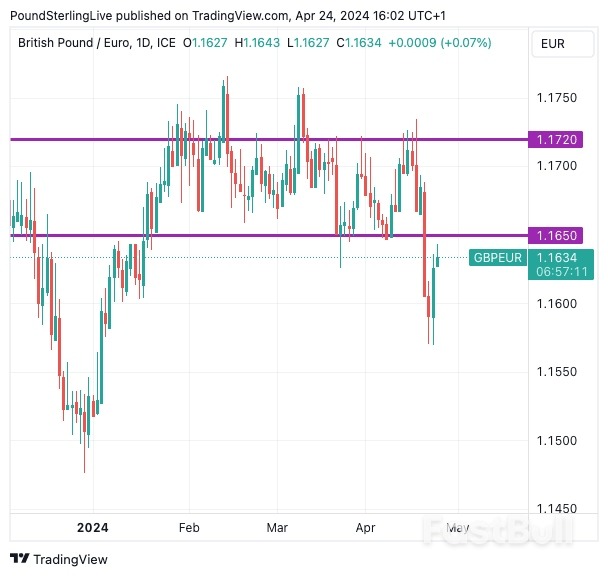
          Pound Sterling Can Recoup Some Euro Losses

          Owen Li

          Economic

          Forex

          "GBP has succumbed to a cyclical unwind which looks excessive," says Kamal Sharma, an analyst at Bank of America, who expects the easiest path of recovery to be against the likes of the Euro.
          The British Pound fell sharply following comments from members of the Bank of England that inflation looks on course to undershoot the Bank's expectations, which analysts said was a potential signpost from the Bank that it was readying to cut interest rates.
          However, subsequent strong PMI data for April and the intervention of the Bank of England's Chief Economist injected a dose of caution into the debate, and the Pound has recovered from recent lows against the Euro, Dollar, and other G10 currencies.
          "BOE speakers Haskel and Pill sounded cautious on rate cuts after Ramsden's dovish comments last week," says Saxo Bank. "GBPUSD rushed back above 1.24 to trade around 1.2450."
          Bank of America says UK interest are only likely to be cut in August and recent comments from Governor Andrew Bailey and Deputy Governor Dave Ramsden should be interpreted as "incremental steps" towards rate cuts, as opposed to a concerted effort to bring forward rate cut expectations.
          Bank of England Chief Economist Huw Pill's comments made on Tuesday suggested there was no material change in the outlook for UK interest rates, which backs an interpretation that the Bank is not ready to cut rates as soon as June.
          "That the UK rates market has reacted by less than GBP is testament to the belief that the Bailey comments are out of sync with the prevailing macro narrative," says Sharma.
          Pound Sterling Can Recoup Some Euro Losses_1
          "With GBP undershooting the move in UK rates and more balanced commentary this week, our bias would be to fade the decent dovishness and for GBP to retrace some of its losses," he adds.
          Sharma says the Pound has a better chance of advancing against low-yielding currencies, such as the Euro.
          Francesco Pesole, FX Strategist at ING, thinks in a similar vein, saying the recent fall in the Pound to Euro exchange rate "might have happened a bit too early".
          He maintains the exchange rate can go above 1.1630 in the short term "as markets hold greater dovish conviction on the ECB than the BoE." (Our view is that a move back into the 2024 range is likely over the coming weeks).
          Ultimately, beyond the short run, any significant downside potential for Pound-Euro would only be unlocked by the Bank of England cutting more aggressively than the market currently prices in, argues Pesole.
          This might not happen in 2024 according to analysts at ABN AMRO, who expect the Bank of England to cut by less (total of 50bp) than the Fed (total of 75bp) and the ECB (total of 125bp) in 2024.
          "We are more dovish than the market concerning these central banks, especially for the ECB. In the near term we expect the dollar to perform well across the board but for sterling to be resilient. We expect Sterling to outperform the Euro in the coming months and to outperform the Dollar later in the year," says Georgette Boele, Senior FX Strategist at ABN AMRO.

          Source: Pound Sterling

          To stay updated on all economic events of today, please check out our Economic calendar
          Risk Warnings and Disclaimers
          You understand and acknowledge that there is a high degree of risk involved in trading. Following any strategies or investment methods may lead to potential losses. The content on the site is provided by our contributors and analysts for information purposes only. You are solely responsible for determining whether any trading assets, securities, strategy, or any other product is suitable for investing based on your own investment objectives and financial situation.
          Add to Favorites
          Share

          German Economic Weakness Spurs Angst in Neighbouring Countries

          Devin

          Economic

          Germany's economic weakness is causing concern in neighbouring countries from Switzerland to Poland, prompting some foreign economists to call for reforms in the euro zone's largest economy to stop the spread of the malaise.
          The International Monetary Fund cut its forecasts for German GDP growth by 0.3% for both 2024 and 2025. It now expects growth of just 0.2% this year, the weakest among its large euro zone peers.
          "Without economic stimulus from Germany, Austria will struggle," said Gabriel Felbermayr, director of the Austrian Institute of Economic Research Wifo.
          Germany is by far Austria's most important trading partner. Just under 30% of exports go to its much larger neighbour, corresponding to 12% of Austria's gross domestic product, Felbermayr said.
          In 2023, bilateral trade volume between Germany and Austria fell by 8%.
          "This means that Germany's weakness is having a direct negative impact on the Austrian economy," Felbermayr said. "Mechanical engineering, chemicals, the metal industry and the automotive sector are particularly dependent on the German economy."
          The situation is similar in Switzerland, for which Germany is also the main trading partner.
          "When Germany suffers a hiccup, Switzerland notices it too," said Martin Mosler, head of financial policy at the Institute for Swiss Economic Policy IWP.
          Swiss exports to Germany fell by 1.1% in the first quarter, having already slipped at the end of 2023.
          "This affects several sectors - from luxury watches to intermediate products that many highly specialised SMEs (small and medium enterprises), such as those in the electronics industry, supply to Germany," said Moser.

          Supply Chains

          In Poland, the industrial sector was impacted by Germany's recession last year.
          Production in energy-intensive industries such as chemicals or metal casting has contracted by around 15% to 20% since Russia's invasion of Ukraine in Feb. 2022, said Paweł Sliwowski, director of the Polish Economic Institute PIE.
          "These sectors are closely integrated into the German supply chains," he said.
          Meanwhile there has been only a very modest expansion in the activity of consumer goods producers.
          "Production of furniture or other household appliances has remained largely unchanged since 2022 due to lower foreign demand," Sliwowski said.
          On average, 27% of total Polish exports go to Germany.
          "From Poland's point of view, a more appropriate policy for the German government would be to increase public investment," said Sliwowski.
          Wifo director Felbermayr made a similar appeal.
          "In Germany, investment activity must get going again. This requires effective short-term stimuli," he said, adding that Berlin must also do more to get long-term growth back on track.
          "It would probably be particularly effective if it were to advocate an ambitious deepening of the EU single market for financial services, energy and telecoms," said Felbermayr.

          Source: Reuters

          To stay updated on all economic events of today, please check out our Economic calendar
          Risk Warnings and Disclaimers
          You understand and acknowledge that there is a high degree of risk involved in trading. Following any strategies or investment methods may lead to potential losses. The content on the site is provided by our contributors and analysts for information purposes only. You are solely responsible for determining whether any trading assets, securities, strategy, or any other product is suitable for investing based on your own investment objectives and financial situation.
          Add to Favorites
          Share
          FastBull
          Copyright © 2025 FastBull Ltd

          728 RM B 7/F GEE LOK IND BLDG NO 34 HUNG TO RD KWUN TONG KLN HONG KONG

          TelegramInstagramTwitterfacebooklinkedin
          App Store Google Play Google Play
          Products
          Charts

          Chats

          Q&A with Experts
          Screeners
          Economic Calendar
          Data
          Tools
          Membership
          Features
          Function
          Markets
          Copy Trading
          Latest Signals
          Contests
          News
          Analysis
          24/7
          Columns
          Education
          Company
          Careers
          About Us
          Contact Us
          Advertising
          Help Center
          Feedback
          User Agreement
          Privacy Policy
          Business

          White Label

          Data API

          Web Plug-ins

          Poster Maker

          Affiliate Program

          Risk Disclosure

          The risk of loss in trading financial instruments such as stocks, FX, commodities, futures, bonds, ETFs and crypto can be substantial. You may sustain a total loss of the funds that you deposit with your broker. Therefore, you should carefully consider whether such trading is suitable for you in light of your circumstances and financial resources.

          No decision to invest should be made without thoroughly conducting due diligence by yourself or consulting with your financial advisors. Our web content might not suit you since we don't know your financial conditions and investment needs. Our financial information might have latency or contain inaccuracy, so you should be fully responsible for any of your trading and investment decisions. The company will not be responsible for your capital loss.

          Without getting permission from the website, you are not allowed to copy the website's graphics, texts, or trademarks. Intellectual property rights in the content or data incorporated into this website belong to its providers and exchange merchants.

          Not Logged In

          Log in to access more features

          FastBull Membership

          Not yet

          Purchase

          Become a signal provider
          Help Center
          Customer Service
          Dark Mode
          Price Up/Down Colors

          Log In

          Sign Up

          Position
          Layout
          Fullscreen
          Default to Chart
          The chart page opens by default when you visit fastbull.com