
• Trade
  • Markets
  • Copy
  • Contests
  • News
  • 24/7
  • Calendar
  • Q&A
  • Chats
Trending
Screeners
SYMBOL
LAST
BID
ASK
HIGH
LOW
NET CHG.
%CHG.
SPREAD
SPX
S&P 500 Index
6827.42
6827.42
6827.42
6899.86
6801.80
-73.58
-1.07%
--
DJI
Dow Jones Industrial Average
48458.04
48458.04
48458.04
48886.86
48334.10
-245.98
-0.51%
--
IXIC
NASDAQ Composite Index
23195.16
23195.16
23195.16
23554.89
23094.51
-398.69
-1.69%
--
USDX
US Dollar Index
97.950
98.030
97.950
98.500
97.950
-0.370
-0.38%
--
EURUSD
Euro / US Dollar
1.17394
1.17409
1.17394
1.17496
1.17192
+0.00011
+ 0.01%
--
GBPUSD
Pound Sterling / US Dollar
1.33707
1.33732
1.33707
1.33997
1.33419
-0.00148
-0.11%
--
XAUUSD
Gold / US Dollar
4299.39
4299.39
4299.39
4353.41
4257.10
+20.10
+ 0.47%
--
WTI
Light Sweet Crude Oil
57.233
57.485
57.233
58.011
56.969
-0.408
-0.71%
--

Community Accounts

Signal Accounts
--
Profit Accounts
--
Loss Accounts
--
View More

Become a signal provider

Sell trading signals to earn additional income

View More

Guide to Copy Trading

Get started with ease and confidence

View More

Signal Accounts for Members

All Signal Accounts

Best Return
  • Best Return
  • Best P/L
  • Best MDD
Past 1W
  • Past 1W
  • Past 1M
  • Past 1Y

All Contests

  • All
  • Trump Updates
  • Recommend
  • Stocks
  • Cryptocurrencies
  • Central Banks
  • Featured News
Top News Only
Share

Cambodian Prime Minister Hun Manet Says He Had Phone Calls With Trump And Malaysian Leader Anwar About Ceasefire

Share

Cambodia's Hun Manet Says USA, Malaysia Should Verify 'Which Side Fired First' In Latest Conflict

Share

Cambodia's Hun Manet: Cambodia Maintains Its Stance In Seeking Peaceful Resolution Of Disputes

Share

Nasdaq Companies: Allergan, Ferrovia, Insmed, Monolithic Power Systems, Seagate Technology, And Western Digital Will Be Added To The NASDAQ 100 Index. Biogen, CdW, GlobalFoundries, Lululemon, ON Semiconductor, And Tradedesk Will Be Removed From The NASDAQ 100 Index

Share

Witkoff Headed To Berlin This Weekend To Meet With Zelenskiy, European Leaders -Wsj Reporter On X

Share

Russia Attacks Two Ukrainian Ports, Damaging Three Turkish-Owned Vessels

Share

[Historic Flooding Occurs In At Least Four Rivers In Washington State Due To Days Of Torrential Rains] Multiple Areas In Washington State Have Been Hit By Severe Flooding Due To Days Of Torrential Rains, With At Least Four Rivers Experiencing Historic Flooding. Reporters Learned On The 12th That The Floods Caused By The Torrential Rains In Washington State Have Destroyed Homes And Closed Several Highways. Experts Warn That Even More Severe Flooding May Occur In The Future. A State Of Emergency Has Been Declared In Washington State

Share

Trump Says Proposed Free Economic Zone In Donbas Would Work

Share

Trump: I Think My Voice Should Be Heard

Share

Trump Says Will Be Choosing New Fed Chair In Near Future

Share

Trump Says Proposed Free Economic Zone In Donbas Complex But Would Work

Share

Trump Says Land Strikes In Venezuela Will Start Happening

Share

US President Trump: Thailand And Cambodia Are In A Good Situation

Share

State Media: North Korean Leader Kim Hails Troops Returning From Russia Mission

Share

The 10-year Treasury Yield Rose About 5 Basis Points During The "Fed Rate Cut Week," And The 2/10-year Yield Spread Widened By About 9 Basis Points. On Friday (December 12), In Late New York Trading, The Yield On The Benchmark 10-year US Treasury Note Rose 2.75 Basis Points To 4.1841%, A Cumulative Increase Of 4.90 Basis Points For The Week, Trading Within A Range Of 4.1002%-4.2074%. It Rose Steadily From Monday To Wednesday (before The Fed Announced Its Rate Cut And Treasury Bill Purchase Program), Subsequently Exhibiting A V-shaped Recovery. The 2-year Treasury Yield Fell 1.82 Basis Points To 3.5222%, A Cumulative Decrease Of 3.81 Basis Points For The Week, Trading Within A Range Of 3.6253%-3.4989%

Share

Trump: Lots Of Progress Being Made On Russia-Ukraine

Share

NOPA November US Soybean Crush Estimated At 220.285 Million Bushels

Share

SPDR Gold Trust Reports Holdings Up 0.22%, Or 2.28 Tonnes, To 1053.11 Tonnes By Dec 12

Share

Brazil's Moraes: We Knew Truth Would Prevail Once It Reached USA Authorities

Share

Brazil's Moraes Thanks President Lula's Commitment To Removal Of USA Sanctions Against Him

TIME
ACT
FCST
PREV
U.K. Trade Balance Non-EU (SA) (Oct)

A:--

F: --

P: --

U.K. Trade Balance (Oct)

A:--

F: --

P: --

U.K. Services Index MoM

A:--

F: --

P: --

U.K. Construction Output MoM (SA) (Oct)

A:--

F: --

P: --

U.K. Industrial Output YoY (Oct)

A:--

F: --

P: --

U.K. Trade Balance (SA) (Oct)

A:--

F: --

P: --

U.K. Trade Balance EU (SA) (Oct)

A:--

F: --

P: --

U.K. Manufacturing Output YoY (Oct)

A:--

F: --

P: --

U.K. GDP MoM (Oct)

A:--

F: --

P: --

U.K. GDP YoY (SA) (Oct)

A:--

F: --

P: --

U.K. Industrial Output MoM (Oct)

A:--

F: --

P: --

U.K. Construction Output YoY (Oct)

A:--

F: --

P: --

France HICP Final MoM (Nov)

A:--

F: --

P: --

China, Mainland Outstanding Loans Growth YoY (Nov)

A:--

F: --

P: --

China, Mainland M2 Money Supply YoY (Nov)

A:--

F: --

P: --

China, Mainland M0 Money Supply YoY (Nov)

A:--

F: --

P: --

China, Mainland M1 Money Supply YoY (Nov)

A:--

F: --

P: --

India CPI YoY (Nov)

A:--

F: --

P: --

India Deposit Gowth YoY

A:--

F: --

P: --

Brazil Services Growth YoY (Oct)

A:--

F: --

P: --

Mexico Industrial Output YoY (Oct)

A:--

F: --

P: --

Russia Trade Balance (Oct)

A:--

F: --

P: --

Philadelphia Fed President Henry Paulson delivers a speech
Canada Building Permits MoM (SA) (Oct)

A:--

F: --

P: --

Canada Wholesale Sales YoY (Oct)

A:--

F: --

P: --

Canada Wholesale Inventory MoM (Oct)

A:--

F: --

P: --

Canada Wholesale Inventory YoY (Oct)

A:--

F: --

P: --

Canada Wholesale Sales MoM (SA) (Oct)

A:--

F: --

P: --

Germany Current Account (Not SA) (Oct)

A:--

F: --

P: --

U.S. Weekly Total Rig Count

A:--

F: --

P: --

U.S. Weekly Total Oil Rig Count

A:--

F: --

P: --

Japan Tankan Large Non-Manufacturing Diffusion Index (Q4)

--

F: --

P: --

Japan Tankan Small Manufacturing Outlook Index (Q4)

--

F: --

P: --

Japan Tankan Large Non-Manufacturing Outlook Index (Q4)

--

F: --

P: --

Japan Tankan Large Manufacturing Outlook Index (Q4)

--

F: --

P: --

Japan Tankan Small Manufacturing Diffusion Index (Q4)

--

F: --

P: --

Japan Tankan Large Manufacturing Diffusion Index (Q4)

--

F: --

P: --

Japan Tankan Large-Enterprise Capital Expenditure YoY (Q4)

--

F: --

P: --

U.K. Rightmove House Price Index YoY (Dec)

--

F: --

P: --

China, Mainland Industrial Output YoY (YTD) (Nov)

--

F: --

P: --

China, Mainland Urban Area Unemployment Rate (Nov)

--

F: --

P: --

Saudi Arabia CPI YoY (Nov)

--

F: --

P: --

Euro Zone Industrial Output YoY (Oct)

--

F: --

P: --

Euro Zone Industrial Output MoM (Oct)

--

F: --

P: --

Canada Existing Home Sales MoM (Nov)

--

F: --

P: --

Euro Zone Total Reserve Assets (Nov)

--

F: --

P: --

U.K. Inflation Rate Expectations

--

F: --

P: --

Canada National Economic Confidence Index

--

F: --

P: --

Canada New Housing Starts (Nov)

--

F: --

P: --

U.S. NY Fed Manufacturing Employment Index (Dec)

--

F: --

P: --

U.S. NY Fed Manufacturing Index (Dec)

--

F: --

P: --

Canada Core CPI YoY (Nov)

--

F: --

P: --

Canada Manufacturing Unfilled Orders MoM (Oct)

--

F: --

P: --

Canada Manufacturing New Orders MoM (Oct)

--

F: --

P: --

Canada Core CPI MoM (Nov)

--

F: --

P: --

Canada Manufacturing Inventory MoM (Oct)

--

F: --

P: --

Canada CPI YoY (Nov)

--

F: --

P: --

Canada CPI MoM (Nov)

--

F: --

P: --

Canada CPI YoY (SA) (Nov)

--

F: --

P: --

Canada Core CPI MoM (SA) (Nov)

--

F: --

P: --

Q&A with Experts
    • All
    • Chatrooms
    • Groups
    • Friends
    Connecting
    .
    .
    .
    Type here...
    Add Symbol or Code

      No matching data

      All
      Trump Updates
      Recommend
      Stocks
      Cryptocurrencies
      Central Banks
      Featured News
      • All
      • Russia-Ukraine Conflict
      • Middle East Flashpoint
      • All
      • Russia-Ukraine Conflict
      • Middle East Flashpoint
      Search
      Products

      Charts Free Forever

      Chats Q&A with Experts
      Screeners Economic Calendar Data Tools
      Membership Features
      Data Warehouse Market Trends Institutional Data Policy Rates Macro

      Market Trends

      Market Sentiment Order Book Forex Correlations

      Top Indicators

      Charts Free Forever
      Markets

      News

      News Analysis 24/7 Columns Education
      From Institutions From Analysts
      Topics Columnists

      Latest Views

      Latest Views

      Trending Topics

      Top Columnists

      Latest Update

      Signals

      Copy Rankings Latest Signals Become a signal provider AI Rating
      Contests
      Brokers

      Overview Brokers Assessment Rankings Regulators News Claims
      Broker listing Forex Brokers Comparison Tool Live Spread Comparison Scam
      Q&A Complaint Scam Alert Videos Tips to Detect Scam
      More

      Business
      Events
      Careers About Us Advertising Help Center

      White Label

      Data API

      Web Plug-ins

      Affiliate Program

      Awards Institution Evaluation IB Seminar Salon Event Exhibition
      Vietnam Thailand Singapore Dubai
      Fans Party Investment Sharing Session
      FastBull Summit BrokersView Expo
      Recent Searches
        Top Searches
          Markets
          News
          Analysis
          User
          24/7
          Economic Calendar
          Education
          Data
          • Names
          • Latest
          • Prev

          View All

          No data

          Scan to Download

          Faster Charts, Chat Faster!

          Download App
          English
          • English
          • Español
          • العربية
          • Bahasa Indonesia
          • Bahasa Melayu
          • Tiếng Việt
          • ภาษาไทย
          • Français
          • Italiano
          • Türkçe
          • Русский язык
          • 简中
          • 繁中
          Open Account
          Search
          Products
          Charts Free Forever
          Markets
          News
          Signals

          Copy Rankings Latest Signals Become a signal provider AI Rating
          Contests
          Brokers

          Overview Brokers Assessment Rankings Regulators News Claims
          Broker listing Forex Brokers Comparison Tool Live Spread Comparison Scam
          Q&A Complaint Scam Alert Videos Tips to Detect Scam
          More

          Business
          Events
          Careers About Us Advertising Help Center

          White Label

          Data API

          Web Plug-ins

          Affiliate Program

          Awards Institution Evaluation IB Seminar Salon Event Exhibition
          Vietnam Thailand Singapore Dubai
          Fans Party Investment Sharing Session
          FastBull Summit BrokersView Expo

          U.S. Labor Market Surges Past Expectations in December with 216,000 Job Additions; Wage Growth Exceeds Estimates

          Warren Takunda

          Economic

          Summary:

          The U.S. job market concluded 2023 on a robust note, exceeding expectations with an impressive addition of 216,000 jobs in December, according to the latest report from the Labor Department. The unemployment rate remained steady at 3.7%, outperforming estimates of 3.8%.
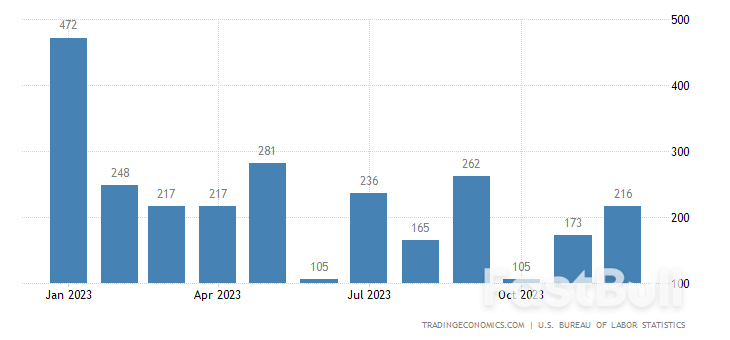
          The U.S. labor market demonstrated unexpected strength as it closed out 2023, with the latest Labor Department report revealing an impressive addition of 216,000 jobs in December. This figure surpassed economists' predictions of 170,000, showcasing a robust pace of hiring that outperformed November's revised figure of 173,000.
           U.S. Labor Market Surges Past Expectations in December with 216,000 Job Additions; Wage Growth Exceeds Estimates_1
          While the unemployment rate held steady at 3.7%, defying estimates of a slight uptick to 3.8%, the broader measure of unemployment, including discouraged workers and part-time employees for economic reasons, saw a marginal increase to 7.1%. The "real" unemployment rate was influenced by a decline in job holders by 683,000, offset by a rise in those working multiple jobs, up by 222,000.
           U.S. Labor Market Surges Past Expectations in December with 216,000 Job Additions; Wage Growth Exceeds Estimates_2
          However, the labor force participation rate experienced a slight dip to 62.5%, marking its lowest point since February and a monthly decline of 0.3 percentage points, equivalent to a reduction of 676,000 in the civilian working-age population.
          The December report, combined with revisions to previous months, resulted in a total of 2.7 million job gains in 2023, with a monthly average of 225,000. This represents a notable decrease from 2022, which saw 4.8 million job additions at an average monthly rate of 399,000.
          Despite the positive job market indicators, financial markets exhibited a meandering response to the data, influenced in part by a lower-than-expected reading from the ISM services gauge, which posted a 50.6 reading—indicating narrow expansion and the lowest employment component level since May 2020.
          In terms of sector-specific contributions to job growth, government jobs saw an increase of 52,000, while health care-related fields, including ambulatory health-care services and hospitals, added another 38,000 positions. Leisure and hospitality contributed 40,000 jobs, social assistance increased by 21,000, and construction added 17,000. Retail trade expanded by 17,000, while transportation and warehousing experienced a loss of 23,000 jobs.
          The report highlighted persistent inflationary pressures in the labor market, with average hourly earnings rising 0.4% on the month and 4.1% from a year ago—exceeding estimates of 0.3% and 3.9%, respectively. The average workweek edged lower to 34.3 hours.
          The market response also extended to Fed funds futures, with the odds of a March rate cut from the Federal Reserve decreasing to approximately 56%, according to the CME Group. Analysts, such as Andrew Patterson, senior international economist at Vanguard, noted that the report underscores the challenges the Fed faces in reaching its 2% inflation target, with policy rate cuts expected in the second half of the year.
          Despite concerns over a potential economic slowdown and expectations of a more dovish Fed, the report suggests that the U.S. economy continues to defy projections. The data challenges the narrative of a substantial easing of monetary policy, with the belief that inflation will recede further in the coming months. As Seema Shah, chief global strategist at Principal Asset Management, pointed out, the recent labor market data points toward strength, adding to the ongoing narrative of a resilient U.S. economy.
          Economic growth indicators also remain positive, with GDP on track to increase at a 2.5% annualized pace in the fourth quarter, according to the Atlanta Fed's GDPNow real-time tracker. Consumer resilience is evident in holiday spending, projected to reach a record $222.1 billion, representing a 5% increase, according to Adobe Analytics. As the U.S. economy continues to outperform expectations, the prospect of a Fed rate cut in March appears less likely, challenging market expectations for a more accommodative monetary policy.
          To stay updated on all economic events of today, please check out our Economic calendar
          Risk Warnings and Disclaimers
          You understand and acknowledge that there is a high degree of risk involved in trading. Following any strategies or investment methods may lead to potential losses. The content on the site is provided by our contributors and analysts for information purposes only. You are solely responsible for determining whether any trading assets, securities, strategy, or any other product is suitable for investing based on your own investment objectives and financial situation.
          Comments
          Add to Favorites
          Share

          Unprecedented Borrowing Surges to Record $141 Billion from Federal Reserve Backstop Facility

          Ukadike Micheal

          Economic

          In the week ending January 3, borrowing from the Federal Reserve's Bank Term Funding Program (BTFP) hit an unprecedented high, reaching $141 billion, surpassing the previous record of $136 billion in the prior week. The surge is attributed to the appealing pricing of the facility, despite diminishing expectations for interest-rate cuts. Launched amid last year's banking crisis, the BTFP allows financial institutions to borrow funds for up to one year, utilizing US Treasuries and agency debt as collateral at par value. The facility, set to expire in March, raises questions about a potential extension by Fed policymakers.
          Recent data from the Fed reveals the heightened demand for the BTFP, with borrowing costs decreasing as traders anticipate more rate cuts in 2024. At approximately 140 basis points, institutions find it economically favorable to borrow through the BTFP, currently offering a rate of 4.90%, rather than resorting to the discount window, which charges eligible institutions 5.5%. In contrast, borrowing from the discount window amounted to just $2.16 billion in the week through January 3, significantly lower than the all-time high of $153 billion in March.
          The drop in BTFP borrowing costs has created a notable arbitrage opportunity for banks. Financial institutions leverage this advantage by borrowing from the facility and then depositing the proceeds in their accounts at the Fed, earning interest on reserve balances at the current rate of 5.40%. This 50-basis-point spread, a mere fraction below the record 57 basis points reached on December 28, underscores the attractiveness of this financial strategy.
          As the BTFP continues to play a pivotal role in shaping banks' borrowing behavior, its significance within the broader financial landscape becomes increasingly apparent. The ongoing appeal of the facility, coupled with potential considerations for an extension beyond March, raises important questions about the evolving dynamics of the financial markets and the Federal Reserve's role in supporting stability. In an environment marked by shifting interest-rate expectations, the BTFP's influence on banks' decision-making underscores the intricate relationship between monetary policy and market dynamics.

          Source: Bloomberg

          To stay updated on all economic events of today, please check out our Economic calendar
          Risk Warnings and Disclaimers
          You understand and acknowledge that there is a high degree of risk involved in trading. Following any strategies or investment methods may lead to potential losses. The content on the site is provided by our contributors and analysts for information purposes only. You are solely responsible for determining whether any trading assets, securities, strategy, or any other product is suitable for investing based on your own investment objectives and financial situation.
          Comments
          Add to Favorites
          Share

          USD/JPY Sneak Peek Into 2024

          Chandan Gupta

          Traders' Opinions

          Economic

          Forex

          In 2023, the USD/JPY pair experienced a trajectory of fluctuating values, showcasing varied highs and lows. The Japanese yen witnessed a consistent depreciation against the US dollar throughout the year, with the USD/JPY pair trending upwards. The year commenced at a low point of 127.21 on January 16th, peaking on November 13th at 151.90 yen per dollar.
          The yen's depreciation was attributed to the prolonged ultra-dovish stance of the Bank of Japan (BoJ), maintaining a negative interest rate of -0.1%. This rate, unattractive compared to higher rates offered by other leading central banks, led investors to engage in carry trade strategies, borrowing yen at low rates and converting it to US dollars and Treasury bonds to capitalize on interest rate differentials without excessive risk.
          The Bank of Japan appeared more inclined towards economic indicators than direct intervention in the yen's exchange rate. Despite rising inflation, hitting 4.2% in June 2023, the BoJ made limited policy adjustments, shifting from a strict to a more flexible yield curve targeting. Verbal assurances from top officials indicated control, but actions remained minimal and largely verbal.
          Expectations were high at the beginning of the year, with various financial institutions predicting a downward trend for the USD/JPY pair. However, as months passed, forecasts were adjusted, reflecting a growing uncertainty among market participants about the direction of the pair.
          By the latter part of the year, as the USD/JPY pair approached a critical level of 150.00, reminiscent of an intervention triggered in 2022, speculations arose about potential interventions by Japanese authorities. On October 3, as the pair briefly surpassed 150.00, a swift decline ensued, leading to a drop of almost 300 points, followed by a partial recovery. This incident raised speculation about a possible currency intervention, although it could not be confirmed.
          The yen showed signs of resilience towards the end of the year, strengthening against the dollar. The positive movement was attributed to market expectations of a potential shift in the BoJ’s policy, with talks of abandoning the negative interest rate policy gaining traction. Furthermore, market sentiments anticipated a plateau in key interest rates of major economies, hinting at a potential reversal in carry trade strategies.
          As the year drew to a close, the USD/JPY pair hit a low of 140.24 on December 28 before concluding the year at 141.00.
          Looking ahead to 2024, forecasts and speculations from various financial institutions and agencies suggest a divergent outlook for the USD/JPY pair. Projections range from a strengthening yen, aiming for a range of 125.00-135.00, to more bullish estimates predicting a continuation of the upward trend towards levels exceeding 180.00. The speculative nature of these forecasts indicates the inherent uncertainty surrounding currency market movements and their unpredictability.
          The USD/JPY journey in 2023 encapsulated a narrative of market expectations, interventions, and persistent volatility. As the new year started, the narrative is poised for a potential continuation or divergence, subject to economic policies, global market sentiments, and unforeseen geopolitical events.USD/JPY Sneak Peek Into 2024_1
          To stay updated on all economic events of today, please check out our Economic calendar
          Risk Warnings and Disclaimers
          You understand and acknowledge that there is a high degree of risk involved in trading. Following any strategies or investment methods may lead to potential losses. The content on the site is provided by our contributors and analysts for information purposes only. You are solely responsible for determining whether any trading assets, securities, strategy, or any other product is suitable for investing based on your own investment objectives and financial situation.
          Comments
          Add to Favorites
          Share

          European Stocks Begin the Day on a Downward Note Amid Waning Global Sentiment; Eyes on Upcoming Euro Zone Inflation Data

          Ukadike Micheal

          Economic

          Stocks

          The dawn of the new year has brought a subdued start to European stocks, setting the tone for what appears to be a challenging first week of trading in 2024. Global sentiment, marked by fluctuating uncertainties, has cast a shadow over the markets, leading to a decline in European stocks. This article delves into the factors contributing to this early market turbulence, examining the impact of German retail sales data on specific sectors and the broader Stoxx 600 index. Additionally, it explores the global context, drawing parallels with the mostly negative start in U.S. and Asia-Pacific stock markets, and sheds light on the upcoming Euro Zone inflation data, a crucial metric influencing investor sentiment.
          The Stoxx 600, a key benchmark for European stocks, witnessed a 0.66% decline at the opening of the trading session, with all sectors slipping into the red. Notably, retail stocks bore the brunt of the market downturn, registering a 1.3% drop, fueled by disappointing German retail sales figures for November. This immediate reaction underscores the sensitivity of the market to economic indicators, with specific sectors feeling the impact more acutely.
          While the pan-European index managed to rebound by 0.7% on Thursday after two consecutive negative sessions, the overall trajectory has mirrored the global trend. U.S. and Asia-Pacific stock markets, which experienced a mostly negative start in 2024, are witnessing major Wall Street averages poised to break nine-week winning streaks. Understanding the interconnectedness of these markets is crucial for a comprehensive analysis of the prevailing challenges.
          The decline in European stocks, particularly in the retail sector, can be traced back to the unexpected drop in German retail sales for November. The 1.3% decrease in retail stocks reflects broader concerns about consumer spending and economic health. This section explores the nuances of the German retail sales data, delving into the factors contributing to the decline and assessing its implications for the retail sector and the broader market.
          To gain a holistic understanding of the challenges facing European stocks, it is essential to contextualize the market movements within the broader global landscape. This section draws parallels between the European market's performance and the mostly negative start observed in U.S. and Asia-Pacific stock markets. By examining the similarities and differences, we can unravel the shared concerns and unique factors influencing market dynamics across regions.
          Against the backdrop of early market challenges, investors are turning their attention to upcoming Euro Zone inflation data. Flash inflation figures, expected on Friday morning, hold significant weight in shaping market sentiment. This section delves into the anticipated impact of the Euro Zone inflation data, analyzing the expectations following higher-than-anticipated headline prints for France and Germany in the previous month. Economists' projections suggest a rise to 3% in December, adding an additional layer of uncertainty to the market dynamics.
          The early market movements in European stocks underscore the intricacies of navigating global uncertainties in 2024. From sector-specific challenges triggered by German retail sales data to the broader context of global market trends, understanding the multifaceted factors influencing market dynamics is paramount. As investors grapple with uncertainties, the forthcoming Euro Zone inflation data stands as a pivotal metric that could further shape market sentiment in the weeks to come. This comprehensive analysis provides insights into the current challenges and sets the stage for continued monitoring of evolving market conditions.

          Source: CNBC

          To stay updated on all economic events of today, please check out our Economic calendar
          Risk Warnings and Disclaimers
          You understand and acknowledge that there is a high degree of risk involved in trading. Following any strategies or investment methods may lead to potential losses. The content on the site is provided by our contributors and analysts for information purposes only. You are solely responsible for determining whether any trading assets, securities, strategy, or any other product is suitable for investing based on your own investment objectives and financial situation.
          Comments
          Add to Favorites
          Share

          China Promotes the Launch of Equity Funds to Bolster Stock Market

          Ukadike Micheal

          Economic

          Stocks

          China has reportedly provided informal guidance to certain money managers, urging them to prioritize the launch of equity funds over other products like bond funds. This "window guidance" from regulatory authorities, particularly the China Securities Regulatory Commission (CSRC), aims to boost the country's lagging stock market. As part of broader efforts to revive investor confidence amid challenges such as a property sector crisis and slowing growth, the move underscores a strategic push by authorities to stimulate investment in stocks.
          The CSRC's recent advice to major mutual fund managers reflects a concerted campaign to revitalize China's $3.8 trillion mutual fund industry, a crucial component of the country's capital markets. The industry has experienced dwindling sales, especially in equity funds, over the past year, coinciding with multi-year lows in stock benchmarks.
          Efforts to launch new equity funds align with the Chinese government's year-long initiative to bolster the stock market, which has faced headwinds from economic uncertainties. Despite previous measures, such as reducing stamp duty on stock trading, slowing initial public offerings (IPOs), promoting margin financing, and safeguarding small investors, China's stock market struggled in 2023. The CSI300 index closed the year with an 11% loss, while global stocks gained 20%.
          As part of the recent guidance, the CSRC reportedly instructed some fund managers to launch a minimum of four new equity funds before introducing any new bond funds. While these measures aim to rejuvenate the equity market, analysts remain skeptical about their efficacy in restoring overall market confidence.
          In 2023, China saw a decline in the launch of new equity funds, with a 22% decrease from 2022 and a significant 49% drop from 2021. The funds' proceeds also experienced declines of 39% and 89% from 2022 and 2021, respectively, amounting to 137.5 billion yuan ($19.18 billion). In contrast, institutional-tailored bond funds, a popular category, witnessed a modest decline in new launches and steady growth in proceeds.
          Amid Beijing's renewed push, the private funds sector, with around 20 trillion yuan in assets, has witnessed quicker approvals for new equity funds compared to funds tracking other asset classes in the past two months.
          Since July, the CSRC has been implementing reforms in the funds industry, directing managers to reduce management fees. While some funds responded with fee cuts or purchasing units in their own funds, the industry observed varying trends, with bond funds often shortening subscription periods or limiting investor subscriptions.
          Despite the regulator's push for mutual fund managers to prioritize equity fund launches, uncertainties persist regarding local investor interest, particularly as they grapple with diminishing stock market returns. Analysts remain cautious about the potential impact of promoting equity funds in a sluggish market, citing high marketing costs and potential low effectiveness.
          China's move to encourage equity fund launches reflects ongoing efforts to navigate challenges in the financial markets. The success of these measures remains uncertain, and the effectiveness of revitalizing investor interest in equities depends on a multitude of factors, including market conditions and investor sentiment.

          Source: Reuters

          To stay updated on all economic events of today, please check out our Economic calendar
          Risk Warnings and Disclaimers
          You understand and acknowledge that there is a high degree of risk involved in trading. Following any strategies or investment methods may lead to potential losses. The content on the site is provided by our contributors and analysts for information purposes only. You are solely responsible for determining whether any trading assets, securities, strategy, or any other product is suitable for investing based on your own investment objectives and financial situation.
          Comments
          Add to Favorites
          Share

          Wave of Debt Sales Adds to January Nerves in Euro Zone Bond Markets

          Devin

          Economic

          Bond

          A 150-billion-euro ($165 billion) deluge of government bond sales in January is fueling unease in euro area bond markets, a foretaste of a potentially record amount of public debt that markets will have to absorb this year.
          Bond yields, which move inversely to prices, have started 2024 higher after plunging in November and December. Germany's 10-year yield, the euro zone benchmark, has risen to just over 2% from a one-year low of 1.896% last week.
          A trimming of investor bets on how much and how early central banks will cut interest rates this year has driven the bond selloff. Now adding to it, are concerns that markets will struggle to digest another year of hefty government debt sales.
          ING estimates that the euro area will issue around 150 billion euros of debt this month alone as governments seek to take advantage of the recent yield fall and investors look for new-year opportunities. There is 72 billion euros of net supply when redemptions are factored in.
          Inflation has driven euro zone states to increase welfare payments and public sector wages, while higher borrowing costs are adding to their interest bills, keeping debt issuance high.
          A similar amount of debt was issued in January last year, but it's now coming after a powerful rally that looks like it's nearing an end, said Societe Generale interest rates strategist Jorge Garayo.
          "The current (yield) levels, they look difficult for the market to digest the amount of supply that is going to be coming," he said. "For us, supply will be a worry and should have an upward impact on yields."
          Michael Weidner, co-head of global fixed income at Lazard Asset Management, said one concern is that governments plan to issue a large amount of longer-dated debt.
          Longer-dated bonds are generally viewed as more risky, so investors typically demand a premium to hold them.
          "We believe there will be more issuance in (longer-dated bonds), and how much duration the market's ready to absorb is a bit of a question mark given the level of yields," said Weidner.
          Germany plans to issue 10-year bonds this month, and Spain has already sold a 30-year maturity.
          ECB Factor
          Adding to investors' worries is the fact that the European Central Bank (ECB), a hoover of government debt over the last decade, is extricating itself from the market.
          The ECB announced in December it would start to reduce its 1.7 trillion-euro pandemic-era bond purchase programme - PEPP - by 7.5 billion euros a month in the second half 2024. It is already winding down another of its asset purchase schemes.
          When so-called quantitative tightening is taken into account, markets could have to absorb a record 675 billion euros of government debt this year, Barclays estimates, up 25 billion euros on last year.
          Wave of Debt Sales Adds to January Nerves in Euro Zone Bond Markets_1Weidner said he expects the gap between Italian and German bond yields to widen as Germany tries to bear down on its debt levels and the ECB, which has been a crutch for Italian bonds, steps out of the market.
          At around 168 basis points, that spread has widened roughly 10 bps over the past week but was still below peaks seen in recent years.
          Not everyone is concerned. Joost van Leenders, senior investment strategist at Van Lanschot Kempen, said inflation and central banks will continue to drive bond markets.
          "The economic and inflation cycles tend to be far more important than concerns about bond issuance," he said. "Bond yields have fallen because inflation has fallen."
          Governments will still be able to issue debt, said RBC Capital Markets' chief European macro strategist Peter Schaffrik, especially as they also plan to redeem plenty of bonds, returning money to investors.
          "I don't think there will be any failed auctions or anything like that, it's just a question of the yield concession that the market demands."
          ($1 = 0.9122 euros)

          Source: Reuters

          To stay updated on all economic events of today, please check out our Economic calendar
          Risk Warnings and Disclaimers
          You understand and acknowledge that there is a high degree of risk involved in trading. Following any strategies or investment methods may lead to potential losses. The content on the site is provided by our contributors and analysts for information purposes only. You are solely responsible for determining whether any trading assets, securities, strategy, or any other product is suitable for investing based on your own investment objectives and financial situation.
          Comments
          Add to Favorites
          Share

          Positive Unemployment Rate & Non Farm Payroll Beats Expectations

          Zi Cheng

          Traders' Opinions

          Economic

          In December, American employers exceeded expectations by hiring a greater number of workers and simultaneously increased wages at a robust pace. This has led to uncertainty regarding financial market predictions that the Federal Reserve would initiate interest rate cuts in March.
          The unemployment rate for November 2023 was 3.7% where economists were predicting the rate for December to be 3.8% which is an increase, negative for the Dollar. The actual turns out to be 3.7% which is the same as previous and lower than the economists' expections. It was a huge positive impact for the dollar.
          Besides that, Non Farm Payrolls data was also released for the month December 2023. Previously, NFP was 199,000 for the month November, economists were expecting a much lower data of 170,000 which is bad for the Dollar. Surprisingly, the actual data, 216,000 came out higher than previous and forecast. Whenever we see the actual data higher than previous and forecast, expect to see some huge candlestick in the markets.

          Positive Unemployment Rate & Non Farm Payroll Beats Expectations _1Positive Unemployment Rate & Non Farm Payroll Beats Expectations _2NFP Impact Highlighted By Red Box

          To stay updated on all economic events of today, please check out our Economic calendar
          Risk Warnings and Disclaimers
          You understand and acknowledge that there is a high degree of risk involved in trading. Following any strategies or investment methods may lead to potential losses. The content on the site is provided by our contributors and analysts for information purposes only. You are solely responsible for determining whether any trading assets, securities, strategy, or any other product is suitable for investing based on your own investment objectives and financial situation.
          Comments
          Add to Favorites
          Share
          FastBull
          Copyright © 2025 FastBull Ltd

          728 RM B 7/F GEE LOK IND BLDG NO 34 HUNG TO RD KWUN TONG KLN HONG KONG

          TelegramInstagramTwitterfacebooklinkedin
          App Store Google Play Google Play
          Products
          Charts

          Chats

          Q&A with Experts
          Screeners
          Economic Calendar
          Data
          Tools
          Membership
          Features
          Function
          Markets
          Copy Trading
          Latest Signals
          Contests
          News
          Analysis
          24/7
          Columns
          Education
          Company
          Careers
          About Us
          Contact Us
          Advertising
          Help Center
          Feedback
          User Agreement
          Privacy Policy
          Business

          White Label

          Data API

          Web Plug-ins

          Poster Maker

          Affiliate Program

          Risk Disclosure

          The risk of loss in trading financial instruments such as stocks, FX, commodities, futures, bonds, ETFs and crypto can be substantial. You may sustain a total loss of the funds that you deposit with your broker. Therefore, you should carefully consider whether such trading is suitable for you in light of your circumstances and financial resources.

          No decision to invest should be made without thoroughly conducting due diligence by yourself or consulting with your financial advisors. Our web content might not suit you since we don't know your financial conditions and investment needs. Our financial information might have latency or contain inaccuracy, so you should be fully responsible for any of your trading and investment decisions. The company will not be responsible for your capital loss.

          Without getting permission from the website, you are not allowed to copy the website's graphics, texts, or trademarks. Intellectual property rights in the content or data incorporated into this website belong to its providers and exchange merchants.

          Not Logged In

          Log in to access more features

          FastBull Membership

          Not yet

          Purchase

          Become a signal provider
          Help Center
          Customer Service
          Dark Mode
          Price Up/Down Colors

          Log In

          Sign Up

          Position
          Layout
          Fullscreen
          Default to Chart
          The chart page opens by default when you visit fastbull.com