• Trade
  • Markets
  • Copy
  • Contests
  • News
  • 24/7
  • Calendar
  • Q&A
  • Chats
Trending
Screeners
SYMBOL
LAST
BID
ASK
HIGH
LOW
NET CHG.
%CHG.
SPREAD
SPX
S&P 500 Index
6811.88
6811.88
6811.88
6861.30
6801.50
-15.53
-0.23%
--
DJI
Dow Jones Industrial Average
48346.87
48346.87
48346.87
48679.14
48285.67
-111.17
-0.23%
--
IXIC
NASDAQ Composite Index
23077.88
23077.88
23077.88
23345.56
23012.00
-117.28
-0.51%
--
USDX
US Dollar Index
97.960
98.040
97.960
98.070
97.740
+0.010
+ 0.01%
--
EURUSD
Euro / US Dollar
1.17444
1.17452
1.17444
1.17686
1.17262
+0.00050
+ 0.04%
--
GBPUSD
Pound Sterling / US Dollar
1.33668
1.33679
1.33668
1.34014
1.33546
-0.00039
-0.03%
--
XAUUSD
Gold / US Dollar
4303.75
4304.09
4303.75
4350.16
4285.08
+4.36
+ 0.10%
--
WTI
Light Sweet Crude Oil
56.429
56.459
56.429
57.601
56.233
-0.804
-1.40%
--

Community Accounts

Signal Accounts
--
Profit Accounts
--
Loss Accounts
--
View More

Become a signal provider

Sell trading signals to earn additional income

View More

Guide to Copy Trading

Get started with ease and confidence

View More

Signal Accounts for Members

All Signal Accounts

Best Return
  • Best Return
  • Best P/L
  • Best MDD
Past 1W
  • Past 1W
  • Past 1M
  • Past 1Y

All Contests

  • All
  • Trump Updates
  • Recommend
  • Stocks
  • Cryptocurrencies
  • Central Banks
  • Featured News
Top News Only
Share

Attempts By Ukrainian Troops To Advance From The South-West To Outskirts Of Kupiansk Are Being Thwarted

Share

Russian Troops Control All Of Kupiansk - IFX Cites Russian Military

Share

On Monday (December 15), The South Korean Won Ultimately Rose 0.60% Against The US Dollar, Closing At 1468.91 Won. The Won Was On An Upward Trend Throughout The Day, Rising Significantly At 17:00 Beijing Time And Reaching A Daily High Of 1463.04 Won At 17:36

Share

Health Ministry: Israeli Forces Kill Palestinian Teen In West Bank

Share

New York Federal Reserve President Williams: Over Time, The Size Of Reserves Could Grow From $2.9 Trillion

Share

New York Fed President Williams: AI Valuations Are High, But There Is A Real Driving Factor

Share

New York Federal Reserve President Williams: The Job Market Is In Very Good Shape

Share

New York Fed President Williams: 'Very Supportive' Of USA Central Bank's Decision To Cut Interest Rates Last Week

Share

New York Fed President Williams: 'Too Early To Say' What Central Bank Should Do At January Meeting

Share

New York Fed President Williams: Strong Markets Part Of Reason Why Economy Will Grow Robustly In 2026

Share

New York Fed President Williams: What Constitutes Ample Reserves Will Change Over Time

Share

New York Fed President Williams: Market Valuations 'Elevated,' But There Are Reasons For Pricing

Share

New York Fed President Williams: Ample Reserves System Working Very Well

Share

New York Fed President Williams: Some Signs That Parts Of Underlying Economy Not As Strong As GDP Data Suggests

Share

New York Fed President Williams: Expects Coming Job Data Will Show Gradual Cooling

Share

Ukraine President Zelenskiy: Monitoring Of Ceasefire Should Be Part Of Security Guarantees

Share

Ukraine President Zelenskiy: Ukraine Needs Clear Understanding On Security Guarantees Before Taking Any Decisions Regarding Frontlines

Share

U.S. Commerce Secretary Rutnick Praised Korea Zinc Co. Ltd., Stating That The United States Will Have Priority Access To The Company's Products In 2026

Share

Ukraine President Zelenskiy: USA Passed On Russian Demands

Share

Zelenskiy Says: Don't Think USA Was Demanding Anything On Territories

TIME
ACT
FCST
PREV
Japan Tankan Small Manufacturing Outlook Index (Q4)

A:--

F: --

P: --

Japan Tankan Large Non-Manufacturing Outlook Index (Q4)

A:--

F: --

P: --

Japan Tankan Large Manufacturing Outlook Index (Q4)

A:--

F: --

P: --

Japan Tankan Small Manufacturing Diffusion Index (Q4)

A:--

F: --

P: --

Japan Tankan Large-Enterprise Capital Expenditure YoY (Q4)

A:--

F: --

P: --

U.K. Rightmove House Price Index YoY (Dec)

A:--

F: --

P: --

China, Mainland Industrial Output YoY (YTD) (Nov)

A:--

F: --

P: --

China, Mainland Urban Area Unemployment Rate (Nov)

A:--

F: --

P: --

Saudi Arabia CPI YoY (Nov)

A:--

F: --

P: --

Euro Zone Industrial Output YoY (Oct)

A:--

F: --

P: --

Euro Zone Industrial Output MoM (Oct)

A:--

F: --

P: --

Canada Existing Home Sales MoM (Nov)

A:--

F: --

P: --

Canada National Economic Confidence Index

A:--

F: --

P: --

Canada New Housing Starts (Nov)

A:--

F: --

P: --
U.S. NY Fed Manufacturing Employment Index (Dec)

A:--

F: --

P: --

U.S. NY Fed Manufacturing Index (Dec)

A:--

F: --

P: --

Canada Core CPI YoY (Nov)

A:--

F: --

P: --

Canada Manufacturing Unfilled Orders MoM (Oct)

A:--

F: --

P: --

U.S. NY Fed Manufacturing Prices Received Index (Dec)

A:--

F: --

P: --

U.S. NY Fed Manufacturing New Orders Index (Dec)

A:--

F: --

P: --

Canada Manufacturing New Orders MoM (Oct)

A:--

F: --

P: --

Canada Core CPI MoM (Nov)

A:--

F: --

P: --

Canada Trimmed CPI YoY (SA) (Nov)

A:--

F: --

P: --

Canada Manufacturing Inventory MoM (Oct)

A:--

F: --

P: --

Canada CPI YoY (Nov)

A:--

F: --

P: --

Canada CPI MoM (Nov)

A:--

F: --

P: --

Canada CPI YoY (SA) (Nov)

A:--

F: --

P: --

Canada Core CPI MoM (SA) (Nov)

A:--

F: --

P: --

Canada CPI MoM (SA) (Nov)

A:--

F: --

P: --

Federal Reserve Board Governor Milan delivered a speech
U.S. NAHB Housing Market Index (Dec)

A:--

F: --

P: --

Australia Composite PMI Prelim (Dec)

--

F: --

P: --

Australia Services PMI Prelim (Dec)

--

F: --

P: --

Australia Manufacturing PMI Prelim (Dec)

--

F: --

P: --

Japan Manufacturing PMI Prelim (SA) (Dec)

--

F: --

P: --

U.K. 3-Month ILO Employment Change (Oct)

--

F: --

P: --

U.K. Unemployment Claimant Count (Nov)

--

F: --

P: --

U.K. Unemployment Rate (Nov)

--

F: --

P: --

U.K. 3-Month ILO Unemployment Rate (Oct)

--

F: --

P: --

U.K. Average Weekly Earnings (3-Month Average, Including Bonuses) YoY (Oct)

--

F: --

P: --

U.K. Average Weekly Earnings (3-Month Average, Excluding Bonuses) YoY (Oct)

--

F: --

P: --

France Services PMI Prelim (Dec)

--

F: --

P: --

France Composite PMI Prelim (SA) (Dec)

--

F: --

P: --

France Manufacturing PMI Prelim (Dec)

--

F: --

P: --

Germany Services PMI Prelim (SA) (Dec)

--

F: --

P: --

Germany Manufacturing PMI Prelim (SA) (Dec)

--

F: --

P: --

Germany Composite PMI Prelim (SA) (Dec)

--

F: --

P: --

Euro Zone Composite PMI Prelim (SA) (Dec)

--

F: --

P: --

Euro Zone Services PMI Prelim (SA) (Dec)

--

F: --

P: --

Euro Zone Manufacturing PMI Prelim (SA) (Dec)

--

F: --

P: --

U.K. Services PMI Prelim (Dec)

--

F: --

P: --

U.K. Manufacturing PMI Prelim (Dec)

--

F: --

P: --

U.K. Composite PMI Prelim (Dec)

--

F: --

P: --

Euro Zone ZEW Economic Sentiment Index (Dec)

--

F: --

P: --

Germany ZEW Current Conditions Index (Dec)

--

F: --

P: --

Germany ZEW Economic Sentiment Index (Dec)

--

F: --

P: --

Euro Zone Trade Balance (Not SA) (Oct)

--

F: --

P: --

Euro Zone ZEW Current Conditions Index (Dec)

--

F: --

P: --

Euro Zone Trade Balance (SA) (Oct)

--

F: --

P: --

Euro Zone Total Reserve Assets (Nov)

--

F: --

P: --

U.K. Inflation Rate Expectations

--

F: --

P: --

Q&A with Experts
    • All
    • Chatrooms
    • Groups
    • Friends
    Connecting
    .
    .
    .
    Type here...
    Add Symbol or Code

      No matching data

      All
      Trump Updates
      Recommend
      Stocks
      Cryptocurrencies
      Central Banks
      Featured News
      • All
      • Russia-Ukraine Conflict
      • Middle East Flashpoint
      • All
      • Russia-Ukraine Conflict
      • Middle East Flashpoint
      Search
      Products

      Charts Free Forever

      Chats Q&A with Experts
      Screeners Economic Calendar Data Tools
      Membership Features
      Data Warehouse Market Trends Institutional Data Policy Rates Macro

      Market Trends

      Market Sentiment Order Book Forex Correlations

      Top Indicators

      Charts Free Forever
      Markets

      News

      News Analysis 24/7 Columns Education
      From Institutions From Analysts
      Topics Columnists

      Latest Views

      Latest Views

      Trending Topics

      Top Columnists

      Latest Update

      Signals

      Copy Rankings Latest Signals Become a signal provider AI Rating
      Contests
      Brokers

      Overview Brokers Assessment Rankings Regulators News Claims
      Broker listing Forex Brokers Comparison Tool Live Spread Comparison Scam
      Q&A Complaint Scam Alert Videos Tips to Detect Scam
      More

      Business
      Events
      Careers About Us Advertising Help Center

      White Label

      Data API

      Web Plug-ins

      Affiliate Program

      Awards Institution Evaluation IB Seminar Salon Event Exhibition
      Vietnam Thailand Singapore Dubai
      Fans Party Investment Sharing Session
      FastBull Summit BrokersView Expo
      Recent Searches
        Top Searches
          Markets
          News
          Analysis
          User
          24/7
          Economic Calendar
          Education
          Data
          • Names
          • Latest
          • Prev

          View All

          No data

          Scan to Download

          Faster Charts, Chat Faster!

          Download App
          English
          • English
          • Español
          • العربية
          • Bahasa Indonesia
          • Bahasa Melayu
          • Tiếng Việt
          • ภาษาไทย
          • Français
          • Italiano
          • Türkçe
          • Русский язык
          • 简中
          • 繁中
          Open Account
          Search
          Products
          Charts Free Forever
          Markets
          News
          Signals

          Copy Rankings Latest Signals Become a signal provider AI Rating
          Contests
          Brokers

          Overview Brokers Assessment Rankings Regulators News Claims
          Broker listing Forex Brokers Comparison Tool Live Spread Comparison Scam
          Q&A Complaint Scam Alert Videos Tips to Detect Scam
          More

          Business
          Events
          Careers About Us Advertising Help Center

          White Label

          Data API

          Web Plug-ins

          Affiliate Program

          Awards Institution Evaluation IB Seminar Salon Event Exhibition
          Vietnam Thailand Singapore Dubai
          Fans Party Investment Sharing Session
          FastBull Summit BrokersView Expo

          [Fed] Powell's Press Conference Speech

          FastBull Featured

          Remarks of Officials

          Summary:

          Interest rates will not be cut until there is greater confidence that inflation is moving consistently towards our long-term target of 2%. In fact, we think it will take longer to gain that confidence.

          On May 1, local time, after the Fed announced the interest rate decision, Chairman Powell held a press conference to answer reporters' questions, the highlights of which are as follows:
          Q1: In the inflation data of the first quarter, which areas of rebound are temporary? What do you expect inflation to look like in the coming months?
          A: Both goods inflation and non-housing services inflation exceeded expectations. The combination of the two resulted in headline inflation exceeding expectations. But my expectation remains that inflation will come down this year.
          Q2: Isn't it a contradiction that the Fed is reducing its balance sheet while keeping interest rates at restrictive levels in an attempt to reduce inflation and slow down the economy?
          A: Interest rates serve as an active tool of monetary policy, a long-standing strategy aimed at either easing or tightening restrictions on the economy to ensure a smooth process of balance sheet reduction without causing financial market turbulence as seen in the previous instance.
          Q3: Given the series of data since March, do you think the likelihood of no rate cuts this year has increased? Do you see a case for more patience with inflation and "synergizing" with the economic cycle to bring it down over time?
          A: The first question did not come as expected, I can only say that we will not lower interest rates until we have greater confidence in moving towards the long-term target of inflation persistently around 2%. In fact, we believe it will take longer to gain this confidence.
          Q4: You said earlier that you wouldn't consider raising interest rates if the economy was growing faster, does that mean you're more worried about causing the economy to slow down than you are about inflation picking up again?
          A: I think our policy stance is correct and appropriate for the current situation. We think it is restrictive, and the evidence for that can be found in the labor market. We think it is restrictive, and the fact that demand has fallen significantly over the last couple of years is due to policy. Therefore, I am not worried about inflation picking up again.
          Q5: With GDP currently around 2%, unemployment at 4%, and inflation hovering just above 3%, and judging by the recent data, it looks like a rate hike will be needed to get inflation back to 2%, was there any discussion of a rate hike at today's meeting? Are you comfortable with inflation at 3% for the rest of the year?
          A: We are not satisfied with 3% inflation, and over time we will bring inflation back to 2%. We believe our policy stance is appropriate. If we conclude that "policy is not restrictive enough to bring inflation below 2% in a sustainable manner", then we will raise interest rates, but we do not see evidence of this at the moment.
          Q6: You've mentioned several times that the labor market is normalizing, but wage growth is still much stronger than it was before the COVID-19 pandemic, so why is that happening?
          A: Compared to the peak three years ago, essentially all wage indicators have come down significantly, just not back to pre-pandemic levels, and we've seen fairly steady progress, but it's not consistent, and the road down has been full of bumps.
          Q7: The slowdown in housing inflation has not come (not reflected in the CPI), how confident are you that rents will fall in the coming months to the point of curbing inflation?
          A: Essentially, inflation in the economy exhibits a lag in many areas, with housing inflation being one of them. This aspect is quite intricate and requires some time to bring down. I believe that as long as market rents continue to decrease, it will be reflected in inflation.
          Risk Warnings and Disclaimers
          You understand and acknowledge that there is a high degree of risk involved in trading. Following any strategies or investment methods may lead to potential losses. The content on the site is provided by our contributors and analysts for information purposes only. You are solely responsible for determining whether any trading assets, securities, strategy, or any other product is suitable for investing based on your own investment objectives and financial situation.
          Add to Favorites
          Share

          Asia's Crude Oil Imports Slip in April, Trail OPEC Forecasts

          Warren Takunda

          Economic

          Commodity

          Asia's imports of crude oil slipped slightly in April from March, as increased arrivals in China failed to offset lower purchases elsewhere in the world's top-importing region.
          April imports were 26.89 million barrels per day (bpd), down from 27.33 million bpd in March and roughly in line with February's 26.68 million bpd, according to data compiled by LSEG Oil Research.
          For the first four months of the year Asia's crude imports were about 27.03 million bpd, only 300,000 bpd higher than for the same period in 2023, the LSEG data showed.
          This means that crude oil arrivals in Asia are growing at a pace that is so far well short of the forecast by groups such as the Organization of the Petroleum Exporting Countries (OPEC).
          OPEC's April oil market outlook forecast that global oil demand will rise by 2.25 million bpd in 2024 from the previous year, with 1.24 million bpd of that coming from non-OECD countries in Asia.
          China, the world's largest crude importer, is expected by OPEC to see demand increase by 680,000 bpd in 2024.
          However, using official customs data for the first quarter and LSEG's estimate for April imports, China's crude arrivals for the January-April period were about 11.17 million bpd, which is 290,000 bpd higher than the customs data for the same period last year.
          It should be noted that there is a difference between crude oil imports and demand growth, as the total demand figure can be met from more than just imports such as domestic production and changes in inventories.
          The Fed concluded its two-day monetary policy meeting with Chair Jerome Powell noting that while the annual inflation rate has dropped significantly, further progress is quote 'not assured'
          Nonetheless, the slower pace of imports in China and the rest of Asia suggest that demand growth is so far nowhere near as strong as the OPEC forecast indicates.
          It should also be noted that OPEC, and other analysts, expect demand growth to accelerate over the northern summer months and extend into the second half of 2024, largely on the view that China's economy is recovering growth momentum and the rest of the world is emerging from its inflation-linked slowdown.
          The International Energy Agency (IEA) has a more modest target for global oil demand growth, with its April report estimating 1.2 million bpd for 2024.
          The IEA's forecast for China's oil demand growth is 500,000 bpd for 2024, meaning it is also significantly above the current growth rate in China's imports.
          Asia's Crude Oil Imports Slip in April, Trail OPEC Forecasts  _1

          Asia crude oil imports vs Brent price

          PRICE IMPACT

          The question then becomes are China's crude imports likely to increase in coming months, and the answer likely depends on movements in crude prices as much as it may on China's improving economy.
          China's recent pattern of crude imports has been that they increase when oil prices soften and ease back when they increase, allowing for a lag of around two months to account for when cargoes are arranged and physically delivered.
          This means that much of the oil that was offloaded in the first four months of the year was bought when crude prices were still soft.
          Global benchmark Brent futures hit a six-month low of $72.29 on Dec. 13, and then recovered to trade in a range around $80 for much of the first quarter.
          Rising geopolitical tensions and extended output cuts by the OPEC+ group, which includes OPEC and allies such as Russia, led Brent higher from mid-March onwards, with the contract peaking at $92.18 on April 12.
          This means the impact of the price spike from mid-March onwards has yet to show up in China's import figures, and it will likely only be a factor from May onwards.
          What happens to China's imports in May, June and July will go some way towards answering the question as to whether China's economic recovery is strong enough to ameliorate the impact of higher oil prices.

          Source: Reuters

          To stay updated on all economic events of today, please check out our Economic calendar
          Risk Warnings and Disclaimers
          You understand and acknowledge that there is a high degree of risk involved in trading. Following any strategies or investment methods may lead to potential losses. The content on the site is provided by our contributors and analysts for information purposes only. You are solely responsible for determining whether any trading assets, securities, strategy, or any other product is suitable for investing based on your own investment objectives and financial situation.
          Add to Favorites
          Share

          US Not Suffering from ‘Stagflation’, Says Fed Chairman Jerome Powell

          Warren Takunda

          Economic

          Stocks

          Bond

          The US is not suffering from “stagflation” and is growing well despite stubborn inflation, Federal Reserve chairman Jerome Powell has said.
          Mr Powell on Wednesday night dismissed suggestions that the US was close to an economic trap of stagnant growth and rampant inflation, saying the economy was among the best in the world and the rate of price rises was on track to fall to the Fed’s 2pc target.
          The central bank chief added that it was “unlikely” the Fed would need to raise interest rates any higher to combat inflation, in comments that raised hopes borrowing costs have peaked and will soon be on the way down.
          Stock markets rallied after Mr Powell’s statements, which took investors by surprise. Most had expected him to signal that the Fed was still willing to put up borrowing costs if necessary after a recent run of strong economic data.
          The S&P 500, the Dow and the tech-heavy Nasdaq indexes all jumped by more than 1pc on Wall Street following Mr Powell’s press conference comments.
          Josh Jamner, a strategist at ClearBridge Investments in New York, said: “Many investors were positioned for, and fearful of, a more hawkish bent after a string of hot inflation prints so far this year.”
          Mr Powell’s rosier-than-expected assessment of the US economy will raise hopes that interest rates will soon begin falling around the world. The Bank of England’s Monetary Policy Committee meets next week, with division on the nine-person board over when to lower rates.
          The Bank’s panel of rate-setters is expected to hold borrowing costs at 5.25pc, even as many analysts believe inflation will have fallen below 2pc in April.
          The Fed on Wednesday held US interest rates at a 23-year-high range of 5.25pc to 5.5pc.
          Mr Powell said it was still too early to declare victory against inflation after “a lack of further progress”. US inflation rose for the second month in a row in March to reach 3.5pc and Mr Powell said it was “likely to take longer for us to gain confidence that we are on a sustainable path” towards 2pc inflation.
          He added that other central banks around the world were likely to cut interest rates before the US, given weaker growth rates elsewhere, but said this was unlikely to create economic problems as it has in the past.
          Asked about concerns that the US economy was at risk of “stagflation”, the Fed chief told reporters in Washington: “Right now we have 3pc growth, which is pretty solid I would say by any measure, and we have inflation running under 3pc. I do not see the ‘stag’ or the ‘flation’.”
          Market commentators last week raised fears of “stagflation” following weaker-than-expected growth in the first three months of the year coupled with surprisingly strong core inflation.
          However, new figures on Wednesday showed that job openings fell to a three-year low in March, a sign that inflationary pressures from a tight labour market are easing.
          Oil prices are also dropping rapidly, which should ease pressure on fuel prices around the world. Brent crude, the international benchmark, has fallen 6.6pc to $83.51 a barrel over the last three days, amid hopes of a ceasefire in the Israel-Gaza conflict.
          While the US economy is performing well, fresh data on Wednesday raised concerns about the strength of Britain’s economic recovery from the recession suffered at the end of last year.
          Manufacturing businesses reported a fall in activity in April, according to S&P Global’s influential purchasing managers’ index survey.
          Output had risen in March for the first time in more than a year but the latest figures suggest factories are struggling to create momentum.
          Companies are also facing the sharpest rise in costs since February of 2023, the survey found, and they are attempting to pass this on to customers, with prices charged to clients also accelerating.

          Source: Yahoofinance

          To stay updated on all economic events of today, please check out our Economic calendar
          Risk Warnings and Disclaimers
          You understand and acknowledge that there is a high degree of risk involved in trading. Following any strategies or investment methods may lead to potential losses. The content on the site is provided by our contributors and analysts for information purposes only. You are solely responsible for determining whether any trading assets, securities, strategy, or any other product is suitable for investing based on your own investment objectives and financial situation.
          Add to Favorites
          Share

          Bitcoin 4% Dip May 'Panic' Short-Term Holders as Price Falls Below Average Cost

          Warren Takunda

          Economic

          Cryptocurrency

          Bitcoin is now trading below the average purchase price paid by short-term holders, potentially causing “panic” due to unrealized losses, according to an on-chain analyst.
          “These recent buyers are statistically the most likely to panic,” analyst James Check, known as “Checkmatey,” said in a May 1 report.
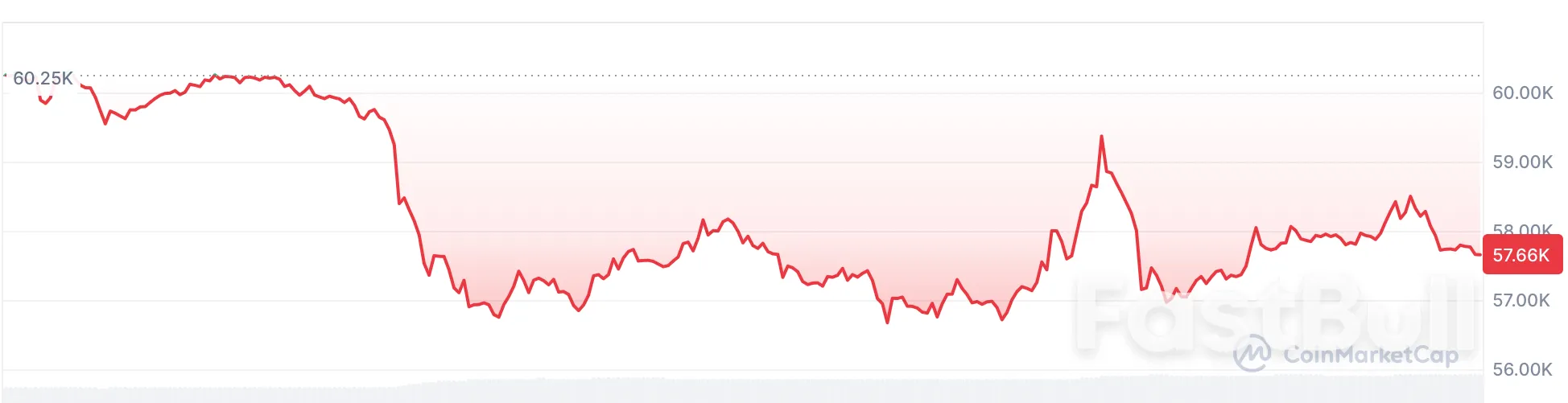
          “What a nuke we have on our hands to open the month of May,” Check added, referring to Bitcoin briefly plummeting 8% below a key support level to $56,814 on May 1, according to CoinMarketCap data.
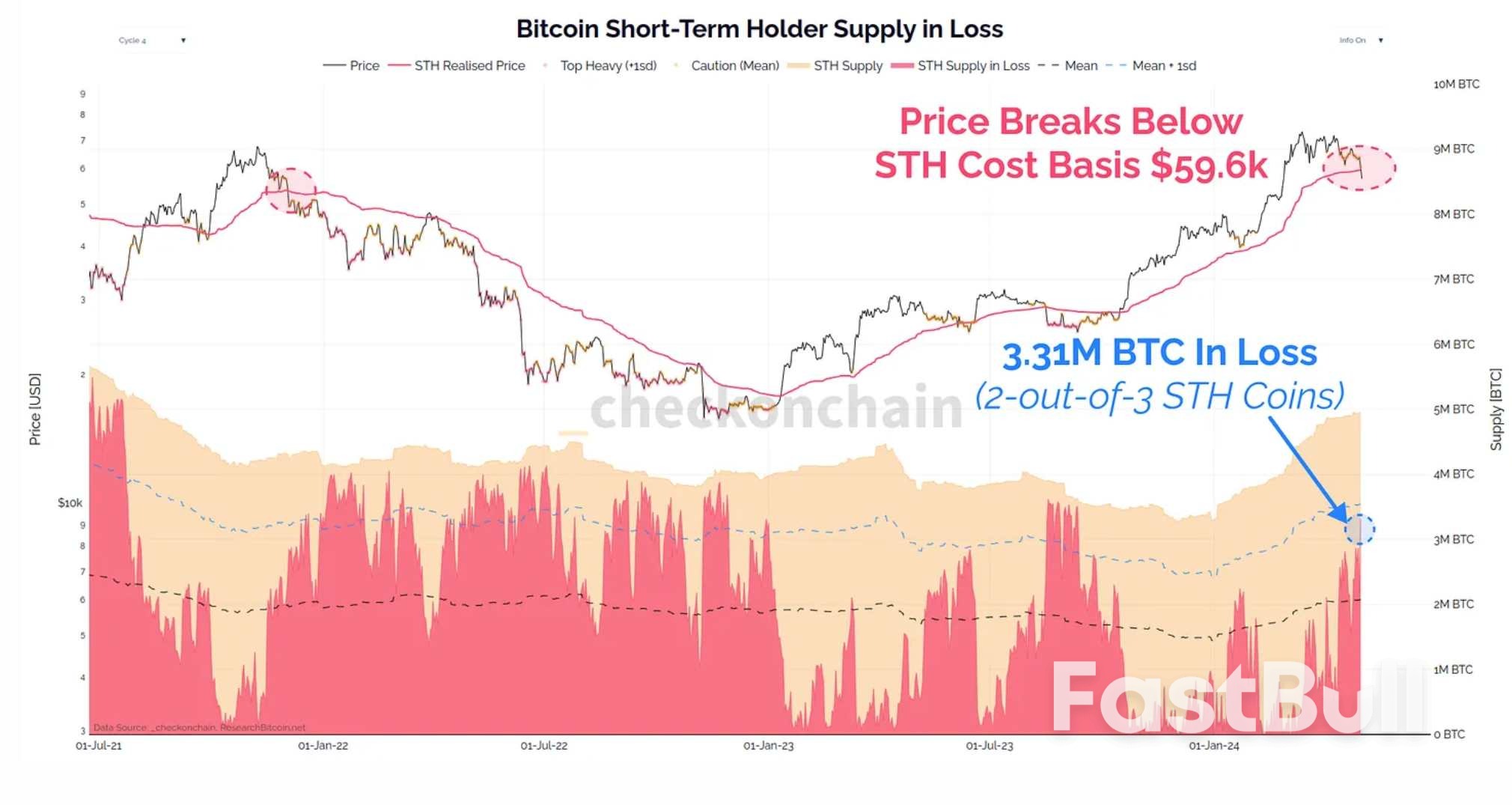
          The recent price drop saw Bitcoin hit its lowest level since February, which is significant for short-term Bitcoin holders — those who have held for under 155 days — as they paid an average price of $59,600 per Bitcoin.
          Even though the price has slightly recovered to $57,631 at the time of publication, short-term holders still hold an average 3% unrealized loss.
          Bitcoin’s price at the time of writing represents a decline of 4% in the past 24 hours. The sharp downturn led to the liquidation of $100.27 million in long positions over that time, according to CoinGlass data.
          Its price decline was driven by a crypto sell-off as market participants awaited the United States Federal Reserve’s interest rate decision, which kept the current high interest rates unchanged, as analysts expected.Bitcoin 4% Dip May 'Panic' Short-Term Holders as Price Falls Below Average Cost_1

          Bitcoin’s price briefly plummeted to its lowest price in three months on May 1. Source: CoinMarketCap

          Check suggested that while holding an unrealized loss is not ideal, short-term Bitcoin holders have experienced this before.
          “Most importantly, breaking the [short-term holder] cost basis isn’t the end of the world, nor the end of the bull market. It doesn’t help…but it is and has been recoverable,” he wrote.
          The short-term holder cost basis typically acts as support during bull periods and resistance during bear periods, explained crypto trading resource On-Chain College in a May 1 X post.
          However, it pointed to a few potential events that will not signal “the bull market is over.”
          A “quick move” to $59,600, roughly 2.2% above Bitcoin’s current price, would be “bullish,” the On-Chain College claimed.
          This is based on a similar pattern in June 2023, when the price dropped below cost basis and quickly rebounded before a significant upswing.Bitcoin 4% Dip May 'Panic' Short-Term Holders as Price Falls Below Average Cost_2

          Bitcoin’s price breaks below the short-term holder cost basis. Source: Checkonchain

          On-Chain College also noted that when Bitcoin’s price pulled back a few months later, in August 2023, it stayed volatile below the short-term cost basis for some time.
          This suggests that a “sustained period” below the cost basis could also signal a bullish trend, according to On-chain College.

          Source: Cointelegraph

          To stay updated on all economic events of today, please check out our Economic calendar
          Risk Warnings and Disclaimers
          You understand and acknowledge that there is a high degree of risk involved in trading. Following any strategies or investment methods may lead to potential losses. The content on the site is provided by our contributors and analysts for information purposes only. You are solely responsible for determining whether any trading assets, securities, strategy, or any other product is suitable for investing based on your own investment objectives and financial situation.
          Add to Favorites
          Share

          RBA Decision: Will A Rate Hike Be Back on The Table?

          XM

          Economic

          Central Bank

          Inflation setback

          The Reserve Bank of Australia is no stranger to policy flip-flops and the May decision may just add to the tally. Having dropped their tightening bias as recently as the last meeting in March, policymakers are staring at an unpleasant inflation picture.
          The monthly CPI reading ticked up to 3.5% y/y in March, while two closely watched underlying measures came in hotter than expected in the first quarter. Moreover, despite the labour market having somewhat cooled over the past year, wage growth has kept on accelerating, reaching 4.2% y/y in the fourth quarter of 2023.RBA Decision: Will A Rate Hike Be Back on The Table?_1
          The Q1 figure for wage costs isn't due until May 15 and the next CPI report will be released even later on May 29. Both pieces of data could be crucial to deciding whether the latest setback in the fight against inflation is just a blip or a warning that monetary policy is not restrictive enough.

          Focus on new CPI forecasts

          Without the additional data, however, the RBA will probably maintain a neutral stance in May, keeping the cash rate at 4.35%. But the Bank will also publish its quarterly Monetary Policy Statement containing updated economic projections. In the previous report, the Bank did not see inflation falling within its 2-3% target band before the end of 2025.
          It's unlikely that Governor Michelle Bullock would tolerate any further delay to meeting the inflation goal so the new forecasts may well provide a vital clue to future policy even if there's little modification to the statement.

          Economic growth has been patchy

          Looking at the economy more broadly, recent indicators support a wait-and-see approach by the RBA. Employment unexpectedly fell in March while the jobless rate crept up slightly. Retail sales also defied forecasts of an increase, suggesting consumers remain cautious about spending.
          But there's been a marked improvement in the services PMI since December and the housing market is booming again. More importantly perhaps for Australian exporters, China's economy seems to be on a steady path to recovery.
          Yet, none of the above pose an outsize danger to inflation, so the main debate for board members will more likely be about how comfortable they are to let CPI run above the target for a prolonged duration rather than how to contain a resurgence.

          Aussie stuck in a downward trajectory

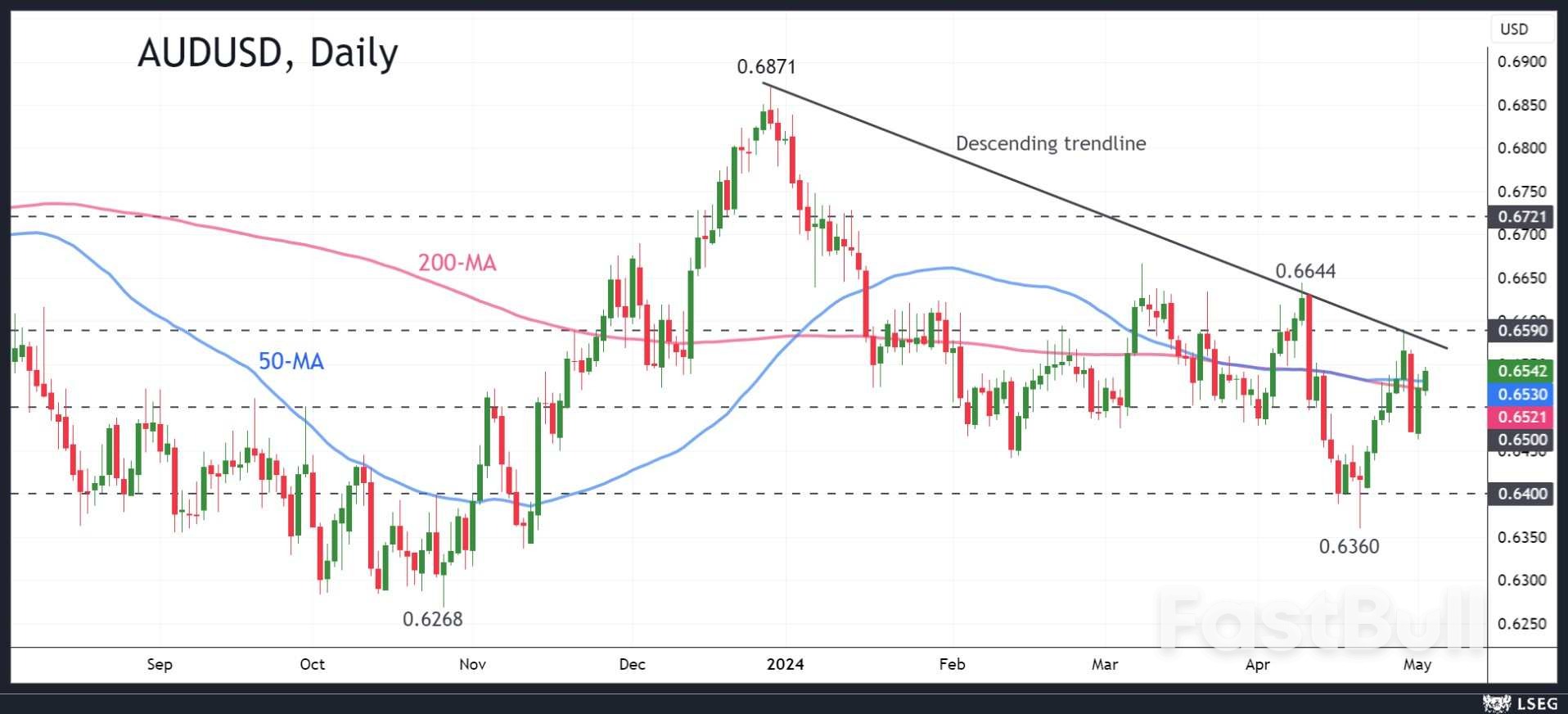
          If there is a hawkish tilt and the RBA reinstates its tightening bias, the aussie could recover above its moving averages and challenge the descending trendline around $0.6590. A step higher would bring the April peak of $0.6644 into range before attention shifts to the $0.6700 level.RBA Decision: Will A Rate Hike Be Back on The Table?_2
          In the scenario that the RBA overlooks the latest signs of price stickiness, the aussie could head back towards the April trough of $0.6360 before revisiting the October low of $0.6268.

          Is there a risk of a surprise rate hike?

          With sticky inflation in the US also proving problematic for the Fed, there's already been a sharp repricing of rate cut expectations for the major central banks. For the RBA, investors have gone a step further and priced in around a 40% probability of a 25-basis-point rate increase by year end. Hence, a hawkish tone alone might not necessarily spur a significant reaction in the markets on Tuesday.RBA Decision: Will A Rate Hike Be Back on The Table?_3
          However, it is worth considering Governor Bullock's greater urgency in beating inflation compared to her predecessor. So a surprise rate hike cannot be completely ruled out, particularly as policymakers have the option of a smaller increase of 15 bps at their disposal.
          To stay updated on all economic events of today, please check out our Economic calendar
          Risk Warnings and Disclaimers
          You understand and acknowledge that there is a high degree of risk involved in trading. Following any strategies or investment methods may lead to potential losses. The content on the site is provided by our contributors and analysts for information purposes only. You are solely responsible for determining whether any trading assets, securities, strategy, or any other product is suitable for investing based on your own investment objectives and financial situation.
          Add to Favorites
          Share

          US Oil and Gas Production Rebounds After Winter Storm

          Kevin Du

          Economic

          Energy

          U.S. oil and gas production rebounded sharply in February after extensive disruption the previous month caused by freezing wells and other outages stemming from Winter Storm Heather in the middle of January.
          Nationwide crude and condensates output jumped by 0.6 million barrels per day (b/d) in February reversing a decline of 0.7 million b/d in January, according to data from the U.S. Energy Information Administration (EIA).
          For 10 days between Jan. 13 and Jan. 23, centred around the winter storm, temperatures across the Lower 48 states were significantly colder than average for the time of year.
          The storm had a relatively large impact on the country's top producing area in the Permian Basin in Texas and New Mexico with frozen equipment and crews unable to reach well sites.
          But as the storm passed and normal operations were restored, output bounced back, causing a large jump in reported daily flows ("Petroleum supply monthly", EIA, April 30).
          Production from the Lower 48 states excluding federal waters in the Gulf of Mexico surged by 0.5 million b/d in February after declining 0.6 million b/d the month before.

          Oil Stabilisation?

          There are tentative signs that U.S. oil production is stabilising after the sharp fall in prices between the middle of 2022 and the middle of 2023.
          Lower 48 production was up by almost 0.7 million b/d in February compared with the same month a year earlier but there had been little or no growth in the last six months.
          Front-month U.S. crude futures prices have averaged around $73-84 per barrel for the last six months, close to the long-run average since the start of the century, after adjusting for inflation.
          Front-month futures prices have retreated from an average of more than $123 in June 2022, in the 82nd percentile for all months since 2000, four months after Russia's invasion of Ukraine.
          In a delayed response to lower prices, the number of rigs drilling for oil has averaged 500-510 per month since September 2023 down from an average of 623 in December 2022.
          Storm-related distortions will make identifying a change in trend difficult for another month or two, but there are signs the industry has found a new equilibrium after the shock caused by Russia's invasion.

          U.S. Gas Production

          Dry gas production rebounded by 2.3 billion cubic feet per day (bcf/d) in February after declining by 3.1 bcf/d in January owing to the storm ("Natural gas monthly", EIA, April 30).
          Production in February had increased by 3.7 bcf/d or 3.7% compared with the same month a year earlier, even after adjusting for the extra day of output owing to the leap year.
          But there had been essentially no growth in daily output since November, which could signal output is stabilising in gas too after an even more severe fall in prices.
          Front-month futures prices have averaged less than $2 per million British thermal units since the start of 2024, the lowest in real terms since the futures contract began trading in 1990.
          The number of rigs drilling primarily for gas averaged between 115 and 120 each month between September 2023 and February 2024, down from a post-invasion peak of 162 in September 2022.
          So far, gas inventories have remained far above normal because of the exceptionally warm winter in 2023/24, which more than offset the impact of ultra-low prices and record gas consumption by power generators.
          Inventories were almost 680 bcf (+39% or +1.46 standard deviations) above the prior 10-year seasonal average in late April 2024, according to weekly gas storage data from the EIA.
          The surplus had swelled almost continuously from just 64 bcf (+2% or +0.24 standard deviations) at the start of winter on Oct. 1, narrowing only briefly during the winter storm in January.
          In late February, however, several of the largest gas producers announced cuts to drilling programmes and/or output in an effort to reduce excess inventories and lift prices.
          The number of rigs drilling for gas declined even further to an average of just 108 in April, the lowest since the pandemic and its aftermath in 2020/21 and before that the last gas glut in 2016.
          Fewer rigs and increased consumption by power generators should eventually eliminated excess inventories, but the adjustment would be accelerated if there is a heatwave this summer boosting airconditioning.

          Source: Reuters

          To stay updated on all economic events of today, please check out our Economic calendar
          Risk Warnings and Disclaimers
          You understand and acknowledge that there is a high degree of risk involved in trading. Following any strategies or investment methods may lead to potential losses. The content on the site is provided by our contributors and analysts for information purposes only. You are solely responsible for determining whether any trading assets, securities, strategy, or any other product is suitable for investing based on your own investment objectives and financial situation.
          Add to Favorites
          Share

          Stalling in Inflation Leaves FOMC Stalling for Time

          WELLS FARGO

          Economic

          Central Bank

          As was widely expected, the FOMC left the fed funds target range unchanged at 5.25%-5.50% at the conclusion of its May meeting. It was evident, however, that the Committee believes inflation's return to its 2% objective likely has a somewhat longer and uncertain journey ahead. In the post-meeting statement, the Committee noted that "in recent months, there has been a lack of further progress" toward its 2% inflation goal. This setback in obtaining confidence that inflation is on a sustainable path back to 2% reinforces our view that any reduction to the fed funds rate remains at least a couple of meetings away.
          The Committee announced that it will slow the pace of quantitative tightening (QT) starting on June 1. The monthly cap for Treasury security redemptions was reduced from $60 billion to $25 billion, while the monthly redemption cap for mortgage-backed securities (MBS) was left unchanged at $35 billion. The slow-but-don't-stop approach to balance sheet runoff is an attempt to keep normalizing the size of the Fed's balance sheet without creating money market stresses like the ones that occurred in September 2019. The move to a slower pace of QT was well-telegraphed by the Committee, and the outlook for the federal funds rate will be far more critical to determining the level and shape of the yield curve in the months ahead, in our view.

          Lack of Progress on Inflation Keeps FOMC on Hold

          As universally expected, the Federal Open Market Committee (FOMC) voted unanimously at its meeting today to leave the target range for the federal funds rate unchanged at 5.25%-5.50%, where it has been maintained since last July (Figure 1). As is typical for the April/May FOMC meeting, the Committee did not release a Summary of Economic Projections, which contains the so-called "dot plot," at the conclusion of this meeting. Therefore, market participants need to infer the FOMC's intentions from its post-meeting statement and from the Q&A session in Chair Powell's press conference. In our view, these data points suggest the Committee is not in any rush to cut rates, a message that was delivered by numerous Fed officials in the weeks leading up to today's meeting (see our recent "Flashlight" report for further discussion.)
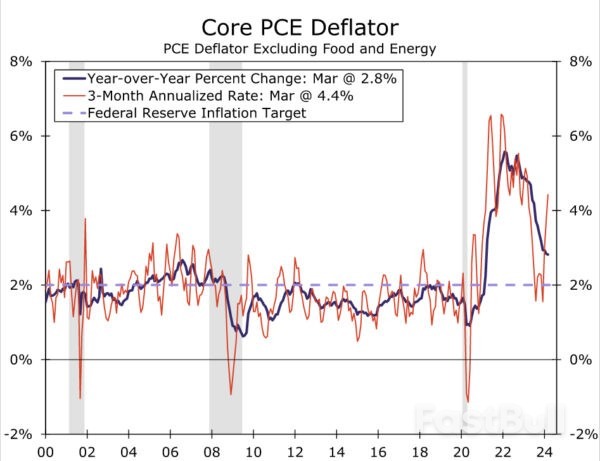
          Stalling in Inflation Leaves FOMC Stalling for Time_1In that regard, the FOMC continues to have an upbeat assessment of the real economy. The post-meeting statement noted once again that "economic activity has continued to expand at a solid pace," that "job gains have remained strong" and that "the unemployment rate has remained low." Furthermore, the Committee continues to acknowledge that "inflation has eased over the past year," although the statement noted for the first time that "there has been a lack of further progress toward the Committee's 2 percent inflation objective." As shown in Figure 2, the year-over-year rate of core PCE inflation, which the FOMC considers to be the best measure of the underlying rate of consumer price inflation, has receded from more than 5% in 2022 to 2.8% in March. However, core PCE prices have shot up at an annualized rate of 4.4% over the past three months. To paraphrase recent Fed speakers, the FOMC will need greater "confidence" that inflation is returning to 2% on a sustained basis before it feels comfortable cutting its target range for the federal funds rate. In our view, the Committee will not have that confidence until the September 18 FOMC meeting, at the earliest.
          Stalling in Inflation Leaves FOMC Stalling for Time_2In Chair Powell's post-meeting press conference, he noted that it likely will take longer than originally thought to get that confidence. Notably, he backed off any reference to the potential timing of a rate reduction in his prepared remarks, no longer stating that "it will likely be appropriate to begin dialing back policy restraint at some point this year" (emphasis ours). Yet he also noted that he believes it is "unlikely" that the FOMC will need to hike again and that policy remains restrictive. On balance, the recent data appear to have pushed the FOMC away from the precipice of rate cuts but still very comfortable with a wait and see approach.

          Slow-But-Don't-Stop for QT

          Although the Committee kept its primary policy tool, the federal funds rate, unchanged at today's meeting, the FOMC did announce some changes to its balance sheet runoff program. The Committee announced that it intends to slow the decline in its securities holdings by reducing the monthly redemption cap on Treasury securities from $60 billion to $25 billion. The monthly redemption cap for mortgage-backed securities (MBS) was left unchanged at $35 billion. The new caps will be effective starting June 1.
          The logic for slowing runoff is fairly straightforward: the ultimate "equilibrium" size of the Fed's balance sheet is uncertain, and a prudent risk management policy calls for a slow-but-don't-stop approach as the Fed feels out the optimal size for its balance sheet. The minutes from the last FOMC meeting noted that "slower runoff would give the Committee more time to assess market conditions as the balance sheet continues to shrink." Powell reiterated in his press conference that slowing the pace of runoff will help ensure a "smooth transition" and "reduce the possibility that money markets experience stress." We think the new pace of runoff will continue through at least year-end 2024.
          To stay updated on all economic events of today, please check out our Economic calendar
          Risk Warnings and Disclaimers
          You understand and acknowledge that there is a high degree of risk involved in trading. Following any strategies or investment methods may lead to potential losses. The content on the site is provided by our contributors and analysts for information purposes only. You are solely responsible for determining whether any trading assets, securities, strategy, or any other product is suitable for investing based on your own investment objectives and financial situation.
          Add to Favorites
          Share
          FastBull
          Copyright © 2025 FastBull Ltd

          728 RM B 7/F GEE LOK IND BLDG NO 34 HUNG TO RD KWUN TONG KLN HONG KONG

          TelegramInstagramTwitterfacebooklinkedin
          App Store Google Play Google Play
          Products
          Charts

          Chats

          Q&A with Experts
          Screeners
          Economic Calendar
          Data
          Tools
          Membership
          Features
          Function
          Markets
          Copy Trading
          Latest Signals
          Contests
          News
          Analysis
          24/7
          Columns
          Education
          Company
          Careers
          About Us
          Contact Us
          Advertising
          Help Center
          Feedback
          User Agreement
          Privacy Policy
          Business

          White Label

          Data API

          Web Plug-ins

          Poster Maker

          Affiliate Program

          Risk Disclosure

          The risk of loss in trading financial instruments such as stocks, FX, commodities, futures, bonds, ETFs and crypto can be substantial. You may sustain a total loss of the funds that you deposit with your broker. Therefore, you should carefully consider whether such trading is suitable for you in light of your circumstances and financial resources.

          No decision to invest should be made without thoroughly conducting due diligence by yourself or consulting with your financial advisors. Our web content might not suit you since we don't know your financial conditions and investment needs. Our financial information might have latency or contain inaccuracy, so you should be fully responsible for any of your trading and investment decisions. The company will not be responsible for your capital loss.

          Without getting permission from the website, you are not allowed to copy the website's graphics, texts, or trademarks. Intellectual property rights in the content or data incorporated into this website belong to its providers and exchange merchants.

          Not Logged In

          Log in to access more features

          FastBull Membership

          Not yet

          Purchase

          Become a signal provider
          Help Center
          Customer Service
          Dark Mode
          Price Up/Down Colors

          Log In

          Sign Up

          Position
          Layout
          Fullscreen
          Default to Chart
          The chart page opens by default when you visit fastbull.com