• Trade
  • Markets
  • Copy
  • Contests
  • News
  • 24/7
  • Calendar
  • Q&A
  • Chats
Trending
Screeners
SYMBOL
LAST
BID
ASK
HIGH
LOW
NET CHG.
%CHG.
SPREAD
SPX
S&P 500 Index
6817.54
6817.54
6817.54
6861.30
6801.50
-9.87
-0.14%
--
DJI
Dow Jones Industrial Average
48368.99
48368.99
48368.99
48679.14
48285.67
-89.05
-0.18%
--
IXIC
NASDAQ Composite Index
23106.34
23106.34
23106.34
23345.56
23012.00
-88.82
-0.38%
--
USDX
US Dollar Index
97.950
98.030
97.950
98.070
97.740
0.000
0.00%
--
EURUSD
Euro / US Dollar
1.17461
1.17469
1.17461
1.17686
1.17262
+0.00067
+ 0.06%
--
GBPUSD
Pound Sterling / US Dollar
1.33712
1.33719
1.33712
1.34014
1.33546
+0.00005
0.00%
--
XAUUSD
Gold / US Dollar
4301.93
4302.34
4301.93
4350.16
4285.08
+2.54
+ 0.06%
--
WTI
Light Sweet Crude Oil
56.320
56.350
56.320
57.601
56.233
-0.913
-1.60%
--

Community Accounts

Signal Accounts
--
Profit Accounts
--
Loss Accounts
--
View More

Become a signal provider

Sell trading signals to earn additional income

View More

Guide to Copy Trading

Get started with ease and confidence

View More

Signal Accounts for Members

All Signal Accounts

Best Return
  • Best Return
  • Best P/L
  • Best MDD
Past 1W
  • Past 1W
  • Past 1M
  • Past 1Y

All Contests

  • All
  • Trump Updates
  • Recommend
  • Stocks
  • Cryptocurrencies
  • Central Banks
  • Featured News
Top News Only
Share

Goldman Sachs Says They Believe That The Copper Price Is Vulnerable To An Ai-Linked Price Correction

Share

Goldman Sachs Upgrades 2026 Copper Price Forecast To $11400 From $10,650

Share

Attempts By Ukrainian Troops To Advance From The South-West To Outskirts Of Kupiansk Are Being Thwarted

Share

Russian Troops Control All Of Kupiansk - IFX Cites Russian Military

Share

On Monday (December 15), The South Korean Won Ultimately Rose 0.60% Against The US Dollar, Closing At 1468.91 Won. The Won Was On An Upward Trend Throughout The Day, Rising Significantly At 17:00 Beijing Time And Reaching A Daily High Of 1463.04 Won At 17:36

Share

Health Ministry: Israeli Forces Kill Palestinian Teen In West Bank

Share

New York Federal Reserve President Williams: Over Time, The Size Of Reserves Could Grow From $2.9 Trillion

Share

New York Fed President Williams: AI Valuations Are High, But There Is A Real Driving Factor

Share

New York Federal Reserve President Williams: The Job Market Is In Very Good Shape

Share

New York Fed President Williams: 'Very Supportive' Of USA Central Bank's Decision To Cut Interest Rates Last Week

Share

New York Fed President Williams: 'Too Early To Say' What Central Bank Should Do At January Meeting

Share

New York Fed President Williams: Strong Markets Part Of Reason Why Economy Will Grow Robustly In 2026

Share

New York Fed President Williams: What Constitutes Ample Reserves Will Change Over Time

Share

New York Fed President Williams: Market Valuations 'Elevated,' But There Are Reasons For Pricing

Share

New York Fed President Williams: Ample Reserves System Working Very Well

Share

New York Fed President Williams: Some Signs That Parts Of Underlying Economy Not As Strong As GDP Data Suggests

Share

New York Fed President Williams: Expects Coming Job Data Will Show Gradual Cooling

Share

Ukraine President Zelenskiy: Monitoring Of Ceasefire Should Be Part Of Security Guarantees

Share

Ukraine President Zelenskiy: Ukraine Needs Clear Understanding On Security Guarantees Before Taking Any Decisions Regarding Frontlines

Share

U.S. Commerce Secretary Rutnick Praised Korea Zinc Co. Ltd., Stating That The United States Will Have Priority Access To The Company's Products In 2026

TIME
ACT
FCST
PREV
Japan Tankan Small Manufacturing Outlook Index (Q4)

A:--

F: --

P: --

Japan Tankan Large Non-Manufacturing Outlook Index (Q4)

A:--

F: --

P: --

Japan Tankan Large Manufacturing Outlook Index (Q4)

A:--

F: --

P: --

Japan Tankan Small Manufacturing Diffusion Index (Q4)

A:--

F: --

P: --

Japan Tankan Large-Enterprise Capital Expenditure YoY (Q4)

A:--

F: --

P: --

U.K. Rightmove House Price Index YoY (Dec)

A:--

F: --

P: --

China, Mainland Industrial Output YoY (YTD) (Nov)

A:--

F: --

P: --

China, Mainland Urban Area Unemployment Rate (Nov)

A:--

F: --

P: --

Saudi Arabia CPI YoY (Nov)

A:--

F: --

P: --

Euro Zone Industrial Output YoY (Oct)

A:--

F: --

P: --

Euro Zone Industrial Output MoM (Oct)

A:--

F: --

P: --

Canada Existing Home Sales MoM (Nov)

A:--

F: --

P: --

Canada National Economic Confidence Index

A:--

F: --

P: --

Canada New Housing Starts (Nov)

A:--

F: --

P: --
U.S. NY Fed Manufacturing Employment Index (Dec)

A:--

F: --

P: --

U.S. NY Fed Manufacturing Index (Dec)

A:--

F: --

P: --

Canada Core CPI YoY (Nov)

A:--

F: --

P: --

Canada Manufacturing Unfilled Orders MoM (Oct)

A:--

F: --

P: --

U.S. NY Fed Manufacturing Prices Received Index (Dec)

A:--

F: --

P: --

U.S. NY Fed Manufacturing New Orders Index (Dec)

A:--

F: --

P: --

Canada Manufacturing New Orders MoM (Oct)

A:--

F: --

P: --

Canada Core CPI MoM (Nov)

A:--

F: --

P: --

Canada Trimmed CPI YoY (SA) (Nov)

A:--

F: --

P: --

Canada Manufacturing Inventory MoM (Oct)

A:--

F: --

P: --

Canada CPI YoY (Nov)

A:--

F: --

P: --

Canada CPI MoM (Nov)

A:--

F: --

P: --

Canada CPI YoY (SA) (Nov)

A:--

F: --

P: --

Canada Core CPI MoM (SA) (Nov)

A:--

F: --

P: --

Canada CPI MoM (SA) (Nov)

A:--

F: --

P: --

Federal Reserve Board Governor Milan delivered a speech
U.S. NAHB Housing Market Index (Dec)

A:--

F: --

P: --

Australia Composite PMI Prelim (Dec)

--

F: --

P: --

Australia Services PMI Prelim (Dec)

--

F: --

P: --

Australia Manufacturing PMI Prelim (Dec)

--

F: --

P: --

Japan Manufacturing PMI Prelim (SA) (Dec)

--

F: --

P: --

U.K. 3-Month ILO Employment Change (Oct)

--

F: --

P: --

U.K. Unemployment Claimant Count (Nov)

--

F: --

P: --

U.K. Unemployment Rate (Nov)

--

F: --

P: --

U.K. 3-Month ILO Unemployment Rate (Oct)

--

F: --

P: --

U.K. Average Weekly Earnings (3-Month Average, Including Bonuses) YoY (Oct)

--

F: --

P: --

U.K. Average Weekly Earnings (3-Month Average, Excluding Bonuses) YoY (Oct)

--

F: --

P: --

France Services PMI Prelim (Dec)

--

F: --

P: --

France Composite PMI Prelim (SA) (Dec)

--

F: --

P: --

France Manufacturing PMI Prelim (Dec)

--

F: --

P: --

Germany Services PMI Prelim (SA) (Dec)

--

F: --

P: --

Germany Manufacturing PMI Prelim (SA) (Dec)

--

F: --

P: --

Germany Composite PMI Prelim (SA) (Dec)

--

F: --

P: --

Euro Zone Composite PMI Prelim (SA) (Dec)

--

F: --

P: --

Euro Zone Services PMI Prelim (SA) (Dec)

--

F: --

P: --

Euro Zone Manufacturing PMI Prelim (SA) (Dec)

--

F: --

P: --

U.K. Services PMI Prelim (Dec)

--

F: --

P: --

U.K. Manufacturing PMI Prelim (Dec)

--

F: --

P: --

U.K. Composite PMI Prelim (Dec)

--

F: --

P: --

Euro Zone ZEW Economic Sentiment Index (Dec)

--

F: --

P: --

Germany ZEW Current Conditions Index (Dec)

--

F: --

P: --

Germany ZEW Economic Sentiment Index (Dec)

--

F: --

P: --

Euro Zone Trade Balance (Not SA) (Oct)

--

F: --

P: --

Euro Zone ZEW Current Conditions Index (Dec)

--

F: --

P: --

Euro Zone Trade Balance (SA) (Oct)

--

F: --

P: --

Euro Zone Total Reserve Assets (Nov)

--

F: --

P: --

U.K. Inflation Rate Expectations

--

F: --

P: --

Q&A with Experts
    • All
    • Chatrooms
    • Groups
    • Friends
    Connecting
    .
    .
    .
    Type here...
    Add Symbol or Code

      No matching data

      All
      Trump Updates
      Recommend
      Stocks
      Cryptocurrencies
      Central Banks
      Featured News
      • All
      • Russia-Ukraine Conflict
      • Middle East Flashpoint
      • All
      • Russia-Ukraine Conflict
      • Middle East Flashpoint
      Search
      Products

      Charts Free Forever

      Chats Q&A with Experts
      Screeners Economic Calendar Data Tools
      Membership Features
      Data Warehouse Market Trends Institutional Data Policy Rates Macro

      Market Trends

      Market Sentiment Order Book Forex Correlations

      Top Indicators

      Charts Free Forever
      Markets

      News

      News Analysis 24/7 Columns Education
      From Institutions From Analysts
      Topics Columnists

      Latest Views

      Latest Views

      Trending Topics

      Top Columnists

      Latest Update

      Signals

      Copy Rankings Latest Signals Become a signal provider AI Rating
      Contests
      Brokers

      Overview Brokers Assessment Rankings Regulators News Claims
      Broker listing Forex Brokers Comparison Tool Live Spread Comparison Scam
      Q&A Complaint Scam Alert Videos Tips to Detect Scam
      More

      Business
      Events
      Careers About Us Advertising Help Center

      White Label

      Data API

      Web Plug-ins

      Affiliate Program

      Awards Institution Evaluation IB Seminar Salon Event Exhibition
      Vietnam Thailand Singapore Dubai
      Fans Party Investment Sharing Session
      FastBull Summit BrokersView Expo
      Recent Searches
        Top Searches
          Markets
          News
          Analysis
          User
          24/7
          Economic Calendar
          Education
          Data
          • Names
          • Latest
          • Prev

          View All

          No data

          Scan to Download

          Faster Charts, Chat Faster!

          Download App
          English
          • English
          • Español
          • العربية
          • Bahasa Indonesia
          • Bahasa Melayu
          • Tiếng Việt
          • ภาษาไทย
          • Français
          • Italiano
          • Türkçe
          • Русский язык
          • 简中
          • 繁中
          Open Account
          Search
          Products
          Charts Free Forever
          Markets
          News
          Signals

          Copy Rankings Latest Signals Become a signal provider AI Rating
          Contests
          Brokers

          Overview Brokers Assessment Rankings Regulators News Claims
          Broker listing Forex Brokers Comparison Tool Live Spread Comparison Scam
          Q&A Complaint Scam Alert Videos Tips to Detect Scam
          More

          Business
          Events
          Careers About Us Advertising Help Center

          White Label

          Data API

          Web Plug-ins

          Affiliate Program

          Awards Institution Evaluation IB Seminar Salon Event Exhibition
          Vietnam Thailand Singapore Dubai
          Fans Party Investment Sharing Session
          FastBull Summit BrokersView Expo

          Obscure Trust Links India's Top Businesses with Modi's Election War Chest

          Thomas

          Political

          Summary:

          The Prudent Electoral Trust has raised $272 million since its creation in 2013, funnelling roughly 75% of that to Prime Minister Narendra Modi's party...
          Behind the doors of a small, non-descript office in the heart of New Delhi lies the headquarters of an electoral trust run by just two men that is the largest-known donor to India’s ruling Bharatiya Janata Party (BJP), according to a Reuters review of public records.
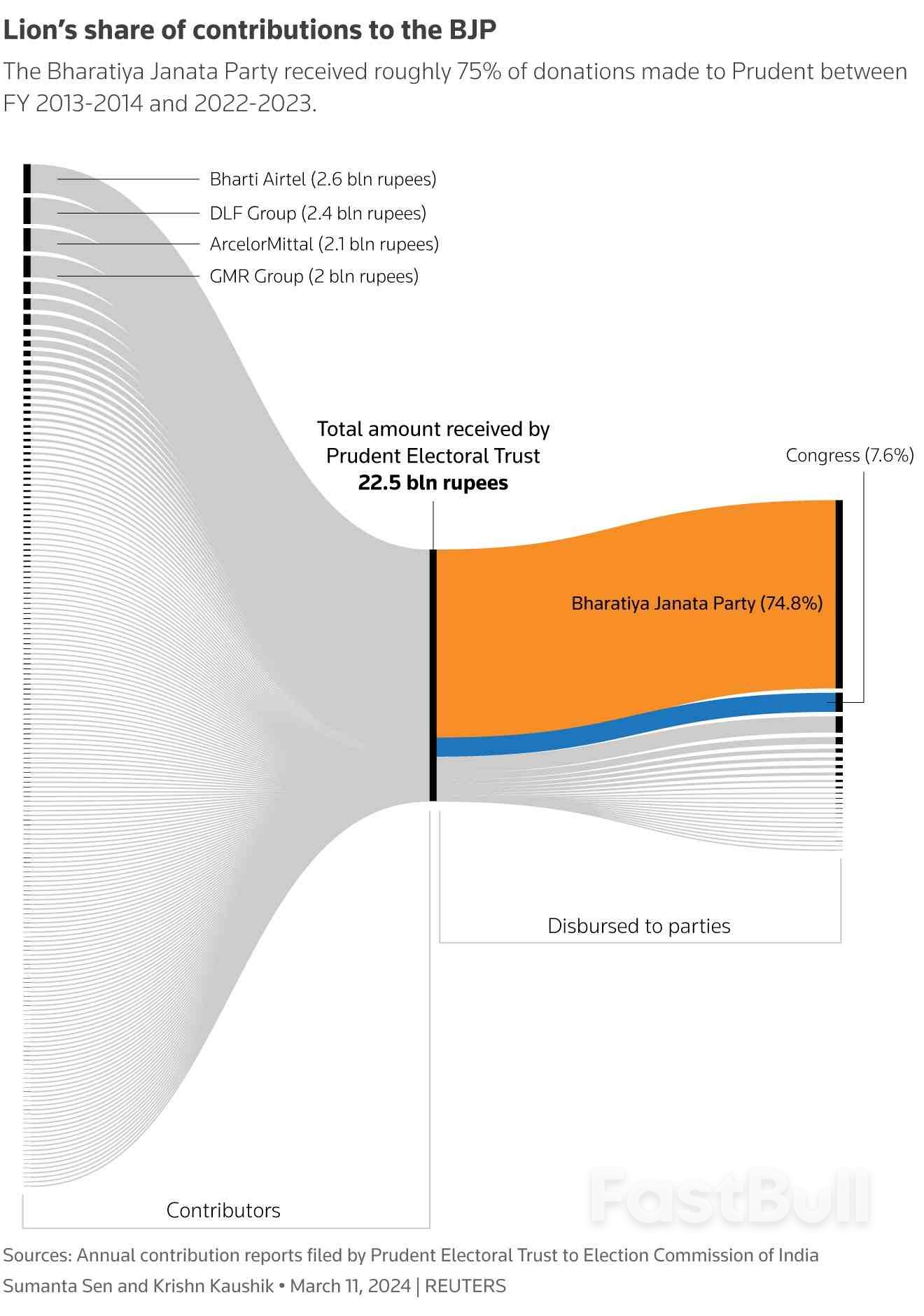
          The Prudent Electoral Trust has raised $272 million since its creation in 2013, funnelling roughly 75% of that to Prime Minister Narendra Modi's party. The trust’s donations to the BJP total 10 times as much as the $20.6 million it issued to the opposition Congress party, the records show.
          The previous Congress-led government introduced electoral trusts in 2013 to allow for tax-exempt contribution to parties. It said the mechanism would make campaign financing more transparent by reducing cash contributions, which are harder to trace.
          But some election experts say the trusts contribute to opacity around the funding of political parties in India, where this year’s general election – due to be called within weeks – is expected to return Modi to power for a rare third term, polls predict.
          While Prudent does not disclose how donations made by individual corporate donors are distributed, Reuters used public records from 2018 to 2023 to track flows from some of India’s largest companies.
          Eight of India's biggest business groups donated at least $50 million in total between 2019 and 2023 to the trust, which then issued cheques for corresponding amounts to the BJP, according to the Reuters analysis.
          Four companies whose transactions were identified by Reuters - steel giant ArcelorMittal Nippon Steel, telco Bharti Airtel, infrastructure developer GMR and energy giant Essar - have not given money to the party directly and do not appear on its donors' list.
          GMR and Bharti Airtel said in response to Reuters questions that Prudent determines how their donations are distributed.
          Prudent decides "as per their internal guidelines, which we are unaware of," said a GMR spokesman. He added that the company doesn't "like to align with any political party."
          Bharti Airtel, which created Prudent before transferring control to independent auditors Mukul Goyal and Venkatachalam Ganesh in 2014, said it has "no influence on the decisions, directions and mode of disbursal of funds."
          Spokespeople for the other groups did not respond to calls, text messages and emails.
          Goyal and Ganesh did not respond to questions sent via email and post. When asked on a brief phone call about how Prudent functioned, Goyal said: "That is something we do not discuss."
          Prudent - the largest of India's 18 electoral trusts - is legally required to declare how much it has collected from each donor and the total amounts disbursed to each party.
          But it is the only one among India's four largest electoral trusts to accept contributions from more than one corporate group.
          Trusts "provide one layer of separation between firms and parties," said Milan Vaishnav, an expert on Indian campaign finance at the Carnegie Endowment for International Peace, a Washington-based think-tank.
          Political finance in India is widely seen as murky, with most political donations in India undisclosed, Vaishnav added.
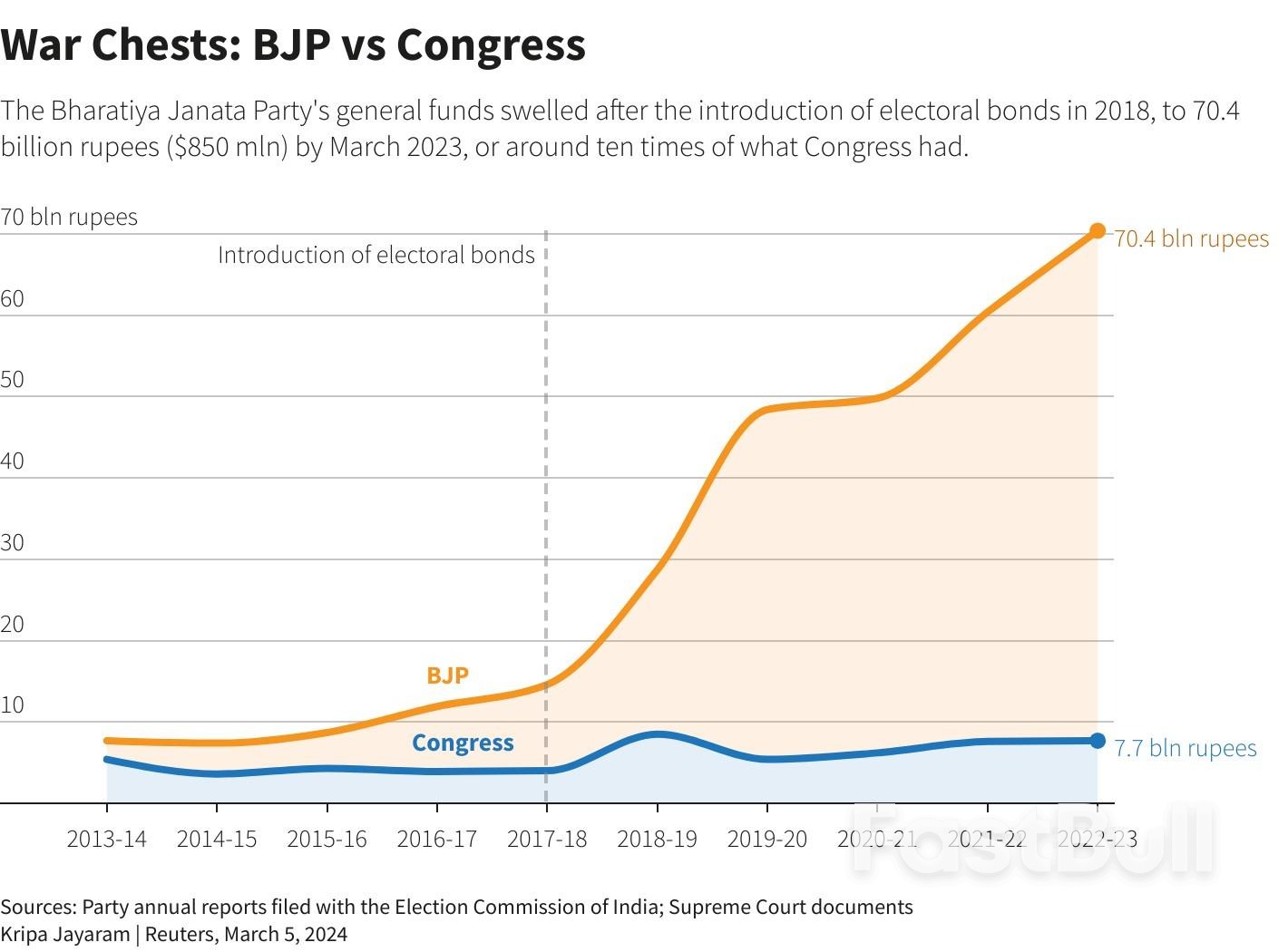
          BJP said in its latest public disclosure in March 2023 that its political war chest - funds it had available including cash reserves and assets - was valued at 70.4 billion rupees ($850 million). That gives it a colossal financial advantage over Congress, which had 7.75 billion rupees in funds.
          BJP spokespeople did not respond to repeated requests for comment for this story.
          The records show that Prudent was also the largest-known donor to the Congress party in the decade to March 2023.
          Obscure Trust Links India's Top Businesses with Modi's Election War Chest_1Layer of Separation
          India's Supreme Court said in a February campaign finance ruling that corporate contributions are "purely business transactions made with the intent of securing benefits in return."
          Reuters was unable to establish if political parties know the identities of donors that give through trusts that receive contributions from multiple groups.
          MV Rajeev Gowda, head of research for Congress, told Reuters that electoral trusts are a "semi fig-leaf" and that he believed parties knew the donors' identities. Gowda, who doesn't manage the party's finances, didn't provide evidence.
          BJP's next largest known donor is Tata Group's Progressive Electoral Trust, which has given the party 3.6 billion rupees collected from the salt-to-airline conglomerate's companies. Progressive is also Congress's next largest donor, having given it 655 million rupees.
          Progressive's by-laws require it to distribute funds proportionate to the number of seats held by each party in parliament. Prudent has no similar restrictions and Reuters' analysis of its donations found no such pattern.
          Obscure Trust Links India's Top Businesses with Modi's Election War Chest_2Near-Instant Transfers
          Trusts are allowed to retain a maximum of 300,000 rupees for annual operating expenses. Remaining funds must be disbursed in the fiscal year they were received.
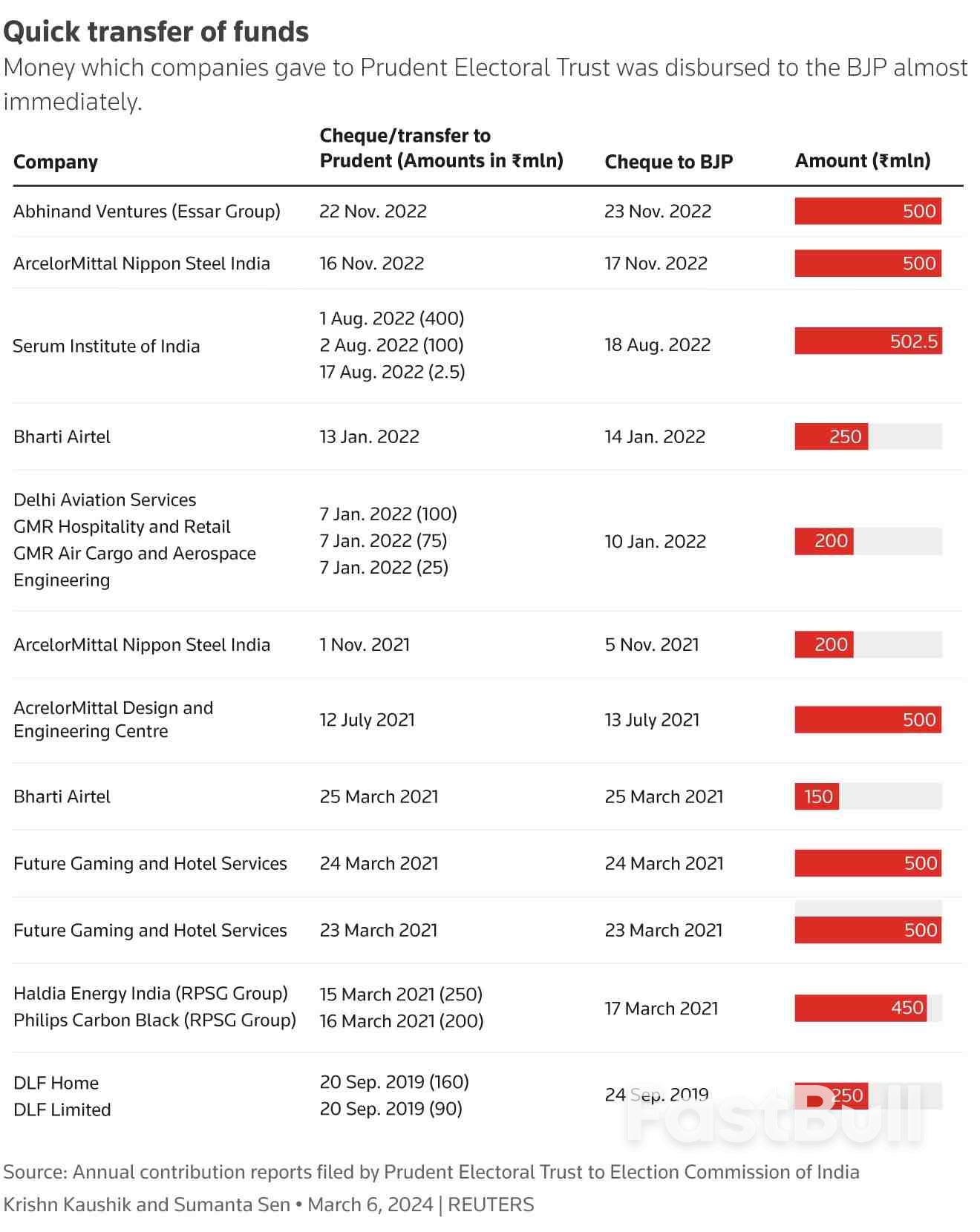
          In its analysis of contribution reports filed by Prudent to electoral authorities, Reuters identified 18 transactions between 2019 and 2022 in which the eight corporate groups made large donations to the trust. Within days, Prudent issued cheques for the same amounts to BJP.
          Before the 18 contributions, which are not exhaustive of all the donations made by the groups to Prudent, the trust did not have sufficient funds for the payments to BJP.
          Companies tied to billionaire L.N. Mittal's ArcelorMittal group were among Prudent's most prolific donors.
          On July 12, 2021, for instance, ArcelorMittal Design and Engineering Centre Private Limited gave Prudent a cheque for 500 million rupees ($6.03 million). The next day, Prudent issued a cheque to BJP for the same amount.
          ArcelorMittal Nippon Steel India also issued 200 million rupees to Prudent on Nov. 1, 2021, and 500 million rupees on Nov. 16, 2022. The respective sums were sent to BJP on Nov. 5, 2021, and Nov. 17, 2022.
          A spokesman for ArcelorMittal did not respond to requests for comment.
          Bharti Airtel, meanwhile, issued 250 million rupees to Prudent on Jan. 13, 2022 and 150 million rupees on March 25, 2021. The trust sent out cheques to BJP for those amounts on Jan. 14, 2023 and March 25, 2021.
          And three companies in the RP-Sanjiv Goenka group - Haldia Energy India, Phillips Carbon Black and Crescent Power - cut cheques for 250 million rupees, 200 million rupees and 50 million rupees on March 15, March 16, and March 19, 2021 respectively. On Mar. 17, BJP received a 450-million-rupee cheque from Prudent; a 50-million-rupee cheque followed on March 20.
          The RPSG group did not respond to requests for comment.
          Obscure Trust Links India's Top Businesses with Modi's Election War Chest_3Donations from Serum Institute and companies in GMR Group, DLF Ltd and Essar Group moved to BJP immediately after Prudent received them.
          Reuters was unable to identify a similar pattern of funds being sent to the trust and transferred to Congress immediately afterwards.
          However, Reuters found similar patterns involving two regional parties. Megha Engineering and Infrastructure transferred 750 million rupees to Prudent across three transactions on July 5 and July 6, 2022. The trust issued a 750-million-rupee cheque on July 7 to Bharat Rashtra Samithi, a centrist party in Telangana state, where Megha group is headquartered.
          And property developers Avinash Bhosale Group, based in the western Maharashtra state, gave 50 million rupees to Prudent on Nov. 27, 2020. The trust issued a cheque for that amount to the Maharashtra Pradesh Nationalist Congress Party, which is independent of the national Congress party, on Nov. 30.
          The corporate groups did not immediately return requests for comment. BRS's general secretary said he was "not aware" of specifics about the donations, while a senior NCP official said that the party had recently split and "every record will not be available with us.
          Obscure Trust Links India's Top Businesses with Modi's Election War Chest_4Cause of concern?
          Public records and party reports show BJP's war chest has swelled since Modi became prime minister in 2014, from 7.8 billion rupees ($94.09 million) in March 2014 to 70.4 billion rupees in March 2023. Congress' funds increased from from 5.38 billion rupees to 7.75 billion rupees in the same time period.
          The financing gap between the BJP and Congress is a cause of concern, said Jagdeep Chhokar of Association of Democratic Reforms, a Delhi-based civil society group that was the main petitioner behind the electoral bonds challenge in the Supreme Court.
          "Level playing field is an essential part of democracy," he said.
          Some BJP officials have said in the past that the large sums it has raised on its books are an example of its transparency.
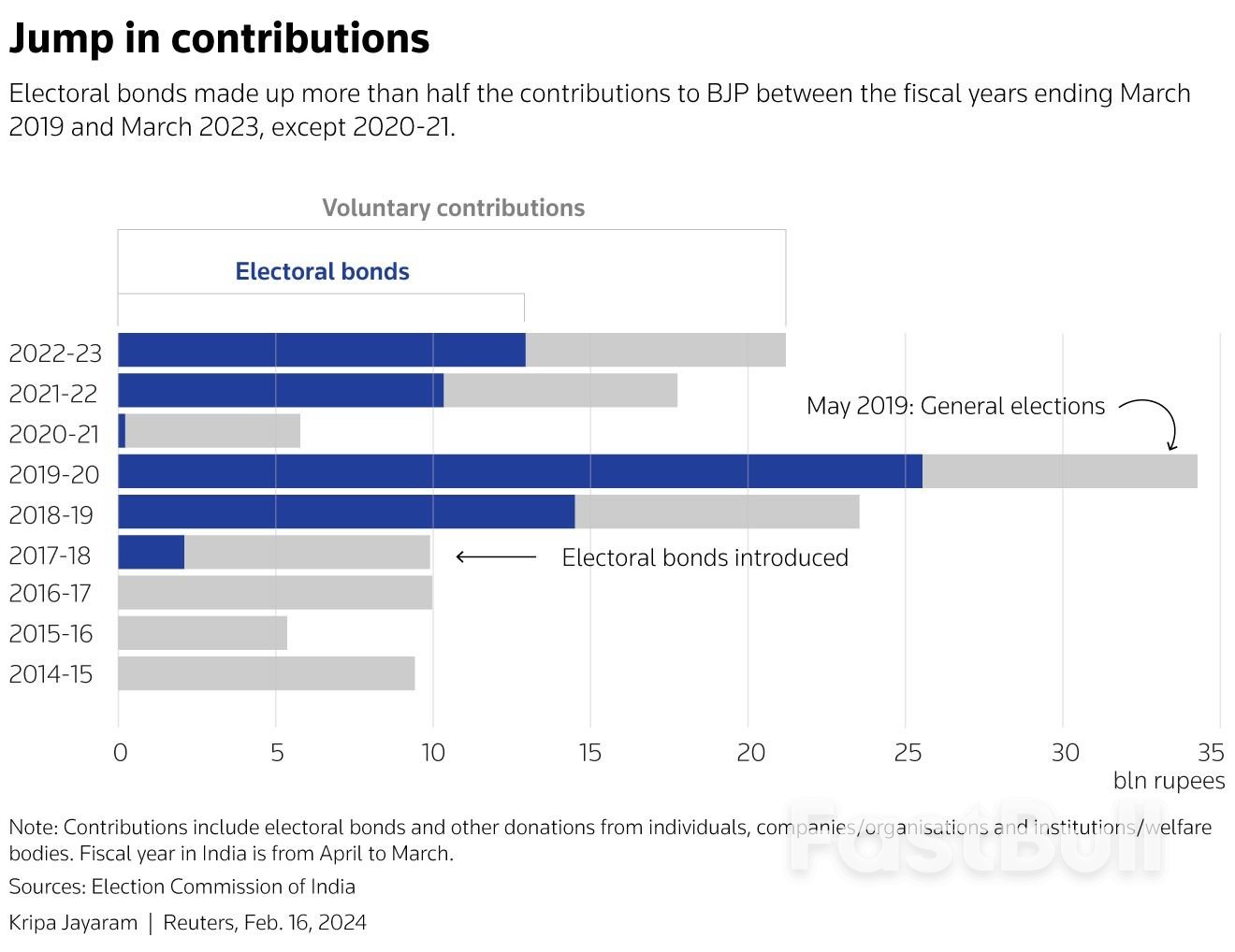
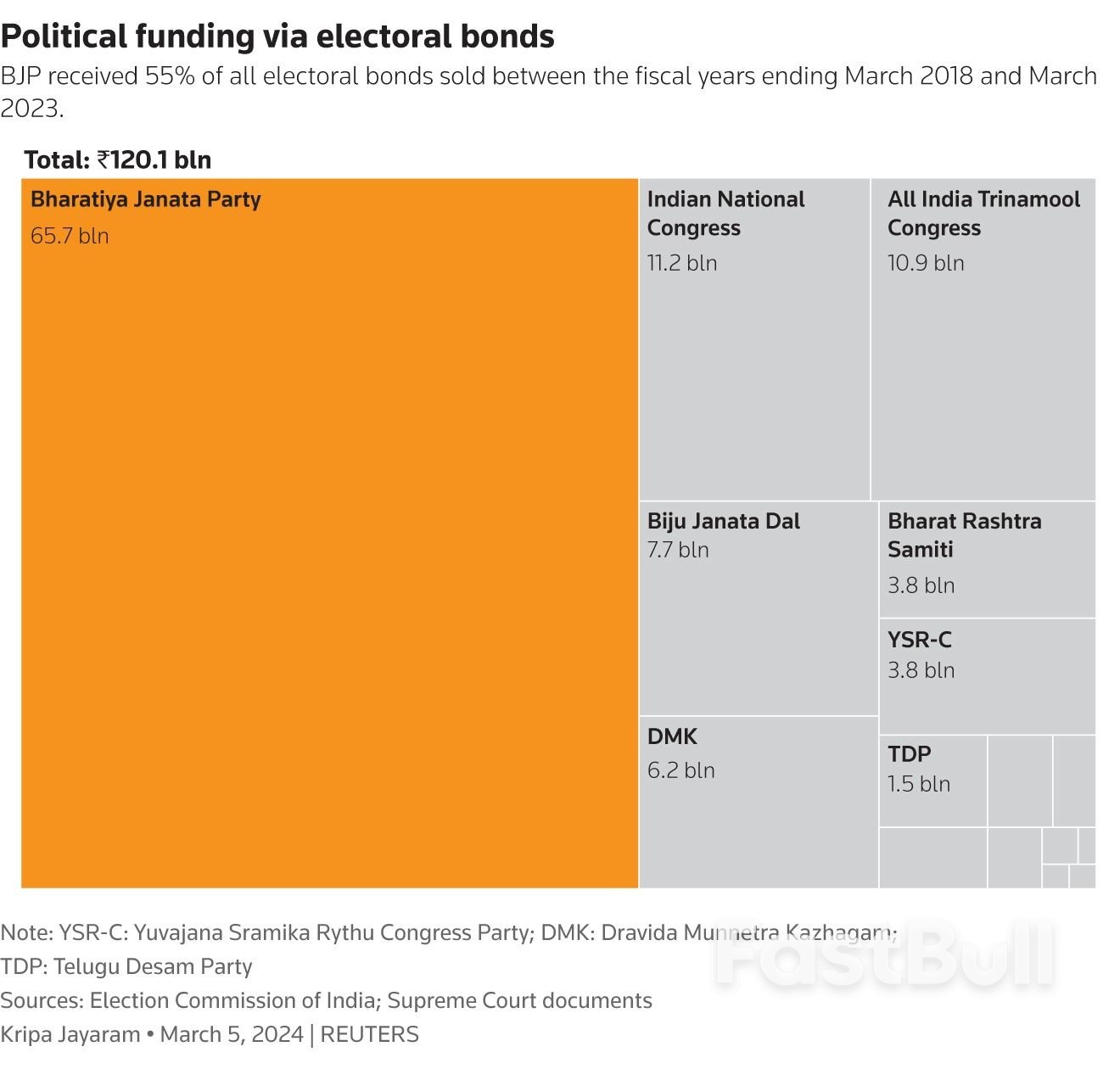
          BJP has been the major beneficiary of electoral bonds, a mechanism that allowed donors to give unlimited amounts to parties without public disclosure.
          It received some 65.66 billion rupees of the 120.1 billion rupees worth of such bonds sold between their January 2018 introduction and March 2023. Such bonds made up more than half the contributions received by the BJP in all but one fiscal year since their introduction.
          The Supreme Court called the mechanism "unconstitutional" in February and ordered the government-owned State Bank of India, which issued the bonds, to release buyers' details. Specifics are set for release by March 15.Obscure Trust Links India's Top Businesses with Modi's Election War Chest_5
          ($1 = 82.7710 Indian rupees)

          Source: Reuters

          Risk Warnings and Disclaimers
          You understand and acknowledge that there is a high degree of risk involved in trading. Following any strategies or investment methods may lead to potential losses. The content on the site is provided by our contributors and analysts for information purposes only. You are solely responsible for determining whether any trading assets, securities, strategy, or any other product is suitable for investing based on your own investment objectives and financial situation.
          Add to Favorites
          Share

          Brazil Soy, Corn Crop Estimates Widen Further After Weather Woes

          Owen Li

          Commodity

          Economic

          Benchmark industry estimates of top exporter Brazil’s soybean crop have deviated even further from each other this month following a season blemished by questionable weather.
          That same controversy may be brewing for the country’s corn crop, especially with unfavorable conditions potentially on tap for Brazil’s top production state.
          Less attention has been paid to the corn estimates versus those for soybeans in recent weeks because Brazil’s heavily exported second corn crop planting efforts are just now concluding, though more than half of the soybeans have been harvested.

          Soybean Variation

          The U.S. Department of Agriculture last week trimmed Brazil’s 2023-24 soybean harvest to 155 million metric tons from 156 million estimated in February, a much smaller cut than expected. Brazil’s statistics body, Conab, on Tuesday reduced its peg to 146.9 million tons from 149.4 million in February.
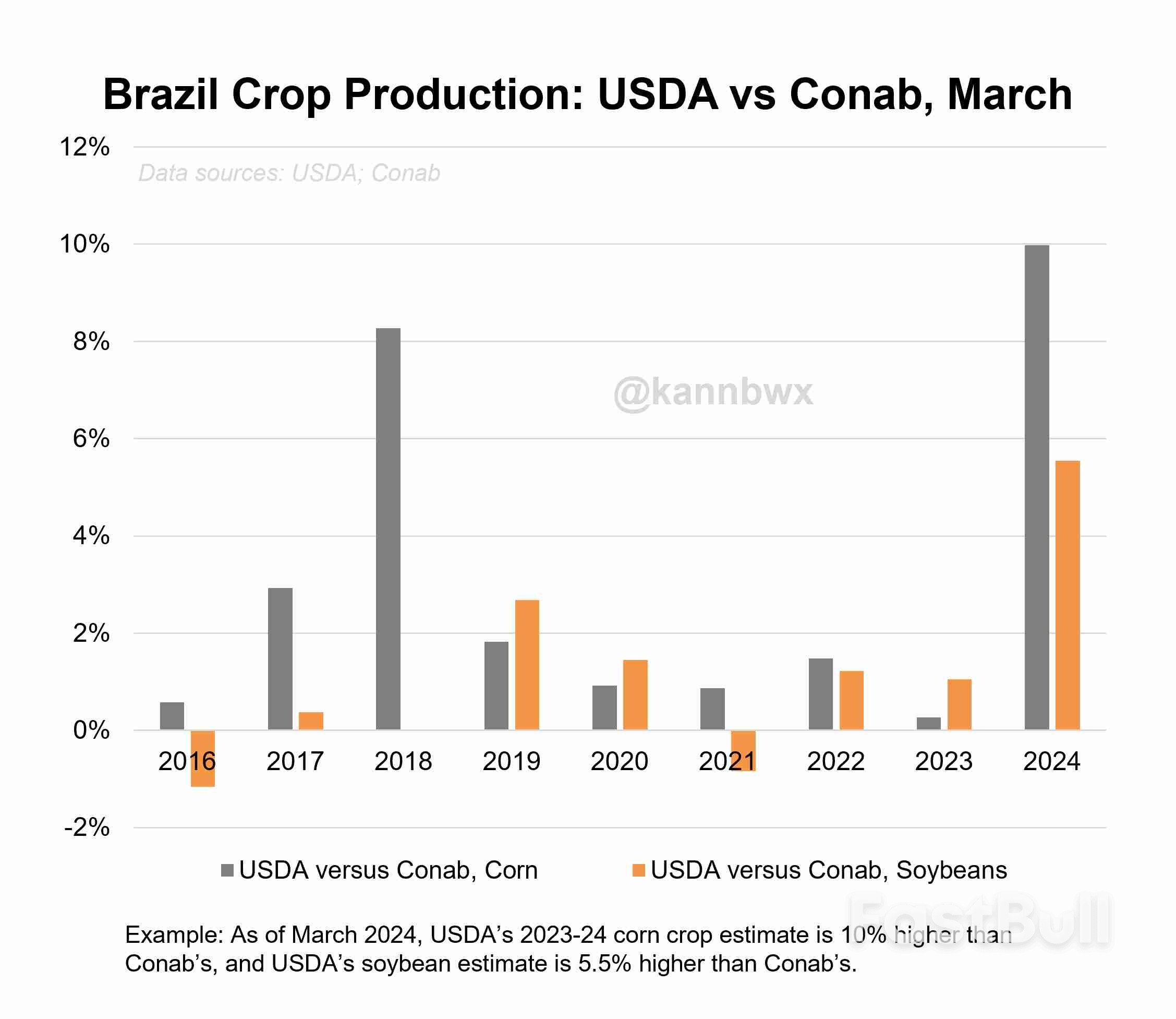
          USDA’s and Conab’s soy crop disparity widened in February with USDA 6.6 million tons (4.4%) higher than Conab. That margin increased to 8.1 million tons (5.5%) this month, equivalent to 300 million bushels. The agencies differed by less than 2 million tons in January.
          In the previous eight seasons, the largest March differential between these forecasts was five years ago, when USDA was 2.7% higher than Conab.
          Brazil Soy, Corn Crop Estimates Widen Further After Weather Woes_1The year-on-year implications are more consistent, suggesting some overlapping assumptions. USDA sees Brazil’s 2023-24 bean harvest down 4.3% on the year while Conab’s figures suggest a 5% decline.
          However, the latest estimate discrepancy, roughly equal to the projected 2023-24 U.S. soy carryout, must be solved somewhere on the balance sheet, especially since Brazil carries relatively low year-end bean stocks.
          USDA and Conab hold similar views of Brazil’s 2023-24 soy carryout, both between 2 million and 3 million tons on a local marketing-year basis (February-January). USDA gets to that number with an export estimate some 6.7 million tons above Conab’s.
          Perhaps Brazil will export these extra beans to top buyer China, as USDA’s 2023-24 Chinese imports stand at 105 million tons versus 102 million estimated last month and 104.5 million last year. USDA this month hiked the current and prior Chinese demand estimates after an in-depth data review.
          But China on Friday kept its 2023-24 soy import forecast unchanged on the month at 97.25 million tons, down fractionally on the year. Additionally, total Chinese soy imports through February, the fifth month of 2023-24, are down 1% from last year to a five-year low for the period.

          Corn concerns?

          USDA predicts the full 2023-24 Brazilian corn harvest at 124 million tons, well above Conab’s view of 112.75 million. This 10% margin is the largest for March in at least eight years, though USDA was 8% higher than Conab in March 2018, and Conab was ultimately closer to the final.
          USDA’s harvested corn area sits 7.5% (3.8 million acres) above Conab’s planted area, implying an even larger difference in the planting estimates. Conab has trimmed its area 4% since its initial forecast as grain prices have slid in recent months.
          However, USDA has made relatively substantial reductions to its Brazil corn estimate, which has fallen 4% since the initial peg last May. That is the largest percentage decline within that time frame in 14 years and the largest by volume in 15 years.
          It is still early for either agency to capture any big downward moves, if relevant, in Brazil’s corn crop. Both the 2015-16 and 2020-21 harvests landed about 20% lower than USDA or Conab had predicted in March as poor weather emerged in the following months.
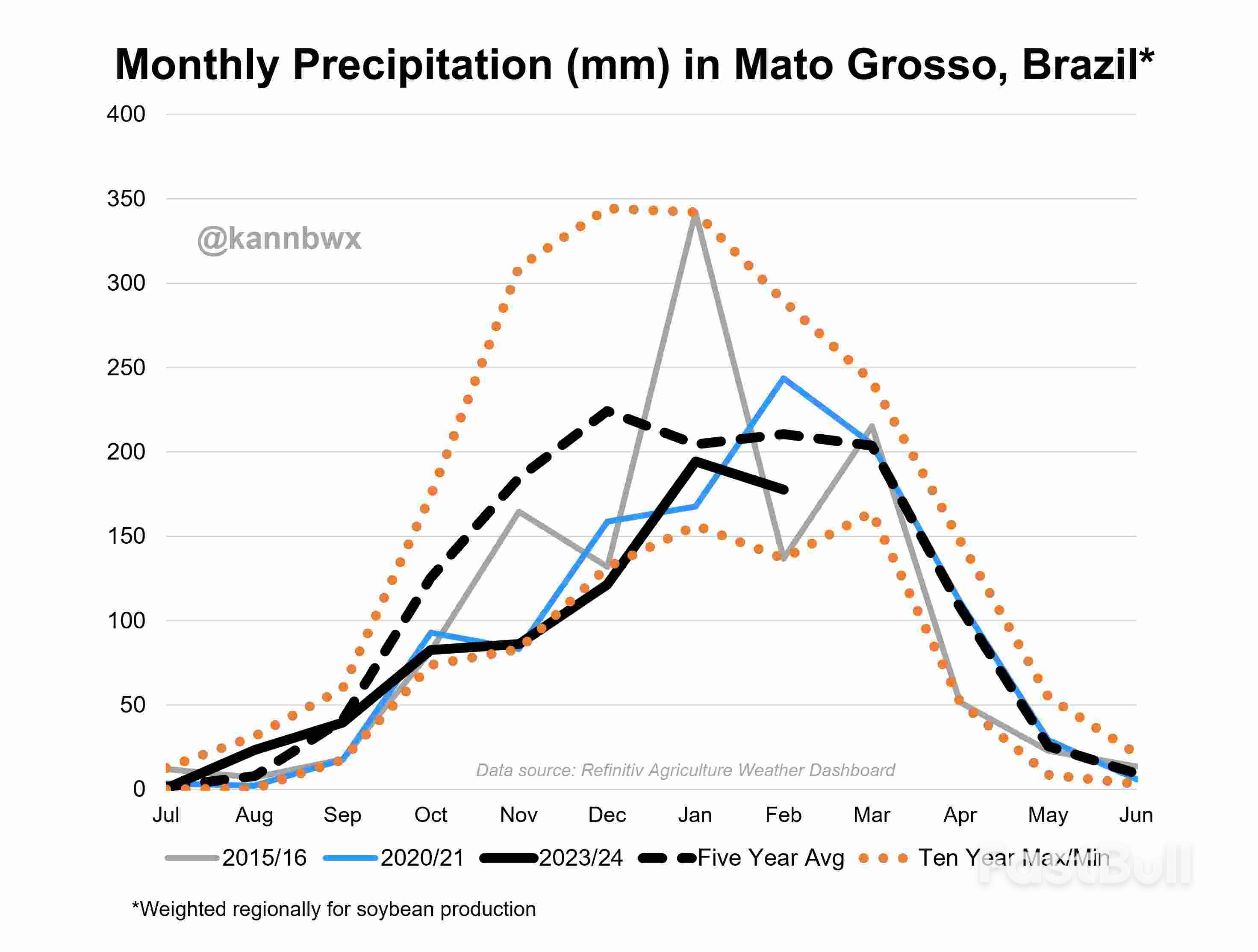
          The 2015-16 corn harvest was notoriously terrible for top grower Mato Grosso amid insufficient rains. The state had moisture deficit issues with soybeans this year, and the same could happen with corn.
          Midday weather models on Wednesday turned drier for Mato Grosso following the driest January-February in nine years. Observed March rainfall plus the two-week forecast suggests chances for the driest March in multiple decades.Brazil Soy, Corn Crop Estimates Widen Further After Weather Woes_2

          Source: 147&100.3 WMBD

          To stay updated on all economic events of today, please check out our Economic calendar
          Risk Warnings and Disclaimers
          You understand and acknowledge that there is a high degree of risk involved in trading. Following any strategies or investment methods may lead to potential losses. The content on the site is provided by our contributors and analysts for information purposes only. You are solely responsible for determining whether any trading assets, securities, strategy, or any other product is suitable for investing based on your own investment objectives and financial situation.
          Add to Favorites
          Share

          The ECB’s Operational Framework Review Formalises The Status Quo

          ING

          Central Bank

          Economic

          The European Central Bank initiated the review of its operational framework in December 2022. It took slightly longer than expected to conclude, but today, we finally got the results.
          Remember that 25 years ago, the ECB started operating a so-called “corridor” system. That system ensured banks were provided with a given amount of central bank reserves sufficient to fulfil their minimum reserves requirements and the demand from so-called 'autonomous factors'. By tailoring the amount of central bank reserves provided to the needs of banks, the ECB could steer the overnight rate close to its Main Refinancing Operations rate (MRO). As a result, the amount of excess liquidity was close to zero until 2008.
          "The ECB flooded markets with liquidity"
          With the financial crisis, the ECB had to live up to its role as lender of last resort, flooding markets with liquidity. This was achieved by basically providing banks with as much liquidity as required via the 'full allotment' system. In addition, the ECB started a long list of long-term refinancing operations (targeted and not targeted) and eventually several outright asset purchase programmes.
          As a result, excess liquidity in the eurozone surged with many intentional and unintentional consequences, one of these being a shift of the overnight interest rate close to the ECB’s deposit rate, making the deposit rate basically the key policy rate.

          Outcome of the review

          The review aimed to fully assess the changes over the last two decades, a bit like cleaning up the house, deciding what can stay and what should go. In short, here is what the ECB announced as the key elements of its operational framework going forward:
          · The deposit facility rate will remain the main policy interest rate.
          · Liquidity will be provided through a mix of short-term credit operations, the traditional longer-term refinancing operations and longer-term credit operations.
          · Short-term liquidity will continue to be provided through fixed-rate tender procedures with full allotment.
          · The spread between the interest rate for primary refinancing operations and the deposit rate will be reduced to 15bp, from currently 50bp, starting in September 2024.
          · New structural longer-term refinancing operations and a structural portfolio of securities will be introduced at a later stage.
          · The reserve ratio for determining banks’ minimum reserve requirements remains unchanged at 1%. The remuneration of minimum reserves remains unchanged at 0%.

          Implications for financial markets

          This outcome largely aligns with market expectations for a demand-driven floor system with practically no impact in the near term, especially since the ECB decided to leave the minimum reserve requirement unchanged.
          ESTR will continue to be steered at the deposit facility as the main policy rate. While the balance sheet will continue to shrink in the next couple of years, the ECB will likely operate with an excess of reserves and, in the more distant future, with liquidity provided through a mix of instruments, including structural longer-term operations and structural bond portfolio.
          However, the Bank does foresee a more prominent role for the shorter-dated weekly (MROs) and also, to some extent, the 3m liquidity operations (LTROs). These will continue to be conducted via fixed-rate full allotment tenders ( i.e., all bids will be satisfied). In order to reduce any stigma for banks participating in the liquidity tenders, the pricing of the weekly operations will be reduced to 15bp above the deposit facility rate starting 18 September.
          For now, though, the banking system is still operating with €3.5tn in excess reserves, meaning demand for the liquidity operations could still be muted. Right now, for instance, the effective market rate would still be 25bp below the proposed MRO rate. Having to resort to the ECB operations amid such conditions could still be seen as lack of market access. However, it would still give weaker banks access to liquidity at less punitive conditions at an earlier stage in the ECB’s balance sheet normalisation process.
          Of course, excess reserves will continue to decline as remaining TLTROs and the bond portfolios run off. Things will become more interesting again once a level in excess reserves has been reached that threatens to detach €STR from the deposit facility rate. This should be the stage where the balance sheet will have to grow organically again alongside the economy, and we think that could come later in 2026.

          Structural credit operations for banks

          The new structural longer-term credit operations will only be introduced at a later stage, potentially incorporating climate-change-related considerations. There is no indication of the pricing or duration of these operations apart from the comment that they will be calibrated to avoid interference with the monetary policy stance. These may make longer-term (longer than 3m) funding for banks available more on a recurring basis, which could be seen as a positive for bank refinancing risks.
          Availability of longer term funding at attractive terms would benefit in particular lower rated banks. As these operations may only be launched at a later stage, they do offer little help for refinancing the outstanding TLTROs though where the shorter operations remain the key for now with the tad more attractive pricing.

          The big unknowns

          There were two big issues on which the European Central Bank still remains vague: the introduction of structural longer-term operations and a new structural securities portfolio (the “bond portfolio”). The ECB only mentioned these two elements, making it clear that a bond portfolio would be independent of the current running-off of existing asset purchase programmes. For instance, regarding the bond portfolio, no mention is made of a possible maturity shortening or the inclusion of corporate and supranational bonds.
          “The review was an overdue clean-up of the ECB's toolkit”
          The ECB has indicated that the structural liquidity provisions could also be used in pursuit of the ECB’s “secondary objective of supporting the general economic policies in the European Union – in particular, the transition to a green economy”. To us, this means that the ECB is still contemplating Green TLTROs. It's clearly keeping the door open to a wide toolkit to assure maximum flexibility in the future.
          All in all, the review was an overdue clean-up of the ECB's toolkit. Very little disappeared; only the newer tools were nicely cleaned and structured.
          To stay updated on all economic events of today, please check out our Economic calendar
          Risk Warnings and Disclaimers
          You understand and acknowledge that there is a high degree of risk involved in trading. Following any strategies or investment methods may lead to potential losses. The content on the site is provided by our contributors and analysts for information purposes only. You are solely responsible for determining whether any trading assets, securities, strategy, or any other product is suitable for investing based on your own investment objectives and financial situation.
          Add to Favorites
          Share

          Argentina's FX Reserves Buys Hits $10 Bln Under Milei

          Alex

          Forex

          Economic

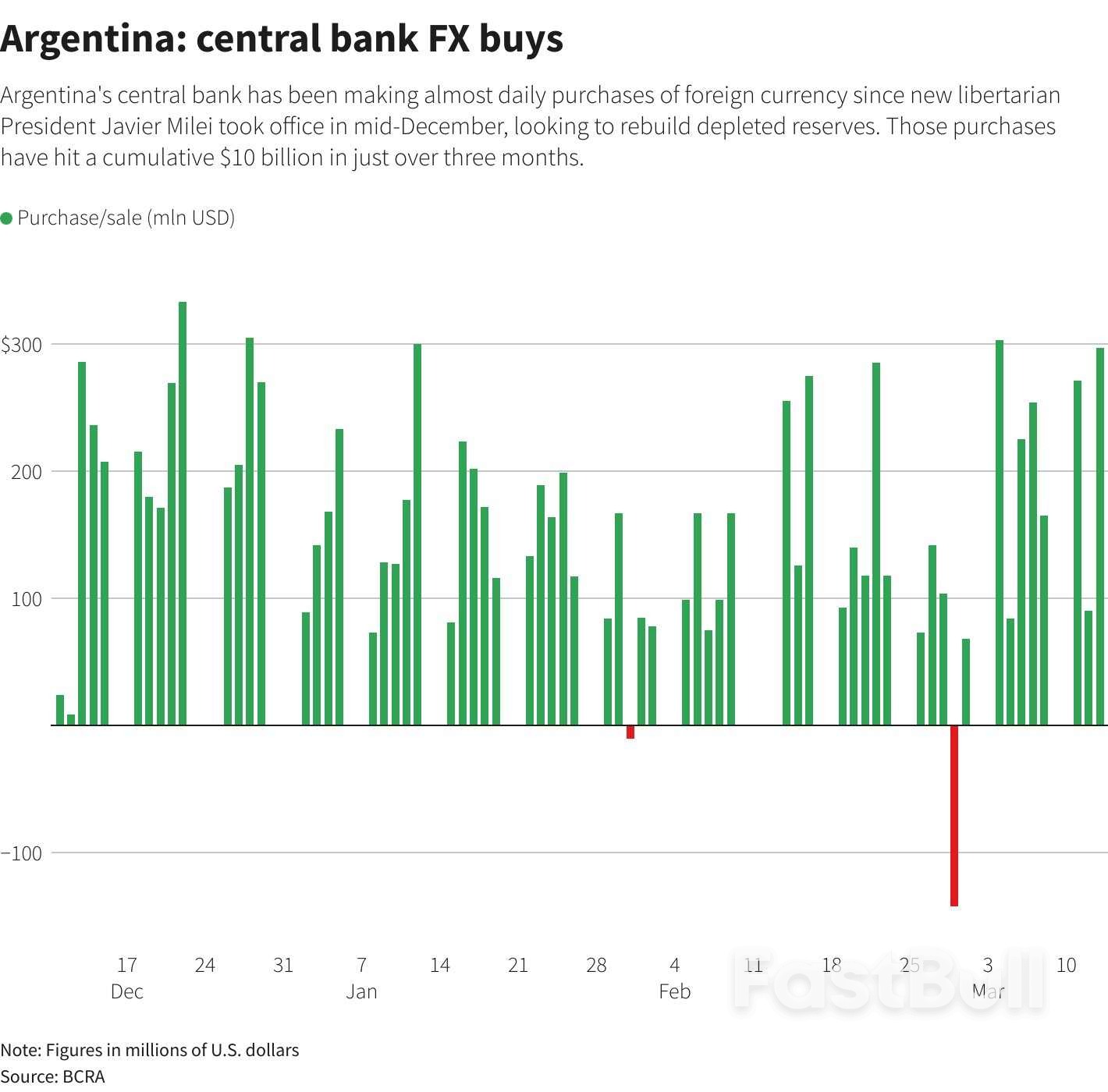
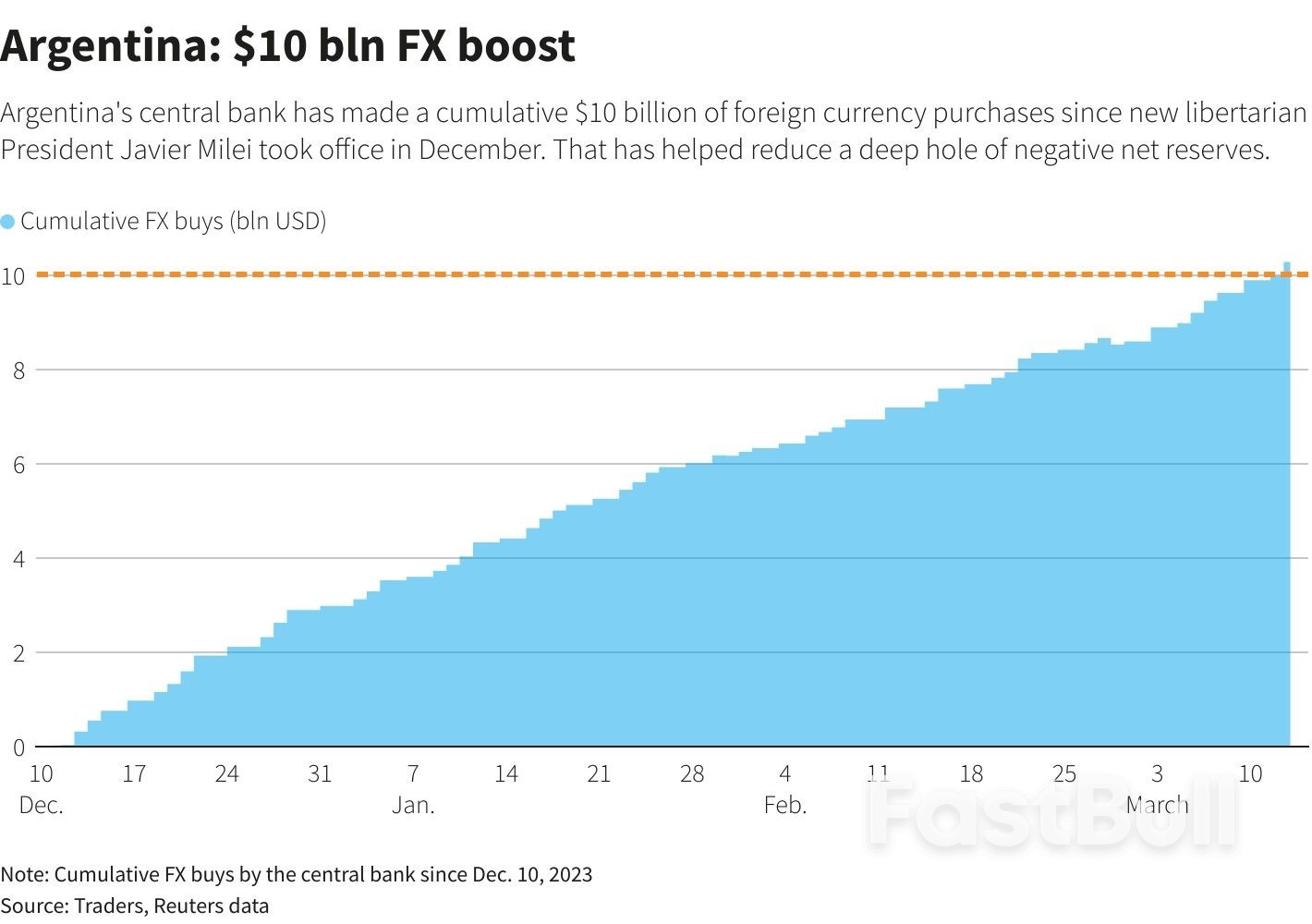
          Argentina's central bank purchases of foreign currency since libertarian President Javier Milei took office in December are set to top $10 billion on Wednesday, Reuters calculations show, as the government looks to erase a deep net reserves deficit.
          The milestone in just three months underscores how Milei, an outsider economist, is making stabilizing public finances his priority, helping the country beat reserve accumulation targets with major lender the International Monetary Fund (IMF).
          "It's an encouraging data point in terms of managing international reserves," said consulting firm EcoGo. "The IMF's reserve accumulation goal has already been met for March and is only $2 billion away from December's target."
          The central bank has bought dollars almost every trading day - aside from two days selling - since Milei's Dec. 10 inauguration, with purchases accelerating in March. Net reserves overall still remain in negative territory around -$1.5 billion.
          Argentina's FX Reserves Buys Hits $10 Bln Under Milei_1That accumulation has also come amid a tough austerity and cost-cutting drive by Milei, which has dampened economic activity, growth and production, weighing on demand for dollars from companies and individuals. Inflation is also over 275%.
          "The deepening of the recession and inflation promotes sales of foreign currency hoarded by companies and individuals," said consulting firm GMA Research, adding this was helping spur the central bank build-up of hard currency.
          Milei recorded a shock election win last year pledging a major overhaul of Argentina's economy after years of crises, which he has blamed on regular deep fiscal deficits from over-spending by the state. He has pledged a "zero" fiscal deficit this year.
          The build-up of dollars is also important to his longer-term goal to remove currency controls and eventually dollarize the economy, though that still remains some way off.
          "Beyond the positive aspect of the accumulation of reserves, I don't believe the controls will be lifted yet as they need to wait and see how the central bank's balance sheet keeps improving," said Buenos Aires-based economist Gustavo Ber.
          Argentina's FX Reserves Buys Hits $10 Bln Under Milei_2Mediterranean Foundation said the improvement in reserves and calmer markets had pushed up dollar deposits at banks, which fell last year during election uncertainty. They have climbed to $16.5 billion from $14.1 billion when Milei took office.
          The government is also hoping the upcoming harvests of soy and corn - Argentina's main exports - will bring in a new wave of foreign currency, though some analysts warned a recent rally of the peso in parallel markets could cause farmers to hold off on sales as they get less local currency for their dollars.
          "In a worst case scenario, we could get to a point where exporters are tempted to delay exports," said Portfolio Personal Inversiones. "That would play against reserves accumulation."

          Source: Reuters

          To stay updated on all economic events of today, please check out our Economic calendar
          Risk Warnings and Disclaimers
          You understand and acknowledge that there is a high degree of risk involved in trading. Following any strategies or investment methods may lead to potential losses. The content on the site is provided by our contributors and analysts for information purposes only. You are solely responsible for determining whether any trading assets, securities, strategy, or any other product is suitable for investing based on your own investment objectives and financial situation.
          Add to Favorites
          Share

          In Wage Growth the BoJ Hopes

          Westpac

          Economic

          Central Bank

          The Bank of Japan and financial markets are eagerly awaiting the Shunto wage decision for Japan's largest trade confederation RENGO, which is due in. In our view, the result will likely be more of a reflection of near-term cyclicality than structural strength in the economy. It is therefore unlikely to justify a material policy shift by the Bank of Japan (BoJ).
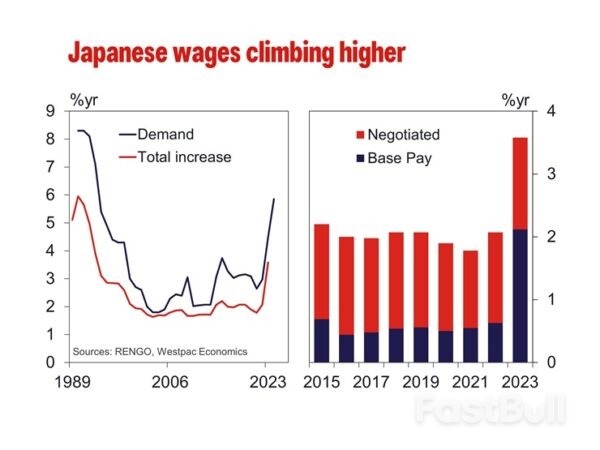
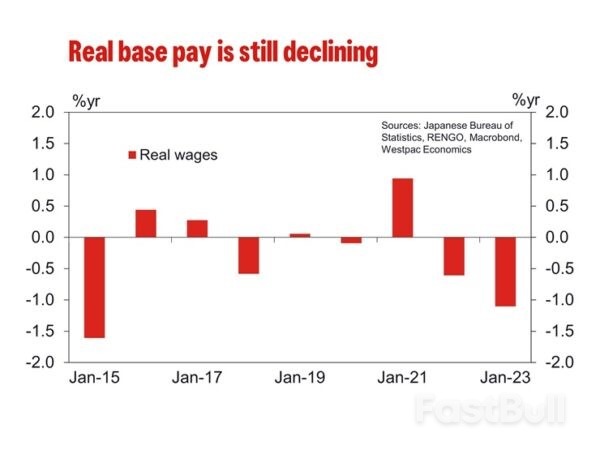
          Japan's recent strong wage growth reflects the lagged effect of cyclical momentum in the economy. RENGO wages rose 3.6% in 2023 after averaging 2% between 2014 and 2022. Base pay, which goes to all employees, rose 2% trumping the average 0.6% rise since 2015. In justifying their decision, RENGO drew attention to higher cost of living. Inflation rose 4% through 2022, well above the 0.5%yr average between 2010 and 2019. Inflation subsequently eased to 2.6%yr during 2023, following the global disinflationary pulse, and is expected to ease further hence.
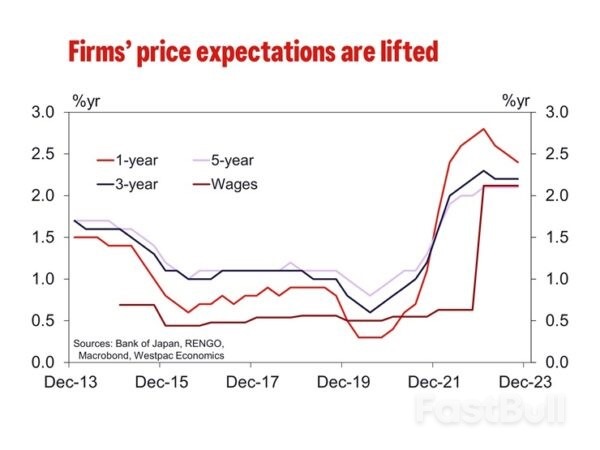
          In Wage Growth the BoJ Hopes_1As of 2023 Q4, the inflation outlook for 1, 3 and 5 years came to 2.4%, 2.2% and 2.1% respectively. While still above the circa 1% average for all three time periods 2014 to 2019, it is also materially below where inflation has been. Still-elevated current inflation expectations may support wage growth in the near-term, but this effect looks set to dissipate as actual inflation prints come in weaker.
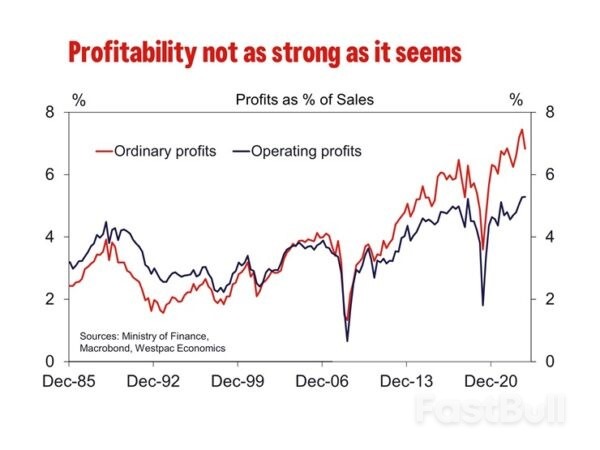
          In Wage Growth the BoJ Hopes_2Rising profitability has also been used to argue for stronger wage growth in 2024 with a focus on strength in ordinary profits. However, operating profits are only slightly above the pre-COVID peak and below the 10-year pre-COVID trend. Operating profit as a share of sales are also relatively unimpressive, hovering around pre-COVID rates. The disparity between operating profits, which do not include investment-related income, and ordinary profits implies profitability is being flattered by financial investment returns not firms' underlying profitability. It is only the latter that would given businesses confidence to increase wages at or above the rate of inflation.
          In Wage Growth the BoJ Hopes_3Rather than being a support for wage growth, beyond 2024, we expect structural factors to act at a headwind for sustained wages growth. In Japan, wage increases depend on seniority, so job mobility is low and companies typically find it unnecessary to raise wages to retain staff. This also disincentivises employees from reskilling or making career changes into higher growth areas. In 2016, then Govenor Kuroda outlined low job mobility as a key challenge for the labour market and the country's growth potential.
          In Wage Growth the BoJ Hopes_4Further, participation has recently been rising thanks to a growing cohort of part-time workers, primarily women and those aged 65 and above. Wage growth is slower for part time workers, and the loss of tax and social benefits for secondary income earners dissaude many from labour market and the country's growth potential.
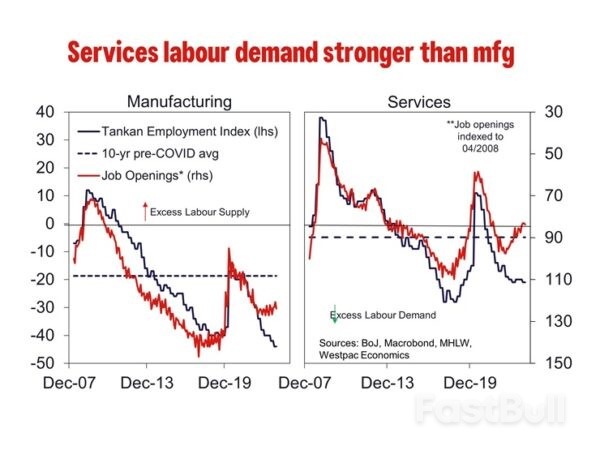
          While some large companies such as Suntory and Nomura have publicly committed to raising salaries by 7-16%, many others will hold back believing the labour they will require will remain available. According to the Tankan survey, firms are reporting labour shortages as less severe than pre-COVID in manufacturing; while shortages in services persist to what was seen in the early 1990s. The number of new job openings in the services sector are also settling below the pre-COVID peak while new openings in manufacturing continue to decline. Part of this reflects a structural decline in manufacturing jobs, with south-east Asia providing attractive alternative locations for facilities and automation also limiting labour demand. Given manufacturing employs around 15% of the labour force, weaker demand will act as a drag on aggregate wages. This points to a softening labour market overall but also diverging outcomes for services and manufacturing.
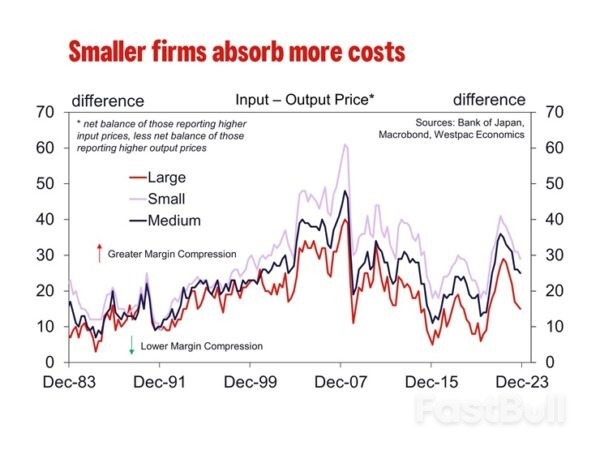
          In Wage Growth the BoJ Hopes_5Small businesses have been particularly unenthusiastic about raising wages. As an example, a survey completed by Johnan Shinkin Bank and the Tokyo Shimbun daily reported 72.8% of small and medium-sized businesses in the Tokyo metropolitan area said they ” have no plans to raise wages this year”. Smaller employers tend to make up the bulk of employers and so can have a significant effect on aggregate outcomes. Their reluctance is arguably principally due to an inability to pass on higher costs to consumers, particularly when households are price sensitive as they are now, but also as they are much less able to scale up and therefore benefit from efficiency and large markets.
          In Wage Growth the BoJ Hopes_6One segment of the labour market that is showing increasing wages is younger Japanese workers. They are more likely to have in demand skills, particularly for high-skill work, and are also more likely to job hop being early in their careers. As such, wage gains are thought to be skewed towards younger workers. BoJ research also shows that wages for high skill workers are increasing. However given Japan's ageing population and weak immigration program, young people make up a small fraction of the labour force, so wage gains in this cohort is unlikely to drive aggregate wage gains or consumption.
          Looking beyond 2024, both cyclical and structural factors are likely to limit wage gains and thereby keep a lid on domestic inflation pressures. While the second estimate for GDP has revised away recession, the economy remains weak and at risk of global developments. All this points to an absence of demand-side inflation pressures necessary to justify a tightening cycle of scale. While the BoJ can likely justify the end of negative rates in coming months, moving the policy materially above zero is unwarranted and potentially a decision that would put at risk all the work undertaken in recent years to aim to achieve the inflation target on a sustainable basis. All considered, the shunto wage outcome is unlikely to be the opportunity markets are hoping for a generational change in monetary policy.
          To stay updated on all economic events of today, please check out our Economic calendar
          Risk Warnings and Disclaimers
          You understand and acknowledge that there is a high degree of risk involved in trading. Following any strategies or investment methods may lead to potential losses. The content on the site is provided by our contributors and analysts for information purposes only. You are solely responsible for determining whether any trading assets, securities, strategy, or any other product is suitable for investing based on your own investment objectives and financial situation.
          Add to Favorites
          Share

          Global Market Quick Take: Asia – March 14, 2024

          SAXO

          Economic

          Global Market Quick Take: Asia – March 14, 2024_1

          US Equities

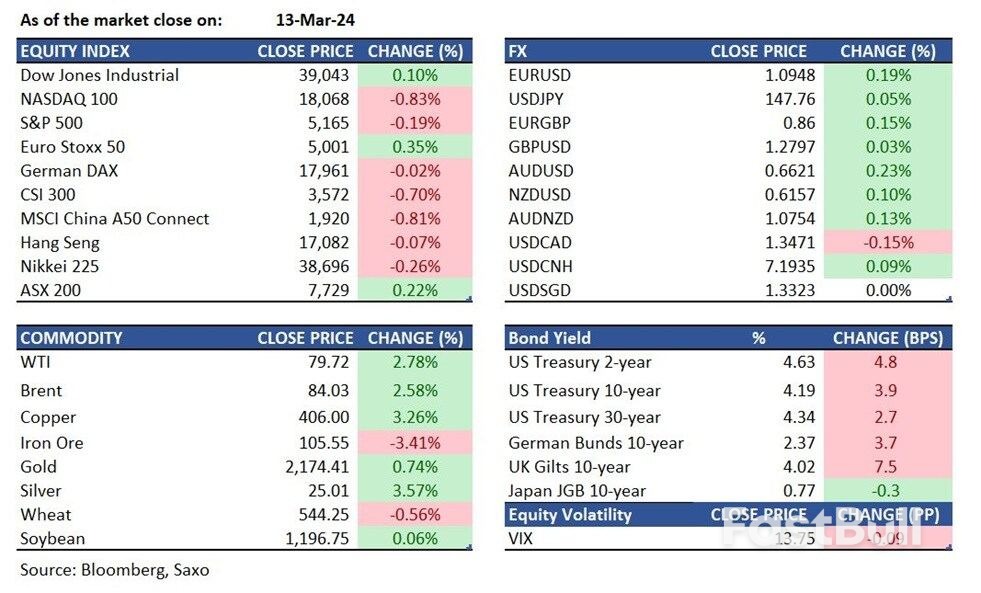
          Copper mining and energy stocks saw gains driven by increases in copper and oil prices. Freeport-McMoRan notably surged by 7.6%, while Valero Energy, Marathon Petroleum, and Marathon Oil each added 3% to 5%. However, the Nasdaq 100 and S&P 500 experienced pullbacks of 0.8% and 0.2%, respectively, partly due to a retreat in chipmaker stocks. Nvidia slid 1.1%, while AMD, Intel, Micron, On Semiconductor, and Marvell Technology all saw declines ranging from 3% to 5%. Additionally, Tesla declined by 4.5% following an analyst downgrade to underweight, citing projections of zero volume growth in 2024 and a volume decrease in 2025. Dollar Tree, a discount store operator, plummeted by 14.2% due to EPS guidance falling below estimates, a pessimistic outlook for 2024, and plans to close 1,000 stores. McDonald’s also experienced a decline of 3.9%, attributing it to lower-income customers opting to eat at home more frequently.

          Hong Kong/China Equities

          Stocks in Hong Kong managed to hold on to recent gains, with the Hang Seng Index ticking down modestly by 0.1% while the Hang Seng Tech Index added another 0.3%. Mining stocks outperformed, led by CMOC, Zijing Mining, MMG, and Jiangxi Copper. Chinese developers retreated as Country Garden missed an onshore bond coupon payment. In the mainland, CSI300 slid 0.7%, dragged down by real estate, non-bank financials, and construction materials.

          Fixed income

          The day following the release of the hot CPI report, and with the Fed currently in blackout ahead of the FOMC meeting, investors further adjusted their expectations for a June Fed rate cut downward. It resulted in a 5bps increase in the 2-year Treasury yield, settling at 4.63%. The 10-year yield also rose, adding 4bps to reach 4.19%. Meanwhile, the auction of $22 billion in 30-year Treasury bonds met with robust demand.

          FX

          Narrow ranges in FX with Fed in a blackout. The dollar pushed slightly lower in the late US session but recovered subsequently. Low volatility continues to fuel carry trades, and funding currencies CHF and JPY were sold off. USDCHF rose to 0.8790 and USDJPY touched 148 despite positive signals on wage negotiations, suggesting that BOJ March pivot may be well priced-in. AUDUSD stayed above 0.66 amid dollar weakness and a rally in metals prices. EURUSD rose to highs of 1.0964 for the week, with immediate resistance at 1.0970. GBPUSD is stuck at 1.28, and we see risks of dampening equity sentiment coming to hurt. EURGBP is back at 0.8560 and could re-test 0.8570.

          Commodities

          Gold resumed its rally and pared the losses seen after the hot US CPI release, coming back to the $2,170+ levels. PPI today could be key and another hot inflation print can derail the momentum and result in a short-term pullback before the yellow metal can continue higher. Iron ore prices continued to grind lower towards USD100/ton amid growing concerns of China’s economic growth prospects and lack of supportive measures at the NPC. Other metals, however, rallied on a weaker dollar. Crude oil prices also inched higher after EIA data showed a withdrawal in US oil inventories, which fell 1.54mb, the first decline in seven months. Markets were also jittery due to the Ukrainian drone attack on a Russian refinery.

          Macro

          Japan’s wage negotiation results started to come through, although the first tally of consolidated results from Rengo – the federation of unions – will be released on Friday. Second tally is due March 22, followed by the third tally on April 4 and final tally in early July. Toyota agreed to meet its union’s pay demands in full with record raises. Honda agreed for wage hike of 5.6% while Nippon Steel agreed for 14.2%. Overall wage hike in 2023 was 3.58% for 2024 forecast is over 4%, the highest in three decades.
          The Atlanta Fed's Wage Growth Tracker was 5.0% in February, the same as for January. For people who changed jobs, the Tracker in February was 5.3%, down from 5.6% in January. For those not changing jobs, the Tracker was 4.7%, unchanged from January. US PPI and retail sales will be on the radar today, and any hints of a hot PPI would send hawkish waves to the market increasing the odds of a dot plot shift from the Fed next week.
          The China Securities Regulatory Commission (CSRC) stated that its top priority is risk prevention and emphasized its commitment to strict control over IPOs, as well as enhanced supervision of listed companies and the securities and futures industry.
          To stay updated on all economic events of today, please check out our Economic calendar
          Risk Warnings and Disclaimers
          You understand and acknowledge that there is a high degree of risk involved in trading. Following any strategies or investment methods may lead to potential losses. The content on the site is provided by our contributors and analysts for information purposes only. You are solely responsible for determining whether any trading assets, securities, strategy, or any other product is suitable for investing based on your own investment objectives and financial situation.
          Add to Favorites
          Share

          Yellen Says Rates ‘Unlikely’ To Return To Pre-Covid Levels

          Alex

          Economic

          US Treasury Secretary Janet Yellen said it’s “unlikely” that market interest rates will return to levels that prevailed before the Covid-19 pandemic triggered a wave of inflation and higher yields.
          Asked why White House projections released Monday showed markedly higher expectations for interest rates in coming years compared with projections a year ago, Yellen said the new numbers were in line with private sector forecasts.
          “I think it reflects current market realities and the forecasts that we’re seeing in the private sector — that it seems unlikely that yields are going to go back to being as low as they were before the pandemic,” Yellen told reporters Wednesday in Elizabethtown, Kentucky.
          The yield on 10-year US Treasury notes averaged 2.39% in the decade through 2019 — low by historical standards. It spiked above 5% last October after the Federal Reserve raised rates aggressively to combat inflation, and now sits just below 4.2%.
          A considerable debate has emerged among economists over whether, in the long run, rates would return to pre-pandemic levels or settle higher.
          The Treasury chief said “it’s important that the assumptions that we built into the budget are reasonable and consistent with thinking of the broad range of forecasters.”
          Yellen has hinted in recent weeks that her own views on the issue had shifted. In January 2023, she indicated it was more likely that low rates would return. But this January she said “the jury’s still out” on the question.
          The new White House projections were part of President Joe Biden’s $7.3 trillion fiscal 2025 budget proposal. They assume now that the average rates on three-month and 10-year US Treasury bills and notes will be markedly higher over the next three years than they anticipated a year ago.

          Higher Forecast

          The three-month rate, for example, will average 5.1% this year, up from the 3.8% projected last March, White House officials said. The 10-year yield projection rose to 4.4% from 3.6%.
          The latter projection might have been even higher but for the intervention of Lael Brainard, director of the National Economic Council, according to people familiar with the matter prior to the release.
          Higher rates on the growing burden of US debt add significantly to the overall deficit and debt figures. Under the current assumptions, the White House expects the US to spend about $890 billion, or 3.1% of gross domestic product, on net interest expenses this year.
          Yellen spoke as she traveled to Kentucky to tout the Biden administration’s economic policy record, part of her stepped up efforts this year to address domestic audiences in the run-up to the 2024 elections.

          Source:Bloomberg

          To stay updated on all economic events of today, please check out our Economic calendar
          Risk Warnings and Disclaimers
          You understand and acknowledge that there is a high degree of risk involved in trading. Following any strategies or investment methods may lead to potential losses. The content on the site is provided by our contributors and analysts for information purposes only. You are solely responsible for determining whether any trading assets, securities, strategy, or any other product is suitable for investing based on your own investment objectives and financial situation.
          Add to Favorites
          Share
          FastBull
          Copyright © 2025 FastBull Ltd

          728 RM B 7/F GEE LOK IND BLDG NO 34 HUNG TO RD KWUN TONG KLN HONG KONG

          TelegramInstagramTwitterfacebooklinkedin
          App Store Google Play Google Play
          Products
          Charts

          Chats

          Q&A with Experts
          Screeners
          Economic Calendar
          Data
          Tools
          Membership
          Features
          Function
          Markets
          Copy Trading
          Latest Signals
          Contests
          News
          Analysis
          24/7
          Columns
          Education
          Company
          Careers
          About Us
          Contact Us
          Advertising
          Help Center
          Feedback
          User Agreement
          Privacy Policy
          Business

          White Label

          Data API

          Web Plug-ins

          Poster Maker

          Affiliate Program

          Risk Disclosure

          The risk of loss in trading financial instruments such as stocks, FX, commodities, futures, bonds, ETFs and crypto can be substantial. You may sustain a total loss of the funds that you deposit with your broker. Therefore, you should carefully consider whether such trading is suitable for you in light of your circumstances and financial resources.

          No decision to invest should be made without thoroughly conducting due diligence by yourself or consulting with your financial advisors. Our web content might not suit you since we don't know your financial conditions and investment needs. Our financial information might have latency or contain inaccuracy, so you should be fully responsible for any of your trading and investment decisions. The company will not be responsible for your capital loss.

          Without getting permission from the website, you are not allowed to copy the website's graphics, texts, or trademarks. Intellectual property rights in the content or data incorporated into this website belong to its providers and exchange merchants.

          Not Logged In

          Log in to access more features

          FastBull Membership

          Not yet

          Purchase

          Become a signal provider
          Help Center
          Customer Service
          Dark Mode
          Price Up/Down Colors

          Log In

          Sign Up

          Position
          Layout
          Fullscreen
          Default to Chart
          The chart page opens by default when you visit fastbull.com